
Ontario, San Bernardino County
Locked Out, Broken Into or Stranded in Ontario? Emergency Locksmith Help
Short answer: An emergency locksmith in Ontario handles the lock and key problems that can't wait: lockouts from a house, car or business, keys snapped inside a cylinder, doors that won't lock after a break-in, and lost keys that call for a same-visit rekey. Julian's Locksmith drives to you, checks ID and ownership, and quotes the job before starting. Call (951) 903-3193.
A car emergency can strand you far from home: keys locked in the cabin at a gas station, a fob that went missing at a trailhead, an ignition that won't turn in a grocery store lot. Julian's Locksmith brings emergency locksmith service for vehicles to wherever you are in Ontario. Our vans carry air wedges and long-reach tools for damage-free entry, Lishi picks for decoding door locks, key-cutting machines, and OBD-II programmers for transponder keys and smart fobs. Give us the year, make and model when you call; some cars need a dealer step, and we'll tell you so before anyone drives out.
An emergency in Ontario rarely fits one template. It might be a rental car locked with the fob inside on a level of the parking structure by the Ontario Convention Center, a dock-side man door at a freight terminal that won't latch before the night crew arrives, or a 1920s front door off Euclid Avenue whose old mortise lock has seized with the family on the porch. On the phone we sort out which of those you have, since each one calls for different tools from the van. Expect a few direct questions when you call (951) 903-3193. Where exactly are you, down to the cross street or the parking level? What is locked or broken? Is anyone at risk? A child or pet shut inside a vehicle on a triple-digit afternoon is a 911 call first, and so is a break-in in progress. Ontario summers are punishing, so wait in shade or a lobby if you can. After a burglary, leave the damaged door and frame alone until the police have documented them. Our hours set the limits of same-day help. We work every day from 6:30 a.m. to 11:30 p.m., and we're closed overnight. If a lock fails after we close, a temporary hasp or a borrowed spare key usually bridges the gap until morning.
How this works in Ontario
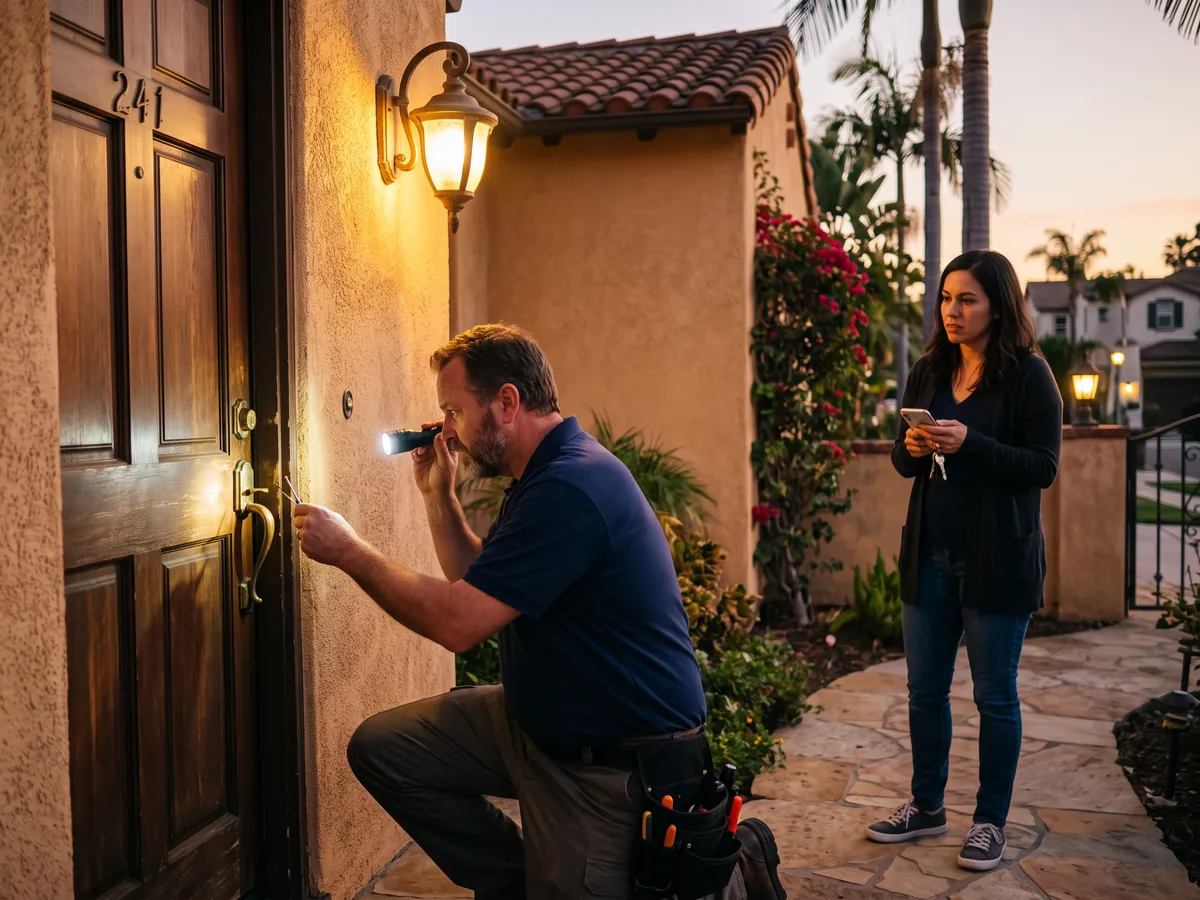
Emergency entry should leave the property the way we found it. For residential pin-tumbler locks, that means picking with a tension wrench and pick, or raking a builder-grade cylinder. Lever handles can often be operated from the inside with an under-door tool, and spring latches without anti-shim plungers can sometimes be slipped. For vehicles, an inflatable air wedge opens a narrow gap at the top corner of the door so a long-reach rod can press the lock switch, or a Lishi tool picks the door cylinder while reading its cuts. Commercial doors call for mortise cylinder picking and care around aluminum stiles that bend easily. Destructive entry exists for good reasons, though. A Medeco or Mul-T-Lock cylinder, a lock seized by corrosion, or a safe with a failed lock may need drilling. When that's the case, the emergency locksmith explains why, shows you any alternative, and replaces what was drilled before leaving your Ontario property. Drilling should never be something you discover on the invoice.
What we can do on-site
- Broken and stuck key extraction. A key snapped off in a deadbolt or knob can usually come out without replacing the lock. Thin extractor hooks slide along the blade, catch a cut and draw the piece forward; if it's wedged, we pull the cylinder and push the fragment out from behind. Then we test the lock and cut a fresh key from the pieces.
- Stranded-driver car keys. A key that won't turn in the ignition is often a steering lock under tension, not a broken lock. Rock the wheel gently both ways while turning the key. If that fails, worn wafers or a worn key are the usual culprits, and we can extract, repair or rebuild the cylinder to fit your existing key where practical.
- Doors that won't lock or latch. On storefront doors, the end-of-day failure is a hookbolt that won't swing out, or a cylinder that spins without moving anything. A loose set screw or a stripped cam is the usual cause. Leaving a business unlocked overnight isn't an option, so the emergency locksmith repairs or replaces the mortise cylinder and cam on the spot.
- Urgent safety lock changes. California tenants with a protective order or qualifying police report can ask the landlord in writing to change the locks, and the landlord has 24 hours to do it. If the landlord doesn't act in time, the law lets the tenant have the locks changed. We can do that work and give you a receipt for the landlord.
- Dead smart locks, keypads and safes. An urgent safe call usually involves medication, passports or a firearm someone needs for work. Electronic safes often fail from dead batteries or a worn keypad, which can sometimes be bypassed with external power or an override key. Others need manipulation, or a precise drill point and a repair. Proof of ownership comes first.
Local factors in Ontario
Older Ontario homes often keep original hardware: mortise locks with skeleton-key interiors, deadbolts added decades later to thin doors, and wood frames dried out by years of sun. Those details shape an emergency call. An old mortise lock may need careful picking rather than a bypass, and a kicked door in a plaster-and-lath house tends to split the jamb. We bring heavy strikes and long screws to reinforce what the original builder never planned for.
Shopping centers along SR-60 are full of aluminum storefront doors with Adams Rite deadlatches and hookbolts, and those tend to fail right at opening or closing time. A spinning cylinder, a stripped cam or a bolt that won't reach its keeper can keep a store from opening or locking. An emergency locksmith with common mortise cylinders and storefront parts on the van can usually fix it before you leave.
Warehouses and distribution centers near Ontario run early shifts, and a locked man door or seized dock padlock can idle a whole crew. We start at 6:30 a.m., cut and replace seized padlocks, rekey after a supervisor's keys go missing, and repair heavy-duty mortise locks and exit devices. Have the authorized contact available, and tell us the building and door or dock number when you call.
Example situations
Say it's a Thursday evening and a shift supervisor calls from a warehouse near the airport's cargo side. Pry marks on the rear man door show someone tried it overnight, and now the latch won't catch. After the police report, we would confirm the caller has authority over the building, straighten the strike, replace the damaged latch set and rekey the cylinder so any key taken during the incident is useless. Then we'd check the other exterior doors before leaving, so the crew can lock up at the end of the shift without second-guessing the building.
- Say a family returns from a weekend away to find the side door by the garage kicked in. The strike plate hangs by one screw and the jamb is split along the bolt line. Police have taken the report. We'd install a heavy-gauge strike with 3-inch screws, check whether the deadbolt bent, rekey if any keys went missing, and recommend a carpenter for the jamb, so the house can be locked that same night.
- For example, a commuter pulls into a park-and-ride off Milliken Avenue at dawn, grabs a coffee, and locks the fob in the cupholder of a push-start sedan. The train leaves soon. We'd confirm the year and model on the phone, open the car with an air wedge and reach tool, check the registration against the driver's license, and then test the fob's coin cell, since a weak battery is often why the car locked with the fob still inside.
- Picture a restaurant manager arriving before the breakfast shift and turning the back-door key in its mortise cylinder. The key snaps flush with the face. Cooks and a produce delivery are due shortly. In a call like this, the emergency locksmith would extract the broken piece with thin hooks, or enter through the front and pull the cylinder from inside, then cut a replacement from the fragments so the morning can still run.
From your call to the finished job
- Check for danger first. If an intruder might still be inside after a break-in, step away and call the police, not a locksmith. Let officers clear the property and take their report. Once they leave, the emergency locksmith can secure the damaged door, and the report number will help with any insurance claim.
- Call and describe the problem. Tell us what's locked (house, car, office, safe), what went wrong (lockout, broken key, damaged lock, lost keys) and exactly where you are: street address, cross street, parking level or unit number. Precise details let us load the right tools before the van leaves.
- Hear the quote and an honest ETA. Before we dispatch, you hear what the job is likely to involve, a quote for that work, and a realistic arrival estimate. If the situation turns out different on site, we requote before continuing. You never pay for extra work you didn't approve first.
- Prepare while you wait. Don't try to force the lock while you wait. Prying, drilling or jamming a screwdriver into the keyway can turn a quick picking job into a lock replacement. If a child or pet is safe inside the house, stay at the door and keep talking to them.
- Verification and damage-free entry. For businesses we confirm you're the owner or an authorized manager, often with a quick call to the owner. For rentals, a lease or the landlord's confirmation works. Once identity is settled, the actual opening is usually quick; the careful part comes first.
- Secure it before we leave. An emergency isn't over when the door opens. If the key snapped, we cut a new one. If the lock was failing, we repair or replace it. If keys went missing, we rekey. Fixing the cause now beats a second emergency call next month.
How we quote the job
- What kind of emergency it is. Think of it in three layers: getting in, fixing what failed, and preventing a repeat. You choose how many layers you want today. Some people only need entry; others want a rekey and a strike upgrade while we're already there. Your quote reflects the layers you pick, nothing more.
- Security level of the lock or vehicle. Builder-grade pin-tumbler locks open faster than high-security cylinders from Medeco, Mul-T-Lock or ASSA Abloy, which are built to resist picking. That resistance is why you bought them, and during a lockout it can mean more time on the door or a cylinder replacement instead of a quick pick.
- Location, distance and access. We're mobile and dispatch from San Bernardino, so distance and drive time are part of the picture. A home a few miles from our base differs from a job at the far side of San Bernardino County. The distance is reflected in the price we quote before work starts, not added later as a surprise.
Every job gets a clear quote before any work starts. Call (951) 903-3193 with the details and we'll tell you what to expect for your situation in Ontario.
Mistakes to avoid
- Calling a locksmith when the situation belongs to 911. A child or pet in a hot car, or someone unresponsive inside a home, needs emergency responders who can force entry on the spot. A locksmith is the right call when nobody is in danger, not when every moment counts.
- Leaving a forced door closed but unlocked overnight because it's late. A door that latches but won't lock invites a return visit from someone who already knows the way in. Even a temporary fix, like a reinforced strike or an added surface lock, beats a chair wedged under the knob.
- Breaking a window to get into your own house or car. Replacement glass often costs more than an emergency locksmith visit, leaves an opening you then have to secure overnight, and carries a real risk of deep cuts. Save glass-breaking for genuine threats to someone's life, and let responders handle it.
Advice before you book
- Save (951) 903-3193 in your contacts today. Searching for a locksmith while stressed in a dark driveway is how people land on call centers that farm the job out to whoever is free, often at a total far above the number quoted on the phone.
- Business owners should keep a written list of who may authorize emergency work: owners, managers and the building's property manager. Share it with the staff who open and close. When a manager calls about a lockout before the first shift, that list keeps the door from staying shut while everyone chases the owner.
- If a key breaks in a lock, keep every piece. A locksmith can usually read the cuts and make a new key from the fragments, which matters when it was your only copy. Don't push the stub deeper, and don't spray oil or squeeze glue into the keyway before extraction.
- Pat your pocket for keys before pulling any self-locking door shut: storm doors, garage entry doors, office doors with storeroom-function locks, and cars that lock automatically as you walk away. It takes two seconds and prevents a surprising number of lockouts.
Getting to Ontario
Ontario is about 25 miles from our San Bernardino base, roughly 33 minutes in light traffic via I-215 North to the I-15 junction at Devore. When you call, you get an arrival estimate based on where the technician is and the traffic at that moment.
Homes and businesses just off I-15 are routine stops for us. Give the suite or unit number and any gate instructions, and say whether the van can park out front or should pull into a side lot.
About Ontario: Euclid Avenue, the Chaffeys' divided boulevard with a wide grassy median, was listed on the National Register of Historic Places in 2005 from Philadelphia Street in Ontario north to 24th Street in Upland.
| Neighborhoods | Ontario Center, Downtown Ontario, Edenglen, North Ontario near Chaffey High School, Park Place, Ontario Ranch |
|---|---|
| ZIP codes | 91761, 91762, 91764 |
| Main routes | I-10, SR-60, I-15, Euclid Avenue |
| From our San Bernardino base | about 25 miles via I-215 North to the I-15 junction at Devore, then I-15 (Ontario Freeway) South to I-10 West and Holt Boulevard for downtown and the airport; stay on I-15 South to Ontario Ranch Road or SR-60 for Ontario Ranch. SR-210 West to I-15 South is the usual alternate. |
Friday is a full day for us. We begin at 6:30 a.m. and close at 11:30 p.m., the same as every other day, Saturday included. If a lock fails after 11:30 p.m., call us when we reopen at 6:30 a.m., and in the meantime fall back on a neighbor's spare key, a night with family, or a door you can secure from inside.
For businesses, the person who calls isn't always the person who can approve the work. Expect us to ask for an employee ID, a business card or a quick call to the owner or manager before we open, rekey or change locks on a storefront, office or warehouse. Property managers can set up an authorized-contact list with us ahead of time.
Locked out in Ontario?
Call (951) 903-3193 with the address and what's locked. You'll get an arrival estimate and a quote before anyone heads out, and when we arrive we'll ask for ID that ties you to the property. If a child or pet is shut inside a hot car or building, call 911 first.
Frequently asked questions
Can you fix my door the same night after a break-in?
Usually, as long as you call while we're open and police are finished at the scene. We replace torn-out strike plates with heavy-gauge strikes and long screws, replace bent deadbolts, and rekey if keys were stolen. A split jamb may need a carpenter afterward, and broken glass needs a glass or board-up company, but the door can typically be locked again that night.
Can you change my locks today for safety reasons?
Yes. If a former partner, roommate or employee still has keys, a same-visit rekey makes those keys useless, and a reinforced strike adds protection against forcing. Tenants with a protective order or police report can ask the landlord to change locks within 24 hours; if the landlord doesn't, California law lets the tenant arrange it. Your details stay private.
Can you make a car key if I've lost every key?
Usually, yes. With proof of ownership, we decode the lock or obtain the key code, cut a new blade on the van's machine, and program the transponder or smart key through the OBD-II port right where the car is parked. Some makes and newer models require dealer programming, and we'll tell you on the phone if yours is one of them.
My key broke off in the lock. What should I do?
Leave the stub alone, keep the piece that came out, and don't add glue or oil. Use another door if you can. We extract the fragment with thin hooks or by removing the cylinder, figure out why it broke (usually a worn key or a binding cylinder), and cut a fresh key from the pieces or by code.
Should I call 911 or a locksmith if a child is locked in a car?
Call 911 first, every time, especially during the warm months in Ontario. Firefighters and police can break a window immediately, and a window is far cheaper than heatstroke. If the child is calm, the engine and air conditioning are running and the cabin is cool, you can call us as well, but never let a locksmith's arrival estimate delay that 911 call.
Can a store manager authorize an emergency business lockout?
Yes, if you have the authority. We ask for ID and confirmation that you can approve work at that location, such as a call to the owner, a letter on file, or your name on the lease or business license. Employees without that authority can't approve entry or lock changes, which protects the business from former staff and impostors.
How far is Ontario from your base?
Ontario is about 25 miles from our San Bernardino base, roughly 33 minutes in light traffic. Arrival time depends on traffic and on the job the technician is finishing, so we give you an estimate on the phone before you commit.
Related services in Ontario
- 24 Hour Locksmith in Ontario
- Mobile Locksmith in Ontario
- Locksmith Near Me in Ontario
- Emergency Lockout Service in Ontario
- Emergency Door Unlocking in Ontario
- Emergency Locksmith Open Now in Ontario
- Home Lockout in Ontario
- Car Lockout in Ontario
- Business Lockout in Ontario
- Broken Key Stuck in Door in Ontario
Emergency Locksmith in nearby cities
- Emergency Locksmith in MontclairSan Bernardino County
- Emergency Locksmith in ChinoSan Bernardino County
- Emergency Locksmith in UplandSan Bernardino County
- Emergency Locksmith in Rancho CucamongaSan Bernardino County
- Emergency Locksmith in ClaremontLos Angeles County
- Emergency Locksmith in EastvaleRiverside County
- Emergency Locksmith in PomonaLos Angeles County
- Emergency Locksmith in EtiwandaSan Bernardino County


