
Claremont, Los Angeles County
Emergency Locksmith in Claremont
Short answer: Julian's Locksmith is not a 24/7 company, and we say so up front. Our emergency locksmith calls in Claremont run every day from 6:30 a.m. until 11:30 p.m. Inside those hours we send a mobile technician carrying tools for houses, vehicles and storefronts.
A car emergency can strand you far from home: keys locked in the cabin at a gas station, a fob that went missing at a trailhead, an ignition that won't turn in a grocery store lot. Julian's Locksmith brings emergency locksmith service for vehicles to wherever you are in Claremont. Our vans carry air wedges and long-reach tools for damage-free entry, Lishi picks for decoding door locks, key-cutting machines, and OBD-II programmers for transponder keys and smart fobs. Give us the year, make and model when you call; some cars need a dealer step, and we'll tell you so before anyone drives out.
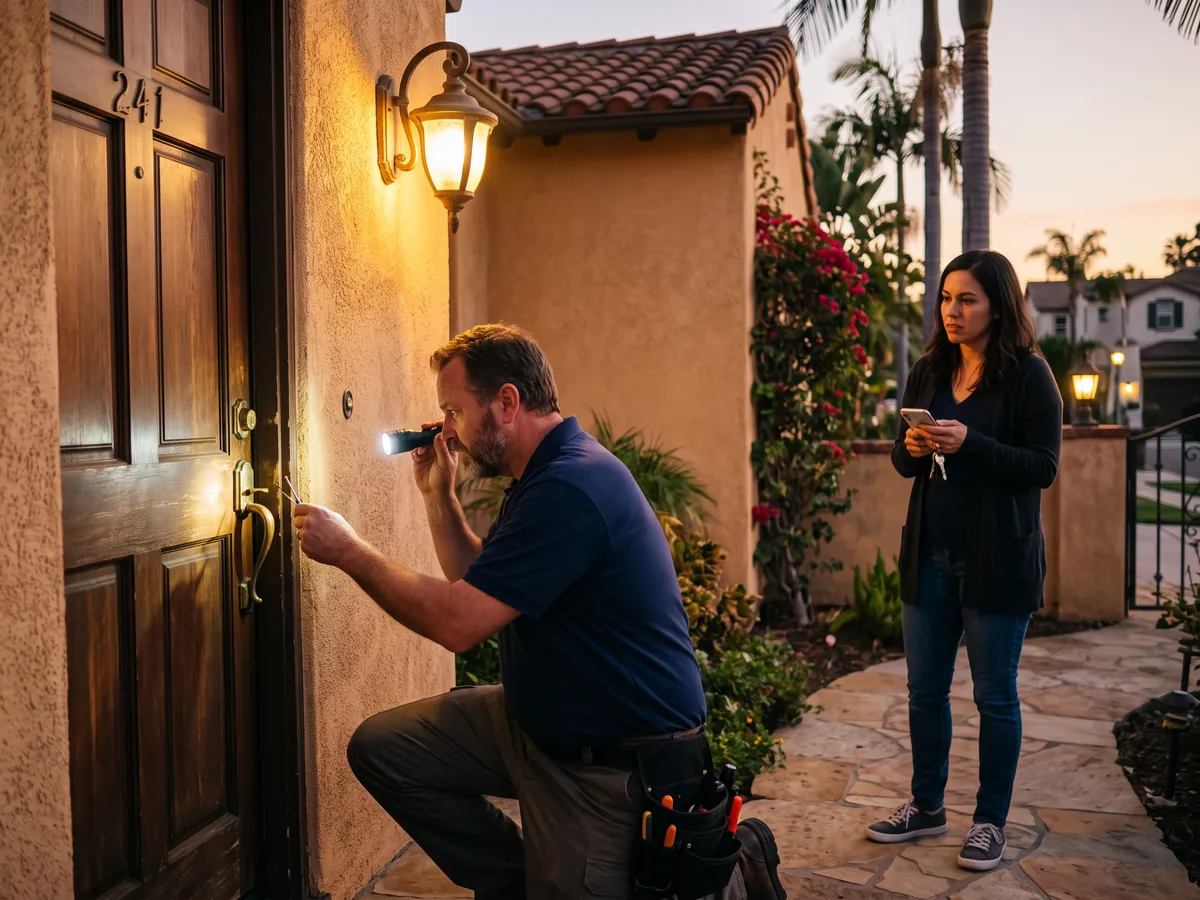
An emergency locksmith call in Claremont usually lands in one of three groups. You cannot get into a house or apartment, you cannot get into or start a car, or a door that ought to lock has stopped locking after a break-in or a failed latch. The third group cannot wait, because an open door has to be closed tonight. When you call (951) 903-3193, expect quick questions about where you are, what lock or vehicle is involved and whether anyone is in danger. If a child, an elderly relative or a pet is shut inside a closed car or house on a 100-degree afternoon, dial 911 first, since fire crews are closer than a van coming from San Bernardino. For everything else, you get an honest ETA based on where we are and how the 210 and the 10 are moving. While you wait, stand somewhere lit and visible rather than beside the door or car. After a break-in, leave the damaged frame as it is until police finish their report. Our hours shape what we can do. The day runs from 6:30 a.m. to 11:30 p.m. every day, so a failure late at night may need a stopgap until we open at 6:30 a.m.
What to know first in Claremont
Not every lock problem is an emergency, and sorting them quickly saves money and stress. We think of urgent calls in three tiers. The first is life safety: a child, a pet or a vulnerable adult in danger inside a locked car or home, or a medical crisis behind a locked door. That tier belongs to 911, full stop. The second is security exposure: a door that won't lock after a break-in, keys stolen along with your address, a storefront that can't be secured at closing, an ex-partner who still holds a key. Those need an emergency locksmith the same day, because every hour the gap stays open is risk. The third is disruption: you're locked out, a key broke, the car won't start with its key, a keypad went dark. Nobody is in danger, but you can't get on with your day. In Claremont, Julian's Locksmith handles the second and third tiers, and we'll help you work out which one you're in when you call. Sometimes the honest answer is that a sticky lock can wait for a scheduled visit, and we'll say that too.
How we can help in Claremont
- Business and storefront lockouts. Office suites, warehouse man doors and roll-up doors each fail differently. A grade 1 mortise lock may take patient picking; a dock door padlock with a rusted shackle may need cutting and replacing on the spot. We carry common padlocks, cylinders and cams so the building is lockable again before we pull away.
- Securing a door after a break-in. A kicked door nearly always fails on the strike side: the strike plate tears out, the jamb splits, and the deadbolt itself often survives. We fit a heavy-gauge strike with 3-inch screws reaching the framing, replace any bent bolt, and get the door locking again tonight. A badly split jamb may still need a carpenter later.
- Lost-key emergency rekeying. A business with a missing master key faces more exposure than a homeowner with a lost house key, since one master may open dozens of doors. We start with exterior doors and rooms holding cash, records, inventory or medication, then plan the rest of the system so the key chart stays accurate.
- Stranded-driver car keys. Some vehicles can't be fully keyed at the roadside. Certain European models and newer cars behind a security gateway need dealer-only programming or a dealer-supplied key. We tell you on the phone when that's likely, and we can still open the car, cut a mechanical blade, or help you line up the dealer step.
- Urgent safety lock changes. California tenants with a protective order or qualifying police report can ask the landlord in writing to change the locks, and the landlord has 24 hours to do it. If the landlord doesn't act in time, the law lets the tenant have the locks changed. We can do that work and give you a receipt for the landlord.
Local factors in Claremont
Foothill homes around Claremont live with dust, wind and wildfire seasons. Santa Ana winds drive grit into exterior cylinders and slam doors hard enough to bend strikes. During an evacuation warning, a lock that won't secure or a gate that won't open feels urgent, but official orders come first; leave safely, then call an emergency locksmith to deal with the hardware once you're allowed back.
Students around Claremont often rent off campus with roommates who hold the other keys, and lockouts happen at odd times. Campus housing lockouts go through residence staff or campus police. For off-campus rentals, we need ID plus a lease or mail showing the address. Keys lost from a shared ring usually justify a rekey, since nobody knows who might have picked them up.
Family neighborhoods in Claremont produce a familiar set of emergencies: kids who lock a door from the inside, garage entry doors that latch behind a parent carrying groceries, teens who lose house keys, toddlers who end up locked in cars. Know the line. A child in a hot car is a 911 call. A child safe inside the house can be talked to through the door while we pick the lock.
Situations this covers
Imagine a Tuesday at 10 p.m. when an alarm company tells the owner of a Yale Avenue gift shop that the front door was tampered with. At the scene the glass door shuts, but the cylinder has been wrenched sideways and the cam is bent, so the hookbolt no longer throws. After checking that the caller owns or manages the shop, we would pull the damaged cylinder, fit a new one with a fresh cam, test the deadlatch and the hookbolt, and leave the door properly locked. Frame repairs and any glass work can wait for daylight.
- For example, a shipping supervisor arrives at 6:30 a.m. to open a roll-up dock door, and the padlock on the hasp won't release; its shackle has seized with rust and grit. A truck is already backing in. We'd try the key with penetrating lubricant first, then cut the shackle cleanly if needed, and install a new shrouded padlock from van stock so the dock can be locked again at the end of the shift.
- For example, a commuter pulls into a park-and-ride off I-10 at dawn, grabs a coffee, and locks the fob in the cupholder of a push-start sedan. The train leaves soon. We'd confirm the year and model on the phone, open the car with an air wedge and reach tool, check the registration against the driver's license, and then test the fob's coin cell, since a weak battery is often why the car locked with the fob still inside.
- A boutique owner in a shopping strip near California Botanic Garden goes to lock up at closing, and the key turns but the hookbolt in the aluminum door never swings out. The cylinder cam has stripped. Leaving an unlocked storefront overnight isn't an option. A typical fix is pulling the mortise cylinder, replacing the cam or the whole cylinder from van stock, and cycling the bolt several times before anyone heads home.
How the visit works
- Check for danger first. Before calling a locksmith, ask whether anyone is at risk. A child or pet in a hot car, someone unresponsive behind a locked door, a stove or bath left running: those are 911 calls, and firefighters can force entry immediately. For everything else in Claremont, call us at (951) 903-3193.
- Call and describe the problem. Tell us what's locked (house, car, office, safe), what went wrong (lockout, broken key, damaged lock, lost keys) and exactly where you are: street address, cross street, parking level or unit number. Precise details let us load the right tools before the van leaves.
- Hear the quote and an honest ETA. Our arrival estimate reflects traffic and distance from wherever the technician is right now, not a number pulled from the air. If it's too long for your situation, you're free to make other arrangements; we'd rather you know now than wait and wonder.
- Prepare while you wait. Find your photo ID plus something tying you to the address or vehicle: a lease, utility bill, registration or insurance card. A phone photo works if the paper is locked inside. Having it ready turns verification into a quick check instead of a search.
- Verification and damage-free entry. If your documents are locked inside, the emergency locksmith may open the door and then check them before you go in or before leaving. Without proof of ownership or residency, nobody gets let in; that rule protects you as much as anyone.
- Secure it before we leave. If something can't be finished on the same visit, such as a dealer-only car key or a door that needs a carpenter, we leave things as secure as possible and explain exactly what comes next, who to call, and what that step should involve.
Pricing factors
- Timing of the call. Late-evening calls, close to our 11:30 p.m. cutoff, involve different scheduling than a midday visit. If the time of day affects your price, you'll hear that on the phone before dispatch. An emergency surcharge should never appear on the invoice when nobody mentioned it at the start.
- Location, distance and access. We're mobile and dispatch from San Bernardino, so distance and drive time are part of the picture. A home a few miles from our base differs from a job at the far side of Los Angeles County. The distance is reflected in the price we quote before work starts, not added later as a surprise.
- Damage and earlier attempts. What happened before we arrived affects the job. A keyway packed with superglue, a cylinder drilled halfway, or a door pried with a screwdriver often turns entry into replacement. If someone already tried, tell us on the phone; it helps us bring the right parts the first time.
Every job gets a clear quote before any work starts. Call (951) 903-3193 with the details and we'll tell you what to expect for your situation in Claremont.
Advice before you book
- Ask for the company name and the full quote on the phone, then check that the technician and paperwork match. A licensed California locksmith company carries a BSIS license number. Ours is LCO7891, and you can look it up at search.dca.ca.gov before we even arrive.
- Business owners should keep a written list of who may authorize emergency work: owners, managers and the building's property manager. Share it with the staff who open and close. When a manager calls about a lockout before the first shift, that list keeps the door from staying shut while everyone chases the owner.
- Pat your pocket for keys before pulling any self-locking door shut: storm doors, garage entry doors, office doors with storeroom-function locks, and cars that lock automatically as you walk away. It takes two seconds and prevents a surprising number of lockouts.
- Replace smart lock batteries on a calendar rather than waiting for the warning light to insist. Inland summer heat shortens battery life in exterior keypads. Swapping them when the clocks change each spring and fall is an easy reminder that costs nothing and prevents the most common keypad lockout.
Common errors that cost time and money
- Forcing a stuck car key with pliers or a wrench. When a key won't turn, the steering lock is often binding or the wafers are worn. Extra torque snaps keys and breaks ignition cylinders, turning a free fix, rocking the wheel gently, into a real repair.
- Breaking a window to get into your own house or car. Replacement glass often costs more than an emergency locksmith visit, leaves an opening you then have to secure overnight, and carries a real risk of deep cuts. Save glass-breaking for genuine threats to someone's life, and let responders handle it.
- Copying a spare and calling it done after losing keys tagged with your address, or a wallet holding your license. A copy doesn't stop the lost key from working. Rekeying the exterior locks is the step that actually closes the gap, and it's usually less work than people expect.
Reaching Claremont
Claremont is about 30 miles from our San Bernardino base, roughly 34 minutes in light traffic via University Parkway to I-215 South. When you call, you get an arrival estimate based on where the technician is and the traffic at that moment.
If you're close to Towne Avenue, tell us which exit or cross street you're nearest. It trims the last mile and keeps the van from circling a block that looks right on the map but isn't.
About Claremont: A 1902 town meeting numbered Claremont's east-west streets and named its north-south streets after colleges and universities, which is why the Village grid includes Yale and Harvard Avenues.
| Neighborhoods | North Claremont, Village expansion and Claremont Packing House, Claremont Village, South Claremont, Village South, Claraboya |
|---|---|
| ZIP codes | 91711 |
| Main routes | I-10, SR-210, Foothill Boulevard, Base Line Road |
| From our San Bernardino base | about 30 miles via University Parkway to I-215 South, then SR-210 West (Foothill Freeway) through Rialto, Fontana, Rancho Cucamonga and Upland to the Base Line Road exit for north Claremont or the Towne Avenue exit for Foothill Boulevard and the Village; I-10 West to Towne Avenue or Indian Hill Boulevard for the south side |
Mornings start early here: phones are answered from 6:30 a.m. seven days a week, which suits commuters who discover a missing key in the driveway and shop owners who can't open the front door. Saturday and Sunday are no different. Every day runs to 11:30 p.m.
Car keys are made only for the registered owner or someone the owner has authorized. Have your driver's license plus the registration or title ready, and we match the name and VIN before cutting or programming anything. If the paperwork is inside the locked car, we open it first and check before going further.
Locked out in Claremont?
Call (951) 903-3193 with the address and what's locked. You'll get an arrival estimate and a quote before anyone heads out, and when we arrive we'll ask for ID that ties you to the property. If a child or pet is shut inside a hot car or building, call 911 first.
Frequently asked questions
Can you make a car key if I've lost every key?
Usually, yes. With proof of ownership, we decode the lock or obtain the key code, cut a new blade on the van's machine, and program the transponder or smart key through the OBD-II port right where the car is parked. Some makes and newer models require dealer programming, and we'll tell you on the phone if yours is one of them.
Should I call my landlord or a locksmith when I'm locked out of my apartment?
Try the landlord or leasing office first during business hours; many keep unit keys and can let you in. After hours, or if they can't get to you soon, we can open the door after verifying your lease or an ID showing the address. We won't change a rental's locks without the owner's okay unless California law gives you that right.
Do you open safes in an emergency?
Yes, when you can show the safe is yours. Electronic safes often fail from dead batteries or a bad keypad, and some can be powered externally or opened with an override key. Mechanical safes may need manipulation, or drilling followed by repair. A safe opening can take longer than a door, so the emergency locksmith sets expectations before starting.
What counts as an emergency locksmith call?
Anything that leaves you unable to get in, unable to lock up, or unable to drive: house, apartment, car and business lockouts, keys broken in a lock, doors damaged in a break-in, lost keys tied to your address, dead keypad locks and failed storefront hardware. If someone's safety is at risk, call 911 first. For everything else in Claremont, call (951) 903-3193.
Can you fix my door the same night after a break-in?
Usually, as long as you call while we're open and police are finished at the scene. We replace torn-out strike plates with heavy-gauge strikes and long screws, replace bent deadbolts, and rekey if keys were stolen. A split jamb may need a carpenter afterward, and broken glass needs a glass or board-up company, but the door can typically be locked again that night.
My key broke off in the lock. What should I do?
Leave the stub alone, keep the piece that came out, and don't add glue or oil. Use another door if you can. We extract the fragment with thin hooks or by removing the cylinder, figure out why it broke (usually a worn key or a binding cylinder), and cut a fresh key from the pieces or by code.
How far is Claremont from your base?
Claremont is about 30 miles from our San Bernardino base, roughly 34 minutes in light traffic. Arrival time depends on traffic and on the job the technician is finishing, so we give you an estimate on the phone before you commit.
Related services in Claremont
- 24 Hour Locksmith in Claremont
- Mobile Locksmith in Claremont
- Locksmith Near Me in Claremont
- Emergency Lockout Service in Claremont
- Emergency Door Unlocking in Claremont
- Emergency Locksmith Open Now in Claremont
- Home Lockout in Claremont
- Car Lockout in Claremont
- Business Lockout in Claremont
- Broken Key Stuck in Door in Claremont
Emergency Locksmith in nearby cities
- Emergency Locksmith in MontclairSan Bernardino County
- Emergency Locksmith in La VerneLos Angeles County
- Emergency Locksmith in UplandSan Bernardino County
- Emergency Locksmith in PomonaLos Angeles County
- Emergency Locksmith in San DimasLos Angeles County
- Emergency Locksmith in OntarioSan Bernardino County
- Emergency Locksmith in ChinoSan Bernardino County
- Emergency Locksmith in Charter OakLos Angeles County


