
Etiwanda, San Bernardino County
Emergency Locksmith Help in Etiwanda for Homes, Cars and Businesses
Short answer: Decide who to call first. If a child, a pet or anyone's health is at risk behind a locked door or inside a locked car in Etiwanda, dial 911; responders can force entry immediately. For everything else, from lockouts to broken keys to damaged locks, an emergency locksmith is the right call. Julian's Locksmith picks up at (951) 903-3193 and gives you an honest ETA.
When a business can't open, can't lock, or has just been broken into, every hour costs something: payroll standing around, deliveries turned away, a storefront sitting exposed overnight. Julian's Locksmith works as an emergency locksmith for Etiwanda shops, offices, restaurants and warehouses, and we know commercial hardware well: aluminum storefront deadlatches, mortise cylinders, panic bars, door closers and the padlocks on roll-up doors. Our day starts at 6:30 a.m., early enough to open a door before most first shifts. Owners and authorized managers can call (951) 903-3193, describe the door, and get a quote before the van leaves.
Emergency locksmith needs in Etiwanda tend to fall into three piles, and the first job on the phone is working out which one you are standing in. The first pile is the house: a front door that won't release, a jamb split open by a kicked-in side door, a garage keypad that went dark with the family stuck outside. The second is the vehicle: a fob sealed inside a car in the Victoria Gardens garage, or a key that snapped in the ignition just before the commute. The third is the business, usually a storefront or warehouse door that refuses to latch behind a closing crew. Safety comes before locks. If a child or pet is shut in a hot car, or a break-in is still happening, dial 911 and let responders handle it. Smoke or flame on the slope above North Etiwanda is a 911 matter too, and getting out matters more than any key. While you wait for us, stand somewhere visible and away from moving traffic. The roads near the preserve at the top of Etiwanda Avenue can be dim after sunset, and the I-15 ramps move fast. After a forced entry, leave the door exactly as it is until police have looked at it. Our day runs from 6:30 a.m. to 11:30 p.m. every day of the week, weekends included, and we are closed overnight.
What to know first in Etiwanda
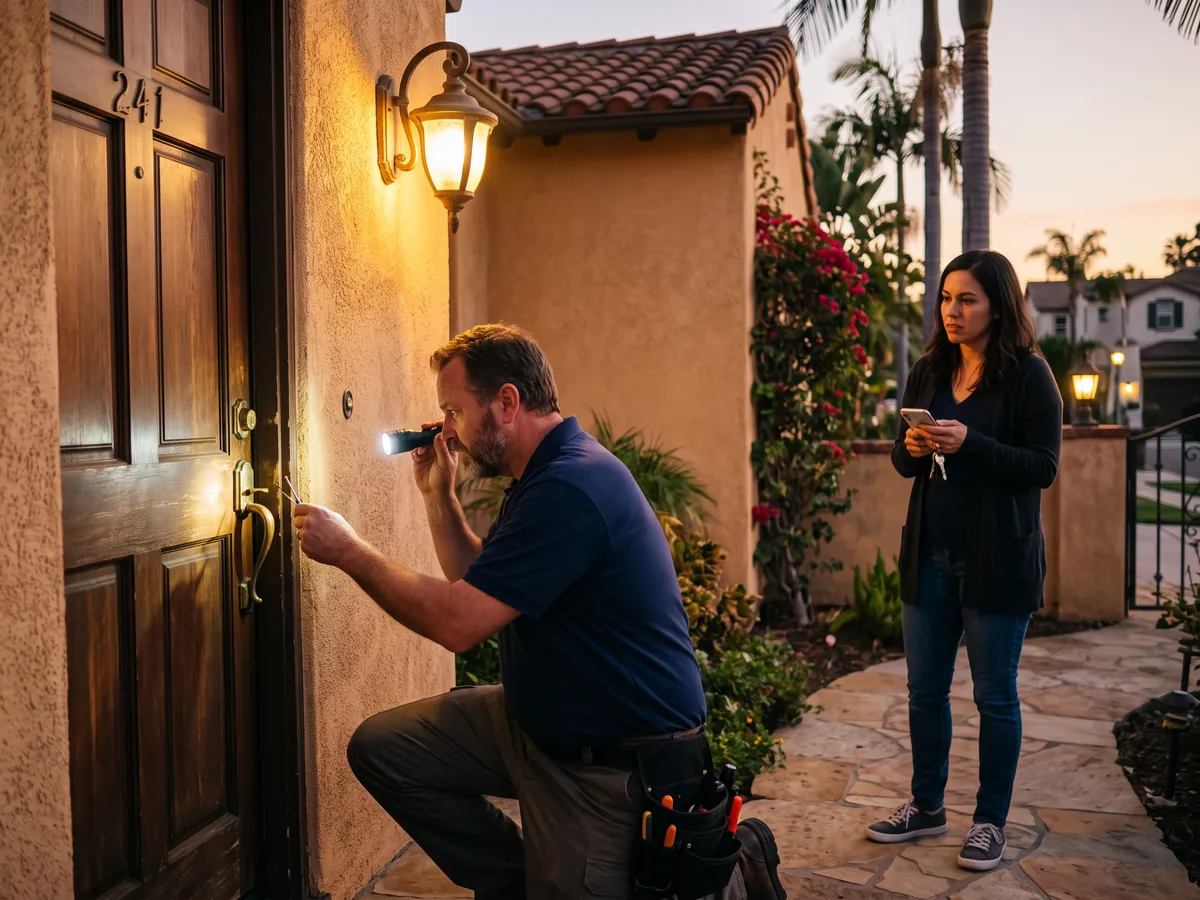
Emergency entry should leave the property the way we found it. For residential pin-tumbler locks, that means picking with a tension wrench and pick, or raking a builder-grade cylinder. Lever handles can often be operated from the inside with an under-door tool, and spring latches without anti-shim plungers can sometimes be slipped. For vehicles, an inflatable air wedge opens a narrow gap at the top corner of the door so a long-reach rod can press the lock switch, or a Lishi tool picks the door cylinder while reading its cuts. Commercial doors call for mortise cylinder picking and care around aluminum stiles that bend easily. Destructive entry exists for good reasons, though. A Medeco or Mul-T-Lock cylinder, a lock seized by corrosion, or a safe with a failed lock may need drilling. When that's the case, the emergency locksmith explains why, shows you any alternative, and replaces what was drilled before leaving your Etiwanda property. Drilling should never be something you discover on the invoice.
Work included on a typical visit
- Business and storefront lockouts. Office suites, warehouse man doors and roll-up doors each fail differently. A grade 1 mortise lock may take patient picking; a dock door padlock with a rusted shackle may need cutting and replacing on the spot. We carry common padlocks, cylinders and cams so the building is lockable again before we pull away.
- Broken and stuck key extraction. Keys that break in an ignition, a padlock or a file cabinet need a lighter touch, because wafer locks damage more easily than pin tumblers. We extract the fragment, check whether the break came from a worn key or a binding cylinder, and fix the cause. A worn key that broke once tends to break its copy too.
- Lost-key emergency rekeying. A business with a missing master key faces more exposure than a homeowner with a lost house key, since one master may open dozens of doors. We start with exterior doors and rooms holding cash, records, inventory or medication, then plan the rest of the system so the key chart stays accurate.
- Doors that won't lock or latch. A deadbolt that won't throw at night usually isn't broken; the bolt is hitting the edge of the strike because the door sagged or the frame shifted. We adjust the strike, deepen the bolt pocket, or shim a hinge so the bolt fully extends. A bolt that only throws halfway protects far less than it appears to.
- Dead smart locks, keypads and safes. An urgent safe call usually involves medication, passports or a firearm someone needs for work. Electronic safes often fail from dead batteries or a worn keypad, which can sometimes be bypassed with external power or an override key. Others need manipulation, or a precise drill point and a repair. Proof of ownership comes first.
How Etiwanda shapes the job
Commuters in Etiwanda tend to hit lock trouble at the very start of the day: a car key that won't turn in the driveway before dawn, a fob locked in the car at a park-and-ride, a front deadbolt that won't throw on the way out. Our 6:30 a.m. start isn't early enough for every shift, so keep a spare car key at home and a plan for the earliest mornings.
In gated communities around Etiwanda, the emergency starts at the gate. Give us the gate code or arrange for the guard to admit our van when you call; otherwise the emergency locksmith waits outside while you wait inside. HOA pedestrian and pool gates also fail with worn latches and dead keypads, and we can usually repair them, with board approval where the association requires it.
Newer tracts around Etiwanda usually come with builder-grade deadbolts and knobsets, keypad locks and app-controlled garage openers. Builder-grade cylinders pick open readily during a lockout, which is also why a rekey after move-in makes sense: you don't know how many construction-era keys are floating around. Emergency calls in newer homes often involve keypads with dead batteries, or a garage entry door that locked behind someone carrying groceries.
Example situations
Say it's a Thursday around nine p.m. and a homeowner off Day Creek Boulevard returns from dinner to find the side-yard door splintered at the jamb, the deadbolt still extended and the strike plate torn out of the wood. Police take the report first. Then we arrive, match ID to a utility bill or deed, and look at the damage. A typical fix is a steel wrap-around reinforcer on the jamb, a new deadbolt with a deep strike and long screws, and a rekey of the other exterior doors, so the house is secure tonight instead of boarded up until next week.
- A typical tricky call: an adult child can't reach an elderly parent who lives alone in a Etiwanda condo, and nobody answers the door. They ask for a locksmith. Here we'd tell them to call 911 or the police non-emergency line for a welfare check first. Officers can enter when needed, and a locksmith shouldn't open a home for someone who doesn't live there without the resident's or owner's authorization.
- For example, a commuter pulls into a park-and-ride off Day Creek Boulevard at dawn, grabs a coffee, and locks the fob in the cupholder of a push-start sedan. The train leaves soon. We'd confirm the year and model on the phone, open the car with an air wedge and reach tool, check the registration against the driver's license, and then test the fob's coin cell, since a weak battery is often why the car locked with the fob still inside.
- For example, a shipping supervisor arrives at 6:30 a.m. to open a roll-up dock door, and the padlock on the hasp won't release; its shackle has seized with rust and grit. A truck is already backing in. We'd try the key with penetrating lubricant first, then cut the shackle cleanly if needed, and install a new shrouded padlock from van stock so the dock can be locked again at the end of the shift.
How the visit works
- Check for danger first. If an intruder might still be inside after a break-in, step away and call the police, not a locksmith. Let officers clear the property and take their report. Once they leave, the emergency locksmith can secure the damaged door, and the report number will help with any insurance claim.
- Call and describe the problem. Mention anything that changes the job: keys stolen in a burglary, an aftermarket car alarm, a high-security cylinder, a gated community that needs a code, or a property or car titled to someone else. Surprises on arrival cost time; details on the phone save it.
- Hear the quote and an honest ETA. Before we dispatch, you hear what the job is likely to involve, a quote for that work, and a realistic arrival estimate. If the situation turns out different on site, we requote before continuing. You never pay for extra work you didn't approve first.
- Prepare while you wait. Wait somewhere safe and visible, such as a lit porch, a store entrance or a neighbor's living room. Keep your phone charged and answer unfamiliar numbers, since the technician may call for a gate code or directions while pulling in.
- Verification and damage-free entry. If your documents are locked inside, the emergency locksmith may open the door and then check them before you go in or before leaving. Without proof of ownership or residency, nobody gets let in; that rule protects you as much as anyone.
- Secure it before we leave. If something can't be finished on the same visit, such as a dealer-only car key or a door that needs a carpenter, we leave things as secure as possible and explain exactly what comes next, who to call, and what that step should involve.
How we quote the job
- Timing of the call. Deadlines matter for businesses. Opening a store before the first shift, or securing it when a lock fails at closing, carries different stakes than a routine appointment. Tell us your deadline and we'll say plainly whether we can meet it and what the visit will involve.
- Location, distance and access. Access can add time: a gated community where we need the code, a car parked on the fourth level of a structure, an industrial park with a security check-in. Telling the emergency locksmith about access in advance keeps the visit on schedule and the quote accurate.
- Parts and hardware. For car keys, the blank or fob is often the largest single item. A smart fob costs more than a basic transponder key, and many vehicles accept only specific parts matched by FCC ID and part number. We'll show you the options instead of quoting the priciest one by default.
Every job gets a clear quote before any work starts. Call (951) 903-3193 with the details and we'll tell you what to expect for your situation in Etiwanda.
What to do before we arrive
- Replace smart lock batteries on a calendar rather than waiting for the warning light to insist. Inland summer heat shortens battery life in exterior keypads. Swapping them when the clocks change each spring and fall is an easy reminder that costs nothing and prevents the most common keypad lockout.
- Save (951) 903-3193 in your contacts today. Searching for a locksmith while stressed in a dark driveway is how people land on call centers that farm the job out to whoever is free, often at a total far above the number quoted on the phone.
- If a key breaks in a lock, keep every piece. A locksmith can usually read the cuts and make a new key from the fragments, which matters when it was your only copy. Don't push the stub deeper, and don't spray oil or squeeze glue into the keyway before extraction.
- Learn your fob's emergency blade before you need it. Most smart fobs have a release slide that frees a small mechanical key, and many driver's door handles hide a keyhole under a plastic cap. Find both once in daylight in your own Etiwanda driveway, where nobody is watching the clock.
Common errors that cost time and money
- Squirting superglue or epoxy into a keyway, or jamming a screwdriver in to turn it, after a key breaks. Glue bonds the pins in place and turns a simple extraction into a cylinder replacement, and a screwdriver can shear pins or crack the plug outright.
- Hiring based on a low service-call price quoted by a call center. Those numbers often leave out the actual labor, and the real total appears after the door is open. Ask what the whole job will cost, who is coming, and which licensed company they work for before agreeing.
- Calling a locksmith when the situation belongs to 911. A child or pet in a hot car, or someone unresponsive inside a home, needs emergency responders who can force entry on the spot. A locksmith is the right call when nobody is in danger, not when every moment counts.
Getting to Etiwanda
Etiwanda is about 17 miles from our San Bernardino base, roughly 22 minutes in light traffic via University Parkway to SR-210 West through Rialto and Fontana, exit Day Creek Boulevard for the historic core and North Etiwanda. When you call, you get an arrival estimate based on where the technician is and the traffic at that moment.
Rush hour on Base Line Road can stretch a drive considerably. We'd rather give you a realistic arrival window than an optimistic one, and we'll call you if a closure or a crash changes the plan.
About Etiwanda: Etiwanda was divided into 10-acre lots, and early settlers planted oranges, lemons, apricots and Muscat grapes on the slope below the San Gabriel Mountains.
| Neighborhoods | East Avenue corridor along I-15, North Etiwanda, South Etiwanda Avenue industrial area, Pacific Electric Trail corridor, Victoria Street and Etiwanda High School area, Foothill Boulevard and Victoria Gardens edge |
|---|---|
| ZIP codes | 91739 |
| Main routes | I-15, SR-210, Etiwanda Avenue, East Avenue |
| From our San Bernardino base | about 17 miles via University Parkway to SR-210 West through Rialto and Fontana, exit Day Creek Boulevard for the historic core and North Etiwanda; for the East Avenue side, switch to I-15 South and exit Base Line Road |
Mornings start early here: phones are answered from 6:30 a.m. seven days a week, which suits commuters who discover a missing key in the driveway and shop owners who can't open the front door. Saturday and Sunday are no different. Every day runs to 11:30 p.m.
Expect a few questions and a signature. A licensed California locksmith has to document who asked for a lock to be opened or a key to be made, and we follow that rule on every job in Etiwanda. If a locksmith skips the ID check entirely, ask yourself whose door they'd open next.
Locked out in Etiwanda?
Call (951) 903-3193 with the address and what's locked. You'll get an arrival estimate and a quote before anyone heads out, and when we arrive we'll ask for ID that ties you to the property. If a child or pet is shut inside a hot car or building, call 911 first.
Frequently asked questions
What should I do if I'm locked out while you're closed?
Start with whoever already has a key: a landlord, property manager, relative or neighbor. For a vehicle, roadside assistance through your auto insurer or motor club may send someone. If you're safe and the property is locked, staying with a friend and calling us when we open at 6:30 a.m. is a reasonable plan. Anything involving danger to a person goes to 911.
What if my car is stuck on a freeway shoulder or in a parking garage?
On a freeway shoulder, safety comes first: stay well away from traffic and call the CHP or your roadside service, since a tow to a safe spot may be needed before anyone can work on the car. In a parking structure near Victoria Gardens or anywhere else, tell us the level and space number and any height limit so the technician can reach you.
Can you make a car key if I've lost every key?
Usually, yes. With proof of ownership, we decode the lock or obtain the key code, cut a new blade on the van's machine, and program the transponder or smart key through the OBD-II port right where the car is parked. Some makes and newer models require dealer programming, and we'll tell you on the phone if yours is one of them.
Do you open safes in an emergency?
Yes, when you can show the safe is yours. Electronic safes often fail from dead batteries or a bad keypad, and some can be powered externally or opened with an override key. Mechanical safes may need manipulation, or drilling followed by repair. A safe opening can take longer than a door, so the emergency locksmith sets expectations before starting.
Is Julian's Locksmith open every hour of every day?
No, and we won't pretend to be. We take emergency calls every day from 6:30 a.m. to 11:30 p.m., and we are closed overnight. Those extended hours cover most early-morning and evening emergencies in Etiwanda, and we'll tell you plainly on the phone if we can't reach you that day.
How quickly can an emergency locksmith get to me?
That depends on where our technician is when you call and on traffic between there and you. We give an honest arrival estimate on the first call rather than a promise we can't keep, and we'll update you if something changes. If the estimate is too long for your situation in Etiwanda, you're free to make other arrangements.
How far is Etiwanda from your base?
Etiwanda is about 17 miles from our San Bernardino base, roughly 22 minutes in light traffic. Arrival time depends on traffic and on the job the technician is finishing, so we give you an estimate on the phone before you commit.
Related services in Etiwanda
- 24 Hour Locksmith in Etiwanda
- Mobile Locksmith in Etiwanda
- Locksmith Near Me in Etiwanda
- Emergency Lockout Service in Etiwanda
- Emergency Door Unlocking in Etiwanda
- Emergency Locksmith Open Now in Etiwanda
- Home Lockout in Etiwanda
- Car Lockout in Etiwanda
- Business Lockout in Etiwanda
- Broken Key Stuck in Door in Etiwanda
Emergency Locksmith in nearby cities
- Emergency Locksmith in Rancho CucamongaSan Bernardino County
- Emergency Locksmith in FontanaSan Bernardino County
- Emergency Locksmith in North FontanaSan Bernardino County
- Emergency Locksmith in Glen AvonRiverside County
- Emergency Locksmith in OntarioSan Bernardino County
- Emergency Locksmith in UplandSan Bernardino County
- Emergency Locksmith in RialtoSan Bernardino County
- Emergency Locksmith in BloomingtonSan Bernardino County


