
Devore, San Bernardino County
Residential Lock Replacement in Devore: Choosing What Goes In
Short answer: Yes, you can replace every lock in your house in one visit. Julian's Locksmith replaces deadbolts, entry sets, interior knobs, patio hardware and garage-entry locks across Devore, keys the new exterior locks to a single key, and sets the strikes so everything closes smoothly. You can supply your own locks or choose from ours. Call (951) 903-3193.
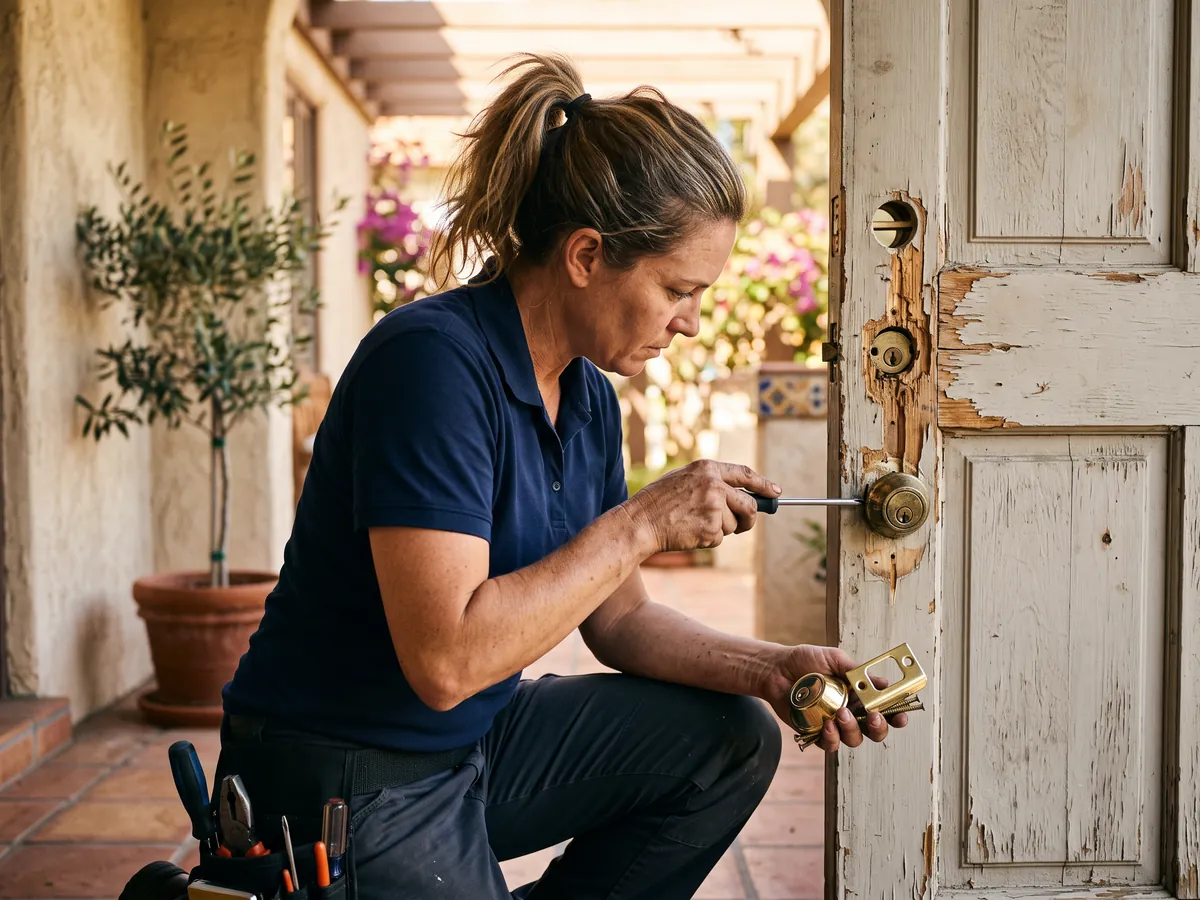
Sometimes locks get replaced because the house changed, not because the locks failed. A new front door color, a kitchen remodel with matte black fixtures, or a move away from the polished brass of the 1990s can make old hardware look out of place. Changing finishes across a house involves more than the front door: back and side doors, interior passage sets, hinges and the screen door all show. We help plan a residential lock replacement in Devore that keeps finish and style consistent, fits existing holes where possible and keys the exterior doors alike. Call (951) 903-3193 and we'll go over the options before anything is ordered.
Residential Lock Replacement in Devore: what to expect
Replacing all the locks in a house goes better with a plan than with a cart full of matching boxes. Start with an inventory: front entry, back door, side or yard door, garage entry, the garage's own side door, patio sliders, French doors and screen doors outside; then passage, privacy and dummy sets inside. Decide which exterior doors get deadbolts and whether keypad or smart locks belong in the mix, such as a garage entry used by kids or a casita used by guests. Choose one keyway for every keyed lock so a single key runs the house, and one finish family so the hardware looks deliberate. Think about egress, too: a double-cylinder deadbolt needs a key to get out, and building codes generally expect the main exit to open from inside without one. Finally, plan the order of work so the house is never left unsecured. Our residential lock replacement visits follow that sequence, and we hand you a short record of brands, keyway and key count when we finish.
How we can help in Devore
- Deadbolt replacement. Choosing between single- and double-cylinder deadbolts is a safety decision as much as a security one. A double-cylinder lock needs a key inside, which can slow an exit in an emergency. We usually recommend single-cylinder deadbolts plus glass reinforcement near sidelights, and we explain the tradeoffs if you're considering hardware keyed on both sides.
- Mortise lock replacement and conversion. Some homeowners upgrade from an old residential mortise set to a modern mortise entry lock with a deadbolt and a standard cylinder. That keeps the solid, single-unit construction mortise hardware is known for, while adding a stronger bolt and a cylinder that can be keyed to the rest of the house.
- Replacing a deadbolt with a smart or keypad lock. Replacing a keyed deadbolt with an electronic one is a good moment to reinforce the strike, since motorized bolts need clean alignment to work reliably. We also key the backup cylinder to match your other locks where the manufacturer allows it, so a dead battery never turns into a locked-out evening.
- Garage entry and side door locks. Side yard doors and detached garage doors take sun, dust and the occasional shoulder bump from someone carrying things. We replace their locks with weather-resistant hardware, add a deadbolt where there was only a knob, and key them with the house or separately, depending on who should have access to what.
- Replacement after forced entry. Insurance claims tend to go more smoothly with clear documentation. We photograph the damaged hardware before removal, list what we replaced and note the grade of the new locks. If police took a report, keep the report number with our invoice. We verify ownership or residence before replacing locks after any break-in.
What's different about Devore
Inland heat is hard on replacement hardware. Dark finishes on west-facing doors get hot to the touch, cheap coatings fade and peel, and electronic locks in direct sun burn through batteries sooner. For residential lock replacement in the hotter parts of Devore, we favor durable finishes, solid metal construction, keypad models with suitable temperature ratings, and lighter finishes on doors that bake in afternoon sun.
Rural properties often have several structures under one owner: the house, a guest unit, a barn, a workshop and gates. When replacing locks, decide which buildings share a key and which don't. We replace exterior house locks with weather-resistant hardware, fit deadbolts on outbuildings with solid doors, and key the property in groups, so a ranch hand's key opens the barn but not the house.
Older homes in Devore often have doors bored for hardware that no longer exists, mortise pockets, or several generations of patched holes. Residential lock replacement there starts with careful measuring and sometimes conversion plates or wood repair. We try to keep the door itself, since solid older doors are worth saving, and choose replacement hardware that fits the period look while adding a modern deadbolt.
Example situations
- A typical garage-entry upgrade: the door from the garage into the laundry room has a builder knob that locks with a push button and no deadbolt. The family wants better security without more keys. We install a keyed lever and a deadbolt keyed to the front door, set the latch to catch with the door's closer, and make sure the strike screws reach solid framing.
- A landlord turning over a duplex off I-215 finds the knob sets on both units worn loose and the deadbolts throwing barely half an inch. We replace each unit's exterior locks with rekeyable Grade 2 hardware and deadbolts that meet the 13/16-inch minimum throw California sets for rental deadbolts, key each unit separately and leave the owner a written key record.
- In a 1930s Spanish-style house, for example, the front door's original mortise lock has a cracked case that can't be rebuilt, and no current mortise body matches the pocket. We fit a conversion plate that covers the old pocket, install a bored entry set and deadbolt in an oil-rubbed bronze finish that suits the house, and hand the original parts back to the owners.
- Picture a front door after an attempted break-in: the deadbolt cylinder was wrenched until the housing cracked, though the door held. The owners want stronger hardware. We remove the damaged deadbolt, install a Grade 1 model with a reinforced strike and long screws, add an edge wrap around the lock area, and rekey the other exterior locks so the whole house shares one new key.
From your call to the finished job
- Inventory and goals. We start with a list: front, back, side and garage-entry doors, sliders, French doors, screen doors and any interior locks you want changed. For each, we note what's there now and what you want it to become. A clear list keeps the quote accurate and makes sure the right hardware is on the van.
- Measure the door prep. We also measure the frame. Strike location, jamb condition, the gap between door and frame, and whether screws can reach the wall framing all affect how the new lock performs. A new deadbolt installed into a weak or misaligned frame won't feel new for long.
- Choose the hardware. Choosing hardware means balancing security, ease of use and appearance. A Grade 1 deadbolt on the main entry, Grade 2 levers elsewhere, a keypad on the garage entry and matching finishes throughout is a common plan. We explain the options and leave the decision with you.
- Quote, approval and verification. You get an itemized quote: hardware for each door, labor, any strike or frame work, and keying. Nothing starts until you approve it. Because we're changing locks, we confirm you own the home or have the owner's authorization; tenants need written landlord approval unless state law gives them a specific right to change locks.
- Remove and install. Installation includes the details that make a lock feel solid: the latch extends fully into the strike, the deadbolt reaches full throw without rubbing, the trim sits flat and screws are snug without cracking the housing. Where a new latch needs a different strike, we chisel or fill the jamb so it fits cleanly.
- Key, test and hand over. We key every new cylinder to your chosen key, test each key in each lock, and cycle every lock with the door open and closed. You get the agreed number of keys plus a note listing the brand, keyway and finish, so future copies or additions match. We can take the old hardware away with us.
How we quote the job
- Hardware grade and brand. Grade 1 deadbolts and solid, premium entry sets cost more than Grade 2 or builder-grade hardware, and decorative brands and special finishes add more. We usually suggest spending where it matters most, on the main entry deadbolt and its strike, and choosing solid mid-grade hardware for less exposed doors.
- Lock type. A keypad deadbolt costs more than a keyed one and takes longer to install because of programming and testing. Retrofit smart locks that keep your existing exterior cylinder can cost less overall when the deadbolt underneath is still in good condition.
- Who supplies the hardware. Customer-supplied locks are welcome. We check them before starting, and if something won't fit or arrived damaged in the box, we tell you before installing. Installation labor is similar either way; what changes is who handles returns and who stands behind the hardware choice.
Every job gets a clear quote before any work starts. Call (951) 903-3193 with the details and we'll tell you what to expect for your situation in Devore.
Advice before you book
- Keep a record of your locks: brand, model, finish and keyway, plus the key code if one came with the hardware. When you add a lock later or need parts, that record lets a locksmith match everything without guessing. Store a photo of it with your home documents.
- Ask for the old strike to be replaced along with the lock. A new deadbolt sliding into an old, thin strike plate held by short screws gives up much of its strength. A heavy-duty strike with screws reaching the framing makes the frame, not just the lock, part of the defense.
- Photograph your current handleset and both sides of the door before shopping, and measure the distance between the grip's mounting holes. Bring those to us or to the store. Matching the hole spacing avoids drilling new holes and leaving old ones exposed on the face of your front door.
- If you're replacing a deadbolt next to a glass sidelight, think through egress before choosing a double-cylinder lock. A single-cylinder deadbolt combined with laminated glass or security film on the sidelight usually solves the reach-through concern without needing a key to get out in an emergency.
What not to do
- Over-tightening the through-bolts on new hardware. Cranking the screws distorts the chassis, binds the latch and can crack a die-cast housing before the lock is a week old. Trim screws should be snug, with the knob or lever still returning freely afterward.
- Choosing hardware on looks alone. Some attractive lever and handleset lines use soft die-cast parts and weak springs that sag within a few years. Check the ANSI/BHMA grade on the package and the finish rating before committing, especially for exterior doors that get daily use.
- Mixing brands with different keyways across the house. It looks fine on installation day, then you're carrying three keys and can't key them alike later without replacing cylinders. Choose one keyway family for every keyed lock before you start buying hardware.
Getting to Devore
Devore is about 8 miles from our San Bernardino base, roughly 14 minutes in light traffic via Kendall Drive or Palm Avenue to I-215 North, through the Devore junction onto I-15 North, exit Kenwood Avenue for Devore Heights. When you call, you get an arrival estimate based on where the technician is and the traffic at that moment.
Stuck on the shoulder or in a parking lot along I-15? Get somewhere safe, turn on your hazards, and give us the nearest exit or business so we can find the car without guessing.
About Devore: The community sits at an elevation of roughly 2,510 feet, just outside the boundary of the San Bernardino National Forest.
| Neighborhoods | Glen Helen, Cajon Boulevard corridor, Lytle Creek, Kenwood Avenue corridor, Devore Heights, Verdemont |
|---|---|
| ZIP codes | 92407 |
| Main routes | I-15, I-215, Cajon Boulevard, Kenwood Avenue |
| From our San Bernardino base | about 8 miles via Kendall Drive or Palm Avenue to I-215 North, through the Devore junction onto I-15 North, exit Kenwood Avenue for Devore Heights; Devore Road exit for Glen Helen and lower Cajon Boulevard |
Home lock work in Devore?
Call (951) 903-3193 with the address and a quick description of the doors and locks involved. We'll quote the job before any work starts.
Frequently asked questions
What lock rules apply when replacing locks on a California rental?
Civil Code §1941.3 requires landlords to provide operable deadbolts on main swinging entry doors and working window locks, and it defines a deadbolt by a minimum throw of 13/16 inch. Under Civil Code §1941.5 and §1941.6, a landlord must change the locks within 24 hours of a tenant's written request in certain protective-order situations. Rekeying or replacing locks between tenants is also widely recommended.
Do you need proof that I own the house?
Yes. Before replacing locks, we confirm you own the home or are authorized to change its locks: photo ID with the address, a deed or tax bill, or a property manager's work order. Tenants generally need the landlord's written approval unless state law gives them a specific right to change the locks. These checks protect you from unauthorized lock changes.
When should I replace a home lock instead of repairing it?
Replace it when the housing or bolt is cracked, parts for that brand are no longer made, the lock was damaged in a forced entry, or the hardware is a low grade you want to upgrade. Replacement also makes sense when you want one key or one finish across the house. If the lock is sound and the issue is alignment or wear, repair usually costs less.
Can all my new locks work with one key?
Yes, as long as they share a keyway. Schlage and Kwikset, for example, use different keyways, so we choose hardware with compatible cylinders and key every new lock to the same combination during installation. Some decorative brands offer cylinders in common keyways, which lets premium hardware share a key with everything else. One key for the front, back, side and garage entry is the usual goal.
What should be replaced after a break-in?
Anything the intruder damaged or might have keys for. That often means the deadbolt and entry set on the forced door, the strike and sometimes the jamb. If keys were stolen, every lock they fit should be rekeyed or replaced. We make the house lockable that day, document the damage for police and insurance, and can upgrade to stronger hardware with reinforced strikes.
Do you replace sliding patio door and French door locks?
Yes. Slider latches and handles are specific to the door's manufacturer, so we identify the door and match the replacement, adding a keyed option or a secondary foot lock if you like. French doors and fiberglass doors with multipoint locks need a compatible mechanism that fits the existing edge cutout. Discontinued designs sometimes need adapter plates or a special order.
How far is Devore from your base?
Devore is about 8 miles from our San Bernardino base, roughly 14 minutes in light traffic. Arrival time depends on traffic and on the job the technician is finishing, so we give you an estimate on the phone before you commit.
Related services in Devore
- Lock Replacement in Devore
- Residential Lock Repair in Devore
- Residential Lock Installation in Devore
- House Lock Replacement in Devore
- Front Door Lock Replacement in Devore
- Deadbolt Replacement in Devore
- Rekey or Replace Locks in Devore
- Same Key for All House Locks in Devore
- Security Lock Upgrade in Devore
- Smart Lock Replacement in Devore
Residential Lock Replacement in nearby cities
- Residential Lock Replacement in Glen HelenSan Bernardino County
- Residential Lock Replacement in MuscoySan Bernardino County
- Residential Lock Replacement in North FontanaSan Bernardino County
- Residential Lock Replacement in RialtoSan Bernardino County
- Residential Lock Replacement in FontanaSan Bernardino County
- Residential Lock Replacement in EtiwandaSan Bernardino County
- Residential Lock Replacement in San BernardinoSan Bernardino County
- Residential Lock Replacement in BloomingtonSan Bernardino County