
Devore, San Bernardino County
A House Locksmith in Devore Who Looks at the Whole Building
Short answer: Older houses and newer tracts need different lock work. A 1940s bungalow may have mortise locks and thin doors, a 1970s ranch has knob locks and aluminum sliders, and a 2000s tract has builder-grade deadbolts with short strike screws. A house locksmith in Devore fits upgrades to what's already there. Julian's Locksmith, license LCO7891, comes to you.
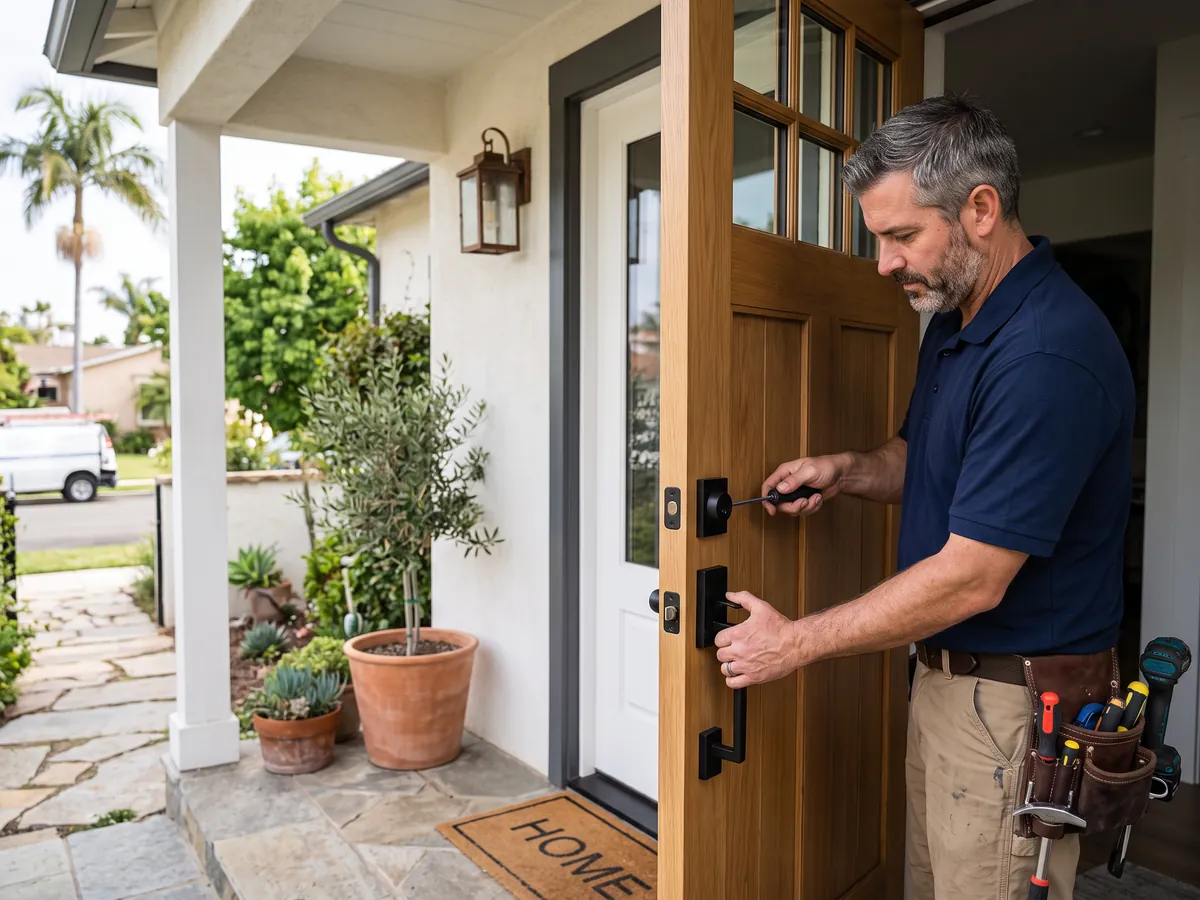
The door between your garage and your house gets used more than your front door and secured less. Many hang on a cheap knob lock left unlocked because the big overhead door is down, and the garage's side door is often a hollow slab with a flimsy latch. Julian's Locksmith treats the garage as part of the house, not an afterthought. In Devore, that means a real deadbolt on the house door, a solid lock on the side door, and a check that the house door still swings shut and latches on its own. We key both doors to your front door too, so the household still carries one key.
How this works in Devore
When a house door is kicked in, the lock almost never breaks. The wood around it does. A standard deadbolt's strike is fastened with short screws into a jamb that's often just a thin strip of softwood, with a gap behind it before the wall framing. A hard kick drives the bolt through that strip and the door swings open with the lock still extended. Reinforcement fixes the weak link. Three-inch screws through the strike reach the framing behind the jamb, and a heavy-gauge strike box or a longer reinforcement plate spreads the force along the frame. The same treatment on the hinge side prevents the door being forced from that edge. On older houses with stucco walls, settling can push the frame out of square, so we adjust the strike to keep the bolt aligned. None of this changes how the door looks from the street, and a house locksmith in Devore can usually do it in the same visit as a rekey or new lock.
Work included on a typical visit
- Back and side doors. On many houses the back door was once an exterior door to a porch that's since been enclosed or converted. We check whether that door is still exterior-rated, whether it locks from the right side, and whether its hardware still makes sense after the change.
- Garage-entry and garage side doors. The door from the garage into the house deserves a real deadbolt, not just a privacy knob. We fit locks that work with the door's self-closing hinges or closer, so it still swings shut and latches on its own, and we key it to the rest of the house.
- Sliding patio doors and French doors. French doors depend on flush bolts at the top and bottom of the inactive leaf. If those bolts don't seat, the active door's deadbolt locks into a door that swings anyway. We repair or replace flush bolts, align strikes, and service multipoint locks where the door uses one.
- Window locks and sash hardware. Ground-floor windows need working locks just like doors. We replace broken sash locks on single-hung windows, install sliding-window locks and pin locks, and add ventilation stops so a window can stay open a few inches without opening further from outside. We match finishes to the existing window hardware wherever we can.
- Older-house hardware and mortise locks. Skeleton-key locks on interior doors are charming but offer no real security, so we keep them for privacy and add proper protection at the exterior doors. When an old exterior mortise lock is beyond saving, we suggest a modern mortise lock or a conversion that avoids drilling through the existing pocket.
What's different about Devore
On large lots, the house is one building among several: detached garages, workshops, barns and well houses, plus long driveways and perimeter gates. A house locksmith can key the outbuildings alike, through-bolt hasps, and fit weather-resistant padlocks. Because neighbors may be far away and response times longer, the main house deserves Grade 1 deadbolts and reinforced frames on every exterior door.
Older houses reward a careful house locksmith. Original mortise locks can often be rebuilt and fitted with modern cylinders, keeping period hardware working. Deadbolts added decades later may sit at mismatched backsets or in frames that have shifted. We measure each door before recommending anything, reinforce strikes that rely on old softwood jambs, and free painted-over window locks, so the house keeps its character while its locks catch up.
Horse properties combine a house with barns, tack rooms, feed storage and paddock gates, and tack is a known target for theft. We fit solid locks on tack room doors, through-bolted hasps with shrouded padlocks on barns, and chains and locks on gates. Keeping the barn on a separate key from the house means farriers and barn help can work without ever holding a house key.
Example situations
- For example, a homeowner wants a double-cylinder deadbolt because the front door has a glass sidelight. We explain the fire-escape concern, then offer alternatives: a captured or removable thumbturn, a single-cylinder deadbolt paired with security film on the sidelight, or relocating the deadbolt farther from the glass. The owner picks the option that fits the house. Whichever route they choose, the door still opens from inside without hunting for a key.
- Imagine French doors to a backyard patio where the inactive leaf's top flush bolt was never thrown because it's too high to reach comfortably. With only the bottom bolt engaged, the pair can be pushed open with the deadbolt still locked. We replace the flush bolts with easier-reach models and align both strikes so the pair locks as one unit.
- For example, a 1950s ranch house in Cable Canyon has a solid deadbolt on the front door, but the back door still runs on its original knob lock. The owners assumed the fenced yard was enough. We add a deadbolt matched to the existing backset, reinforce the strike with three-inch screws, and key it to the front door so they still carry one key.
- A typical call: the owner of a 1920s bungalow loves the original mortise lock on the front door, but it now takes three tries to latch. Inside the case, a broken spring and a worn latch bolt explain it. We rebuild the mechanism, fit a new cylinder that threads into the old case, and cut keys. The door keeps its character and locks properly again.
How the visit works
- Describe the house and the problem. Photos help a lot. Snap the outside face of each lock, the edge of the door showing the latch faceplate, and anything unusual like a mortise lock or a multipoint handle. That lets us bring the right cylinders, strikes and hardware on the first trip.
- Arrival and ownership check. Verification protects your house from someone else's request. If you're having work done while you're away, we'll arrange how to confirm your authorization in advance. We work under California's Locksmith Act, and our license, LCO7891, can be checked at search.dca.ca.gov.
- Walk the perimeter. We go door by door around the house: front entry, back door, garage-entry and garage side doors, sliders, French doors and side gates. At each one we test the latch and deadbolt, check strike and hinge screws, and look at the frame. Ground-floor windows get a quick check too.
- A prioritized quote. When a repair and a replacement would cost about the same, we tell you, along with which one should last longer on your particular door. Sometimes keeping the old hardware is the better value; sometimes it isn't. Either way, the decision stays with you.
- Do the work, door by door. Rekeys, strike reinforcement, latch replacements and new deadbolts happen on-site. We work one door at a time so the house is never left with every lock apart at once. Drilling dust gets vacuumed and old hardware is boxed for you or taken away.
- Final check from both sides. Before we leave, we test each door from outside and inside: key, thumbturn, latch and deadbolt, with the door closed normally rather than slammed. Every new key is tried in every lock it should open. You walk the house with us and confirm it all works.
What affects the cost
- Door material and existing prep. Older solid-wood doors with mortise pockets cost more to convert to modern bored locks, and doing it carelessly weakens the door. Rebuilding or replacing the mortise lock is often the cleaner path. We'll price both options when your door allows a choice.
- Frame and strike condition. Reinforcing a sound frame is a modest add-on: longer screws, a heavier strike, perhaps a reinforcement plate. A frame already split by a forced entry or softened by rot costs more, because the wood has to be repaired or replaced before any hardware can hold properly.
- Age of the house and parts availability. Mid-century houses frequently have a patchwork of hardware from different decades. Converting everything to one keyway can mean replacing a couple of cylinders that can't be rekeyed to match. We itemize those so you can see which locks drive the cost.
Every job gets a clear quote before any work starts. Call (951) 903-3193 with the details and we'll tell you what to expect for your situation in Devore.
What to do before we arrive
- Photograph each exterior lock face and the latch edge of each door before you call a locksmith, and note the house's approximate build year. That gives us brand, keyway, backset clues and finish, and means the van arrives with parts likely to fit your house.
- Test each deadbolt's throw with the door open: turn it fully and note how far the bolt extends. Then close the door and try again. If the thumbturn stops short, the bolt isn't fully seating, so the strike pocket needs deepening or the strike needs to move.
- Once a year, walk your house's perimeter and operate every lock: each deadbolt, slider latch, window lock and gate. Locks that are rarely used tend to seize, and you'll want to find that out on a calm afternoon rather than the night you actually need them.
- Keep side gates locked from the yard side and keep trash bins, ladders and patio furniture away from fences. A gate that's latched but easy to climb, or with a latch reachable over the top, buys you little. A latch shield or a keyed gate lock changes that.
Mistakes to avoid
- Leaving a hollow-core door between the garage and the house. It offers little resistance to forced entry and falls short of what California's residential code generally expects for fire separation. A solid or fire-rated door that closes on its own, with a real deadbolt, fixes both problems.
- Installing a premium deadbolt and reusing the short screws that came with the old strike. The lock is rarely what fails in a kick-in; the jamb is. Without three-inch screws into the framing, and ideally a reinforced strike, the expensive lock's strength never gets used.
- Installing a pet door in the lower panel right beside a deadbolt's thumbturn, or in a door to the garage. A pet door large enough for a dog can let an arm or a tool through to reach the lock. Position pet doors away from hardware and use the locking cover when you're away.
Service in Devore
Devore is about 8 miles from our San Bernardino base, roughly 14 minutes in light traffic via Kendall Drive or Palm Avenue to I-215 North, through the Devore junction onto I-15 North, exit Kenwood Avenue for Devore Heights. When you call, you get an arrival estimate based on where the technician is and the traffic at that moment.
If you're close to Cajon Boulevard, tell us which exit or cross street you're nearest. It trims the last mile and keeps the van from circling a block that looks right on the map but isn't.
About Devore: The Devore Water Company received water rights in 1904 and 1911 and still operates as the community's local water producer.
| Neighborhoods | Kimbark Avenue area, Cable Canyon, Cajon Boulevard corridor, Kenwood Avenue corridor, Verdemont, Glen Helen |
|---|---|
| ZIP codes | 92407 |
| Main routes | I-15, I-215, Cajon Boulevard, Kenwood Avenue |
| From our San Bernardino base | about 8 miles via Kendall Drive or Palm Avenue to I-215 North, through the Devore junction onto I-15 North, exit Kenwood Avenue for Devore Heights; Devore Road exit for Glen Helen and lower Cajon Boulevard |
Home lock work in Devore?
Call (951) 903-3193 with the address and a quick description of the doors and locks involved. We'll quote the job before any work starts.
Frequently asked questions
How much does it cost to have a house locksmith secure every door?
It depends on how many entry points you have, whether locks are rekeyed or replaced, the grade of hardware, and the condition of doors and frames. We don't quote blind. After walking your house in Devore, we price each item separately so you can approve everything at once or tackle it in stages. If something unexpected turns up once a lock is apart, we stop and requote before continuing.
Can you fix the old mortise lock on my front door?
Often, yes. Many vintage mortise locks have springs, latch bolts or cylinders that can be replaced while the original case and trim stay in place. We open the case, diagnose the failure and give you a price to rebuild it. If it's beyond repair, we can suggest a modern mortise lock that fits the existing pocket.
Which door on a house is usually the weakest?
Rarely the front door. More often it's the garage's side door, the door from the garage into the house, a back door with only a knob lock, or a sliding glass door with a worn latch. Those doors face fenced or hidden areas. A whole-house walkthrough in Devore identifies yours, and the fixes are usually modest. Most of those weaknesses take an hour or two of work, not a remodel.
Can you reinforce my door frame without replacing the door?
Yes, in most cases. We replace short strike and hinge screws with three-inch screws into the framing, install heavy-duty strike boxes, and add reinforcement plates along the latch side when needed. The door and frame stay in place and look the same from outside. If the jamb is already split or rotted, a carpenter may need to repair it first.
Can you put locks on my shed or detached garage?
Yes. We through-bolt hasps, install shrouded padlocks that resist cutting, and fit deadbolts on shed or workshop doors solid enough to hold them. Detached garages can be keyed to the house or kept separate. We choose weather-resistant hardware, since outbuilding locks face sun, sprinklers and dust all year. Keying a shed alike with the house saves carrying another key.
Can all the exterior doors on my house use one key?
In most houses, yes. If the locks share a keyway, we rekey them to match. If they're mixed brands, we replace a cylinder or two so everything shares one keyway. Detached structures can share that key too, or have their own if you'd rather keep a workshop or pool room separate. We test the single key in every door, both locking and unlocking, before we finish.
How far is Devore from your base?
Devore is about 8 miles from our San Bernardino base, roughly 14 minutes in light traffic. Arrival time depends on traffic and on the job the technician is finishing, so we give you an estimate on the phone before you commit.
Related services in Devore
House Locksmith in nearby cities
- House Locksmith in Glen HelenSan Bernardino County
- House Locksmith in MuscoySan Bernardino County
- House Locksmith in North FontanaSan Bernardino County
- House Locksmith in RialtoSan Bernardino County
- House Locksmith in FontanaSan Bernardino County
- House Locksmith in EtiwandaSan Bernardino County
- House Locksmith in San BernardinoSan Bernardino County
- House Locksmith in BloomingtonSan Bernardino County