
Devore, San Bernardino County
Trunk Lockout in Devore: When the Trunk Won't Open
Short answer: If a person or animal could be inside the trunk, call 911 first. For a trunk lockout with only cargo inside, a licensed locksmith can usually open the lid without bending it, by picking the trunk lock, folding a rear seat from the cabin or powering the latch directly. In Devore, we answer every day from 6:30 a.m. to 11:30 p.m. Call (951) 903-3193.
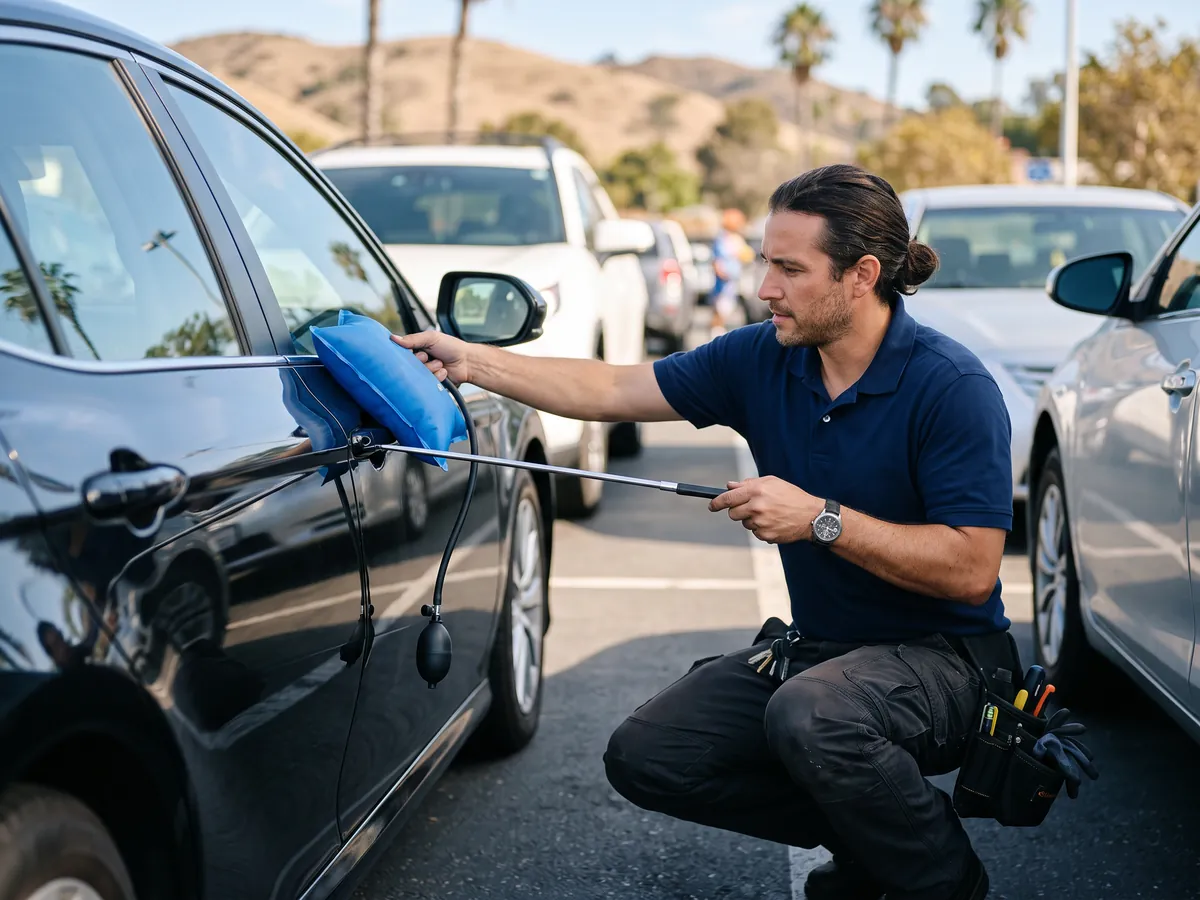
Two different trades touch a trunk lockout, and it helps to know which one you need. A locksmith gets the lid open: picking or bypassing the lock, going in through the cabin, powering a dead release or moving the latch by hand. A mechanic or body shop repairs what failed: a latch motor, a cable, a wiring fault, a bent striker. Sometimes one visit covers both, and often it takes two. Julian's Locksmith serves Devore and will say honestly where our work ends. We open the trunk, replace and rekey trunk lock cylinders, and describe exactly what we found, so your repair shop doesn't start from scratch. Call (951) 903-3193.
Trunk Lockout in Devore: what to expect
A trunk lid stays shut because a latch on the lid grips a metal striker on the body. Three separate paths can release that latch: a key cylinder on the lid, when the car has one; an electric actuator driven by the fob, a dash button or a handle sensor; and an emergency pull inside the trunk meant for anyone shut in. A trunk lockout happens when the path you depend on has failed, and the sound it makes tells us which. A click with no movement points to a jammed latch or a lid under load. A faint whir or a slow groan points to a tired motor or a weak battery. Silence points to power: a dead 12-volt battery, a blown fuse, a cancel setting or a broken wire. A key that goes in but won't turn points to a corroded cylinder. A lid that rises an inch and stops usually means the latch released but something is binding, such as a bent striker or cargo jammed against the edge. Describe the symptom plainly on the phone, and we can arrive with tools that fit it.
How we can help in Devore
- Picking or bypassing a trunk lock. Not every trunk lock picks quickly. Worn wafers, damaged lids and unusual keyways sometimes call for another approach, such as removing the cylinder and driving the latch directly through its tailpiece. We choose the least invasive option and tell you before we start if the cylinder will need replacing afterward.
- Dead-battery trunk releases. A flat 12-volt battery is behind many trunk lockouts, because an electric latch can't move without power. We test the battery, connect a jump pack to the battery or to the hood-side jump posts, and try the release again. When the lid opens, we'll tell you whether the battery needs replacing or just a long drive.
- Cancel, valet and child-lock switches. Many trunks are disabled on purpose. A glove-box cancel switch, a valet mode in the infotainment menu or a trunk lock setting on the fob can all stop the release working. It's often the previous owner's setting, a valet's, or a teenager's. We check each one quickly, and it ends more calls than you'd expect.
- Trunk lock cylinder repair, replacement and rekeying. A worn or damaged trunk cylinder can be rebuilt or replaced, and a new one can be keyed to match your existing key, so one key still handles doors, ignition and trunk. If a part isn't available for your model, we'll say so up front and offer the best alternative.
- Misaligned lids after a rear impact. Hitch balls, shopping carts and parking-lot taps cause plenty of minor misalignment. The lid may still close but latch only halfway, which is a safety concern on the road. If your trunk catches only on its first notch, call before you drive. We can usually seat it properly or tell you it needs a shop.
What's different about Devore
A closed trunk in inland summer heat gets far hotter than the cabin, and that matters for what's inside: groceries, medication, electronics, even a spare fob. Heat also bakes latch grease, shortens 12-volt battery life and makes plastic latch parts brittle, which is why trunk releases often quit in July. If your trunk lockout in Devore involves anything perishable, say so on the call, and wait in shade while we travel to you.
Horse people carry saddles, tack, feed and show gear in trunks and hatches, often at dawn in dusty lots. Fine dust and hay chaff clog latches and lock cylinders, and a stuck lid at a show or trailhead turns into a long wait. Tell us whether horses are waiting nearby, because their shade and water come first. We can work around the rig in a cleared spot.
Trailheads, scenic overlooks and canyon roads near Devore are far from help, and a trunk that holds your jack, spare, water and first-aid kit is the wrong thing to have jammed. Cell coverage can be thin, so call from wherever you have signal and describe the turnout or trail sign. On red-flag days or in strong wind, wait on pavement, not in dry brush.
Common situations
- An older sedan has a keyhole on the trunk lid, and the owner's key snapped off halfway inside while forcing a stiff lock. The lid is still shut. We'd extract the broken piece with fine tools, cut a new key by decoding the lock, then open the trunk and test the key in the doors and ignition, since a worn key often means worn locks elsewhere.
- Say a caregiver stored a cooler of prescription medication in the trunk before a clinic visit near Cajon Pass, and the lid won't release. Time matters more than price here. We'd ask what's inside, reach the cooler through the cabin if the seats fold, and be straight about our arrival time. If it becomes a medical emergency rather than a delay, we'd tell the caller to dial 911.
- A traveler heads for a flight from an off-airport lot near Sycamore Grove, and the trunk holding the carry-on and passport won't open because the fob battery has died. We'd be honest about our arrival time, since a promise we can't keep helps no one. Using the emergency blade in the fob, we'd open a door, fold the seat and reach the bag.
- Consider a contractor's pickup whose tailgate lock has corroded and refuses to turn, with a bag of tools in the bed. The key goes in and stops. We'd use a dry lubricant and a gentle pick rather than force it, free the linkage, and replace the cylinder keyed to the truck's existing key if it's beyond saving. The contractor gets back to the job site near Devore Road.
From your call to the finished job
- Tell us what the trunk does when you try it. If a person or an animal could be in the trunk, hang up and call 911. Otherwise, give us your location in Devore, a callback number and a safe place to wait. We'll ask whether you've tried the cancel switch and the spare fob, which sometimes solves it over the phone.
- Get a quote and an honest ETA. Hours matter: we answer every day from 6:30 a.m. to 11:30 p.m. If you call outside them, we'll say so and suggest alternatives such as roadside assistance, rather than leave you waiting on a callback that can't happen.
- Check the easy causes at the car. Next comes power. We look at the dome lights, test the 12-volt battery and, if it's weak, connect a jump pack. A latch that seemed dead often wakes right up. We also check the fuse for the release circuit and ask when the battery was last replaced.
- Open the trunk by the gentlest route. Hatch and liftgate cars follow the same pattern in a different order. We check the power-gate switch and child lock, use the manual release if there is one, and support the gate on its struts before anyone reaches in. Safety comes first, since a heavy gate can drop fast.
- Retrieve your cargo and verify ownership. For company and fleet cars, a manager's confirmation by phone or text plus the driver's ID covers it. We record who approved the work and when. If it's a vehicle we can't confirm, we say so politely and leave it closed, because protecting the owner's property is the point.
- Test, repair what we can and advise on the rest. Before we leave, we open and close the lid several times, check that it latches fully and make sure the release works from the fob, the dash and the key. If we replaced a cylinder or cut a key, we test them in the trunk and the doors.
How we quote the job
- Parts, cylinders and key work. If you've lost the trunk key, a replacement means decoding the lock, cutting a blade and testing it. A trunk-only blade usually needs no transponder programming, though an ignition key does. We explain what applies to your car before we start.
- Distance, location and site access. Our base is in San Bernardino's University Heights, so the drive to Devore is part of the quote. A car in a covered garage, behind a gate or at the end of a long drive adds time. Tell us the address, any gate code and where to park the van.
- Repairs and follow-up beyond the opening. If your insurance covers rear-end damage, the trunk repair may be part of the claim. We can add a short description of what we found to the work order, which helps your adjuster and your body shop agree on what failed. The opening and any extras are quoted as usual.
Every job gets a clear quote before any work starts. Call (951) 903-3193 with the details and we'll tell you what to expect for your situation in Devore.
What to do before we arrive
- Find out where your spare tire and jack actually live. Some cars keep them under the cargo floor, some under the vehicle, some not at all. If yours ride in the trunk, a flat tire plus a trunk lockout becomes a roadside problem, so keep the release working and save a roadside number.
- Exercise the trunk lock twice a year if your trunk has a keyhole. Turn the key both ways, then add a dry lubricant made for locks. Heavy grease and oily sprays attract dust and gum up the wafers, which is how a lock that worked last year seizes this year.
- If your fob works the doors but not the trunk, compare it with a spare. A worn trunk button on one fob is cheap to fix with a replacement shell or button pad. If both fobs fail the same way, the problem is probably in the car. Knowing which saves a diagnosis and a trip.
- Test your 12-volt battery before summer and before any trip that leaves the car parked for weeks. Inland heat shortens battery life, and a weak battery causes odd symptoms, trunk releases that quit among them. Most parts stores check batteries on request, and a test costs far less than a tow.
Mistakes to avoid
- Spraying heavy grease or an oily lubricant into the trunk lock. It attracts grit and gums up the pins and wafers, so a stiff lock becomes a stuck one. A dry lubricant made for locks keeps the cylinder turning without collecting dust.
- Prying the lid at the seam with a screwdriver or tire iron. It dents the lid skin, tears the weatherstrip and often fails to reach the latch anyway. A bent seam then leaks water into the trunk well and starts rust along the drip rail, long after the cargo is out.
- Driving with a trunk that only latches on its first notch. Cargo can slide out, and a half-latched lid can pop open without warning on the freeway. Rope and bungee cords are a stopgap at most. Get the latch looked at before the lid decides for you.
Getting to Devore
Devore is about 8 miles from our San Bernardino base, roughly 14 minutes in light traffic via Kendall Drive or Palm Avenue to I-215 North, through the Devore junction onto I-15 North, exit Kenwood Avenue for Devore Heights. When you call, you get an arrival estimate based on where the technician is and the traffic at that moment.
Stuck on the shoulder or in a parking lot along I-15? Get somewhere safe, turn on your hazards, and give us the nearest exit or business so we can find the car without guessing.
About Devore: Cajon Boulevard through Devore is an original stretch of U.S. Route 66, which crossed the Cajon Pass from 1926 until 1979, when Interstate 15 replaced it.
| Neighborhoods | Kimbark Canyons, Glen Helen, Kimbark Avenue area, Kenwood Avenue corridor, Lytle Creek, Cable Canyon |
|---|---|
| ZIP codes | 92407 |
| Main routes | I-15, I-215, Cajon Boulevard, Kenwood Avenue |
| From our San Bernardino base | about 8 miles via Kendall Drive or Palm Avenue to I-215 North, through the Devore junction onto I-15 North, exit Kenwood Avenue for Devore Heights; Devore Road exit for Glen Helen and lower Cajon Boulevard |
Friday is a full day for us. We begin at 6:30 a.m. and close at 11:30 p.m., the same as every other day, Saturday included. If a lock fails after 11:30 p.m., call us when we reopen at 6:30 a.m., and in the meantime fall back on a neighbor's spare key, a night with family, or a door you can secure from inside.
Car keys are made only for the registered owner or someone the owner has authorized. Have your driver's license plus the registration or title ready, and we match the name and VIN before cutting or programming anything. If the paperwork is inside the locked car, we open it first and check before going further.
Locked out of your car in Devore?
Call (951) 903-3193 with the year, make and model and where the car is parked. You'll get an arrival estimate and a quote before anyone heads out. If a child or pet is shut inside a hot car or building, call 911 first.
Frequently asked questions
Can you open my trunk without damaging it?
In nearly every case, yes. We pick or bypass the lock, go in through the cabin or power the latch directly, and none of those methods involves prying. Damage usually comes from screwdrivers, tire irons and force. If your lid is already bent from an impact, we work carefully to avoid making it worse, and we note its condition for your body shop.
What hours can I call about a trunk lockout?
We answer every day from 6:30 a.m. to 11:30 p.m. We're closed overnight, and we aren't a 24/7 service. Outside those hours, a spare fob, your roadside plan or your automaker's app may help. If someone or something alive is inside the trunk, call 911 immediately.
What is a trunk cancel or valet switch, and could mine be on?
It's a switch or menu setting that disables the trunk release, so valets and borrowers can't open it. Many sedans put a key-operated or push switch in the glove box, while others use a menu setting or a long press on the fob. A previous owner, a valet or a teenager may have turned it on. Check your owner's manual or call us, and we'll look.
I bought a used car and have no trunk key. What now?
Bring your bill of sale or registration and a photo ID. We confirm ownership, check the cancel switch, fuse and fob, then decode the trunk lock and cut a key if the car has one. Many modern cars have no trunk keyhole at all, in which case the answer is the fob or the dash release, and we can help find out why it isn't working.
Does a valet key open the trunk?
On many cars it doesn't. A valet key often opens the driver's door and starts the engine, but it's cut or coded so it can't open the trunk or the glove box. If a valet key is the only key you were given, that may be why the trunk stays shut. We can make a full-function key after confirming the car is yours.
What ID do I need if the car isn't in my name?
Bring photo ID and whatever links you to the car: a bill of sale, a rental agreement, an insurance card or a call from the registered owner. For a company car, a manager's confirmation by phone or text works. We check this before opening any trunk, and the license we hold, LCO7891, expects it. If something doesn't match, we pause until it does.
How far is Devore from your base?
Devore is about 8 miles from our San Bernardino base, roughly 14 minutes in light traffic. Arrival time depends on traffic and on the job the technician is finishing, so we give you an estimate on the phone before you commit.
Related services in Devore
Trunk Lockout in nearby cities
- Trunk Lockout in Glen HelenSan Bernardino County
- Trunk Lockout in MuscoySan Bernardino County
- Trunk Lockout in North FontanaSan Bernardino County
- Trunk Lockout in RialtoSan Bernardino County
- Trunk Lockout in FontanaSan Bernardino County
- Trunk Lockout in EtiwandaSan Bernardino County
- Trunk Lockout in San BernardinoSan Bernardino County
- Trunk Lockout in BloomingtonSan Bernardino County