
Cypress, Orange County
A House Locksmith in Cypress Who Looks at the Whole Building
Short answer: A house locksmith in Cypress works on the building's entry points: front and back doors, the door from the garage, sliding patio doors, side gates and window latches. Julian's Locksmith rekeys, repairs, reinforces and replaces that hardware on-site, matched to your house's age and existing door prep. Call (951) 903-3193 for a quote before any work starts.
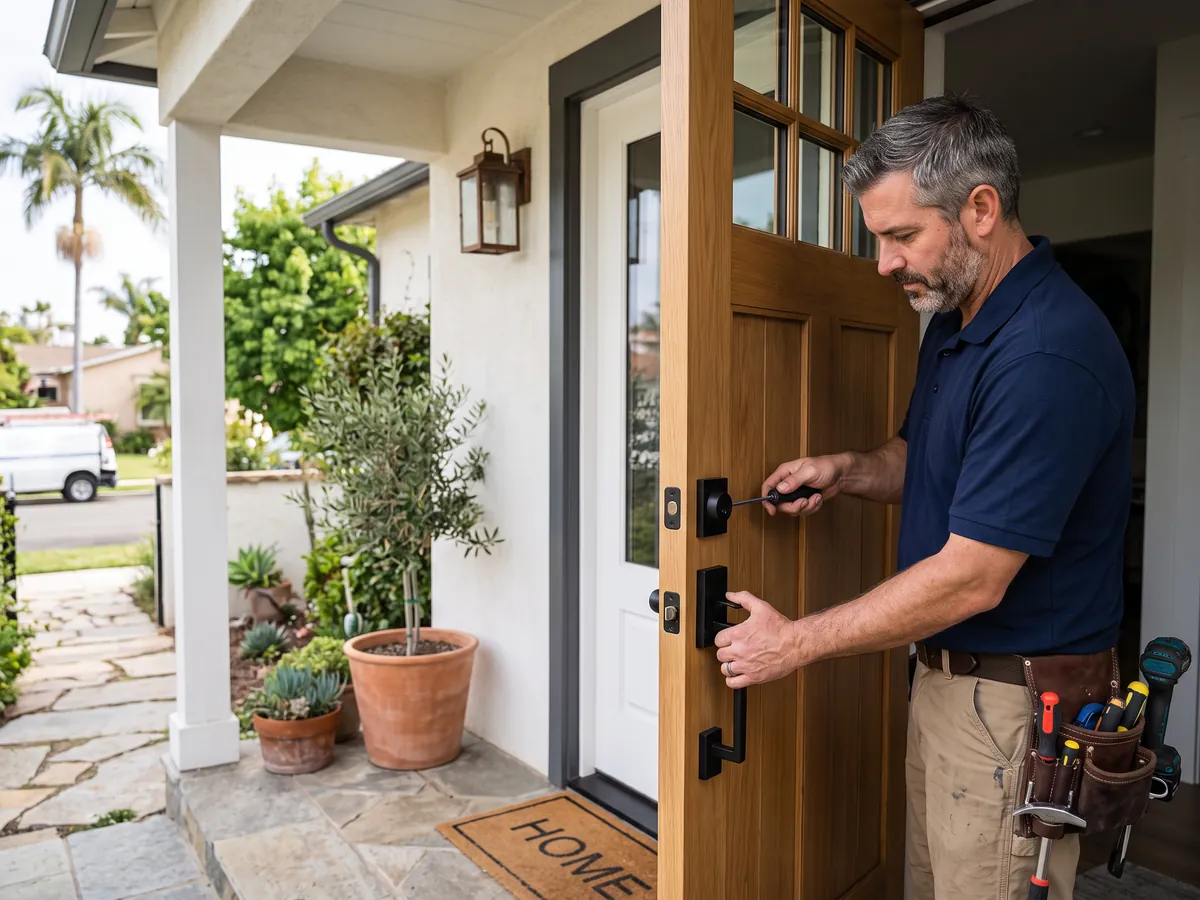
A deadbolt is only as strong as the wood it locks into. On many houses the strike plate is held by two short screws that bite only into the soft door jamb, so a firm kick splits the frame before the lock gets a chance to resist. Fixing that is some of the most valuable house locksmith work there is, and it rarely costs much: longer screws reaching the framing, a reinforced strike, sometimes a full-length jamb plate. In Cypress, Julian's Locksmith does this on-site, often during the same visit as a rekey or new deadbolt. Ask for it whenever we are already at the door for something else.
How this works in Cypress
Doors get the attention, but sliders, windows and gates are part of a house's perimeter too. Many sliding glass doors rely on a single hook latch that wears until it barely catches, and older panels can sometimes be lifted right off their track. A new latch, anti-lift blocking or screws in the upper track, and a secondary foot lock or locking bar close that gap. Ground-floor windows need working sash or slider locks, and ventilation stops let you leave a window cracked without leaving it open. Side gates often have latches anyone can reach over the top. Keyed gate locks, latch shields or a padlock on the yard side fix that, though a pool gate must keep its self-closing, self-latching function. Then there's the door from the garage: California's residential code generally calls for it to be a solid or fire-rated door that closes on its own, so any lock we fit there works with its closer or spring hinges. A house locksmith in Cypress treats each of these as part of one plan.
What we can do on-site
- Back and side doors. Back doors often end up with whatever hardware was cheapest when the last lock failed. We bring them up to the standard of the front: a Grade 1 or 2 deadbolt, a reinforced strike, and a knob or lever that latches cleanly. Keying it to the front door saves a key on everyone's ring.
- Strike, frame and hinge reinforcement. Most kick-ins split the jamb at the strike rather than breaking the lock. We replace short strike screws with three-inch screws that reach the framing, install heavy-duty strike boxes, and add reinforcement plates where a frame needs it. The door looks the same from outside.
- Whole-house rekey and keying alike. A house often ends up with locks from three or four decades and three or four brands. We sort out which cylinders can be rekeyed, which should be replaced, and which can be converted to a common keyway, then deliver a single key that opens every exterior door.
- Older-house hardware and mortise locks. Vintage doors are often thinner than modern ones and may have unusual backsets. We measure before recommending anything, because forcing a standard deadbolt into a narrow or previously mortised door can weaken the very spot that needs to hold. When a door is too thin for a bored deadbolt, a surface-mounted rim lock or a narrow mortise deadbolt is often the sounder choice.
- Side gates, sheds and detached structures. Heat, sprinklers and dust are hard on outdoor hardware. We choose gate and shed locks with weather-resistant finishes, adjust sagging gates so latches line up again, and recommend stainless or brass padlocks over cheap steel ones that rust shut by summer. A little lock lubricant before summer keeps them turning freely.
How Cypress shapes the job
When a house sits empty all day while everyone commutes, the doors facing the backyard and side yard do most of the security work. We focus on those first: solid deadbolts, long-screw strikes, slider bars and locked side gates. An early start at 6:30 a.m. every day also means a deadbolt that won't throw at departure time can be looked at before you lose the day.
In areas dominated by apartments, single-family houses are often rentals themselves, owned by landlords juggling several properties. California Civil Code §1941.3 requires working deadbolts on main swinging entry doors and security devices on openable windows. A house locksmith can bring a rental house up to that standard, rekey between tenants, and key the owner's storage room separately so tenants never hold that key.
Single-family houses rented to students tend to get rough treatment: doors slammed, strikes pulled loose, sliders left unlatched and locks changed haphazardly between leases. For owners, we reinforce frames, install durable Grade 1 or 2 hardware, rekey between tenancies and bring windows up to the security standard California Civil Code §1941.3 sets for rental housing. Durable levers stand up to heavy use far better than cheap knobs, and reinforced strikes survive slammed doors.
Situations this covers
- Take a hillside house in Cypress where the stucco has settled over the years. The front deadbolt now hits the edge of the strike and only throws with the door pulled hard. We enlarge and reposition the strike opening, deepen the bolt pocket, and tighten the top hinge with a long screw. The bolt slides home without help again.
- A recently built house has a fiberglass patio door with a multipoint lock, and the handle no longer lifts to engage the hooks. We remove the hardware, identify the gearbox model and confirm it has failed. Some multipoint systems need a factory part, so we order it, secure the door temporarily, and come back to install it. The temporary fix holds the door closed and locked with the deadbolt until the part arrives.
- Here's a common one: a family returns from a weekend away to find the slider closed but no longer latching. The hook latch had worn so badly it barely engaged. We replace the latch and handle set, adjust the rollers so the panel sits right, add anti-lift screws in the upper track, and install a foot lock for nights. The whole job happens in one visit, and the old latch goes home with them as proof of how worn it was.
- Suppose a house's garage side door is a lightweight slab with a cheap knob and no deadbolt, facing an alley. The door into the house is often left unlocked. We add a deadbolt and reinforced strike to the side door, put a deadbolt on the garage-entry door, and make sure its spring hinges still pull it shut and latched. Both doors now open with the same key the family already carries for the front.
Step by step with Julian's Locksmith
- Describe the house and the problem. We'll ask whether anyone is locked out, whether there's been a break-in, and whether you want a whole-house check or just one door looked at. Then you'll get an honest ETA and an idea of what drives the cost before anyone heads your way.
- Arrival and ownership check. Once we've confirmed the details, we park close to the door we're working on so tools and parts are on hand. Most jobs happen at the door itself, with key cutting and parts from the van just a few steps away.
- Walk the perimeter. If you only called about one door, we'll still mention anything obvious we notice along the way. You decide whether it's worth addressing now, later or not at all. It's your house; our job is to give you an accurate picture of it.
- A prioritized quote. When a repair and a replacement would cost about the same, we tell you, along with which one should last longer on your particular door. Sometimes keeping the old hardware is the better value; sometimes it isn't. Either way, the decision stays with you.
- Do the work, door by door. If a part has to be ordered, such as a multipoint gearbox or a high-security cylinder, we secure the door in the meantime and schedule a return visit. You'll know before we leave exactly what's pending and roughly when it will arrive.
- Final check from both sides. The last check is the one homeowners notice most: every door closing and locking with ordinary effort. If a door still needs a push, a lift or a slam to lock, we keep adjusting until it doesn't. Only then do we pack up the van.
What affects the cost
- How many entry points are involved. Fixing one door is cheaper today, but doing several in one visit lowers the cost per item because there's only one trip involved. If the back door and the garage-entry door share the front door's weaknesses, handling all three together usually makes the most sense.
- Frame and strike condition. Stucco, brick and older lath-and-plaster walls affect how easily we can reach framing behind the jamb. Most of the time it's straightforward, but occasionally a frame needs shimming or blocking. We'll point out any such condition when we quote. None of it changes the price without your approval.
- Hardware grade and type. Hardware ranges from basic builder-grade sets to ANSI Grade 1 deadbolts and high-security cylinders such as Medeco or Mul-T-Lock. Higher grades cost more but resist forced entry, picking and wear better. We'll recommend a grade for each door based on its exposure rather than one choice for the whole house.
Every job gets a clear quote before any work starts. Call (951) 903-3193 with the details and we'll tell you what to expect for your situation in Cypress.
Advice before you book
- Test each deadbolt's throw with the door open: turn it fully and note how far the bolt extends. Then close the door and try again. If the thumbturn stops short, the bolt isn't fully seating, so the strike pocket needs deepening or the strike needs to move.
- Aim lawn sprinklers away from doors and gates. Repeated wetting swells wooden doors and frames, corrodes lock finishes and rusts latches, which leaves you with doors that won't latch in some seasons. A small sprinkler-head adjustment can extend hardware life by years.
- When painting exterior doors or trim, remove the strike plates and mask the deadbolt and latch, or take them off entirely. Paint in a strike pocket or on a latch bolt is a classic cause of a deadbolt that suddenly won't throw after a weekend project.
- Pull one screw from your front door's strike plate and measure it. If it's under an inch long, it reaches only the jamb. Replacing both strike screws with three-inch screws that bite into the framing is one of the cheapest, most effective upgrades a house can get.
Mistakes to avoid
- Leaving a hollow-core door between the garage and the house. It offers little resistance to forced entry and falls short of what California's residential code generally expects for fire separation. A solid or fire-rated door that closes on its own, with a real deadbolt, fixes both problems.
- Buying a lockset based on looks, then discovering its backset or bore doesn't match the door. The result is new holes overlapping old ones and hardware that sits crooked. Measure the backset, bore and door thickness first, or ask a house locksmith to bring matching options.
- Painting over window locks, strikes and hinge pins during a remodel. Painted sash locks stop latching, painted strikes bind deadbolts, and painted hinges make doors sag over time. Masking or removing hardware takes a few extra minutes and saves a repair call later.
Reaching Cypress
Cypress is about 63 miles from our San Bernardino base, roughly 68 minutes in light traffic via I-215 South through Colton and Grand Terrace to SR-91 West through Riverside, Corona and the Santa Ana Canyon. When you call, you get an arrival estimate based on where the technician is and the traffic at that moment.
Commercial jobs on busy stretches like Ball Road sometimes need a parking plan, especially for storefront doors or roll-up gates. Let us know about loading zones, red curbs or parking structures before we arrive.
About Cypress: The Cypress Community Festival, begun in 1981 as a city birthday celebration, fills Oak Knoll Park beside the Cypress Community Center each July.
| Neighborhoods | Arnold Cypress Park area off Watson Street, Veterans Park area, College Park beside Cypress College, Larwin Park area off Ball Road, Oak Knoll Park neighborhood, Civic Center area on Orange Avenue |
|---|---|
| ZIP codes | 90630, 90720 |
| Main routes | I-605, SR-91, SR-22, Katella Avenue |
| From our San Bernardino base | about 63 miles via I-215 South through Colton and Grand Terrace to SR-91 West through Riverside, Corona and the Santa Ana Canyon, then the Valley View Street exit and south into Cypress; alternate via SR-57 South to SR-22 West and the Valley View Street exit when the 91 is jammed |
Home lock work in Cypress?
Call (951) 903-3193 with the address and a quick description of the doors and locks involved. We'll quote the job before any work starts.
Frequently asked questions
Can you reinforce my door frame without replacing the door?
Yes, in most cases. We replace short strike and hinge screws with three-inch screws into the framing, install heavy-duty strike boxes, and add reinforcement plates along the latch side when needed. The door and frame stay in place and look the same from outside. If the jamb is already split or rotted, a carpenter may need to repair it first.
Do you install window locks?
Yes. We replace broken sash locks, install sliding-window locks and pin locks, and add ventilation stops so windows can stay partly open. For bedroom windows we choose locks that release quickly from inside, since those windows may be fire escape routes. Rental owners should know that California Civil Code §1941.3 requires security devices on openable windows in rental units.
Do you repair sliding glass door locks?
We do. We replace worn mortise latches and handle sets, adjust rollers so latches engage, add keyed or foot-operated secondary locks, and install anti-lift blocking so the panel can't be raised off its track. If the frame itself is badly bent or the glass is damaged, a glass and door company may be needed first, and we'll tell you so. Most slider fixes are completed in the same visit.
What kind of lock should the door from my garage have?
Treat it as an exterior door. It should have a deadbolt as well as a latch, a reinforced strike, and hardware that works with its self-closing hinges or closer. California's residential code generally expects that door to be solid or fire-rated and self-closing, so check with your local building department before replacing the door itself. We can rekey that door to your house key in the same visit.
Can all the exterior doors on my house use one key?
In most houses, yes. If the locks share a keyway, we rekey them to match. If they're mixed brands, we replace a cylinder or two so everything shares one keyway. Detached structures can share that key too, or have their own if you'd rather keep a workshop or pool room separate. We test the single key in every door, both locking and unlocking, before we finish.
What grade of deadbolt should my house have?
For exterior doors, ANSI Grade 1 or a solid Grade 2 deadbolt is a sensible target. Grade 3 builder hardware works but wears faster and resists less force. Just as important is a strike fastened with three-inch screws. A Grade 1 bolt sitting in a weak strike with short screws doesn't deliver its rated strength. We can recommend specific models for each door during a visit.
How far is Cypress from your base?
Cypress is about 63 miles from our San Bernardino base, roughly 68 minutes in light traffic. Arrival time depends on traffic and on the job the technician is finishing, so we give you an estimate on the phone before you commit.
Related services in Cypress
House Locksmith in nearby cities
- House Locksmith in Los AlamitosOrange County
- House Locksmith in Hawaiian GardensLos Angeles County
- House Locksmith in La PalmaOrange County
- House Locksmith in StantonOrange County
- House Locksmith in Buena ParkOrange County
- House Locksmith in CerritosLos Angeles County
- House Locksmith in ArtesiaLos Angeles County
- House Locksmith in Seal BeachOrange County