
Brea, Orange County
Locked Out, Broken Into or Stranded in Brea? Emergency Locksmith Help
Short answer: An emergency locksmith in Brea handles the lock and key problems that can't wait: lockouts from a house, car or business, keys snapped inside a cylinder, doors that won't lock after a break-in, and lost keys that call for a same-visit rekey. Julian's Locksmith drives to you, checks ID and ownership, and quotes the job before starting. Call (951) 903-3193.
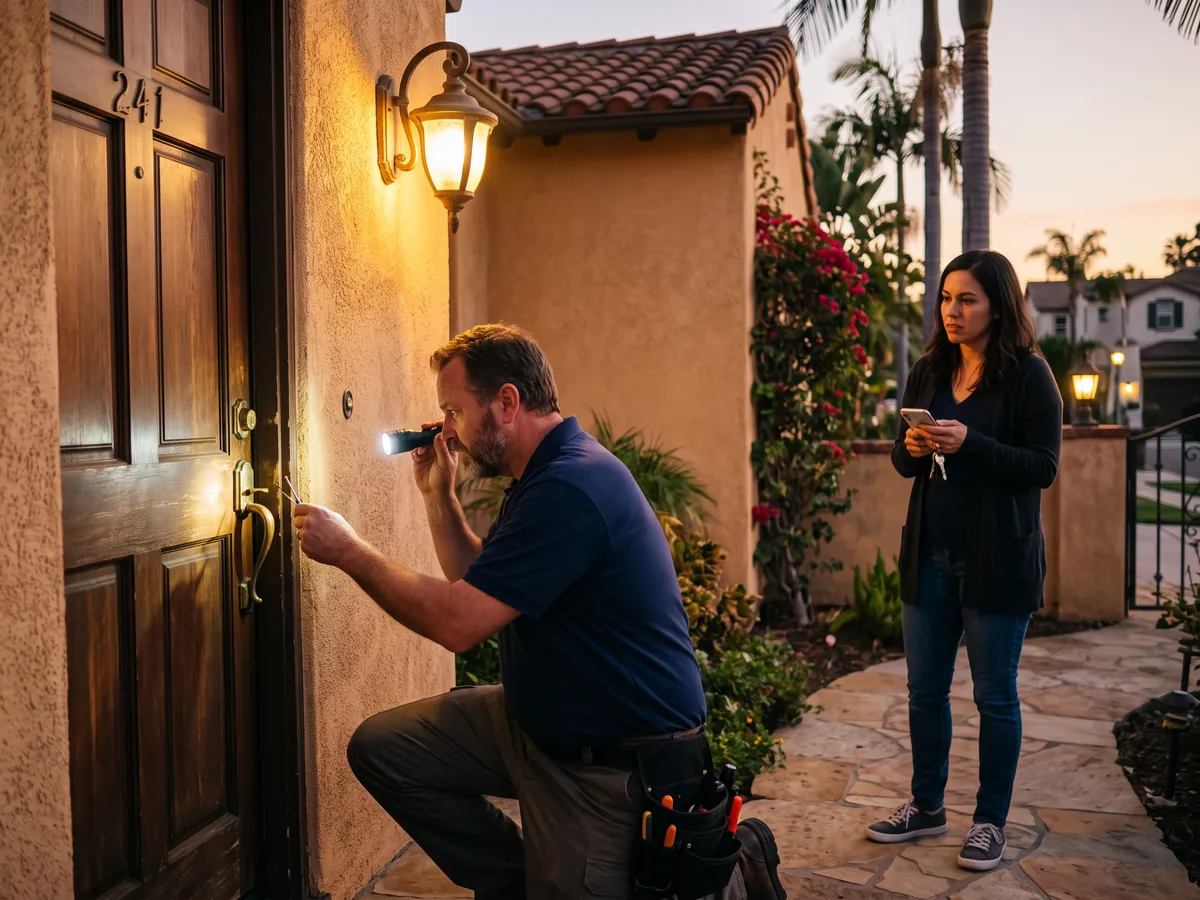
When a business can't open, can't lock, or has just been broken into, every hour costs something: payroll standing around, deliveries turned away, a storefront sitting exposed overnight. Julian's Locksmith works as an emergency locksmith for Brea shops, offices, restaurants and warehouses, and we know commercial hardware well: aluminum storefront deadlatches, mortise cylinders, panic bars, door closers and the padlocks on roll-up doors. Our day starts at 6:30 a.m., early enough to open a door before most first shifts. Owners and authorized managers can call (951) 903-3193, describe the door, and get a quote before the van leaves.
Emergencies in Brea come in a few shapes: someone is locked out of a house, a car or a shop; a key has snapped or gone missing; or a door has been forced and no longer secures anything. The last kind is the most urgent. A pried side door on an early-1900s home near City Hall Park, or a glass door on Birch Street with its cylinder wrenched out, can't wait for a convenient appointment, so closing up the opening comes before any talk of upgrades. When you call (951) 903-3193, expect a few quick questions: where you are, what lock or vehicle is involved and whether anyone is in danger. A child or pet shut inside a parked car is a 911 call first, because fire crews can reach a window faster than we can drive in from San Bernardino. Brea is about 51 miles from our base, so you get a straight arrival estimate based on how the 210 and the 57 are moving that day. Our hours shape emergencies, too. We work every day, Sunday through Saturday, from 6:30 a.m. to 11:30 p.m. If something breaks after our 11:30 p.m. close, a barrel bolt or a door wedge can serve as a temporary fix, and we can plan the permanent repair for the next morning, from 6:30 a.m.
How this works in Brea
The moment the door opens is the middle of an emergency call, not the end. Whatever caused the problem usually needs attention while we're standing there. A key that snapped was probably worn thin, so we cut a new one by code or from the pieces. A deadbolt that wouldn't throw likely has a misaligned strike that will fail again next week. Keys lost along with your address mean the cylinders get rekeyed. A forced door needs a reinforced strike and 3-inch screws reaching the framing, because a factory strike held by short screws is the weak point. That's why an emergency locksmith van from Julian's carries pins, followers and key blanks, common Kwikset and Schlage deadbolts and knobsets, heavy-gauge strikes, mortise cylinders and cams, padlocks and transponder blanks. In Brea, most urgent calls end in a single visit with the door locking properly and the cause dealt with. When something needs a part we don't stock, or a different trade, we secure what we can and lay out the next step clearly.
What we can do on-site
- Vehicle lockouts, including trunks. Keys in the trunk add a step. Once the cabin is open, the emergency locksmith uses the interior trunk release, folds a rear seat, or works the trunk cylinder, depending on the model. Some sedans disable the release button while the car is locked, and a few have no pass-through at all; we'll tell you which applies.
- Business and storefront lockouts. Office suites, warehouse man doors and roll-up doors each fail differently. A grade 1 mortise lock may take patient picking; a dock door padlock with a rusted shackle may need cutting and replacing on the spot. We carry common padlocks, cylinders and cams so the building is lockable again before we pull away.
- Securing a door after a break-in. If keys were taken in the burglary, every lock they fit is compromised, including the garage side door, a side gate and the mailbox. Rekeying on the same visit changes the pin stacks so stolen keys stop working. Get the police report number first; insurers usually ask for it, so keep it with our receipt.
- Broken and stuck key extraction. A key snapped off in a deadbolt or knob can usually come out without replacing the lock. Thin extractor hooks slide along the blade, catch a cut and draw the piece forward; if it's wedged, we pull the cylinder and push the fragment out from behind. Then we test the lock and cut a fresh key from the pieces.
- Doors that won't lock or latch. A deadbolt that won't throw at night usually isn't broken; the bolt is hitting the edge of the strike because the door sagged or the frame shifted. We adjust the strike, deepen the bolt pocket, or shim a hinge so the bolt fully extends. A bolt that only throws halfway protects far less than it appears to.
Local factors in Brea
Commuters in Brea tend to hit lock trouble at the very start of the day: a car key that won't turn in the driveway before dawn, a fob locked in the car at a park-and-ride, a front deadbolt that won't throw on the way out. Our 6:30 a.m. start isn't early enough for every shift, so keep a spare car key at home and a plan for the earliest mornings.
Condos and townhomes mix private ownership with shared doors. Your unit's entry lock is yours to rekey or replace, but lobby doors, parking gates and mailbox clusters usually belong to the HOA. During an emergency in Brea, we open your unit after verifying ownership or residency, and tell you which shared locks need the association's involvement before anyone touches them.
Family neighborhoods in Brea produce a familiar set of emergencies: kids who lock a door from the inside, garage entry doors that latch behind a parent carrying groceries, teens who lose house keys, toddlers who end up locked in cars. Know the line. A child in a hot car is a 911 call. A child safe inside the house can be talked to through the door while we pick the lock.
Common situations
Picture a Thursday evening call from a 1950s ranch house near Arovista Park. You get home to find the laundry-room door kicked in and the latch bent out of shape. Police have already taken the report, but the door will not stay shut. A typical visit means squaring up the jamb, fitting a Grade 2 deadbolt and knob set, and driving a long-screw strike plate into the framing so the door holds again. A replacement door can wait for a carpenter. By the time we pack up, the house is closed and you know exactly which keys exist.
- For example, a shipping supervisor arrives at 6:30 a.m. to open a roll-up dock door, and the padlock on the hasp won't release; its shackle has seized with rust and grit. A truck is already backing in. We'd try the key with penetrating lubricant first, then cut the shackle cleanly if needed, and install a new shrouded padlock from van stock so the dock can be locked again at the end of the shift.
- A typical tricky call: an adult child can't reach an elderly parent who lives alone in a Brea condo, and nobody answers the door. They ask for a locksmith. Here we'd tell them to call 911 or the police non-emergency line for a welfare check first. Officers can enter when needed, and a locksmith shouldn't open a home for someone who doesn't live there without the resident's or owner's authorization.
- For example, a commuter pulls into a park-and-ride off Brea Boulevard at dawn, grabs a coffee, and locks the fob in the cupholder of a push-start sedan. The train leaves soon. We'd confirm the year and model on the phone, open the car with an air wedge and reach tool, check the registration against the driver's license, and then test the fob's coin cell, since a weak battery is often why the car locked with the fob still inside.
Step by step with Julian's Locksmith
- Check for danger first. If an intruder might still be inside after a break-in, step away and call the police, not a locksmith. Let officers clear the property and take their report. Once they leave, the emergency locksmith can secure the damaged door, and the report number will help with any insurance claim.
- Call and describe the problem. For vehicles, give us the year, make and model, whether it has push-button start, and where the keys are. For buildings, mention the lock brand if you can see it, and whether the door has a deadbolt, a lever, a storefront hookbolt, or a keypad.
- Hear the quote and an honest ETA. Close to our cutoff, which is 11:30 p.m. each night, we'll tell you honestly whether an emergency locksmith can still reach you that day. If not, we'll suggest what to do meanwhile and when to call back.
- Prepare while you wait. Don't try to force the lock while you wait. Prying, drilling or jamming a screwdriver into the keyway can turn a quick picking job into a lock replacement. If a child or pet is safe inside the house, stay at the door and keep talking to them.
- Verification and damage-free entry. If your documents are locked inside, the emergency locksmith may open the door and then check them before you go in or before leaving. Without proof of ownership or residency, nobody gets let in; that rule protects you as much as anyone.
- Secure it before we leave. Before leaving your Brea property, we test every lock we touched with every key you'll use, confirm deadbolts throw fully into the strike, and make sure you can lock up on your own. You get an itemized receipt for insurance or the landlord.
Pricing factors
- Security level of the lock or vehicle. Builder-grade pin-tumbler locks open faster than high-security cylinders from Medeco, Mul-T-Lock or ASSA Abloy, which are built to resist picking. That resistance is why you bought them, and during a lockout it can mean more time on the door or a cylinder replacement instead of a quick pick.
- Location, distance and access. Access can add time: a gated community where we need the code, a car parked on the fourth level of a structure, an industrial park with a security check-in. Telling the emergency locksmith about access in advance keeps the visit on schedule and the quote accurate.
- Parts and hardware. For car keys, the blank or fob is often the largest single item. A smart fob costs more than a basic transponder key, and many vehicles accept only specific parts matched by FCC ID and part number. We'll show you the options instead of quoting the priciest one by default.
Every job gets a clear quote before any work starts. Call (951) 903-3193 with the details and we'll tell you what to expect for your situation in Brea.
Mistakes to avoid
- Hiring based on a low service-call price quoted by a call center. Those numbers often leave out the actual labor, and the real total appears after the door is open. Ask what the whole job will cost, who is coming, and which licensed company they work for before agreeing.
- Leaving a forced door closed but unlocked overnight because it's late. A door that latches but won't lock invites a return visit from someone who already knows the way in. Even a temporary fix, like a reinforced strike or an added surface lock, beats a chair wedged under the knob.
- Breaking a window to get into your own house or car. Replacement glass often costs more than an emergency locksmith visit, leaves an opening you then have to secure overnight, and carries a real risk of deep cuts. Save glass-breaking for genuine threats to someone's life, and let responders handle it.
What to do before we arrive
- Plan ahead for the stretch when we're closed, which runs from 11:30 p.m. to 6:30 a.m. Know who holds a spare key, whether your auto policy includes roadside assistance, and your landlord's after-hours number. A few minutes of planning now beats an evening sitting on the curb.
- Replace smart lock batteries on a calendar rather than waiting for the warning light to insist. Inland summer heat shortens battery life in exterior keypads. Swapping them when the clocks change each spring and fall is an easy reminder that costs nothing and prevents the most common keypad lockout.
- After a break-in, photograph the door, frame, lock and every bit of damage before anything gets repaired. Your insurer will want images and police may ask too. Once you have them, getting the door locking again the same day matters more than waiting for an adjuster to look.
- Ask for the company name and the full quote on the phone, then check that the technician and paperwork match. A licensed California locksmith company carries a BSIS license number. Ours is LCO7891, and you can look it up at search.dca.ca.gov before we even arrive.
Reaching Brea
Brea is about 51 miles from our San Bernardino base, roughly 55 minutes in light traffic via I-215 South briefly to SR-210 West. When you call, you get an arrival estimate based on where the technician is and the traffic at that moment.
Rush hour on Valencia Avenue can stretch a drive considerably. We'd rather give you a realistic arrival window than an optimistic one, and we'll call you if a closure or a crash changes the plan.
About Brea: Edward L. Doheny brought in Olinda's first well in 1897, and the original Olinda townsite is registered as California Historical Landmark No. 918.
| Neighborhoods | Olinda Village, Greenbriar, Carbon Canyon, Olinda Ranch, Country Hills, La Floresta |
|---|---|
| ZIP codes | 92821, 92823 |
| Main routes | SR-57, SR-90, SR-142, Brea Boulevard |
| From our San Bernardino base | about 51 miles via I-215 South briefly to SR-210 West (Foothill Freeway) through Rialto, Fontana, Rancho Cucamonga and La Verne, then SR-57 South (Orange Freeway) through Pomona and Diamond Bar and over the Puente Hills to the Lambert Road or Imperial Highway (SR-90) exits; alternate via I-15 South and SR-60 West to SR-57 South, or SR-60 West to SR-71 South and Carbon Canyon Road (SR-142) through Chino Hills for Olinda Village and Olinda Ranch |
We start at half past six every morning, seven days a week. Every day the phones stay on until 11:30 at night, so an after-dinner lockout is usually still within reach. Saturday is no exception, with service ending at 11:30 at night. Call early that day if the problem can't wait until Sunday morning.
Before we open a home or business, we ask for photo ID and something tying you to the address: a lease, a utility bill, mail with your name on it, or written authorization from the property manager. It adds a minute or two, and it's the same check you'd want if a stranger tried to get into your place.
Locked out in Brea?
Call (951) 903-3193 with the address and what's locked. You'll get an arrival estimate and a quote before anyone heads out, and when we arrive we'll ask for ID that ties you to the property. If a child or pet is shut inside a hot car or building, call 911 first.
Frequently asked questions
What if my car is stuck on a freeway shoulder or in a parking garage?
On a freeway shoulder, safety comes first: stay well away from traffic and call the CHP or your roadside service, since a tow to a safe spot may be needed before anyone can work on the car. In a parking structure near Brea Civic & Cultural Center or anywhere else, tell us the level and space number and any height limit so the technician can reach you.
Do you open safes in an emergency?
Yes, when you can show the safe is yours. Electronic safes often fail from dead batteries or a bad keypad, and some can be powered externally or opened with an override key. Mechanical safes may need manipulation, or drilling followed by repair. A safe opening can take longer than a door, so the emergency locksmith sets expectations before starting.
Will you have to drill my lock to get me in?
Rarely. Most residential and commercial locks can be picked or bypassed without damage, and cars open with an air wedge and reach tool. Drilling becomes necessary with some high-security cylinders, seized or broken locks, and certain safes. If it comes to that, we explain why, ask first, and fit a new cylinder before leaving so your Brea door still locks.
How quickly can an emergency locksmith get to me?
That depends on where our technician is when you call and on traffic between there and you. We give an honest arrival estimate on the first call rather than a promise we can't keep, and we'll update you if something changes. If the estimate is too long for your situation in Brea, you're free to make other arrangements.
Can you make a car key if I've lost every key?
Usually, yes. With proof of ownership, we decode the lock or obtain the key code, cut a new blade on the van's machine, and program the transponder or smart key through the OBD-II port right where the car is parked. Some makes and newer models require dealer programming, and we'll tell you on the phone if yours is one of them.
Can you fix my door the same night after a break-in?
Usually, as long as you call while we're open and police are finished at the scene. We replace torn-out strike plates with heavy-gauge strikes and long screws, replace bent deadbolts, and rekey if keys were stolen. A split jamb may need a carpenter afterward, and broken glass needs a glass or board-up company, but the door can typically be locked again that night.
How far is Brea from your base?
Brea is about 51 miles from our San Bernardino base, roughly 55 minutes in light traffic. Arrival time depends on traffic and on the job the technician is finishing, so we give you an estimate on the phone before you commit.
Related services in Brea
Emergency Locksmith in nearby cities
- Emergency Locksmith in La HabraOrange County
- Emergency Locksmith in PlacentiaOrange County
- Emergency Locksmith in Rowland HeightsLos Angeles County
- Emergency Locksmith in FullertonOrange County
- Emergency Locksmith in La Habra HeightsLos Angeles County
- Emergency Locksmith in Yorba LindaOrange County
- Emergency Locksmith in AnaheimOrange County
- Emergency Locksmith in City of IndustryLos Angeles County


