
Brea, Orange County
Deadbolt Replacement in Brea, Fitted to Your Door
Short answer: Deadbolt replacement in Brea makes sense when the bolt no longer extends fully, can be pushed back after locking, the housing or thumbturn has cracked, or the lock was damaged in a break-in. Julian's Locksmith brings replacement deadbolts to your door, fits them to the existing bore, keys them to your current key if you like, and quotes before starting. Call (951) 903-3193.
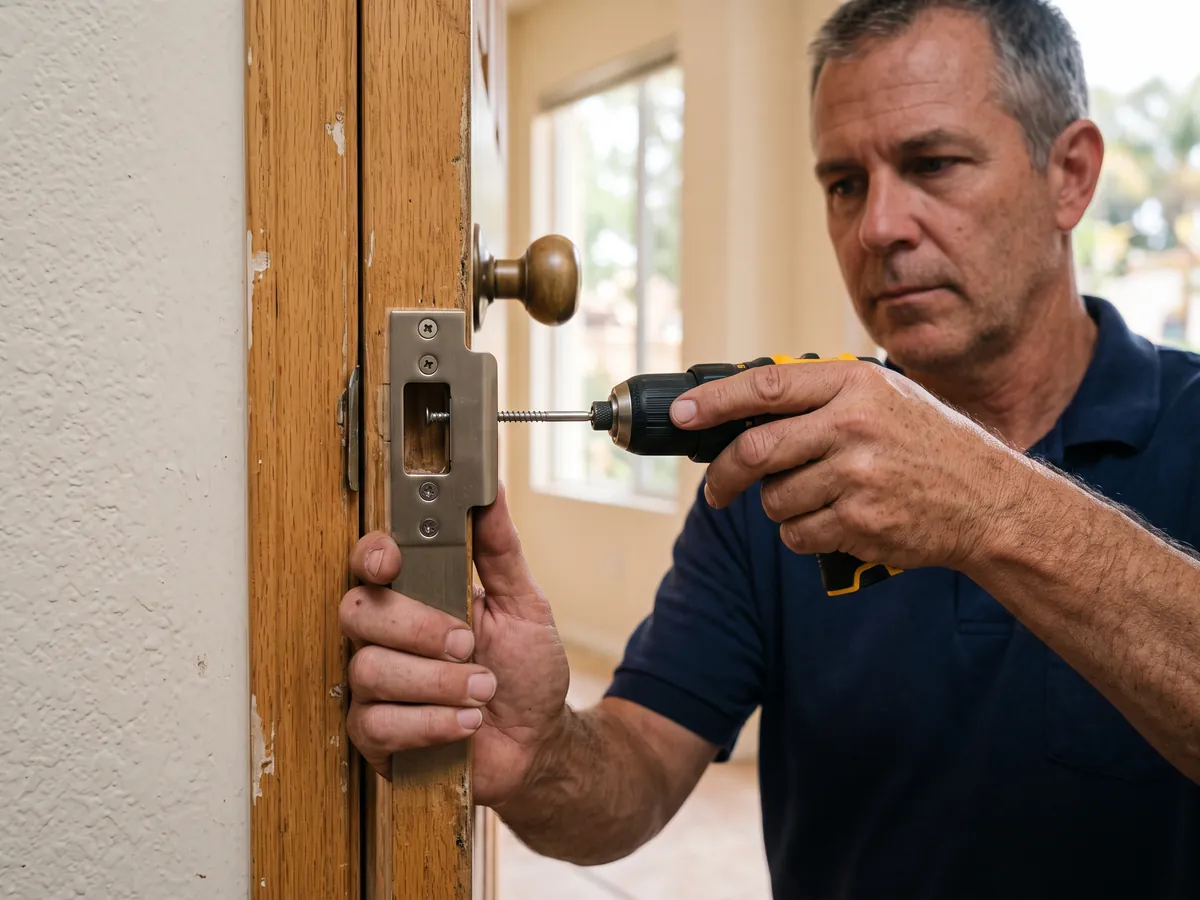
Before you pay for a new deadbolt, it's worth knowing whether you actually need one. A bolt that only locks when you push the door usually points to a sagging door or a shifted strike, not a broken lock. A key that won't turn may be a worn copy rather than a worn cylinder. Lost keys call for rekeying, which costs less. Julian's Locksmith diagnoses the deadbolt on site in Brea and recommends deadbolt replacement only when the lock itself has failed, is too weak for the door, or doesn't do what you need. If a cheaper fix will last, we'll say so. Call (951) 903-3193 and describe what's happening.
How this works in Brea
Most residential deadbolts sold today expect the same door preparation: a 2-1/8-inch hole through the face of the door, a 1-inch hole into the edge, and a backset (the distance from the door edge to the center of the big hole) of either 2-3/8 or 2-3/4 inches. Most replacement bolts adjust between the two backsets, so a modern-to-modern swap usually needs no drilling. The trouble comes with older or unusual hardware. Some deadbolts use a round drive-in bolt with no faceplate, so switching to a faceplate bolt means chiseling a shallow mortise in the door edge. Older locks sometimes sat in a smaller face bore that has to be enlarged with a jig. Surface-mounted rim deadlocks leave screw holes and a cylinder hole that need covering. Thick custom doors, often 2-1/4 inches, need a thick-door kit with longer tailpieces and screws. Handlesets and interconnected apartment locks tie the deadbolt to the handle, which narrows the choices. We measure all of this before quoting a deadbolt replacement in Brea, so the price reflects the door you actually have.
What we can do on-site
- Like-for-like deadbolt replacement. When your deadbolt has failed but the door prep is standard, we remove the old lock and install a new one in the same holes. Before mounting, we check the bores for split wood or old shims, confirm the backset, and set the bolt so it extends freely. Most Brea swaps of this kind need no new drilling at all.
- Upgrading to a stronger deadbolt. Upgrading doesn't always mean switching brands. Schlage, Kwikset and Yale each make deadbolts at several strength levels, so you can often step up within the same keyway and keep your existing house key. We look at the package grade, the bolt construction and the strike included in the box, then improve whatever falls short.
- Keying the replacement to your keys. A new deadbolt doesn't have to mean a new key. If the replacement uses the same keyway as your other locks, we rekey its cylinder on site so your existing house key works it. That keeps one key for the front door, the garage entry and the back door instead of adding another to the ring.
- Smart and keypad deadbolt replacements. Replacing a keyed deadbolt with a smart or keypad model, such as a Schlage Encode, Yale Assure or Kwikset Halo, uses the same standard bore in most cases. What matters is making the bolt run freely first, because a motor fighting a misaligned strike drains batteries and jams. We fix the alignment, then install and enroll codes.
- Finish and style replacement. Changing style is also a chance to fix function. When a homeowner replaces a dated brass deadbolt purely for looks, we still check the throw, the strike and the screws behind it, because a handsome new deadbolt bolted into the old weak strike is mostly cosmetic. Appearance and strength get handled in one visit.
Local factors in Brea
Deadbolts in Brea's older homes were often added decades after the house was built, by whoever owned it that year. We see surface rim locks, drive-in bolts with no faceplate and bores drilled slightly off-center. Replacement here means reading the door first: plugging old holes, mortising a faceplate, and fitting a strike into a frame that may have shrunk or rotted. The result looks original but works like new.
Newer tract homes in Brea usually come with builder-grade Grade 3 deadbolts and thin strikes held by short screws. They feel fine on day one and noticeably loose by year five. Replacement is easy here because the bores are standard and the doors hang straight. It's also the moment to key every exterior door alike and add a long-screw strike, two small changes builders rarely make.
Family houses in Brea run on deadbolts that get used dozens of times a day. Kids lean on them, groceries bang into them and teenagers force keys. A replacement for a family home should prioritize durability and ease of use: a smooth, graded cylinder, a thumbturn small hands can turn, and a strike that doesn't require lifting the door. We'll also match the key to your garage entry.
Situations this covers
- Two days before closing on a house off Associated Road, the home inspection report notes that the back-door deadbolt extends only about half an inch and its strike is loose. The seller's agent needs it fixed quickly. After confirming who has authority over the property, we replace the deadbolt, fit a proper strike, and key it alike to the front door so the buyer receives fewer keys to track.
- A homeowner near Brea Mall says her front deadbolt has started catching halfway through the turn, and she assumes it needs replacing. We try the key she uses every day, then a fresh copy cut from her original. The daily key turns out to be a third-generation copy with rounded cuts, and the lock itself is fine. A new key costs far less than a new deadbolt, so that's the honest recommendation.
- A homeowner tries to rekey a Kwikset SmartKey deadbolt using the small tool from a hardware-store kit. The tool tip snaps off inside the side slot, and now the cylinder won't learn a new key at all. Because the broken tip can't be reached without disassembly, we replace the deadbolt, pin the new cylinder to the key the family already carries, and take away the old lock.
- A keypad deadbolt on a west-facing door in Brea begins rejecting codes every July afternoon, then works normally after sundown. Heat, tired batteries and a motor fighting a slightly off strike are all suspects. We align the strike first. When the lock still struggles, we replace it with a newer model suited to hot doors and keep a keyed override for the days the battery runs low.
From your call to the finished job
- Tell us what the deadbolt is doing. Call (951) 903-3193 and describe the symptom: a key that catches, a bolt that stops short, a thumbturn that spins loose or a lock that was damaged. Tell us the brand on the faceplate if you can read it, and send a photo of both sides of the door. We give an honest arrival estimate and say what we'll check first.
- Diagnose before replacing. First we check ID and proof that you live at or manage the property. Then we diagnose: key wear, cylinder tightness, tailpiece, bolt travel, strike position. If a cheaper fix will hold up, we describe it and let you decide before any lock comes off the door.
- Measure the prep and quote the replacement. Here the quote comes together. We note the brand, finish and grade you prefer, the keying you want, and whether the strike needs upgrading. You see the total for the lock, the labor and any door repair before we remove a screw, and you can decline at that point.
- Remove the old lock and prep the door. Out come the old lock, screws and strike. We clean paint and dust from the bores, check the latch hole depth, and test-fit the new bolt before mounting anything. Paint on the door edge that could stop the bolt gets scraped away, which cures more sticky deadbolts than people expect.
- Install, key and set the strike. The new lock goes in with its latch set to your backset, the interior assembly aligned to the cylinder, and screws snug but not crushed. If you chose to match your current key, we rekey the cylinder right at the door. A bent or loose strike is replaced or repositioned, not reused.
- Test and hand over. Before leaving, we check that each key works, the bolt throws its full inch, and nothing rubs. We also look over the other hardware on the door. If keys changed, we confirm the old ones no longer operate the lock. You watch it all work before we pack up.
Pricing factors
- How much door work the old prep needs. Preparation is where surprises hide. Paint-packed bores, old shims, rotted edges and mis-drilled holes all lengthen the job. We look before quoting, tell you what we see, and avoid mid-job price changes by putting the prep work in the quote up front.
- Keying and number of keys. Keying the new deadbolt to your current key takes a few extra minutes and is usually cheaper than carrying another key. Keying several locks alike, or restricting key copies, adds time and parts. Extra copies are priced per key. We confirm the plan before we pin anything.
- Number of doors, finish and scheduling. Batching helps. If the front, garage entry and back doors all need attention, doing them together saves travel and lets us key everything alike. Interconnected apartment locks, handleset pairs and unusual finishes raise the total. We list each door separately in the quote.
Every job gets a clear quote before any work starts. Call (951) 903-3193 with the details and we'll tell you what to expect for your situation in Brea.
What to do before we arrive
- Test the new deadbolt again after a week. Wood settles, screws bed in and humidity can shift a door. The bolt should still slide into the strike without touching, and the key should turn without force. If something has changed, tell us early, because small adjustments are far easier than waiting for a bolt that has started to bind.
- If a deadbolt only binds in the afternoon, suspect the door, not the lock. A sun-baked wood door or a steel slab in direct sun expands, and the bolt drifts out of line with the strike. A new lock won't cure that, but moving the strike or easing the door edge will. Check at different times of day.
- After a break-in, photograph the door, frame and lock before anyone touches them, and keep the broken parts. Your insurer or the police may want to see them. Then replace the deadbolt and also check the hinge screws and strike screws, because the door often gave way somewhere other than the lock face.
- Skip general-purpose oil sprays on a failing deadbolt. They attract dust, and in dry, windy inland air the mix turns into a paste that packs the pins. Use dry graphite or a PTFE lock lubricant, one small puff at a time. If lubricating doesn't cure the stiffness, the lock is worn and replacement is the next step.
Common errors that cost time and money
- Swapping hardware without permission when renting. Tenants who replace a landlord's deadbolt, or add one, can create lease problems and leave the landlord without a key. Put the request in writing, keep the old lock, and ask for approval. Because California puts the duty to maintain working deadbolts on landlords, a failing lock is a repair request.
- Replacing a deadbolt that only needed adjusting. A bolt that grinds into the strike, or only locks when you lift the door, usually points to alignment. Buying a new lock treats the symptom and leaves the cause, so the new bolt wears the same way. Diagnose first; it can save the entire cost of the lock.
- Forgetting about handlesets and interconnected locks. If the deadbolt is part of a set, buying a standalone replacement can leave extra holes or mismatched trim. Identify the brand and model of the whole set first. Photos of both sides of the door make that quick and spare you a second trip for another part.
Service in Brea
Brea is about 51 miles from our San Bernardino base, roughly 55 minutes in light traffic via I-215 South briefly to SR-210 West. When you call, you get an arrival estimate based on where the technician is and the traffic at that moment.
Traffic matters more than mileage. We check conditions on SR-90 and its connecting routes before quoting you a time, and we don't pretend a long drive through heavy congestion is a short one.
About Brea: Brea's Art in Public Places program began in 1975 and has placed more than 140 sculptures and other artworks around the city.
| Neighborhoods | Olinda Village, Downtown Brea, La Floresta, Carbon Canyon, Arovista, Olinda Ranch |
|---|---|
| ZIP codes | 92821, 92823 |
| Main routes | SR-57, SR-90, SR-142, Brea Boulevard |
| From our San Bernardino base | about 51 miles via I-215 South briefly to SR-210 West (Foothill Freeway) through Rialto, Fontana, Rancho Cucamonga and La Verne, then SR-57 South (Orange Freeway) through Pomona and Diamond Bar and over the Puente Hills to the Lambert Road or Imperial Highway (SR-90) exits; alternate via I-15 South and SR-60 West to SR-57 South, or SR-60 West to SR-71 South and Carbon Canyon Road (SR-142) through Chino Hills for Olinda Village and Olinda Ranch |
New or replacement locks in Brea?
Call (951) 903-3193 and tell us which doors and what kind of hardware you have in mind. If you already bought the lock, keep the box handy so we can check it fits the door, and we'll quote the install before any work starts.
Frequently asked questions
When can you come to Brea?
We're a mobile locksmith based in San Bernardino. We work every day from 6:30 a.m. to 11:30 p.m. We're closed between 11:30 p.m. and 6:30 a.m. Call (951) 903-3193 and we'll give you an honest arrival estimate based on where we are that day. Outside our hours, we'll return your call when we reopen.
How long does a deadbolt replacement take?
A straightforward swap in standard holes is a short visit, usually well under an hour. Adding a reinforced strike, rekeying to match your keys or repairing damaged wood adds time. Several deadbolts take proportionally longer, although setup is shared. We give you an honest estimate for your doors when you call (951) 903-3193 instead of promising a number up front.
What grade of deadbolt should I choose as a replacement?
Grade 1 is the heaviest rating and suits front doors facing a street or alley. Grade 2 is a sound middle choice for most homes. Grade 3 is acceptable on lower-risk doors but is often what you're replacing in the first place. The grade on the package reflects tested cycles and force resistance, so check it rather than relying on finish or price.
Can you replace only the cylinder instead of the whole deadbolt?
Sometimes. If the housing, bolt and thumbturn are sound and only the cylinder is worn or you want a different key, a cylinder swap or rekey costs less. On many budget deadbolts, however, cylinders aren't sold separately, and a worn cylinder usually means a tired bolt too. We check the whole lock and tell you which option makes sense.
Should I replace or rekey my locks when I move into a new home?
Rekeying is the usual answer, because it makes every old key useless without replacing sound hardware. Replace a deadbolt when it is worn, loose, light-duty or mismatched with the others. We inspect each door in Brea, rekey what's solid and replace what isn't, and key the lot to one key if you like.
What deadbolts and finishes do you carry?
We stock common residential deadbolts from Kwikset, Schlage and similar brands in popular finishes such as satin nickel, bronze and matte black, plus heavier Grade 1 and Grade 2 options. Special finishes, handleset-matched pieces, high-security cylinders and some smart models may need to be ordered. We tell you at the quote whether we can finish in one visit.
How far is Brea from your base?
Brea is about 51 miles from our San Bernardino base, roughly 55 minutes in light traffic. Arrival time depends on traffic and on the job the technician is finishing, so we give you an estimate on the phone before you commit.
Related services in Brea
Deadbolt Replacement in nearby cities
- Deadbolt Replacement in La HabraOrange County
- Deadbolt Replacement in PlacentiaOrange County
- Deadbolt Replacement in Rowland HeightsLos Angeles County
- Deadbolt Replacement in FullertonOrange County
- Deadbolt Replacement in La Habra HeightsLos Angeles County
- Deadbolt Replacement in Yorba LindaOrange County
- Deadbolt Replacement in AnaheimOrange County
- Deadbolt Replacement in City of IndustryLos Angeles County