
Bloomington, San Bernardino County
Condo Locksmith in Bloomington for Owners
Short answer: Condo entry doors that open onto an interior hallway are often fire-rated, with a label on the hinge edge. Their locks should be replaced only with hardware listed for fire doors so the door still closes and latches on its own. A condo locksmith from Julian's Locksmith checks the label before swapping anything in Bloomington and tells you when the HOA should be involved.
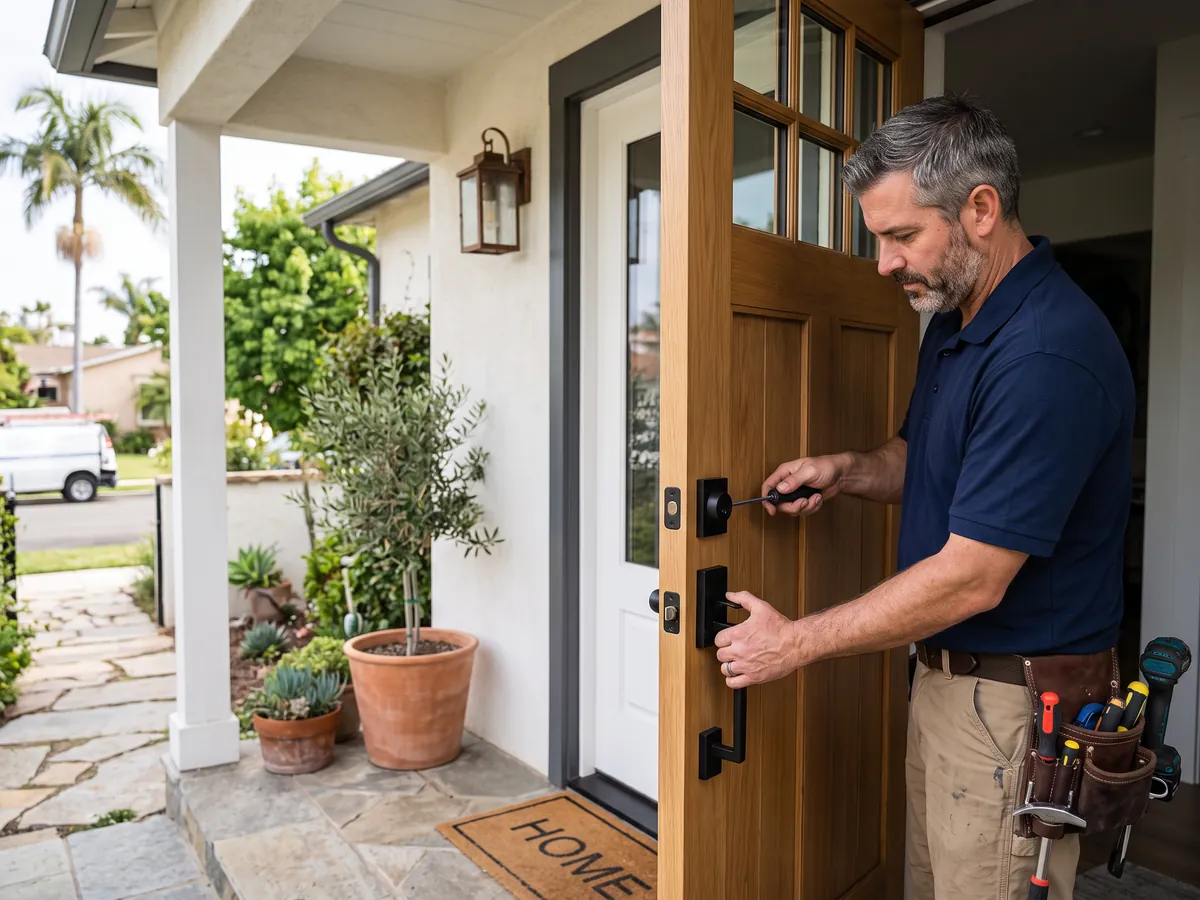
Working in a mid-rise condo building takes more coordination than knocking on a house door. There's guest parking to find, a lobby or gate to get through, an elevator or stairwell, and sometimes association rules about contractor hours, proof of license or protecting hallway floors. Tell us about your building when you call, and we'll plan around it. Julian's Locksmith is a mobile condo locksmith serving Bloomington every day from 6:30 a.m. to 11:30 p.m. We'll give you an honest ETA and a price before arriving.
How this works in Bloomington
In a California common-interest development, three kinds of space matter to a locksmith. Your separate interest is the unit itself. The common area belongs to everyone and is managed by the association: lobbies, hallways, pool gates, shared garages. In between sits exclusive-use common area, a category for features that serve only your unit but sit outside its boundaries, which in many associations includes front door hardware, patios and balconies. The CC&Rs spell out who maintains what, within the framework of the Davis-Stirling Common Interest Development Act. For a condo locksmith, the practical rule is simple. Rekeying your cylinders changes nothing anyone can see, so it's yours to order. Replacing a handleset, adding a keypad, or mounting a security screen door changes the look of a door the HOA may control, so it often needs architectural approval first. We ask about your association's rules before suggesting hardware, and if the HOA requires a particular finish or style, we match it rather than leaving you to undo the work after a violation notice arrives.
How we can help in Bloomington
- Rekeying after you buy a condo. We rekey every keyed cylinder in your unit to one new key: front knob or lever, deadbolt, garage entry door and any keyed side door. The pins inside change, the hardware stays, and every old key stops working. You leave with as many new keys as your household needs, cut on the van.
- Clearing old master keys. Some associations once kept master or emergency keys for pest control and maintenance. If your CC&Rs require emergency access, a rekey doesn't prevent you from providing it; it simply means you decide who gets a key and keep a record of it, rather than inheriting an unknown arrangement.
- HOA-approved hardware replacement. Replacement hardware has to fit the door as drilled. Standard bores and backsets of 2-3/8 or 2-3/4 inches cover most condo doors, so a better Grade 1 or Grade 2 lockset usually drops in without new holes. We measure first and tell you if a door needs modification before anything is ordered.
- Lockout help for owners and residents. Owners prove residence with photo ID showing the unit address. If yours shows an older address, a grant deed, property tax bill or HOA statement works. Tenants of a condo show their lease and, when needed, we confirm with the owner. Nobody gets into a unit without that check.
- Mailbox, storage and closet locks. Balcony storage closets, water heater closets and garage cabinets often have cheap keyed locks that nobody has rekeyed in years. We can rekey or replace them, and where the hardware allows, key them to match your unit so one key handles everything except the mailbox, which usually stays separate.
What's different about Bloomington
Older condo complexes in Bloomington, many from the 1970s and 1980s, often still have original hardware: knobsets with separate deadbolts, worn hook latches on sliders and strikes held by short screws. Some were built as apartments and converted later, which raises the possibility of leftover master pins. A condo locksmith can repin those cylinders, upgrade strikes and source compatible parts for discontinued hardware without changing the door's appearance. Ask us to check every cylinder, including garage and storage locks, while the tools are out.
Summer heat in Bloomington affects condo doors more than people expect. Metal entry doors facing open walkways expand, deadbolts start dragging on the strike, and smart lock batteries drain faster. If a lock gets stiffer every afternoon, a strike adjustment is usually the fix. For smart locks, change batteries before summer rather than waiting for the low-battery warning on the hottest day of the year. Sun-faded keypad buttons are another sign that a lock in direct sun needs attention.
Townhome condos in family neighborhoods of Bloomington have attached garages, patio sliders opening onto small yards and plenty of comings and goings. A deadbolt on the garage-to-house door, a slider bar for nights and keypad codes for older kids who forget keys cover most of what families need. Keep the release tool for interior privacy locks handy for the inevitable locked bathroom door. Teach older children to throw the deadbolt behind them, not just the knob lock.
Common situations
- A second-floor owner shares a balcony divider with the neighboring unit. The slider latch is worn, and the divider is easy to step around. We replace the hook latch, add a secondary lock at the top of the slider and leave a track bar for nights. None of it changes the exterior, so no HOA form is needed.
- A townhome owner's car is broken into in the driveway off Valley Boulevard, and the garage remote is taken. The garage-to-house door has only a knob lock. The owner reprograms the opener, and we add a deadbolt with a reinforced strike to that interior door, rekey it to the front door key, and confirm the self-closing hinges still pull it shut.
- Sometimes the caller isn't the owner. For example, an executor settling a parent's condo needs control of the unit during probate while relatives hold old keys. After reviewing the executor's ID and court documents, we rekey the unit, cut two keys, and note that the HOA should be told who now manages the property and its fobs.
- Consider an 80-year-old owner in a 55+ condo community whose daughter lives in another state. Knobs have become hard to grip and keys easy to misplace. With the HOA's approval of the exterior look, we fit lever handles and a keypad deadbolt, give the daughter, a neighbor and a home health aide separate codes, and show the owner how the inside thumbturn works.
How the visit works
- Tell us about the property. Call (951) 903-3193 and describe the building: townhome, garden-style or mid-rise, gated or open, and how a van gets close. Mention what you need done and which doors are involved. Photos of the locks and the hinge edge of your entry door help us plan the visit to Bloomington.
- Confirm who can authorize the work. Owners authorize work on their own unit with ID showing the address, or a deed or tax bill if the ID is outdated. Tenants need the owner's approval for anything beyond a lockout. Common-area work needs authorization from the HOA board or manager, never just a resident.
- Check the rules and the door. Some associations limit contractor hours or require noisy work to stay within set times. Tell us the rules and we'll schedule inside them, which matters since our day starts at 6:30 a.m. Rekeying is quiet; drilling and strike work are not.
- Quote before any work. We explain your choices plainly: rekey or replace, Grade 2 or Grade 1, mechanical or smart, and what each means for cost and security. If a cheaper option meets your needs, we say so. The decision is yours, and there's no pressure to add extras.
- Do the work cleanly. Every lock gets tested with each new key, from both sides, with the door closed in its normal position. On fire-rated doors and garage-to-house doors, we confirm the door still closes and latches by itself before we consider the job finished.
- Keys, records and HOA follow-up. If you rent the unit out, record which keys went to the tenant and which stayed with you. That log, plus our invoice, answers most questions at the next turnover. When that turnover comes, call us back and we'll pick up from our notes.
What affects the cost
- Master pins and older parts. Cylinders from converted apartment buildings may contain master wafers that have to be identified and removed. That takes a little more bench time than a standard rekey, but it's still far cheaper than replacing the locks. We'll tell you if master pins turn up once the cylinder is open.
- Building access and HOA logistics. Some associations restrict contractor hours, require advance notice, or ask that work in common hallways be scheduled. We plan around those rules. Building them into the appointment from the start avoids a wasted trip when a manager turns us away at the gate.
- Timing within our hours. We work every day from 6:30 a.m. to 11:30 p.m., and we're closed overnight. Late-evening calls may be priced differently from daytime work. We give you the price for your time slot on the phone before driving to Bloomington.
Every job gets a clear quote before any work starts. Call (951) 903-3193 with the details and we'll tell you what to expect for your situation in Bloomington.
Mistakes to avoid
- Fitting a security screen door with a lock keyed on both sides and keeping the key somewhere other than right beside it. In a fire, nobody should have to hunt for a key to get out. Choose a screen lock with an inside thumbturn, or keep the key within immediate reach of the door.
- Assuming the seller handed over every key to the condo. Sellers rarely know how many copies exist, and former tenants, contractors and agents may have had their own. Until the locks are rekeyed, treat the unit as accessible to people you've never met.
- Installing a new handleset, keypad or security screen door without checking the association's rules. The HOA can require you to remove it, and you pay twice: once for the new hardware and again to restore the old look. A quick check of the guidelines or a call to the manager prevents it.
What to do before we arrive
- Don't leave a garage remote clipped to the visor of a car parked outside in a shared lot or driveway. A broken window gives a thief the remote and, often, your address from the registration. Use a keychain remote or a phone app, and keep paperwork with your address out of sight.
- Ask the association in writing whether it keeps a key or code for your unit and under what rules it can be used. After a rekey, you'll know whether you need to provide a new one. Keeping that arrangement documented avoids confusion when a leak in the unit below needs urgent access.
- If your condo is a second home or sits empty for long stretches, use a keypad lock with an access log and give the HOA an emergency contact who lives nearby. Ask a neighbor to collect packages, and set lights on timers. An unoccupied unit looks occupied when nothing piles up at the door.
- Choose spare-key arrangements that fit condo living. A trusted neighbor in another unit is often best. Lockboxes clipped to common-area railings or hose bibs may break HOA rules and advertise that a key is nearby. A keypad deadbolt removes the need for a hidden spare altogether.
Getting to Bloomington
Bloomington is about 14 miles from our San Bernardino base, roughly 22 minutes in light traffic via Belmont Avenue and Palm Avenue to I-215 South, SR-210 West to the Riverside Avenue exit. When you call, you get an arrival estimate based on where the technician is and the traffic at that moment.
We plan the drive the way a delivery route gets planned: freeway first, Cedar Avenue where it makes sense, then the side streets you describe. A landmark or the color of your building helps the technician spot you.
About Bloomington: The Semi-Tropic Land and Water Company, formed in 1887, surveyed the Bloomington town site in April 1888 and also laid out Rialto and Fontana; it survives today as the West Valley Water District.
| Neighborhoods | Locust Avenue and Alder Avenue horse properties, Original 1888 town site, Cedar Avenue corridor, Crestmore, Valley Boulevard corridor, South Bloomington |
|---|---|
| ZIP codes | 92316, 92335 |
| Main routes | I-10, Cedar Avenue, Valley Boulevard, Slover Avenue |
| From our San Bernardino base | about 14 miles via Belmont Avenue and Palm Avenue to I-215 South, SR-210 West to the Riverside Avenue exit, then south on Riverside Avenue and west on Bloomington Avenue; the alternate is I-215 South to I-10 West and the Cedar Avenue exit, about 17 miles |
Home lock work in Bloomington?
Call (951) 903-3193 with the address and a quick description of the doors and locks involved. We'll quote the job before any work starts.
Frequently asked questions
Should I rekey my condo after buying it?
Yes. Sellers, former tenants, contractors, agents and sometimes the association may hold keys, and you have no way to know how many copies exist. A condo locksmith rekeys your unit's cylinders so old keys stop working, usually without replacing hardware. Do it on the day you take possession, and ask the HOA to deactivate the seller's fobs at the same time. If the unit has an attached garage, include the garage-to-house door and any garage side door in the same rekey.
Can you rekey the lobby door, pool gate or garage gate for me?
Not at an individual owner's request. Those doors and gates belong to the association, so the board or property manager has to authorize the work. If the HOA hires us, we can rekey or repair common-area locks and gate hardware. As an owner, your best step is reporting the problem to the manager in writing. Include dates, times and what happened, such as a gate that fails to latch, so the vendor knows what to look for.
What hours do you work, and can you fit HOA contractor rules?
We work every day from 6:30 a.m. to 11:30 p.m. If your association restricts contractor hours or noisy work, tell us when you call and we'll schedule inside those limits. Rekeying is quiet; drilling and strike work are best kept to permitted times. Outside our hours, your HOA emergency line can handle common-area problems such as a gate that will not close.
Can you match the hardware finish my HOA requires?
In most cases, yes. Tell us the required finish and style, or send a photo of a neighbor's approved hardware. We'll source a matching lockset, give you the model and finish details for any architectural form, and key it to your existing key. If the exact model is discontinued, we'll show you the closest approved alternatives. Keep the approval letter with your records in case the board changes or a future buyer asks.
How should I secure a condo that sits empty part of the year?
Rekey so you know exactly who holds keys, then consider a keypad lock with an access log so you can see entries remotely. Give the HOA a local emergency contact, arrange for mail and packages to be collected, and put lights on timers. Add a secondary lock or bar on sliders. Those steps make an empty unit look lived in. Check in with a neighbor after storms or heat waves, when doors and locks are most likely to need attention.
I'm selling my condo. What should I do about keys?
Collect every key, fob, remote, mailbox key and storage key, label them, and hand them over at closing. Let the buyer know which items exist. Give the listing agent only what the lockbox needs, and get it back. You don't need to rekey before selling, but the buyer should rekey after taking possession. If the unit will sit vacant before closing, consider rekeying so only you and your agent have access during the sale.
How far is Bloomington from your base?
Bloomington is about 14 miles from our San Bernardino base, roughly 22 minutes in light traffic. Arrival time depends on traffic and on the job the technician is finishing, so we give you an estimate on the phone before you commit.
Related services in Bloomington
- Condo Lockout in Bloomington
- Residential Locksmith in Bloomington
- Rekey Locks after Buying a House in Bloomington
- Locksmith for New Homeowners in Bloomington
- Apartment Locksmith in Bloomington
- Smart Lock Installation in Bloomington
- Deadbolt Installation in Bloomington
- Cluster Mailbox Lock in Bloomington
- Keyed Alike Locks in Bloomington
- Locksmith for Rental Property in Bloomington
Condo Locksmith in nearby cities
- Condo Locksmith in RialtoSan Bernardino County
- Condo Locksmith in FontanaSan Bernardino County
- Condo Locksmith in ColtonSan Bernardino County
- Condo Locksmith in RubidouxRiverside County
- Condo Locksmith in Grand TerraceSan Bernardino County
- Condo Locksmith in North FontanaSan Bernardino County
- Condo Locksmith in Jurupa ValleyRiverside County
- Condo Locksmith in San BernardinoSan Bernardino County