
Bloomington, San Bernardino County
Home Locks Acting Up in Bloomington? We Repair Them On Site
Short answer: Residential lock repair in Bloomington means fixing the lock you already own instead of buying a new one. Much of the time the door is the real culprit: a sagging top hinge or a shifted strike makes a deadbolt drag. Julian's Locksmith repairs deadbolts, knobs, levers, handlesets, patio sliders and security-door locks at your house and quotes before starting. Call (951) 903-3193.
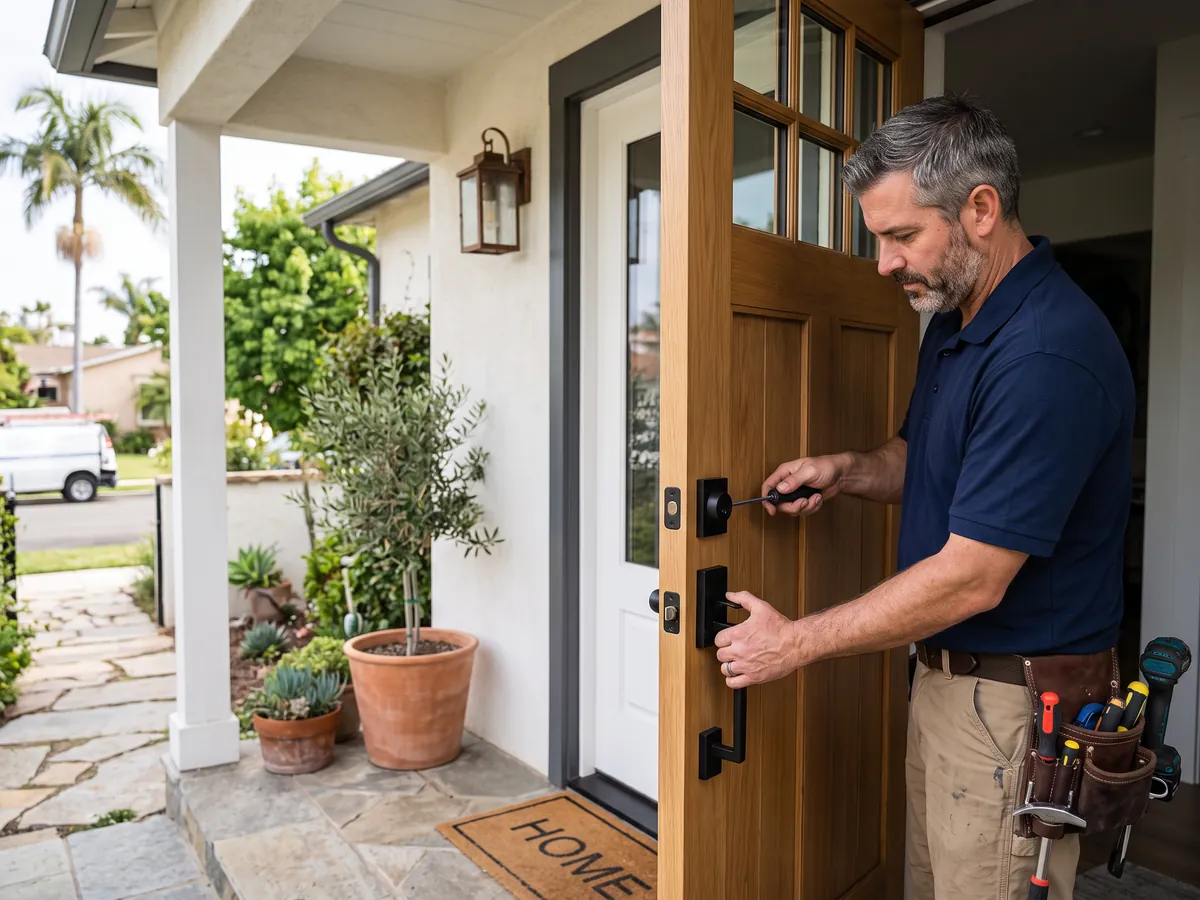
If you own or manage rental homes around Bloomington, lock trouble arrives as a maintenance request: the tenant can't lock the back door, the slider won't catch, a deadbolt only throws halfway. California expects landlords to keep main entry deadbolts and window locks in working order (Civil Code §1941.3), so those requests shouldn't sit in a queue for weeks. A repair visit is often the quickest fix. We diagnose the lock on site, repair it with parts that match the existing hardware, and keep it on the property's current key so nobody needs new copies. Tenants calling about a lock they don't own should check with the landlord first. Call Julian's Locksmith at (951) 903-3193 to schedule.
Residential Lock Repair in Bloomington: what to expect
A typical residential door has two separate mechanisms, and each wears out in its own way. The knob or lever set holds a spring latch, a spindle that retracts it, and a spring cassette (sometimes called the chassis) that returns the handle to level. The deadbolt has a cylinder, a tailpiece or cam that passes through the door, and a bolt that should travel about an inch into the frame. On the knob side, the usual failures are a cracked spring cassette, which makes levers sag, and a latch whose tail no longer catches the spindle, so turning the handle does nothing. On the deadbolt side, cylinder pins wear along with the key, dirt packs into the keyway, and the bolt itself rarely breaks unless someone kicked the door. The strike plate and the pocket behind it complete the system; if the bolt bottoms out in a shallow pocket, it never fully extends and never deadlocks. Residential lock repair means finding which of these pieces has failed and replacing or adjusting that piece, rather than throwing out a whole assembly over one cracked spring.
What we can do on-site
- Cylinder cleaning, lubrication and re-pinning. Years of the same key sliding in and out wear the tops of the pins and the cuts on the key itself. We decode the cylinder, re-pin it to factory depths and cut a fresh key by code rather than copying a worn one. That pairing of new pins and an accurate key often makes an old lock feel brand new.
- Knob and lever latch repair. A latch that rattles, a knob that spins loosely or a lever that wobbles on its rose usually means loose through-bolts or a worn spindle. We tighten, shim or replace the worn piece and check that the latch springs fully into the strike. A latch that only half extends can be slipped open with a card.
- Handleset and thumb-latch repair. Decorative entry sets are expensive to replace, and the mounting holes in the door are specific to that design. Changing to a different brand often leaves exposed holes above or below the new grip. Fixing the original avoids that: we rebuild the latch connection, tighten the mounting screws into solid wood and adjust the deadbolt that sits above it.
- Sliding patio door lock repair. A slider that doesn't latch is often the easiest way into a house. Along with repairing the hook latch, we can add a secondary foot lock or pin lock and check any anti-lift blocks in the upper track, so the panel can't be lifted off its rollers from outside while you're away.
- Hinge and door-sag correction. Many lock problems are really hinge problems. Short screws in the top hinge loosen, the door drops on the latch side, and the bolt rubs the strike. We replace at least one screw per hinge with a three-inch screw that reaches the stud behind the jamb, which pulls the door back into position and often cures the lock.
How Bloomington shapes the job
Inland summers bake doors. Dark-painted and west-facing doors expand, metal strikes heat up, factory grease thins out, and keypad batteries wear down sooner when the exterior unit sits in direct sun. A deadbolt that works in March may bind in August. In Bloomington, much of our summer residential lock repair is adjusting strikes for swollen doors, re-lubricating latches and checking keypad locks that face the afternoon sun.
Older houses around Bloomington often keep their original hardware: mortise locks with skeleton keys, early Schlage and Kwikset knobs, rim latches, and doors that have shifted through decades of settling. Residential lock repair in older homes leans toward restoration. We service the original mechanism where parts can be found or made, correct the door's hang and avoid boring period doors for modern hardware unless security truly requires it.
Family homes put locks through constant use: kids slam doors, hang backpacks on levers, lock themselves into bathrooms and leave sliders half-latched. Residential lock repair in suburban Bloomington usually means level levers, latches that catch on a gentle close, privacy locks that release from outside and patio doors that lock properly. We also look at the garage entry door, since that's the one most families use every day.
Example situations
- A landlord with a rental near Crestmore sends a list before new tenants arrive: a deadbolt that throws halfway, a loose kitchen-door knob, a window latch missing a screw and a slider that won't lock. One visit covers all four. The deadbolt pocket gets drilled deeper, the knob gets new through-bolts, the window lock is replaced and the slider keeper reset, all on the property's existing key.
- A typical garage-entry call: the door from the garage into the kitchen has a self-closer, but it no longer latches on its own, so it drifts open and the air conditioning leaks into the garage. The latch is fine; the strike sits a hair too far toward the stop. We move the strike, adjust the closer's latching speed and test the door repeatedly from full open.
- Picture a keypad deadbolt that has been chewing through batteries every few weeks and grinding when it locks. The owner has already bought fresh batteries twice. With the door open, the bolt runs smoothly; with it closed, the bolt scrapes the strike lip and the motor strains. We shift the strike, deepen the pocket and recalibrate the lock in its app, and battery life returns to normal.
- For example, a family's back-door lever has drooped for months, and now it doesn't fully retract the latch, so the kids get stuck out on the patio. Inside the lockset, the return spring cassette has cracked. Because that Kwikset model is common, a matching chassis is likely on the van, so the lever comes back level the same afternoon and the existing keys still fit.
From your call to the finished job
- Tell us what the lock is doing. Call (951) 903-3193 and describe the symptom in plain terms: the key sticks, the bolt stops halfway, the handle droops, the slider won't catch. Tell us which door, roughly how old the hardware is, and the brand if you can see it on the latch faceplate. That helps us load the right parts.
- Arrival and verification. Before opening any locked home, we check ID or proof of residence. That's how a California-licensed locksmith (ours is LCO7891, issued by BSIS) works under the state's Locksmith Act. Tenants should expect a question about the landlord's approval for changes to hardware they don't own. It takes a moment and protects you.
- Diagnose lock versus door. A stiff lock can come from five or six different places, so we narrow it down methodically: key condition, cylinder, tailpiece, bolt, strike, then the door's hang. Each check is quick. The result is an explanation you can see for yourself, like a bright scuff mark on the strike or a cracked spring in our hand.
- Quote the repair and the alternative. You get a price before any work starts. When a repair and a replacement are both reasonable, we lay out both with their tradeoffs: keeping your keys and finish versus newer hardware or a higher security grade. You choose. If a part must be ordered, we tell you how long that typically takes.
- Make the repair. Most repairs happen at your door with parts from the van: cleaning and re-pinning cylinders, replacing latches and spring cassettes, re-mortising strikes, swapping hinge screws, adjusting slider rollers. We protect floors and finishes, keep the door secure throughout, and put back every screw we remove, tight and into solid wood.
- Test and walk through care. Before we leave, the lock should work with light, one-handed effort. We cycle it repeatedly, check that the latch catches on a gentle close and test any spare keys you hand us. If one doesn't work because it's a worn copy, we can cut a fresh key by code on the spot.
What affects the cost
- Brand and parts availability. Some parts are proprietary. Smart lock electronics, specific multipoint gearboxes and certain handleset components only come from the original manufacturer. A special order adds lead time and sometimes a manufacturer charge, which we pass along plainly in the quote so there are no surprises when the part arrives.
- Number of locks and doors. Repairing several locks in one visit costs less per lock than separate calls, because the trip and setup happen once. If you have a list, like a front deadbolt, a slider and a garage-entry latch, tell us when you call so we can quote the whole job and bring parts for each.
- Lock type and complexity. A standard knob or deadbolt is straightforward to service. Handlesets, mortise locks, multipoint locks and electronic deadbolts take longer to disassemble and need more specific parts. Security screen door locks fall in between, depending on corrosion. Describing the lock type on the phone lets us give a realistic price range before arrival.
Every job gets a clear quote before any work starts. Call (951) 903-3193 with the details and we'll tell you what to expect for your situation in Bloomington.
Advice before you book
- With a smart deadbolt, suspect alignment before you suspect the electronics. If the lock jams, logs errors or drains batteries quickly, try it with the door open. A bolt that runs freely when open but strains when closed is rubbing the strike, and correcting that usually ends the battery drain.
- Keep the emergency release tool for your interior privacy locks somewhere predictable, such as on top of the bathroom door casing. Most push-button privacy locks open from outside with a small pin or flat key, and searching drawers with a child crying on the other side is no fun.
- Always copy keys from the original, or from a key cut by code, never from a copy of a copy. Small errors compound with every generation, and a key that's slightly off wears the cylinder pins unevenly. If your best key is already sloppy, ask us to cut a fresh one by code.
- Aim sprinklers away from security screen doors and side gates. Hard-water deposits and rust seize latches and cylinders faster than anything else outdoors. A light coat of dry lubricant on the latch and a wipe-down of the faceplate a couple of times a year keep them moving freely.
Mistakes to avoid
- Filing the deadbolt or grinding the key to make them fit. Shortening a bolt reduces how far it reaches into the frame, and a filed key wears the pins unevenly. The real issue is almost always strike position or a worn cylinder, and both can be corrected without weakening anything.
- Spraying WD-40 or household oil into a sticky keyway. It frees things up for a few days, then mixes with dust into a gum that binds the pins. By the time a locksmith opens the cylinder, it needs a full cleaning instead of a light lubrication. Use a dry lock lubricant instead.
- Buying a new lock when the door is the problem. A new deadbolt installed in a sagging door binds exactly like the old one, and now the house has a different key as well. If the old lock worked smoothly with the door open, fix the alignment before spending money on hardware.
Getting to Bloomington
Bloomington is about 14 miles from our San Bernardino base, roughly 22 minutes in light traffic via Belmont Avenue and Palm Avenue to I-215 South, SR-210 West to the Riverside Avenue exit. When you call, you get an arrival estimate based on where the technician is and the traffic at that moment.
Most trips into Bloomington use Jurupa Avenue for at least part of the drive, and the technician keeps an eye on live traffic along the way so the arrival estimate you heard on the phone stays honest.
About Bloomington: The older Crestmore community sits between Locust and Larch Avenues south of Jurupa Avenue and extends to the Riverside County line.
| Neighborhoods | Cedar Avenue corridor, Valley Boulevard corridor, Locust Avenue and Alder Avenue horse properties, North Bloomington, Kessler Park area, Santa Ana Avenue large-lot area |
|---|---|
| ZIP codes | 92316, 92335 |
| Main routes | I-10, Cedar Avenue, Valley Boulevard, Slover Avenue |
| From our San Bernardino base | about 14 miles via Belmont Avenue and Palm Avenue to I-215 South, SR-210 West to the Riverside Avenue exit, then south on Riverside Avenue and west on Bloomington Avenue; the alternate is I-215 South to I-10 West and the Cedar Avenue exit, about 17 miles |
Home lock work in Bloomington?
Call (951) 903-3193 with the address and a quick description of the doors and locks involved. We'll quote the job before any work starts.
Frequently asked questions
Can you repair a lock after a break-in?
Yes. Forced entries often damage the jamb and strike more than the lock itself. We repair or reinforce the jamb, install a heavy-duty strike with long screws and test the lock. If the cylinder was picked, drilled or twisted, we replace or rekey it. If you're filing a police report or an insurance claim, photograph the damage before we start.
Should I spray WD-40 in a sticky lock?
No. WD-40 and household oils give a short-term improvement, then attract dust and leave a gummy residue that binds the pins. Inland dust makes it worse. Use dry graphite or a PTFE dry lubricant made for locks, and if the lock is already gummed up, the cylinder needs to come out for a proper cleaning.
Do you repair old mortise locks with skeleton keys?
Yes, in many cases. Original mortise locks in older homes are built from steel levers and flat springs that can be cleaned, re-sprung and adjusted, and we can often fit a key to the existing lever tumblers. Keep in mind that skeleton-key locks offer little security, so on exterior doors we may suggest pairing the original look with a modern deadbolt or mortise cylinder.
Is it worth repairing a cheap builder-grade lock?
Sometimes. If the issue is alignment, cleaning or a loose screw, the repair costs little and the lock is fine. If the internals are cracked and parts cost close to what a new lock would, replacing it with a better-grade lock usually makes more sense. We give you both numbers and let you decide; we don't push one answer over the other.
Can you repair the lock the same day?
Often, yes. The van carries common latches, cylinders, springs, strikes, screws and slider parts, so many residential lock repair jobs in Bloomington finish during the first visit. Specialty pieces, such as a particular multipoint gearbox or a smart lock component, may need ordering. In that case we leave the door secure and schedule a return once the part arrives.
Can you repair a security screen door lock?
Yes. Steel security doors are common across Southern California, and their locks fight sun, rust and sprinkler minerals. We free and clean seized latches, replace corroded cylinders, swap failed lock bodies for matching units and adjust the door and strike so it latches cleanly. We can also key the screen door to match your front door so one key handles both.
How far is Bloomington from your base?
Bloomington is about 14 miles from our San Bernardino base, roughly 22 minutes in light traffic. Arrival time depends on traffic and on the job the technician is finishing, so we give you an estimate on the phone before you commit.
Related services in Bloomington
- Residential Locksmith in Bloomington
- Lock Repair in Bloomington
- Door Lock Repair in Bloomington
- Deadbolt Repair in Bloomington
- Lock Not Turning in Bloomington
- Jammed Door Lock in Bloomington
- Loose Door Lock in Bloomington
- Latch Repair in Bloomington
- Mortise Lock Repair in Bloomington
- Residential Lock Replacement in Bloomington
Residential Lock Repair in nearby cities
- Residential Lock Repair in RialtoSan Bernardino County
- Residential Lock Repair in FontanaSan Bernardino County
- Residential Lock Repair in ColtonSan Bernardino County
- Residential Lock Repair in RubidouxRiverside County
- Residential Lock Repair in Grand TerraceSan Bernardino County
- Residential Lock Repair in North FontanaSan Bernardino County
- Residential Lock Repair in Jurupa ValleyRiverside County
- Residential Lock Repair in San BernardinoSan Bernardino County