
Bloomington, San Bernardino County
Commercial Rekey Projects in Bloomington, Planned Door by Door
Short answer: Commercial rekeys in Bloomington can be scheduled before tenants arrive or after they leave. Julian's Locksmith works every day from 6:30 a.m. to 11:30 p.m. Buildings on interchangeable cores often need far less time on site, because new cores are pinned in the van and swapped at each door with a control key.
Every commercial building builds up a key history. Former tenants, leasing agents, HVAC and fire-alarm vendors, janitorial crews, contractors from the last remodel: each may have been handed a key at some point, and very few of those keys come back. A commercial rekey in Bloomington resets that history in a single project. Julian's Locksmith re-pins your existing cylinders to new combinations, cuts a counted set of keys, and gives you a written record of which key operates which door. From that point forward, you know exactly who can get in, and the next rekey starts from accurate records instead of guesswork. Call (951) 903-3193 to talk through the property.
What to know first in Bloomington
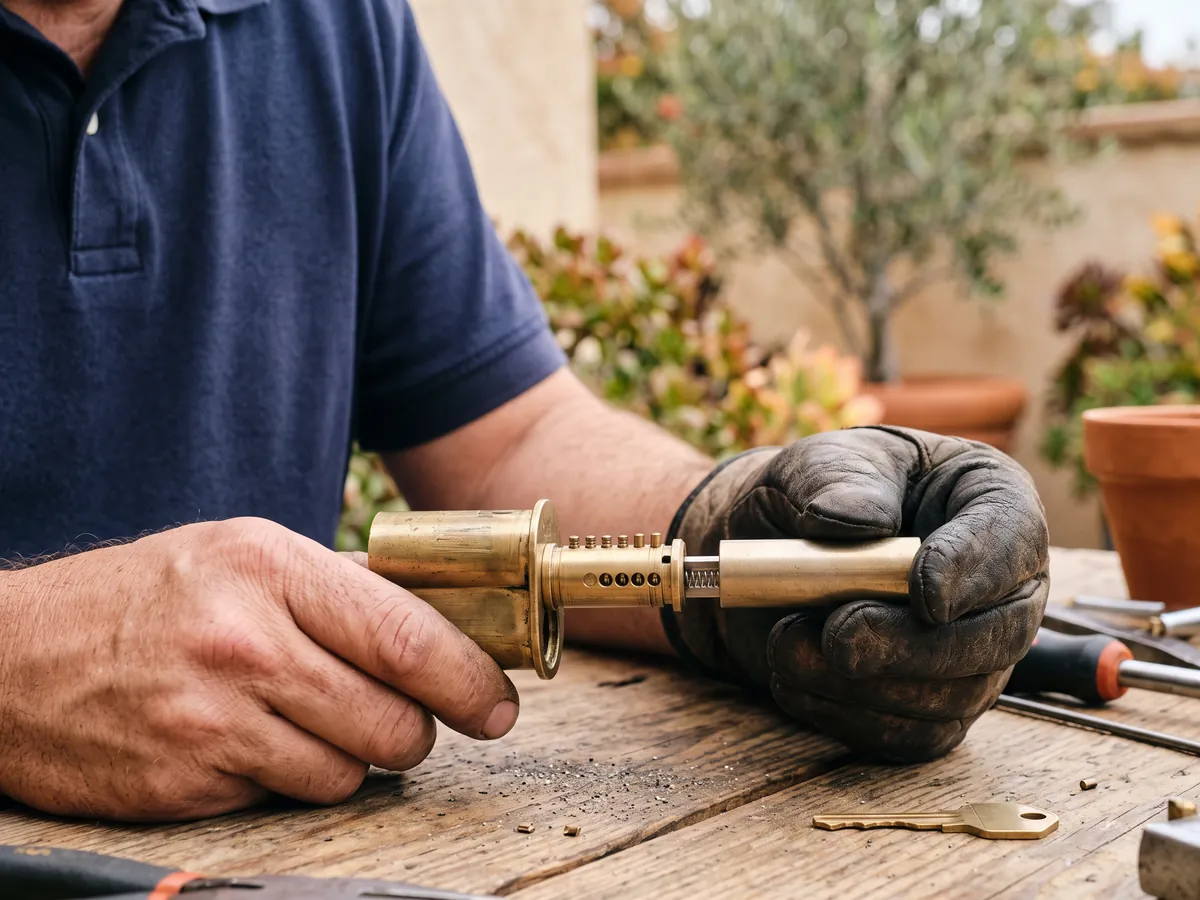
Under the trim, every commercial cylinder works on the same principle as a house lock: a plug held in place by pin stacks until the right key lifts each stack to the shear line. What differs is how you get to that plug. Mortise cylinders thread into the lock body and are held by a set screw on the edge of the door; the cam on the back has to match the lock, whether it's a standard Yale-style cam, an Adams Rite cam for a storefront deadbolt, or a manufacturer-specific cam for a Schlage L or Sargent 8200 series lock. Rim cylinders for exit devices and night latches come off from the inside once two long connecting screws are removed. Key-in-lever locks need the lever released with a catch tool before the cylinder can come out. Once the plug is free, we push it out with a plug follower so the top pins and springs stay in the shell, dump the old bottom pins, and load new ones to the chosen bitting. On a master keyed building, master pins go in too, calculated from the keying chart. A commercial rekey is mostly careful disassembly and record keeping; the pinning itself is the quick part.
What we can do on-site
- Mortise cylinder rekeying. A mortise cylinder only works if its cam matches the lock body behind it. When we rekey these cylinders, we keep each cam paired with its own cylinder, check that the cylinder seats to the right depth against the trim, and tighten the set screw so nobody can spin the cylinder out from the hallway side.
- Rim cylinders on exit devices and night latches. Panic bars from Von Duprin, Sargent, Detex and Precision often take a rim cylinder for the outside trim. We remove the connecting screws from the inside, re-pin the cylinder, set the tailpiece to the right length for the device, and confirm the outside trim retracts the latch with the new key before moving on.
- Interchangeable core rekeys. If your hardware takes small or large format interchangeable cores, a commercial rekey becomes mostly prep work. We pin new cores to the agreed bitting in the van, then use the control key to pull each old core and drop in the new one. Each door is back in service almost as soon as we reach it.
- Key-in-lever and cylindrical locks. Interior doors are the forgotten part of many commercial rekeys. Owners focus on exterior entrances while a dozen office, records and supply-room levers keep working with keys that left with the last tenant. We include those cylinders in the inventory so the keying schedule reflects every door that actually locks.
- Office furniture, cabinet and mailbox locks. Desk pedestals, lateral files and storage cabinets often use cam locks or removable-core furniture locks. In offices that store records or petty cash, those cores deserve the same attention as the doors. We can rekey or replace them during the commercial rekey and key them alike, individually, or under a master.
What's different about Bloomington
Plenty of building managers and owners drive in from elsewhere in San Bernardino County, so timing a commercial rekey around when a key holder can be on site matters. We start at 6:30 a.m. every day, which lets us finish a suite before tenants arrive, and we can work into the evening for buildings that clear out late. Tell us when your contact will be there, and we'll plan the visit around that window.
Inland summers bake metal doors and the cylinders inside them. In Bloomington, south- and west-facing commercial doors often show dried-out cylinders, gummy lubricant and storefront locks that stick in the afternoon. During a commercial rekey we clean each plug, use a dry lubricant that won't collect dust, and check that heat-swollen doors still let deadbolts and hook bolts throw fully into their strikes.
Parts of Bloomington with older housing usually have older commercial buildings close by, often with original mortise hardware, brass rim cylinders and keys stamped with numbers nobody can trace. Those locks are frequently still sound and worth rekeying rather than replacing. We clean and re-pin them, replace the few cylinders that are too worn, and document the result, since older properties tend to have the thinnest key records of all.
Common situations
- Imagine a car dealership service department where a key to the parts room went missing during a busy month. The showroom and sales offices aren't affected. We'd rekey only the service-side cylinders, cut a limited number of new keys for the service manager and parts lead, and suggest restricted blanks so nobody can copy them at a hardware counter.
- Picture a strip center where the landlord gets a storefront back after a restaurant tenant closes. The front is a narrow-stile aluminum door with an Adams Rite deadbolt; the back is a steel door with a panic bar and rim cylinder. A typical commercial rekey here covers both cylinders plus the grease-enclosure padlock, and we'd note whether the storefront hook bolt is worn before the next tenant moves in.
- Imagine a medical office building near Crestmore Elementary School where a dental practice is moving out and a physical therapy group is moving in. The suite has a records room, a supply closet and a staff entrance off the parking lot. We'd rekey those cylinders separately from the main entry, so the new tenant can give front-desk staff one key and clinicians another while management keeps its master.
- For example, a church or community nonprofit that rents its fellowship hall to outside groups may have lent out keys for years without tracking them. A commercial rekey can split the property into a key for staff offices, a key for the hall and kitchen, and a master for the facilities committee, so a weekend rental no longer means handing over access to everything.
Step by step with Julian's Locksmith
- Scope call. Call (951) 903-3193 and describe the property: building type, rough door count, whether it's master keyed, and why you're rekeying. Mention any padlocks, roll-up doors or cabinets you want included. Those details tell us whether to schedule a site walk first or quote from your description.
- Authorization and site walk. On the walk-through we look at each door's hardware, not just its cylinder. A sagging closer, a strike that's out of line or a loose lever won't be fixed by rekeying, and it's better to know before keys are cut. Every observation goes into the quote so you decide what to include.
- Keying plan and quote. The quote breaks out cylinder rekeys, cores, padlocks, keys and any replacement hardware, so you can trim or add items. If the property needs restricted blanks or a keying chart drawn up from scratch, that shows as its own line. Nothing gets added on rekey day without your sign-off.
- Scheduling around occupants. Occupied buildings need notice. We'll suggest giving tenants a short heads-up with the date, the doors affected and how they'll receive new keys. When a suite can't spare its entrance during business hours, we rekey it first thing in the morning or after close.
- Rekeying and testing each opening. On site, each cylinder is removed, re-pinned to its assigned bitting and reinstalled, or its core is swapped. We test the new key with the door open, then again with the door closed against the strike, and confirm the old key fails. Master keys and change keys are each tried on the doors they should operate.
- Keys, records and handoff. Before we leave, you can walk the property with your new keys if you want to. Afterward, keep the keying record somewhere secure and update it whenever keys are issued or returned. That record is what makes the next commercial rekey quick and accurate instead of starting over.
How we quote the job
- Keyway and key security. Some owners change the keyway at the same time as the rekey, moving from an open keyway to a restricted one. That means new cylinders or cores instead of re-pinning, so the cost goes up, but every future copy has to be requested through an authorized source with a record kept.
- Timing, phasing and access. Urgency matters too. A same-week rekey after a master key goes missing is a different job from a planned rekey at lease turnover, especially on a large property. We give an honest price for the timing you need, and we quote before any work starts.
- Cylinder condition and extra parts. Missing keys raise the cost of the first cylinder or two. With a working key, we turn the plug and pull it quickly. Without one, we may need to pick or decode the lock first. After that, the remaining cylinders on the same key usually go faster.
Every job gets a clear quote before any work starts. Call (951) 903-3193 with the details and we'll tell you what to expect for your situation in Bloomington.
What not to do
- Rekeying the suite but forgetting the shared doors. The outgoing tenant's key no longer opens their old space, but it still opens the back corridor, the roof hatch or the trash enclosure because those were on the same key. Always check what else the old key operates before settling the scope.
- Ignoring hardware condition while the locks are apart. A rekey is the cheapest moment to catch a cracked cylinder, a stripped set screw or a worn storefront hook bolt. Skipping that inspection means paying for a second trip when the part fails a few months later.
- Booking from a phone price that never asked about cylinder count or hardware type. A commercial rekey priced without knowing the doors is a number that will change once someone arrives. Ask what's included per cylinder, whether keys and padlocks are extra, and get the full price before work starts.
What to do before we arrive
- Keep the number of masters small. Every master in circulation multiplies the cost of losing one, since a lost master usually means rekeying every cylinder it opens. Give supervisors sub-masters for their own areas and keep the top-level master in a locked cabinet with a sign-out log.
- Before calling for a commercial rekey, walk the property with a notepad and list every keyed thing: doors, panic bar trims, storefront locks, roll-up padlocks, gates, cabinets, mailbox compartments. Most owners undercount by a few. A complete list makes the quote accurate and keeps forgotten locks from undermining the new key plan.
- If your property uses interchangeable cores, keep a few spare cores pinned to the current keying and store them with the control key. When a tenant leaves or a key disappears in Bloomington, a pre-pinned core turns an urgent rekey into a short swap at the door.
- Collect old keys at tenant move-out even though you're rekeying. Returned keys tell you whether anyone held a master or a key to shared doors that wasn't on your list. If a returned key opens something unexpected, that door belongs in the commercial rekey too.
Getting to Bloomington
Bloomington is about 14 miles from our San Bernardino base, roughly 22 minutes in light traffic via Belmont Avenue and Palm Avenue to I-215 South, SR-210 West to the Riverside Avenue exit. When you call, you get an arrival estimate based on where the technician is and the traffic at that moment.
If you're close to Santa Ana Avenue, tell us which exit or cross street you're nearest. It trims the last mile and keeps the van from circling a block that looks right on the map but isn't.
About Bloomington: With no city government, Bloomington is patrolled by the San Bernardino County Sheriff's Fontana Station and the California Highway Patrol, and San Bernardino County Fire provides fire protection.
| Neighborhoods | Original 1888 town site, North Bloomington, Crestmore, Valley Boulevard corridor, Cedar Avenue corridor, South Bloomington |
|---|---|
| ZIP codes | 92316, 92335 |
| Main routes | I-10, Cedar Avenue, Valley Boulevard, Slover Avenue |
| From our San Bernardino base | about 14 miles via Belmont Avenue and Palm Avenue to I-215 South, SR-210 West to the Riverside Avenue exit, then south on Riverside Avenue and west on Bloomington Avenue; the alternate is I-215 South to I-10 West and the Cedar Avenue exit, about 17 miles |
Planning a rekey in Bloomington?
Call (951) 903-3193 and tell us how many doors you want on the new key and the brand of the locks if you know it. We'll quote the rekey before any work starts.
Frequently asked questions
What goes into the price of a commercial rekey?
Our quote lists the per-cylinder rekey work, the number of keys, any new cores or padlocks, replacement parts such as cams or collars, and keying chart work if it's needed. We don't publish fixed prices, because the mix of hardware varies so much from building to building. We count cylinders, confirm the plan with you, and quote before starting. Call (951) 903-3193.
Can you rekey one suite and keep the building master working?
Yes, as long as we can work from the existing keying chart or decode the system reliably. The suite's cylinders get a new change key that fits inside the current master structure, so management and maintenance keys still open the suite. If records are missing, we'll explain what decoding involves before quoting, since guessing at a master system produces keys that open the wrong doors.
Do you rekey office furniture and file cabinets?
Yes. Many desks and file cabinets use cam locks or removable-core furniture locks that can be rekeyed or replaced. We can key them individually, key them alike within a department, or put them under a master. Cabinets holding personnel files, patient records or cash are good candidates to move off generic stamped codes during a commercial rekey.
What happens if a master key is lost?
A lost master usually means every cylinder that master operates needs attention, because whoever finds it can open all of those doors. Sometimes we can rekey to a new master while keeping change keys the same, which avoids recutting every tenant's key. Other times the whole system needs new bittings. We'll review your chart and explain the options before quoting.
What does a commercial rekey include?
A commercial rekey changes the internal combination of your property's lock cylinders so existing keys no longer work, then supplies new keys. On a typical Bloomington building that covers mortise cylinders, rim cylinders on panic bars, storefront cylinders, key-in-lever locks, and often padlocks and cabinet locks. Doors, levers, exit devices and closers stay in place. You end up with new keys and a record of which key opens each door.
Do you rekey padlocks, gate locks and roll-up doors?
Yes, where the lock has a rekeyable cylinder, as many commercial American Lock and Abus padlocks do. Cheap laminated padlocks usually can't be rekeyed and are better replaced with rekeyable units on the new key. Roll-up door locks with standard cylinders can be rekeyed, while proprietary parts from a door manufacturer may need replacing. We sort all of this out during the inventory.
How far is Bloomington from your base?
Bloomington is about 14 miles from our San Bernardino base, roughly 22 minutes in light traffic. Arrival time depends on traffic and on the job the technician is finishing, so we give you an estimate on the phone before you commit.
Related services in Bloomington
- Lock Rekey in Bloomington
- Commercial Lock Rekey in Bloomington
- Master Key System in Bloomington
- Master Key Rekey in Bloomington
- Commercial Locksmith in Bloomington
- Restricted Key System in Bloomington
- Key Control System in Bloomington
- Commercial Lock Replacement in Bloomington
- Business Lock Rekey in Bloomington
- Storefront Lock Repair in Bloomington
Commercial Rekey in nearby cities
- Commercial Rekey in RialtoSan Bernardino County
- Commercial Rekey in FontanaSan Bernardino County
- Commercial Rekey in ColtonSan Bernardino County
- Commercial Rekey in RubidouxRiverside County
- Commercial Rekey in Grand TerraceSan Bernardino County
- Commercial Rekey in North FontanaSan Bernardino County
- Commercial Rekey in Jurupa ValleyRiverside County
- Commercial Rekey in San BernardinoSan Bernardino County
