
Automotive Locksmith
Car Locksmith Service: What Gets Fixed Where Your Car Is Parked
Short answer: A car locksmith fixes the lock and key side of a vehicle on site: opening locked cars, cutting and programming keys and fobs, originating keys when all are lost, and repairing ignitions and door locks. For most cars this costs less and takes less time than a tow to the dealer. Julian's Locksmith, California license LCO7891, serves the Inland Empire, San Gabriel Valley, Pomona Valley, north Orange County and southeast Los Angeles County.
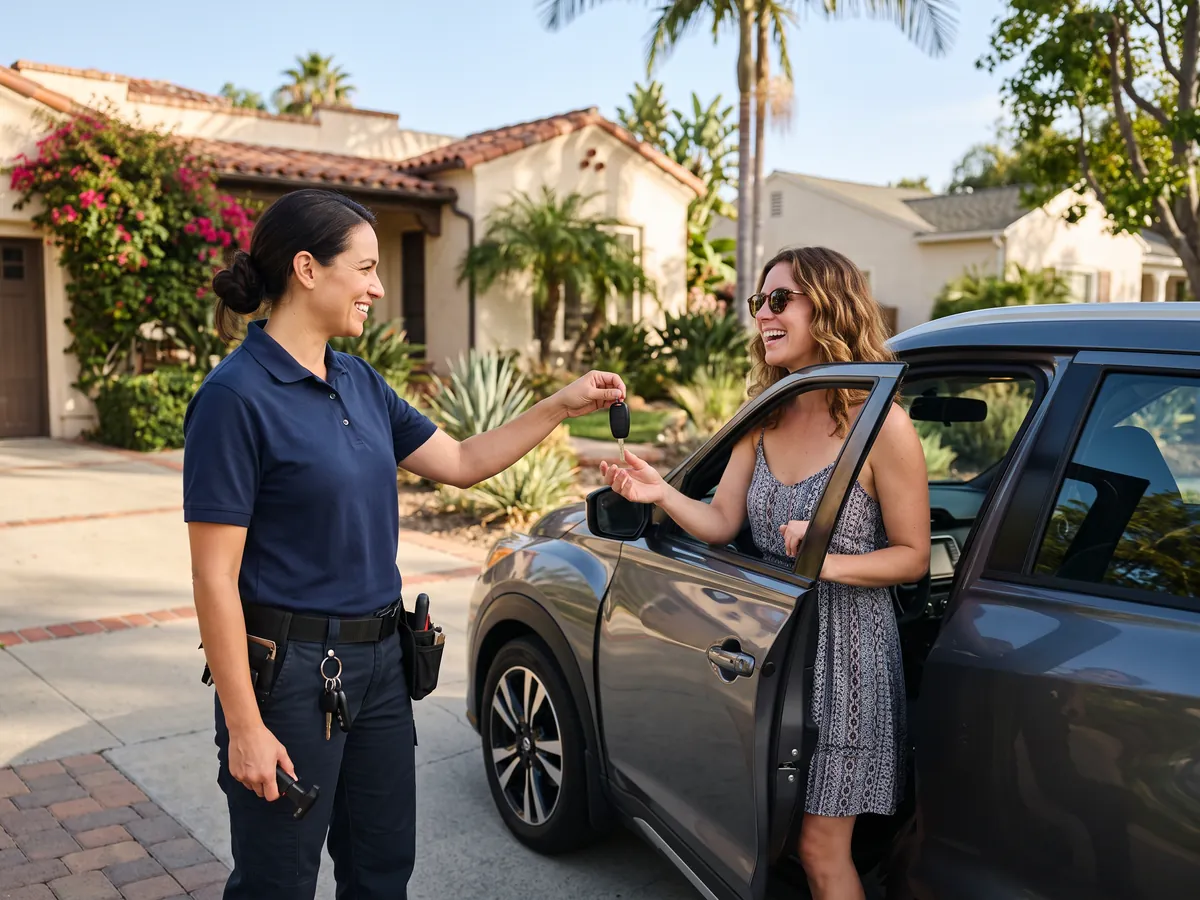
What a car locksmith actually works on
Think of your car as having two separate systems that decide whether you get to drive. The first is mechanical: the door, trunk and ignition cylinders, the cut blade that turns them, and the latches and linkages behind them. The second is electronic: the transponder chip the immobilizer reads before it allows the engine to run, the remote that sends lock and unlock commands, and, on push-button cars, the smart fob that antennas in the doors and cabin must detect. A car locksmith specializes in both systems and in the way they interact.
That covers a wider range of problems than most drivers expect:
- Opening a locked car, truck or van without damaging paint, glass or seals
- Cutting keys by code, by decoding a lock, or by copying a working key
- Programming transponder keys, remote-head keys, flip keys and proximity fobs
- Making a first key when every key has been lost, and erasing the missing ones
- Repairing or replacing ignition cylinders, door locks, trunk locks and tailgate locks
- Extracting keys that broke off inside a lock
- Replacing fob shells, batteries and emergency blades
What a car locksmith doesn't do is engine, transmission or general electrical repair. If a problem sits outside the lock-and-key system, a good locksmith will say so and point you toward the right shop instead of selling you a key you don't need. Knowing where that line falls is the first step in deciding who to call.
What a driveway visit looks like
The phrase 'mobile locksmith' undersells how much equipment arrives at your curb. A properly outfitted van carries a computerized key cutting machine, drawers of blanks and fobs sorted by make and FCC ID, pick-decoders for reading door locks, a diagnostic programmer for the OBD-II port, and a battery maintainer to keep the car's voltage steady while modules are being written to.
A visit runs in a predictable order. We park as close to the car as practical and confirm the details you gave on the phone. Then comes the ownership check: your photo ID against the registration, title or lease documents. If those papers are inside a locked car, we open the car first and check them before any key work starts.
Next is diagnosis. We test whatever key or fob you still have, look at the dash for security warnings, and check whether the ignition and door cylinders turn properly. Only then do we cut a blade, either to a code or to depths decoded from your lock, and connect the programmer to register the new key with the car.
The visit ends with testing in real conditions. Every key starts the engine, every remote button gets pressed, the doors lock from outside, and the emergency blade opens the driver's door. You leave knowing how many keys the car now recognizes and how its backup start method works, and you never had to move the car an inch.
Key problem, lock problem or car problem?
Calling the right trade first saves time and money. These symptoms point in useful directions, though a hands-on check is always the final word:
- Engine cranks, then dies, with a flashing key or security light: the immobilizer isn't accepting the key's chip. That's locksmith work.
- No crank, no dash lights, no clicking. Almost always the 12-volt battery or its connections. Start with a jump or a mechanic.
- A key-not-detected message on a push-start car. Often a weak fob battery. Hold the fob against the start button, or use the backup slot your owner's manual describes.
- Key won't turn in the ignition. Check whether the steering wheel is locked under tension and the shifter is fully in Park. If those aren't the cause, the key or the cylinder is worn.
- Key turns but feels loose or spins freely. A broken ignition cylinder or a damaged switch behind it.
- Remote buttons do nothing, but the car starts. The transmitter or its battery has failed while the chip still works.
- Door key won't turn in the driver's lock. A seized cylinder from disuse, or damage from an attempted break-in.
When symptoms overlap, we diagnose before quoting parts. Some calls end with a coin cell or a quick lesson in the backup start method rather than a new key, and we would rather tell you that than sell you something you don't need.
Locksmith, dealer or tow truck: comparing the three routes
When a key is lost or the car won't start, most drivers weigh three options. Each one has its place.
The dealership route. A dealer can make keys for every model it sells, including the ones a locksmith can't do. The catch is logistics. Without a working key, your car usually has to be towed there, often on a flatbed because the shifter is locked in Park and the steering is locked. The parts department may order a key cut by VIN, which can take days, and the service department programs it once the key arrives and an appointment opens. Most service departments keep weekday business hours.
The roadside assistance route. Roadside plans are good at what they're designed for: opening a locked car and towing within a set distance. Most don't originate transponder keys or program smart fobs, so for a lost key they usually solve the tow, not the key itself.
The car locksmith route. A mobile locksmith cuts and programs the key where the car sits. For most domestic, Japanese and Korean vehicles, and a good share of European models, the job finishes in one visit with no tow at all.
The practical decision rule is simple. Call a locksmith first and ask whether your exact year, make and model can be done on site. If the honest answer is no, you've spent a phone call. If it's yes, you've likely saved a tow and a few days without your car.
What shapes the price of car locksmith work
We don't publish flat prices, because two jobs that sound identical on the phone can involve very different work. What we do is quote before starting, and the quote reflects a handful of factors:
- Whether you still have a working key. Adding a spare is the least involved job; originating a key with nothing to copy is the most involved.
- The key technology. A plain metal key costs least, followed by transponder keys, then remote-head and flip keys, with push-button smart fobs typically at the top.
- The blade. Edge-cut keys cut quickly; laser-cut and other high-security blades take a specialized machine and pricier blanks.
- The security system. Some cars accept keys through a short diagnostic routine; others need a PIN, a built-in waiting period, a secure-gateway connection or direct module work.
- Parts. Factory keys cost more than quality aftermarket ones, and some cars are fussy enough that factory parts are the better choice.
- Travel and access. The service call reflects the distance from our base in San Bernardino and how easy it is to reach the car.
When you compare a locksmith quote against the alternatives, add up the whole alternative: the tow, the dealer's key and programming charges, rideshares, and the hours or days spent without a car. And ask any locksmith you call whether the quote includes cutting, programming and travel. If it doesn't, it isn't really a quote yet.
How to choose a car locksmith
Most car locksmith calls happen under stress, which is exactly when a bad choice is easiest to make. A few checks take only minutes and filter out most of the trouble.
First, confirm the license. California requires locksmith companies to be licensed by the Bureau of Security and Investigative Services. Ask for the company's legal name and license number, then look it up at search.dca.ca.gov. Ours is LCO7891.
Second, notice how the call is handled. A real automotive locksmith wants your year, make and model, the kind of key you had, and whether any key still works, because those details determine the parts and the price. A call taker who offers a low price without asking anything about the car is quoting a number that will change once someone arrives.
Third, ask what the quote includes. It should cover travel, the key or fob, cutting and programming. Ask whether the fob will be a factory part or aftermarket, and what happens if it won't program.
Fourth, expect an ownership check. A locksmith who doesn't ask for ID and registration before making a key for your car is a locksmith who would make a key for your car for someone else.
Finally, be wary of anyone who wants to drill or pry a car door for a simple lockout. Modern vehicles open without damage in skilled hands, and destructive entry on a routine lockout is a reason to stop the job and send the person on their way.
Proof of ownership and why we insist on it
A car key is effectively a pocket-sized title to the car. Anyone holding a working one can drive the vehicle away, which is why we verify ownership on every lockout and every key we make. California's Locksmith Act, which begins at Business and Professions Code section 6980 and is administered by BSIS, governs this trade, and confirming identity and authority before opening or keying a vehicle is a basic part of practicing it responsibly.
What usually works:
- A government-issued photo ID plus the registration card, the title (the pink slip), or a current lease or purchase contract
- For a car registered to a spouse or parent. A registration listing you, or the owner reachable by phone and able to confirm the request
- For company vehicles. Authorization from the fleet manager or business owner
- For a car just bought from a private party. The signed-over title or a bill of sale along with your ID
If the paperwork is locked in the glove box, we open the vehicle first and verify before any key work begins. We also keep a written record of each job, including whose vehicle it was and what was done.
None of this is meant to slow you down. It's the same check you'd want a locksmith to run on a stranger standing next to your car at night, asking for a key.
Where a car locksmith's abilities end
Honest limits matter as much as capabilities. Here is where a car locksmith may not be the complete answer:
- Some late-model European vehicles. Certain systems still require keys ordered from the manufacturer and programmed with dealer software. We'll tell you on the phone.
- Brand-new platforms. When a model launches with a new immobilizer, aftermarket programming tools sometimes lag behind for a while.
- Secure-gateway vehicles. Many Chrysler, Dodge, Jeep and Ram models from roughly 2018 on place a security gateway between the diagnostic port and the rest of the car. Programming them takes a bypass connection or an authenticated login. It's doable, but it adds a step.
- Failed modules. If a body control module, immobilizer module or electronic steering lock has failed, a new key won't fix it. Some of these repairs belong to a dealer or an automotive electrical specialist.
- Phone-as-key and key-card systems. Some electric vehicles tie new keys to the owner's account and an already-authorized key; when every credential is lost, the manufacturer's service center usually has to be involved.
- Mechanical faults. A bad starter, dead battery, fuel problem or broken steering column is outside the locksmith's lane.
When your situation falls into one of these, we'll still help where we can, often with the lockout, a mechanical emergency blade, or simply clear advice about the next step and who to call for it.
Older cars, worn keys and tired ignitions
Plenty of Southern California drivers keep cars and trucks running long past the age when their keys started to wear out. That brings a specific set of problems, and they tend to sneak up on you.
A turn-key ignition uses small spring-loaded wafers that ride on the key's cuts. Over years of use, the key's peaks round off and the wafers wear in step with them. At first the key needs a little wiggle. Later it only turns when pushed in a certain way. Eventually it won't turn at all, sometimes while you're parked far from home.
Copying the worn key only preserves the wear. The better fix is cutting a key to the original factory depths, from a key code or by decoding a door lock, and then checking the ignition. If the wafers are worn, rebuilding the cylinder, or replacing it and keying it to match your doors, restores a smooth turn.
Heavy keychains speed all of this up. A ring of house keys, a bottle opener and a couple of fobs swinging from the ignition at every bump puts constant load on the cylinder. Keep the car key separate if you can.
Vehicles from before transponders became common in the mid-to-late 1990s use purely mechanical keys, so a fresh key cut by code is quick work. Some GM models from that era add a twist: a small resistor pellet in the blade that the car reads, which the replacement must match. For chip-era cars, we either transfer the chip or program a new one.
Southern California conditions that wear out keys and locks
Our region adds its own wear and tear. Inland summer heat shortens the life of fob coin cells and bakes plastic shells until they crack along the seams. Fobs left on a dashboard or in a sunny cupholder cook faster than you'd expect. Rubber button pads harden and split, and the emergency blade can work loose in a brittle case.
Dust is the other enemy. Santa Ana winds and dirt roads push fine grit into door cylinders, especially on cars whose owners never use the mechanical key. When the day comes that the fob dies and you need the hidden blade, the driver's lock may be seized solid. Turning the key in that lock every few months keeps it free.
Parking patterns matter too. Large apartment carports, commuter lots and shopping center parking see their share of break-ins, and a pried door lock is often what's left behind. Long freeway commutes put a lot of turns on ignitions. Big employer lots make a dropped key harder to find.
A few habits help:
- Replace fob batteries on a schedule, ideally before summer
- Keep fobs out of direct sun and off the dashboard
- Use a dry lock lubricant, not heavy oil, in door cylinders
- Keep a spare key at home, never in the car
- Exercise the hidden door key a few times a year
None of these take more than a minute, and together they prevent a large share of the problems we're called out to fix.
Getting ready before you need a car locksmith
The most useful car locksmith visit is often the one you schedule on a calm day. A few minutes of preparation now makes any future emergency smaller.
- Count your keys. If you have only one, get a second programmed while that one still works. It's the least involved and least expensive key job there is.
- Photograph your registration and the VIN plate visible at the base of the windshield. With those on your phone, the ownership check and the parts lookup go faster, even if the papers end up locked inside.
- Note your fob's FCC ID and battery size. Both are usually printed on the back or inside the case.
- Learn your backup start. The owner's manual explains where to hold a fob with a dead battery and how to release the hidden blade.
- Read your roadside plan and insurance policy so you know what's covered before a crisis.
- Save a licensed locksmith's number in your phone now, rather than searching for one in a dark parking lot later.
If you just bought a used car, add one more step. Have the immobilizer checked for how many keys it recognizes, and erase any that didn't come with the car. The previous owner's spare could still be sitting in a kitchen drawer somewhere, and erasing it costs far less than dealing with what it could be used for.
Where Julian's Locksmith works and how to book
Julian's Locksmith is a mobile locksmith company based in San Bernardino, in University Heights near Cal State San Bernardino. We don't run a storefront; every car locksmith job happens at the vehicle. Our service area covers the Inland Empire, the San Gabriel Valley, the Pomona Valley, north Orange County and southeast Los Angeles County, so the van may meet you in a home driveway, an employee lot, a campus garage or a shopping center lot.
Our hours are every day from 6:30 a.m. to 11:30 p.m. Yes, we're open on weekends. If you're stuck outside those hours, a roadside plan can usually handle a basic lockout, and a car with a lost key is generally safest left parked and locked until we can get to it.
To book, call (951) 903-3193 and have these ready:
- Year, make and model, or the VIN
- Where the car is parked, including level and space for garages
- Whether any working key exists
- The symptom, in as much detail as you can give
We'll tell you whether your vehicle can be done on site, quote the full job, and give an honest estimate of when we can arrive. Our California license, LCO7891, can be checked at search.dca.ca.gov at any time before or after the visit.
Frequently asked questions
Can a car locksmith work on a car that's at a tow yard or impound lot?
Sometimes. Tow yards and impound lots set their own rules about outside service providers on their property, and many require the vehicle to be released to you first, which means your paperwork has to be in order with the yard. Call the yard and ask whether a locksmith can come in to make a key, then call us with the yard's name and rules. If the yard won't allow it, getting the car released and towed to your home or another safe spot is the usual workaround.
Do you make keys for classic and vintage cars?
Many older vehicles use simple mechanical locks, and those are often easier than modern cars because no chip or programming is involved. We can cut keys by code when the code is known, decode door or trunk locks, or fit a key to an ignition cylinder. The challenge with classics is usually parts: some original key blanks are no longer made, and very old locks may need rebuilding first. Tell us the year, make and model, and we'll say whether we have a blank that fits.
Will a new key work with my aftermarket alarm or remote starter?
Usually, but the aftermarket system may need its own step. Many remote starters use a bypass module that learns the car's key data, and some alarms use a separate remote that has nothing to do with the factory key. After we add a key to the car, a remote starter's bypass may need to be relearned, which is sometimes a job for the original installer. Mention any aftermarket system when you call so we can plan for it before arriving.
Can you make keys for a leased car?
Yes. A leased car belongs to the leasing company, but you're the authorized user named on the registration and lease agreement, and that's what we check along with your ID. Keep in mind that many leases expect you to return the car with the same number of keys it came with, so replacing a lost key before turn-in can help you avoid a charge at the end of the lease. Read your lease terms or ask the leasing company if you're unsure.
My wallet and keys were stolen together. What should I do?
Report the theft to police first, since the report helps with insurance and documents the loss. Then deal with the car and the house. Your driver's license shows your address, so whoever has your keys may know where the car and home are. We can erase the stolen car key from the immobilizer, program new keys, and rekey the door cylinders if needed. Rekeying or changing your home's locks the same day closes the other gap.
Can you open a locked glove box or center console?
Usually, yes. Glove boxes, center consoles and some storage compartments use small wafer locks that we can pick or decode without damage, then cut a key to match. On many vehicles these locks share some or all of the door key's cuts, so a correctly cut key may already fit. If a compartment lock is broken, we can often replace the cylinder itself. Ownership is verified first, exactly as it is before we open a door.
Is it safe to let a locksmith connect to my car's diagnostic port?
Yes, when the work is done with professional equipment and proper procedure. The OBD-II port is the same connection dealers and repair shops use for programming and diagnostics. The real risk during programming is low battery voltage, which can interrupt a module partway through a write, so we connect a battery maintainer whenever a car's battery is weak. We only perform the key functions you approved, and we'll explain each step if you'd like to watch.
Do you make keys for motorcycles, RVs and trailers?
Often, yes. Many motorcycles use mechanical or transponder keys that can be cut and programmed much like a car's, though some brands have their own procedures. Motorhomes have a chassis key that works like a car or truck key, plus entry door and compartment locks that are usually separate. Trailer hitch and coupler locks can often be rekeyed or replaced. Give us the make, model and year for anything with a motor, and a photo of the lock for anything without one.
Car Locksmith by city
Local details, routes and answers for car locksmith in each city we cover across four counties.
San Bernardino County
Riverside County
Los Angeles County
- Rosemead
- San Gabriel
- Temple City
- Arcadia
- Sierra Madre
- Monrovia
- Duarte
- Bradbury
- El Monte
- South El Monte
- Baldwin Park
- West Covina
- Covina
- Azusa
- Irwindale
- Glendora
- San Dimas
- La Verne
- Pomona
- Claremont
- Diamond Bar
- Walnut
- La Puente
- City of Industry
- Hacienda Heights
- Rowland Heights
- Avocado Heights
- Charter Oak
- Valinda
- West Puente Valley
- South San Gabriel
- East San Gabriel
- North El Monte
- Citrus
- La Habra Heights
- La Mirada
- Cerritos
- Artesia
- Hawaiian Gardens
- Lakewood
- Bellflower
- Norwalk
- Downey
- Pico Rivera
- Whittier
- Santa Fe Springs