
Automotive Locksmith
Ignition Repair: Diagnosing, Rebuilding and Replacing Worn Ignition Cylinders
Short answer: Ignition repair fixes the keyed lock cylinder in your steering column or dash when the key sticks, refuses to turn, won't come out, or spins without doing anything. Most worn cylinders can be rebuilt with new wafers and keyed to the key you already use, so the doors and transponder still match. Julian's Locksmith does this work on site across the Inland Empire and neighboring regions.
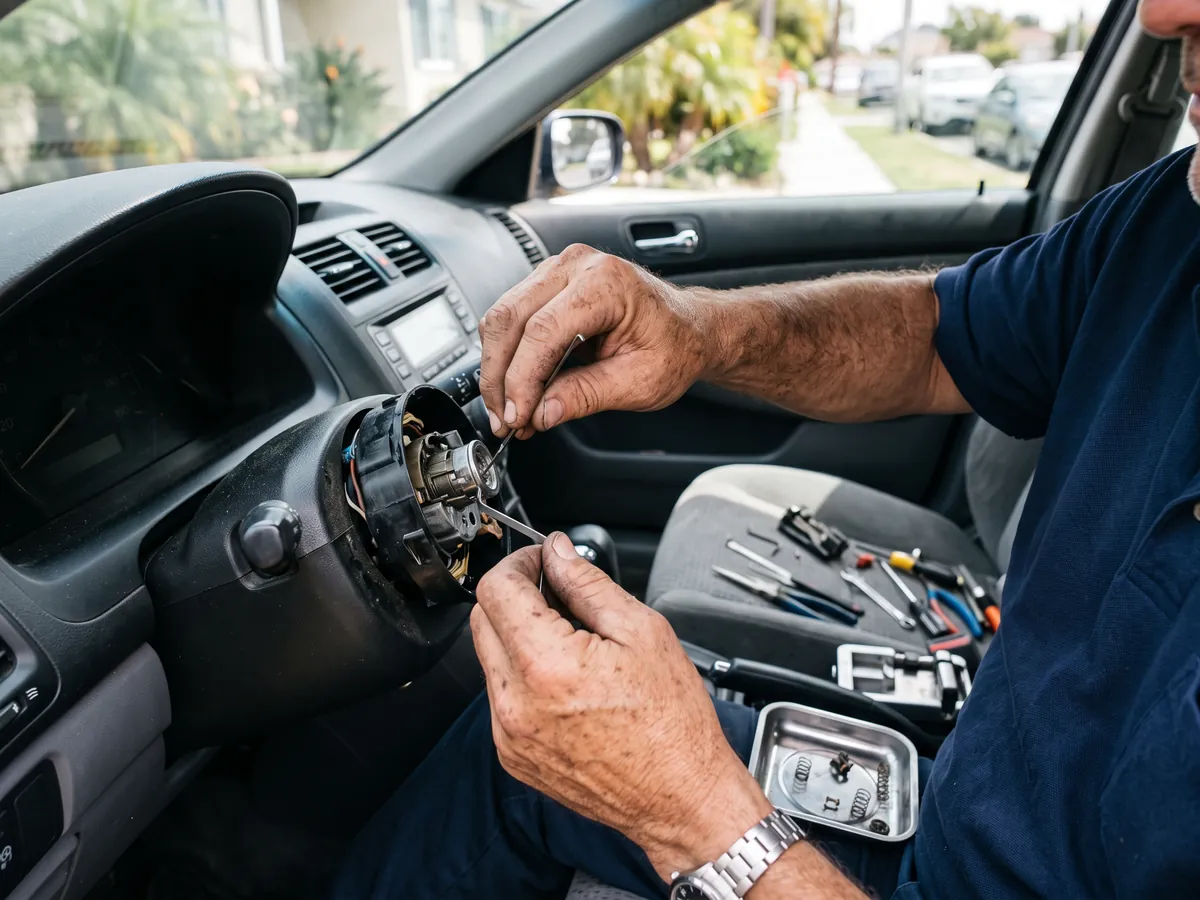
What sits behind the keyhole
Most drivers only ever see the face of the ignition: a slot surrounded by a metal or plastic bezel. Behind it is a small, precise assembly, and knowing its parts makes every repair decision easier to follow.
- The plug is the rotating core. Your key slides into it, and it carries the tumblers.
- Wafers, also called disc or plate tumblers, are flat steel or brass plates stacked in slots across the plug, each pushed by a tiny spring. Most automotive ignitions use wafers rather than the pin tumblers found in house locks.
- The sidebar, used in many designs since the 1990s, is a spring-loaded bar along the side of the plug. It retracts only when every wafer has been positioned correctly, and it is the part that actually blocks rotation.
- The housing, or shell, surrounds the plug and mounts in the steering column or dash. A retainer pin or tab locks the cylinder into it.
- The tailpiece at the back of the plug drives the electrical ignition switch, either directly or through an actuator rod and gear that run down the column.
- The steering lock bolt drops into a slotted collar on the steering shaft when the key comes out, which is why a parked wheel feels solid.
- An antenna ring, or transponder coil, wraps around the cylinder face on most vehicles built since the late 1990s and reads the chip in your key.
In the locksmith sense, ignition repair is mostly about the first five items: the mechanical lock. The switch, the column and the immobilizer all interact with it, though, which is why a good diagnosis looks at the whole chain before any part gets replaced.
Why ignition cylinders wear out
An ignition is the lock you use more than any other you own. A daily driver can rack up a couple of thousand key cycles a year, and every one drags the key's cuts across the wafers. Four things speed that wear along.
Weight comes first. A key ring loaded with house keys, a garage remote and a souvenir bottle opener hangs from the ignition key every time you drive. Each bump in the road and each brush of your knee pries that weight against the plug. Over years the wafer edges polish down and the plug bore can wear slightly out of round.
Key copies come second. A copy traced from a worn key reproduces the wear and adds a small error of its own. Repeat that a few times and a household's keys drift well away from the factory cut, while the cylinder slowly wears to match them.
Environment is third. Fine dust from inland valleys, construction sites and dirt roads packs into keyways. Summer heat bakes lubricant out of columns parked in the sun, and coastal humidity adds corrosion to springs. Oil-based sprays, used with good intentions, collect all that grit into a paste.
Force is last. Turning a binding key harder chips wafers, bends blades and cracks die-cast plugs. Sidebar locks are especially unforgiving: once a single wafer sits out of position, the sidebar stays put no matter how hard you turn. That precision is good security, but it means a sidebar ignition tends to go from mildly sticky to fully locked faster than an older design would.
Symptoms and what they usually mean
The way an ignition misbehaves is the best clue to what has failed. Here is how the common complaints map to likely causes.
- Key won't turn at all and the steering wheel feels solid. The steering lock bolt is loaded by tire pressure. Rocking the wheel while turning the key usually frees it.
- Key turns only after jiggling, or only partway. Worn wafers, a worn key, or both. A spare that works better points to the key.
- Key goes in only partway. Debris in the keyway, a bent blade, a wafer stuck in a raised position, or simply the wrong key.
- Key won't come out. Shifter not fully in Park, a misadjusted park-lock cable, a dead battery on cars with an electric key interlock, or a worn wafer catching a key cut.
- Key turns with no resistance and nothing happens. A broken tailpiece, a worn actuator rod or gear in the column, or a snapped cylinder retainer.
- Key reaches START but the engine doesn't crank. Battery, starter, neutral safety switch or the electrical ignition switch rather than the lock.
- Engine cranks or starts briefly, then dies with a security light showing: the immobilizer isn't reading the key's chip. Suspect the antenna ring, its connector, or the chip itself.
- Dash flickers or the engine cuts out when the key is bumped. Worn contacts in the electrical switch. Treat this as a safety issue and stop driving the car until it's checked.
- Key sticks only in hot weather. Worn wafers sitting at the limit of their tolerance, made worse by expansion and dried lubricant.
Some of these are lock problems and some aren't. Reading the symptom correctly is what keeps an ignition repair from turning into an expensive parts-swapping exercise.
Quick checks before you call
A handful of checks cost nothing, take moments, and solve a surprising share of ignition complaints.
First, work the steering wheel. Turn the key gently toward ON while rocking the wheel left and right. If you parked with the wheels turned or pressed against a curb, you'll feel the lock let go.
Second, reseat the shifter. Press the brake, move the lever out of Park and back in firmly, then try the key again. On column shifters, pulling the lever slightly toward you while turning the key can help a worn park-lock detent engage.
Third, check the battery. If the dome light and dash are dim or dark, a weak battery can stop an electric key interlock from releasing, and it will certainly stop the starter.
Fourth, try the spare. A spare that turns smoothly while your daily key fights is a strong sign the key is the worn part.
Fifth, look at the key itself. Sight down the blade for a bend and check for cracks near the head. A bent key can sometimes be eased straight enough to remove it, but it shouldn't go back into service.
What not to do: no pliers, no hammering, no screwdriver in the keyway, and no repeated soaking with penetrating oil. If one short puff of dry graphite or PTFE lock lubricant doesn't change anything, the cylinder has a mechanical problem that needs parts, and every extra twist risks a broken key on top of it.
Steering lock binding and the park interlock
Two mechanisms outside the lock cylinder cause many of the stuck-key and won't-turn complaints we hear, and neither usually needs parts.
The steering column lock is a spring-loaded bolt that moves into a slotted collar on the steering shaft when you remove the key. With the wheel straight and nothing pushing on it, the bolt slides back out easily the next time you turn the key. Park with the front wheels turned hard, against a curb or on a steep driveway, and the tires twist the shaft until the collar pinches the bolt. The key can't retract it until that pressure is relieved by turning the wheel a little. Hillside streets and tight parking structures produce this constantly.
The park interlock does a different job. On automatic transmissions it keeps the key from returning to LOCK unless the shifter is in Park, so you can't walk away from a car that could roll. Older designs use a cable between the shifter and the ignition; newer ones use an electric solenoid. A stretched cable, a worn shifter detent or a weak battery can leave the key trapped even though the car looks parked.
Both mechanisms wear too. A steering lock bolt that has been forced many times can burr, and the collar can chip. A park-lock cable can slip out of adjustment after console or shifter work. When the quick checks stop working reliably, the fix may be an adjustment or a smaller part rather than a whole new ignition, and a careful diagnosis tells you which.
Rebuild or replace: how the decision gets made
Once the cylinder is out and on the bench, the choice between rebuilding and replacing usually becomes clear. These are the criteria we work through.
Rebuilding is the better option when: - The plug and housing are free of cracks and the plug still rotates without wobble. - Replacement wafers and springs are available for that cylinder family. - The wear is in the wafers and the key rather than in the plug body. - A new cylinder would be dealer-only, expensive or slow to arrive.
Replacement is the better option when: - The plug is cracked, the face is punched, or the cylinder has been drilled. - The wafer slots in the plug are worn so wide that new wafers still rock. - The retainer bore or tailpiece is broken. - The cylinder is a sealed design the manufacturer never intended to be serviced. - Theft damage extends into the housing, which may then need its own replacement.
A third path sits between the two: a new, uncoded cylinder fitted with wafers chosen to match your key. You get new metal throughout while keeping one key for the whole car, and it is often the right answer for cylinders too far gone to rebuild.
Whichever route makes sense, the reasoning should be visible to you. We'll show you the worn wafers or the damaged plug, explain the alternatives and their tradeoffs in cost and timing, and let you choose. If the only sensible part is a cylinder ordered from the dealer by VIN, you'll hear that before any money changes hands.
Keeping the key you already carry
Many drivers assume an ignition repair ends with a new set of keys. That's rarely necessary, and avoiding it has real advantages.
Your current key does two jobs. Its blade operates the mechanical wafers, and on most cars built from the late 1990s on, a transponder chip in its head tells the immobilizer that the key is genuine. Keep the key and you keep a chip the car already trusts. Change the key and new chips must be programmed or cloned, which adds equipment, time and occasionally a dealer visit.
Coding a cylinder to your key works like this. We read the key's cuts with a key gauge or decoder, or use the factory code when it's available, and compare them with factory depths. If the key is worn, we cut a fresh one to code first, because a cylinder matched to a tired key will feel sloppy from day one. Each wafer position in the plug then receives the wafer size that sits flush with that cut. The plug is tested outside the housing with every key you own before it goes back in.
The result is one key for the ignition, doors, trunk and glovebox, just as the car left the factory. If a previous owner left you with mismatched keys, the same process works in reverse: we usually recode the door and trunk cylinders to match the ignition key, since that key already holds the programmed chip. Either way, you stop carrying two keys for one car.
Removing a cylinder when the key won't turn
Ignition cylinders are designed to come out only when the plug is turned to a service position, usually ACC or ON, so a thief can't simply pull them. That's sensible until your own key stops turning.
With a working key, removal is mostly a matter of knowing the design. Many Ford columns have a small access hole beneath the cylinder where a punch depresses the retaining pin, and many Toyota columns use a similar pin once the lower cover is off. Many GM columns rely on a release tab reached after removing trim. Imports vary widely, and some cylinders can only be removed after the column covers and switch come off.
Without a working key, the plug has to reach that service position another way. We start by picking it, using ignition picks or a two-in-one pick and decoder made for that keyway, which positions each wafer the way a correct key would. Picking also reveals the key's cuts, which lets us cut a new key on the spot. It takes patience on worn sidebar locks, but it leaves the cylinder intact and often rebuildable.
Drilling is the last resort, used when the cylinder is already damaged or picking isn't practical. A controlled drill path defeats the retainer or the wafer stack, but it destroys the cylinder, and the metal chips must be kept out of the switch and column bearings.
Throughout, steering columns deserve respect. Airbag clock springs, multifunction switch harnesses and immobilizer wiring all share that space, and a careless pry can trigger warning lights that only a scan tool will clear.
Immobilizers, anti-theft systems and electronic ignitions
Mechanical repair is only half the story on most modern cars, because the ignition is tied into anti-theft electronics.
Transponder systems place a coil antenna ring around the cylinder face. When the key turns to ON, the ring energizes the chip in the key head and reads its code. During ignition repair the ring is unplugged, removed and reinstalled, and a cracked ring or loose connector produces a crank-then-stall no-start that can look like a failed repair. Checking it is part of finishing the job.
Some systems need more than a reinstalled ring: - GM's VATS, used on a range of GM cars from the late 1980s into the early 2000s, reads a resistor pellet embedded in the key blade. The cylinder's contacts must be clean and intact, and any new key needs the matching resistor value. - GM's Passlock, found on many GM cars and trucks from the late 1990s into the 2000s, puts a sensor in the cylinder housing. Replacing the cylinder can set the theft-deterrent system, which then needs a timed relearn before the engine will run. - Many Chrysler, Dodge and Jeep models from around 2008 onward use a wireless ignition node, a dash-mounted module that the fob-style key slides into. When it fails, the repair is a module service or replacement, and some units require dealer-level programming. - Push-button vehicles have no key cylinder at all. Problems there involve smart keys, start buttons, brake switches and electronic steering column locks, and several of those are dealer or specialist repairs.
We'll be straightforward about which category your car falls into. Where a job needs dealer software or a dealer-only module, we say so at the start rather than after a wasted visit.
Theft damage, recalls and regional wear
Some ignition repairs begin with a crime. Older cars without immobilizers have always been targets, and in recent years many turn-key Hyundai and Kia models built without a factory immobilizer became notorious once methods for starting them spread online. A typical attack cracks the column shroud, pulls or punches the cylinder, and turns the switch directly. Owners of those vehicles should ask a dealer whether the manufacturer's free anti-theft software update or other theft-deterrent measures apply to their VIN, and consider a visible steering wheel lock.
After an attack, photograph the damage, file a police report and contact your insurer before repairs begin. A replacement cylinder keyed to your existing key, plus any housing or actuator parts the damage requires, usually returns the car to normal.
Recalls are worth checking too. The best known is GM's 2014 recall of several million small cars, including the Chevrolet Cobalt and Saturn Ion, whose ignition switches could slip out of RUN under the weight of a heavy key ring or a jolt. Enter your VIN at nhtsa.gov/recalls before paying for ignition work, since recall repairs are performed by dealers at no charge.
Regional conditions shape the rest. Inland valleys bring summer heat that dries lubricant and weakens springs, plus dust from construction, agriculture and Santa Ana winds. Foothill parking loads steering locks. Areas near the coast add humidity and salt. Long commutes pile up key cycles. None of these alone ruins an ignition, but together they explain why so many cylinders in Southern California wear out well before the rest of the car.
What drives the price of ignition repair
Ignition repair pricing varies more than most locksmith work because vehicles differ so much. Rather than a one-size number, here are the factors that move a quote up or down.
- Removal method. A cylinder that comes out with your key is quick; one that has to be picked takes longer; one that must be drilled requires a replacement part.
- Rebuild or new part. Rebuilding uses inexpensive wafers and springs. A replacement cylinder adds a part whose cost depends heavily on the make and on whether a dependable aftermarket option exists.
- Key situation. Keeping your current key avoids blanks and programming. A worn key adds one fresh code-cut key. Lost keys add decoding, cutting and transponder programming.
- Vehicle design. Tilt and telescoping columns, actuator-driven switches, tight dash layouts and anti-theft relearns all add labor.
- Damage. Theft attempts and forced keys can add housing, actuator or switch parts.
- Extras. Spare keys, door lock recoding and remote service are optional and priced separately.
We ask enough questions on the phone to give you a realistic estimate, then confirm a firm price at the car before any tools come out. If something unexpected appears once the shroud is off, such as a cracked housing, we stop and requote before going further. You won't find a surprise line item on the invoice that you didn't approve first.
Ownership checks, licensing, hours and service area
Because ignition work gives someone the ability to start a car, we verify ownership every time. Expect to show a photo ID that matches the registration, title or lease agreement. If the car belongs to a family member, an employer or a lender, call ahead so we can tell you what documentation will work.
Julian's Locksmith holds California locksmith company license LCO7891, issued by the Bureau of Security and Investigative Services, which administers the state's Locksmith Act (Business and Professions Code section 6980 and following). You can confirm the license yourself at search.dca.ca.gov.
We're a mobile service based in San Bernardino, and the van comes to you throughout the Inland Empire, the San Gabriel Valley, the Pomona Valley, north Orange County and southeast Los Angeles County. Hours are 6:30 a.m. to 11:30 p.m., every day of the week. We're closed overnight, between 11:30 p.m. and 6:30 a.m.
To get started, call (951) 903-3193 or email info@julians-locksmith.com with the vehicle's year, make and model, what the key is doing, and where the car is parked. We'll ask a few diagnostic questions, give you an honest ETA, and quote the work before we begin. If the problem turns out to be outside ignition repair, such as a starter or wiring fault, we'll tell you so and point you in the right direction instead of selling you a cylinder you don't need.
Frequently asked questions
How long should a rebuilt ignition last?
There's no fixed number, because wear depends on how often you drive, how heavy your key ring is and whether the key stays in good shape. A properly rebuilt cylinder with new wafers, fresh springs and a correctly cut key should behave like a healthy original part. The best ways to stretch its life are a light key ring, a dry lubricant instead of oil, and replacing the key itself once its cuts start to look rounded.
Can a worn ignition shut the engine off while I'm driving?
It can. Worn contacts in the electrical switch, or a switch whose detent has weakened, can drop out of RUN when the key is bumped or dragged by a heavy key ring. That cuts engine power and, on some cars, power steering assist and airbag readiness. If your engine ever stalls when you touch the key, stop driving the car, take the extra keys off the ring, check for recalls by VIN, and have the ignition and switch inspected.
Are aftermarket ignition cylinders any good?
Quality varies. Some aftermarket cylinders are well made and accept standard wafer kits, which makes coding them to your key straightforward. Others use softer metal or loose tolerances and wear out quickly. We choose parts by vehicle family and use OEM cylinders when the aftermarket choices for your car aren't dependable. If the only good part has to come from the dealer, we'll explain the wait and the cost before ordering it.
Why did the ignition I bought online come with its own keys?
Most retail replacement cylinders are pre-coded to a random key so they work straight out of the box. Installing one leaves you with a different key for the ignition than for the doors, and on a transponder car the new key's chip still has to be programmed. A locksmith can usually recode that cylinder to your existing key instead, although some pre-coded cylinders can't be re-wafered. Ask before installing it yourself.
Do classic cars without chip keys need the same repair?
The mechanical work is similar and often simpler. Many older vehicles use wafer cylinders without sidebars or transponders, so a rebuild or a recoded replacement is all it takes. Parts for uncommon classics can be harder to find, and an original cylinder is often worth rebuilding to keep the car correct. GM cars with VATS resistor keys are the main exception, since the resistor value has to match as well.
What should I do if my ignition fails while you're closed?
Make sure you're safe and the car is legally parked, then try the steering wheel, shifter and spare-key checks. If the car can stay where it is, leaving it until we open often costs less than a tow. We're closed overnight, after 11:30 p.m., and we open at 6:30 a.m. every day. Call (951) 903-3193 when we open and we'll schedule the repair.
Is it safe to keep driving with a sticking ignition key?
Short term, usually, but it's a gamble. A sticking cylinder can refuse to turn the next time you start the car, strand you far from home, or trap the key so you can't lock up and walk away. In rare cases a binding key won't let the cylinder return fully to OFF. The cheapest time to repair a worn ignition is while the key still turns, because removal is simple and rebuilding is still an option.
Will insurance cover ignition damage from a theft attempt?
Many comprehensive auto policies cover theft and attempted-theft damage, subject to your deductible, but coverage varies by insurer and by policy. Call your insurer before repairs if you plan to file a claim, take photographs of the column, and get a police report number. We provide an itemized invoice describing the damage we found and the parts and labor used, which is what most adjusters ask to see.
Ignition Repair by city
Local details, routes and answers for ignition repair in each city we cover across four counties.
San Bernardino County
Riverside County
Los Angeles County
- Rosemead
- San Gabriel
- Temple City
- Arcadia
- Sierra Madre
- Monrovia
- Duarte
- Bradbury
- El Monte
- South El Monte
- Baldwin Park
- West Covina
- Covina
- Azusa
- Irwindale
- Glendora
- San Dimas
- La Verne
- Pomona
- Claremont
- Diamond Bar
- Walnut
- La Puente
- City of Industry
- Hacienda Heights
- Rowland Heights
- Avocado Heights
- Charter Oak
- Valinda
- West Puente Valley
- South San Gabriel
- East San Gabriel
- North El Monte
- Citrus
- La Habra Heights
- La Mirada
- Cerritos
- Artesia
- Hawaiian Gardens
- Lakewood
- Bellflower
- Norwalk
- Downey
- Pico Rivera
- Whittier
- Santa Fe Springs