
Perris, Riverside County
Rekey Your Business Locks in Perris and Retire the Old Keys
Short answer: Rekey when the lock body is sound and only the key's secrecy is the problem. Replace when the lock is worn, damaged, residential grade on a heavy-use door or out of code. Julian's Locksmith examines each commercial door in Perris, shows you the parts that argue for replacement and prices both choices side by side before work begins. Call (951) 903-3193.
If you lease your space in Perris, the first question about rekeying isn't about pins, it's about who controls the cylinder. Many landlords run a building-standard keyway with their own emergency key, and some leases require that a copy of any new key goes to the property manager. Others let tenants change locks freely as long as the originals are restored at move-out. Read the lease or ask your manager before we start, and tell us what you find. Julian's Locksmith will rekey what you're allowed to rekey, leave landlord-controlled cylinders alone and note the difference on the work order. Call (951) 903-3193.
Commercial Lock Rekey in Perris: what to expect
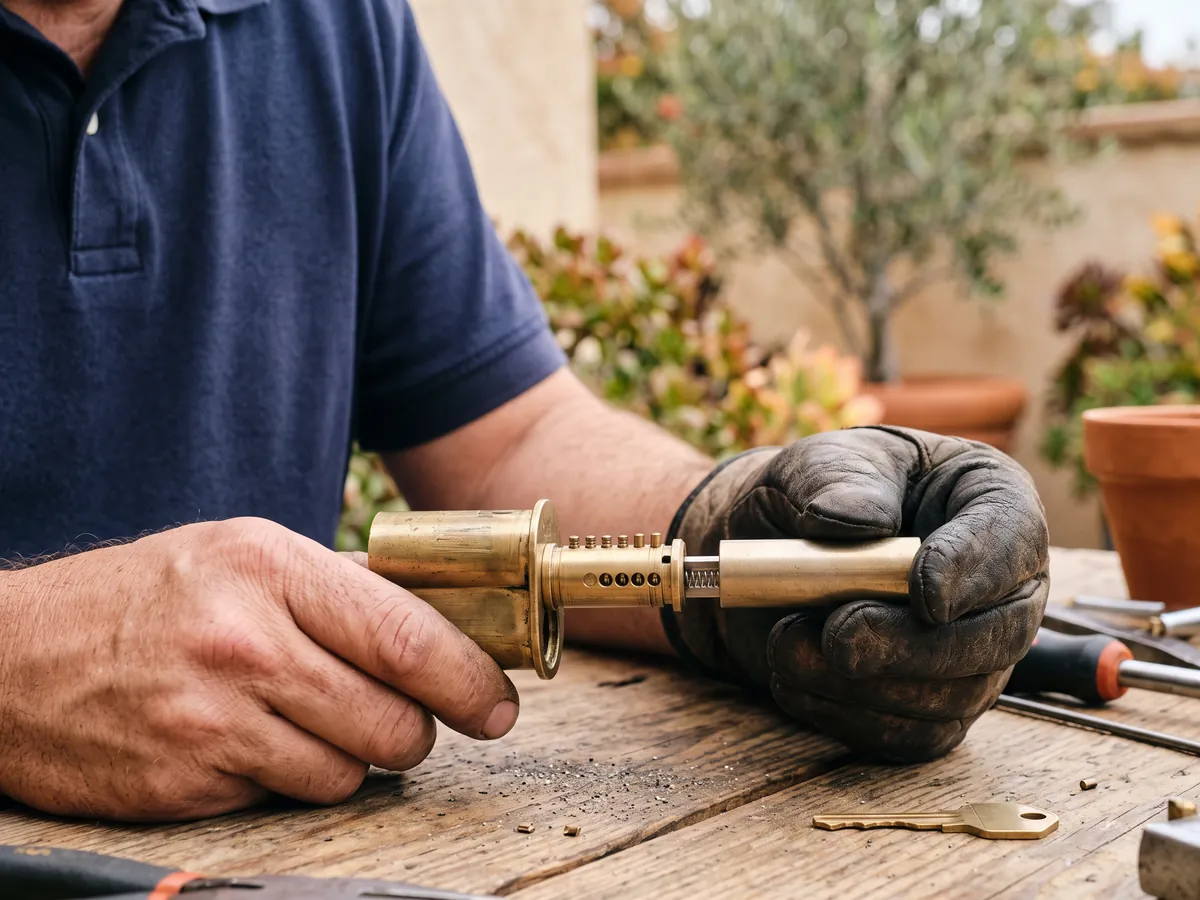
Think of three tools. Re-pinning keeps the cylinder and changes its pins; it suits sound cylinders on a standard keyway. Recoring applies to interchangeable-core locks, where we swap the whole core for one pinned to the new key, often the fastest option for a many-door system. Replacement fits when the cylinder is worn, damaged or built so cheaply that it won't hold up, when its keyway has been discontinued or when you want to move to a restricted keyway whose keys can't be copied freely. A keyway change can't be done by re-pinning, because the shape of the slot is fixed. The same goes for a lock body that is residential grade on a heavy-use door, cracked or out of code, such as a double-cylinder deadbolt on an exit. We examine each lock, show you the wear we find and give you pricing for both paths side by side. Many businesses end up with a mix, rekeying the sound locks and replacing the two or three that argue for it.
What we can do on-site
- Rekeying under a landlord's building standard. Suite doors in office and industrial parks can sit on a master key you don't control. When the landlord's master is the problem, your options are to ask the landlord to re-master, to add a second, tenant-controlled lock where the lease allows, or to leave the suite door alone and secure the interior doors instead.
- Forgotten openings that stay on the old key. Rekey lists tend to leave out roof hatches, electrical and riser rooms, sprinkler closets, alarm-panel boxes and key switches. Those cylinders are often decades old and still on keys handed out long ago. We look for them on the walk-through and quote them with the main doors.
- Worn, stuck or damaged cylinders. Cylinders damaged in a prying attempt often show scratches, a bent tailpiece or a plug that no longer seats. We check the door, strike and frame as well, since a rekey won't help a frame that has been spread. Damaged parts are replaced and priced separately.
- Alike, different and master: planning which doors share a key. Before we pin anything, we sort the doors. Back-of-house doors might share one key, the front door and office another, and a manager's key might open both. Keyed-alike groups are simple; keyed-different doors need more keys. We sketch the plan with you and keep it to one page.
- Proof that the old keys are dead. A rekey's value is a failed key, so we prove it. At each rekeyed door we try an old key and show it won't turn the plug, then try the new key and cycle the lock. If you have old keys on hand, give us one per door and we'll use them for the test.
What's different about Perris
Child care centers, tutoring studios and small schools in Perris's family neighborhoods have to balance security with quick, safe exits. Keep key levels simple, put a thumbturn or lever on exits so staff never need a key to leave, and rekey when a teacher or volunteer leaves. We check that exit hardware works for small hands and adult hands alike.
Summer heat across inland Southern California dries out cylinders and expands metal. Exposed rear-door cylinders and gate padlocks take the worst of it and can seize or bind right after a rekey if they were already marginal. We clean and lubricate each cylinder with a dry lubricant, test it warm when we can and replace cylinders on exposed doors that show wear.
Converted houses used as offices, salons or small shops in older Perris neighborhoods often mix residential locks with commercial needs. A knob and a deadbolt from the 1960s can be rekeyed, but they may not meet commercial egress rules or hold up to staff use. We rekey what's sound and recommend commercial-grade levers or exit hardware where the occupancy and the code call for it.
Example situations
- For example, a small dental office near Perris High School lets a hygienist go. She returns her key, but the practice wants more than that. We rekey the front, supply room and records closet, and remind the office manager that the alarm code, the supply cabinet combination and the keypad PIN are separate changes a rekey doesn't cover.
- A typical call: an auto repair shop near D Street has three bay doors, an office and a parts room, each on a different key left behind by three owners. The current owner wants fewer keys on every ring. We identify the keyways, re-pin the compatible cylinders to one shop key, swap two worn ones and give the office its own key.
- A franchise owner finishes a build-out in a shopping center and receives a ring of contractor keys along with the permanent set. Before opening, we pin the entry, stockroom and office to a final set of keys, collect the contractor's keys against a sign-off and hand the owner a one-page chart showing which key opens what.
- Picture a child care center whose front door has a keypad lock with a mechanical override. The director changes the keypad code herself, but the override key is still the one given to a former assistant. We rekey the override cylinder, check that the door releases freely from inside and show that the old key no longer turns.
Step by step with Julian's Locksmith
- List every opening. Before the visit, list every key-operated opening: exterior doors, interior doors, roll-up doors, padlocks, cabinets, roof hatches and alarm boxes. Count them, even the ones you rarely use. A complete list is the difference between a firm quote and a rough guess, and it keeps a forgotten door from staying on the old key.
- Identify the cylinders on site. While we're there, we test door operation: closer sweep, latch retraction, strike alignment and whether the door locks as intended. A rekey exposes problems that habit had hidden. We report what we find and leave the repair decision to you.
- Decide rekey, recore or replace, door by door. If a lock is a poor candidate for rekeying, we show you why: a loose plug, a missing part, a keyway with no available blanks. Sometimes replacing a cylinder costs about the same as rebuilding it, and we say so honestly, so you aren't paying for labor that isn't worth it.
- Choose the key system and quantities. If you want a master or manager's key, now is the time to say so. We explain how a master adds pin work and why it should stay with one or two people. If that's more than your business needs, we'll suggest a simpler layout that still gives you a clear key for each level.
- Re-pin, cut and test. We work from the van. Each cylinder comes out, gets rebuilt to the new key, goes back in and is tested with the new key before the next one starts. Doors are never left open or unlatched, and we ask you which entrances must stay usable during the work.
- Prove the old keys are dead and close out. We also give you a close-out list: collect old keys, update alarm and keypad codes, review credential lists and decide who holds spares. Rekeying is the central step, but these small tasks complete it. If you'd like, we'll walk through the list before we leave.
Pricing factors
- Cylinder family and pin count. Common commercial families, such as standard mortise and rim cylinders, come with readily available pins and blanks, which keeps the job straightforward. Less common keyways or proprietary lines take longer to source and sometimes need factory-held parts. We tell you early if your cylinders fall into that group.
- Re-pinning versus replacement parts. Replacement parts vary widely. A basic mortise cylinder is inexpensive; a restricted, patented one costs considerably more and comes with controlled blanks. If you're upgrading to a higher-security keyway, expect the parts to be the largest part of the bill, and ask us to price a phased plan.
- Key quantity and key type. Cutting by code from a record is faster than copying from a worn key, and it gives cleaner results. If we're building a small system, we cut keys on site and test them in the rebuilt cylinders, which adds a little time but prevents a drawer full of keys that stick.
Every job gets a clear quote before any work starts. Call (951) 903-3193 with the details and we'll tell you what to expect for your situation in Perris.
Mistakes to avoid
- Rekeying only the front door. Back doors, loading docks and roll-up gates are where intruders head because they know owners overlook them. Include every exterior opening and any interior door that guards cash, records or stock. Walk the list once in daylight and once after closing, when forgotten doors tend to show themselves.
- Paying to re-pin a cylinder that is already failing. A plug that spins, pins that stick or a bent cam will keep misbehaving. Test first, replace what fails and pin the replacement to the same key as the rest of the system.
- Rekeying the locks but leaving the keypad PIN, alarm code and safe combination as they were. A former employee who remembers a code doesn't need a key at all. List every secret, not just every key, and change each at the same visit.
What to do before we arrive
- Gather every old key you can find, even the odd ones. We use them during testing to prove they no longer work, and they help us spot keyways you didn't know you had. Bag them by door if you can, and don't throw any away until after the test.
- Look for double-cylinder deadbolts, chains, hasps or padlocks on exit doors. They block escape, and a fire inspector will flag them. Mention them during the visit. We can swap them for hardware that opens without a key from inside while keeping the outside secure.
- Treat an interchangeable-core control key like a master. Keep it locked up, give it to one or two people and write down who holds it. Anyone with a control key can pull cores, so losing one is a bigger event than losing a door key.
- Make a door list before you call, and count every keyed point, not just doors: padlocks, roll-up doors, cabinets, roof hatches and the alarm-panel key switch. A complete list is the difference between a firm quote and a rough guess, and it keeps a forgotten opening from staying on the old key.
Getting to Perris
Perris is about 32 miles from our San Bernardino base, roughly 37 minutes in light traffic via University Parkway to I-215 South through San Bernardino, Colton and Grand Terrace, along the SR-60 overlap in Riverside and past March Air Reserve Base. When you call, you get an arrival estimate based on where the technician is and the traffic at that moment.
Homes and businesses just off Harley Knox Boulevard are routine stops for us. Give the suite or unit number and any gate instructions, and say whether the van can park out front or should pull into a side lot.
About Perris: The 2020 census counted 78,700 Perris residents, and the Census Bureau's 2024 estimate put the population at 83,032.
| Neighborhoods | Rider Street tracts near Avalon Elementary, Pinacate area along South A Street, May Ranch, West Perris toward Mead Valley and Good Hope, South Perris near Case Road and Ethanac Road, Downtown Perris |
|---|---|
| ZIP codes | 92570, 92571 |
| Main routes | I-215, SR-74, Ramona Expressway, Perris Boulevard |
| From our San Bernardino base | about 32 miles via University Parkway to I-215 South through San Bernardino, Colton and Grand Terrace, along the SR-60 overlap in Riverside and past March Air Reserve Base; exit Harley Knox Boulevard or Ramona Expressway for north Perris, Nuevo Road or D Street for downtown, Ethanac Road for the south side |
Business lock or door work in Perris?
Call (951) 903-3193 with the address, the doors or hardware involved and when the site is open. We'll quote the job before any work starts and book a time within our hours that suits your schedule.
Frequently asked questions
What's the difference between rekeying and recoring?
Rekeying changes the pins inside a cylinder you keep. Recoring applies to interchangeable-core locks: we pull the figure-eight core with a control key and install a core already pinned to the new key. Recoring is often faster across many doors, but it needs a working control key and the right core platform. We tell you which fits your locks.
What if my business uses a master key system?
Rekeying a master-keyed lock takes extra care because each cylinder carries master pins. We can change individual cylinders, re-master a set or build a new hierarchy. We need your key records or permission to decode the existing system. We explain the scope before pricing, since master systems affect every cylinder.
My landlord controls my locks. Can I still rekey?
It depends on the lease. Some landlords keep a building-standard cylinder and an emergency key and don't permit changes, while others allow tenant rekeys with a copy for the manager. Check the lease or ask your property manager, and send us the answer. We won't touch landlord-controlled cylinders without clear authorization.
How long does a commercial lock rekey take?
It depends on the cylinder count, the lock types and whether any need replacement. A few doors are often a single visit, while a large building takes longer or is phased. Interchangeable cores go faster than conventional cylinders. After the walk-through we give you a realistic time frame instead of a number promised over the phone.
Can exit devices and panic bars be rekeyed?
The cylinder on an exit device's outside trim or dogging can be rekeyed like any other rim or mortise cylinder. The device itself doesn't change. We also check that the bar releases freely from inside, because egress rules require that. If the device is damaged or worn, we can quote a repair or replacement.
How much does a commercial rekey cost?
We don't post flat prices because the job varies. The main factors are the number of cylinders, their type and condition, whether you want restricted keys, how many keys you need, the structure of the key system and your timing. We walk the space, then give you a written quote before starting. Call (951) 903-3193 to begin.
How far is Perris from your base?
Perris is about 32 miles from our San Bernardino base, roughly 37 minutes in light traffic. Arrival time depends on traffic and on the job the technician is finishing, so we give you an estimate on the phone before you commit.
Related services in Perris
Commercial Lock Rekey in nearby cities
- Commercial Lock Rekey in Good HopeRiverside County
- Commercial Lock Rekey in Mead ValleyRiverside County
- Commercial Lock Rekey in RomolandRiverside County
- Commercial Lock Rekey in NuevoRiverside County
- Commercial Lock Rekey in Quail ValleyRiverside County
- Commercial Lock Rekey in March Air Reserve BaseRiverside County
- Commercial Lock Rekey in HomelandRiverside County
- Commercial Lock Rekey in MenifeeRiverside County