Orange, Orange County
Keypad Access Control in Orange: Choose, Install, Manage
Short answer: A keypad is only as secure as the way its codes are managed. One shared code that never changes is convenient and weak, because it can't say who came in and it can't remove a former employee. Personal PINs on a networked keypad fix that. For Orange back-of-house doors, storage rooms and gates they work well; for cash and records, pair the PIN with a card.
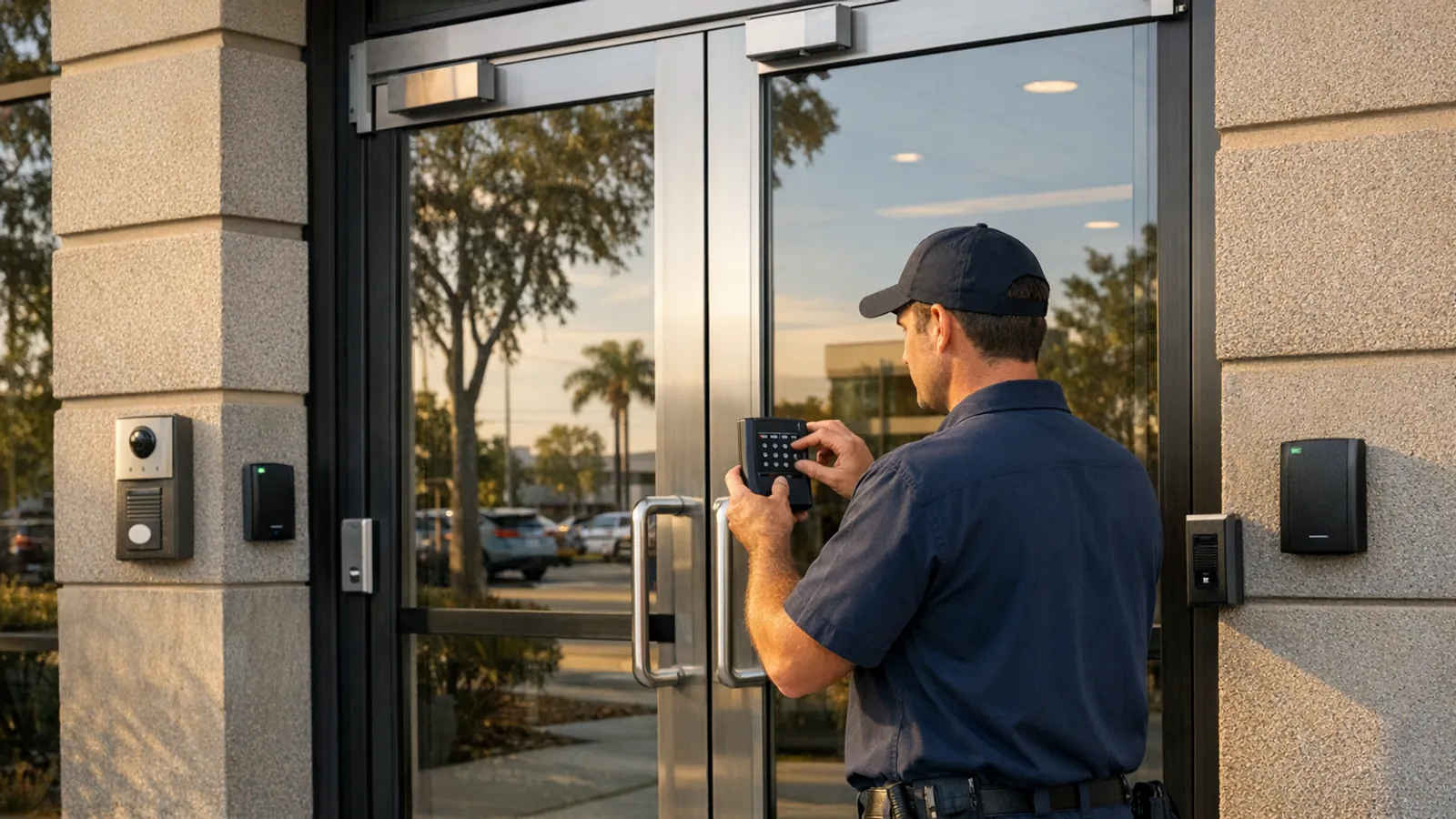
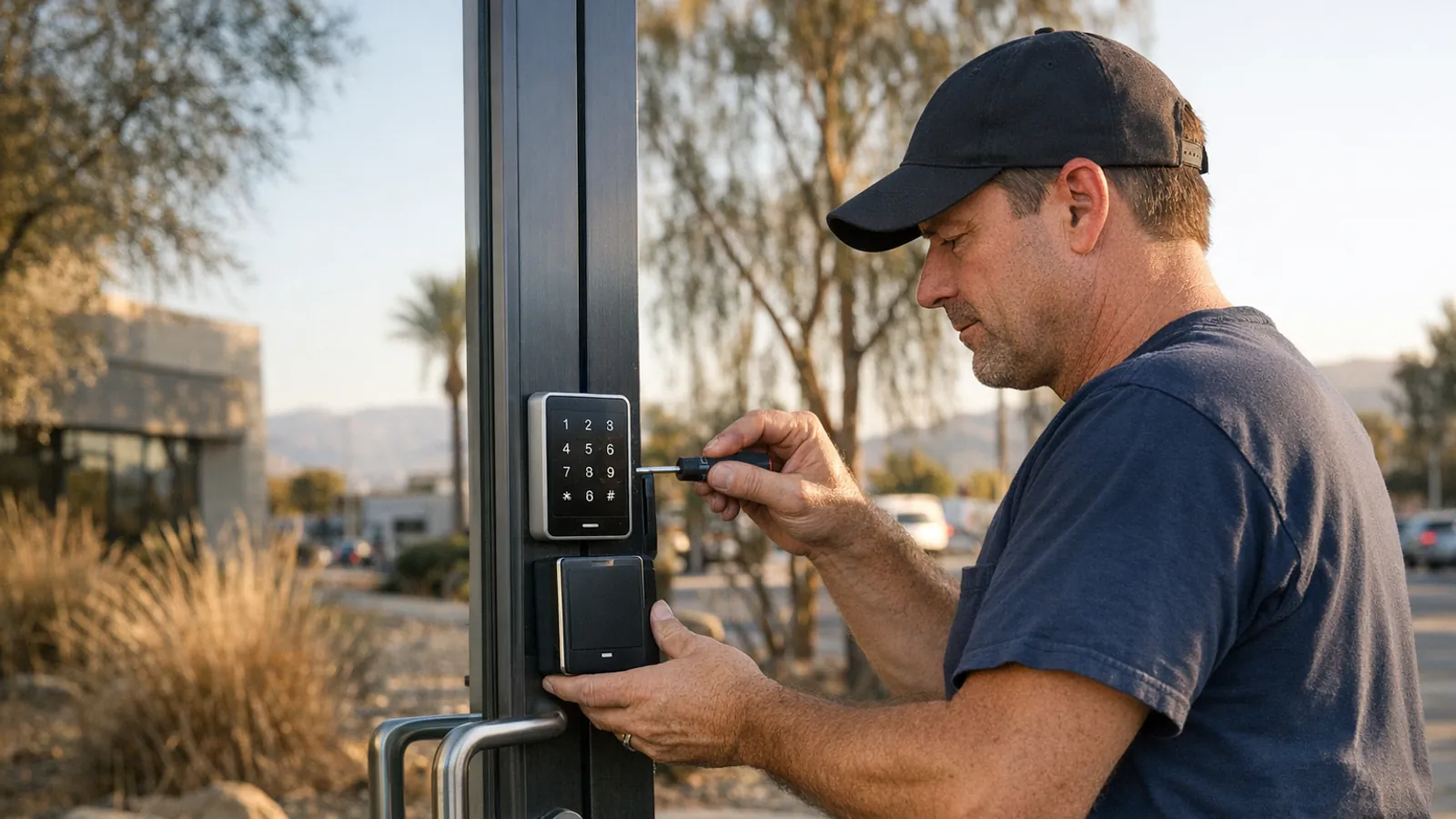
Keypads on outdoor doors live a hard life in Orange. Summer sun bakes the faceplate, sprinklers soak the back plate, and a gate or loading door gets used hundreds of times a week. Keypad access control for gates, side yards, trash enclosures and dock doors needs sealed metal hardware, a sensible mounting spot and a power plan that survives the weather. Julian's Locksmith chooses hardware for the location rather than the catalog photo: backlit, rated for rain and dust, and mounted where people can reach it without craning. We also look at the door or gate itself, because a gate that won't latch makes any keypad pointless.
Keypad Access Control in Orange: what to expect
A code is a credential like any other, with quirks that cards and keys don't have. It can be watched, guessed, shared and forgotten, but it can't be dropped in a parking lot. Length is the first lever: four digits allow 10,000 combinations, six allow a million and eight allow a hundred million. Most systems also offer a lockout, so several wrong tries disable the keypad briefly, which makes guessing impractical at any length. The second lever is ownership. A code assigned to one person can be removed alone and traced in the log; a shared code can do neither. The third is time. Schedules and expiration dates let a cleaner's PIN work only on the evenings the crew is booked and let a contractor's PIN die on the last day of the job. Some systems add a duress code that opens the door and quietly alerts someone. Add a card for two-step entry on sensitive doors, and a leaked code alone no longer matters. Keypad access control in Orange works best when you decide these things first and buy hardware second.
How we can help in Orange
- Standalone keypad locks for single doors. A standalone keypad stores its codes inside the lock, so there's no controller, software or network cable to maintain. We mount it on stock rooms, offices, utility closets and side entries, set the master code and enter each user code. It's the quickest way to retire a shared key ring on one door.
- Outdoor and vandal-resistant keypads. A keypad on a gate post, loading dock, dumpster enclosure or side-yard door needs weather sealing and a metal face. We install sealed, backlit stainless or zinc-alloy units, mount them at a reachable height, and gasket the back plate so water and dust stay out. Plastic keypads rarely last a summer in direct sun.
- Electric strikes and electrified locks driven by a keypad. Cutting a strike into an aluminum storefront frame, a steel hollow-metal frame and a wood jamb are three different jobs with different templates. We check the frame type, the latch on the door, and whether a fire label limits what can be changed before we pick the strike.
- Keypad repair and replacement. When a manufacturer discontinues a model, a direct replacement may not exist. We look for a unit with the same cutout and wiring footprint, or modify the door prep. If the lock is old enough that repairs cost more than a modern commercial replacement, we'll tell you and show the comparison.
- Mechanical key override and backup. Every keypad lock needs a way in when the battery dies or the board fails. We install or rekey the override cylinder, keep it on a separate key from your main system when that makes sense, and label which key opens which door. A dead keypad then becomes an annoyance rather than a lockout.
Local factors in Orange
Clinics and medical offices near Orange Transportation Center and the historic Santa Fe depot need controlled supply rooms, medication areas and records storage. Privacy rules for patient information expect reasonable limits on who can enter, and an audit trail helps. We use keypad-plus-card readers on sensitive doors and plain PINs on staff areas, with individual codes so a departure never forces a whole-office code change or a nervous afternoon.
Older downtown buildings in Orange bring narrow stairwells, multi-tenant floors and doors that have been patched over the years. Keypads help suite doors, shared stairwell entrances and cleaning-crew access without rekeying the whole floor. Historic frames can limit how much we cut, so we survey first and may choose surface-mounted or less invasive hardware, then coordinate with the building owner before touching common doors.
Horse properties in Orange have tack rooms, feed rooms, barn doors and arena gates that stay dusty, damp and in constant use. A weather-rated keypad lets boarders, trainers, farriers and vets enter on set days without hunting for keys. Dust-proof housings and a mounting spot away from hoses and sprinklers keep these keypads working through the season. We also set codes for the farrier and vet to expire.
Situations this covers
- A veterinary clinic stores controlled medications in a back room. A keypad alone isn't enough there, so we install a card-and-PIN reader on that door, keep the staff entrance on PIN only, and leave the audit log with the practice manager. The cabinets inside stay separately locked, because a door is only one layer of the storage plan.
- A shop owner arrives at 6:45 a.m. to find the standalone keypad on the back door dead. The batteries were last changed years ago, and the low-battery beeps went unnoticed. We open the door with the override key, fit fresh lithium cells, test the lock and write the install date inside the door so the next change doesn't come as a surprise.
- A typical call: a dental office near UCI Medical Center has used the same four-digit code on its supply room since opening. Staff have come and gone, and nobody remembers who knows it. We replace the keypad lock with a model that supports individual codes, give each employee a personal PIN, remove the old one, and show the office manager how to delete a code the day someone leaves.
- A distribution warehouse brings in seasonal temps each fall. The break-room door and parts cage get a networked keypad reader, so each worker receives a PIN tied to the start and end dates of the assignment. When the contract ends, the code stops working without anyone remembering to delete it, and supervisors can pull the log if a tool goes missing.
Step by step with Julian's Locksmith
- Tell us about the doors and the people. For a keypad that's misbehaving, tell us the make if you know it, what happens when you press a key and when the batteries were last changed. A video of the beeps or lights and a photo of the model label are enough for us to bring the right parts.
- Choose standalone or networked. We also weigh the building. Thick concrete, long cable distances and doors in separate buildings all push the decision. Standalone locks avoid cabling altogether, while a networked system needs a controller location, power and cable paths that we map before anything gets quoted.
- Survey the door, frame and power. For networked keypads the survey includes where the controller will sit, how cable gets from the reader to it, where power comes from and whether a ceiling space or conduit can be used. If the path crosses finished walls, roofs or rated assemblies, we may recommend a low-voltage contractor.
- Install the keypad and locking hardware. On gates and outdoor posts we mount the keypad on a solid surface, seal the cable entry, check alignment of the latch and test it across the temperature swings of a typical day. If a gate operator is involved, we coordinate release wiring with that technician rather than guess.
- Program codes, schedules and admin settings. We change the manufacturer's default master code first, since defaults are printed in public manuals. Then we enter user codes, choose code length, set lockout after failed tries, and record the master code in a handoff sheet for you, not on a sticky note stuck to the cabinet.
- Test, train and hand over. Before we leave, we test every code from outside, confirm the door opens from inside with no code, try a wrong code to see the lockout behavior and operate the override key. You get a short written summary: where the master code is kept, what each door does and what to do when something fails.
How we quote the job
- Standalone or networked. Standalone keypads cost less to install because there's no controller, cable pull or software, but each door is managed separately. Networked keypad readers add a controller, power supply and cabling, and in return you get central user lists and logs. The more doors you have, the more the networked approach makes sense.
- Outdoor exposure and mounting. A sealed, backlit, weather-rated metal keypad costs more than an indoor plastic one, and it earns the difference on a sun-baked wall. Skipping the rating on an outdoor door usually leads to replacement within a season or two, which ends up costing more than buying right.
- Programming scope and software. Training and documentation are part of the work. If more than one person will manage codes, or you want a printed procedure, tell us. A little extra time at handoff keeps your system from turning into something only we can operate.
Every job gets a clear quote before any work starts. Call (951) 903-3193 with the details and we'll tell you what to expect for your situation in Orange.
What to do before we arrive
- Use the longest code your keypad accepts and your staff can remember. Four digits give 10,000 possibilities and six give a million. Avoid birthdays, addresses, repeated digits and straight runs like 1234, which are the first guesses anyone makes, and never use the last digits of the business phone number.
- Keep the master code and programming instructions on paper in a locked place, with a named backup person. A frequent call we hear is some version of nobody knows the master code. A sealed envelope in a safe can save a service visit and sometimes a replacement lock.
- Don't depend on a keypad alone for the rooms that matter most. Cash, medication, personnel records and server equipment deserve a second step, such as a card plus a PIN, and a log you review. A keypad is a good gatekeeper for shared spaces and a weak sole defense for sensitive ones.
- Look at the keypad itself every few months. Digits with a shiny or faded finish show which numbers get pressed most, and that narrows a stranger's guesses a great deal. When wear shows, replace the keypad rather than just changing the code.
What not to do
- Skipping the mechanical override or never testing it. When the batteries or board fail, the key is the only way in. If it's lost, stuck in a seized cylinder or was never cut, a dead keypad becomes a lockout and a service call.
- Mounting a keypad with its own relay on the outside of the door. If the switching electronics sit in the exposed housing, a pry bar and a few seconds can reach the wires that open the lock. The decision-making part belongs on the secure side.
- Choosing the cheapest outdoor keypad for a sun-facing wall. Heat softens plastic keys, sprinkler spray finds poorly sealed housings and the display fades. You end up replacing it within a season and wondering why it was ever sold as weatherproof.
Reaching Orange
Orange is about 52 miles from our San Bernardino base, roughly 60 minutes in light traffic via I-215 South through Colton and Grand Terrace to SR-91 West. When you call, you get an arrival estimate based on where the technician is and the traffic at that moment.
Once the evening commute thins out on SR-22, drive times usually shrink. That makes an evening call before closing a practical option for non-urgent jobs that you couldn't fit into the workday.
About Orange: Orange Park Acres was founded in 1928 as an equestrian community, and almost all of its homes sit on lots of at least 20,000 square feet.
| Neighborhoods | Olive Heights, Chapman University area, Old Towne Orange, Fairhaven Eichler tract, Fairmeadow Eichler tract, El Modena |
|---|---|
| ZIP codes | 92865, 92866, 92867, 92868, 92869 |
| Main routes | I-5, SR-22, SR-55, SR-57 |
| From our San Bernardino base | about 52 miles via I-215 South through Colton and Grand Terrace to SR-91 West (Riverside Freeway) through Riverside, Corona and the Santa Ana Canyon, then SR-55 South (Costa Mesa Freeway) to the Chapman Avenue exit; west on Chapman Avenue for Old Towne and the Plaza, east on Chapman Avenue for El Modena, Santiago Canyon College and Orange Park Acres; alternate via I-10 West to SR-57 South and the Chapman Avenue exit for The City district, The Outlets at Orange and UCI Medical Center when the 91 is jammed |
Business lock or door work in Orange?
Call (951) 903-3193 with the address, the doors or hardware involved and when the site is open. We'll quote the job before any work starts and book a time within our hours that suits your schedule.
Frequently asked questions
How much does keypad access control cost in Orange?
It depends on standalone versus networked, the number of doors, door and lock hardware, wiring and power, outdoor exposure and any software fees. We don't quote by guesswork or phone teasers. We look at your doors, give a clear quote before starting, and when the choice is close, price both a standalone and a networked version so you can compare.
Can you add a keypad to a door I already have?
Usually. Standalone keypad locks fit standard door preps, and we can add an electric strike in the frame for a networked keypad reader. The door must close and latch properly first, and fire-rated, glass and aluminum storefront doors need specific hardware. We check the door and frame during the survey and tell you honestly if something won't work.
Can I combine a keypad with cards or fobs?
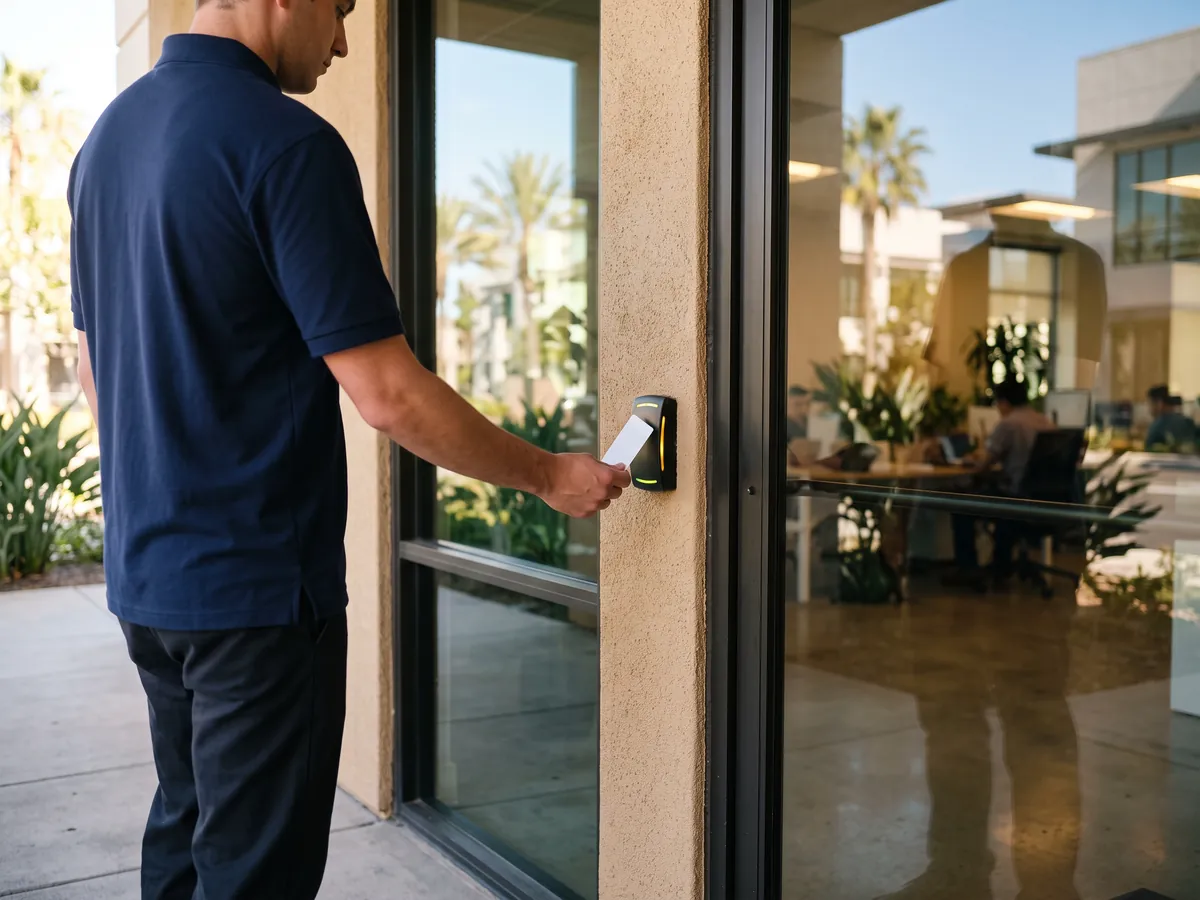
Yes. Many readers combine a keypad with a card or fob reader, so a door can accept a card alone in the daytime and require card plus PIN after hours. We check that the reader and controller speak the same format. If you already have a card system, ask about adding keypad readers on the doors that need extra control.
What happens if the power or batteries die?
It depends on the lock. Standalone keypads usually warn with low-battery beeps for a while and have a keyed override. Networked doors use a power supply with battery backup, and fail-secure locks stay locked from outside but always open from inside, while fail-safe hardware releases when power drops. We choose each door's behavior with you before installing.
How do I remove a former employee's code?
On a networked system, delete that person's user record and the code stops working at every door. On a standalone lock, delete the code at the keypad using the master code, and if everyone shared one code, change it and tell the remaining people in person. We can show you the procedure for your model or do the change for you.
How is keypad access control different from a keypad door lock?
A keypad door lock is one self-contained product for one door, with codes managed at the keypad. Keypad access control is the broader idea of managing who gets in, which can mean many doors, user groups, schedules and a log. The same hardware can be either, depending on whether doors connect to a controller and software.
How far is Orange from your base?
Orange is about 52 miles from our San Bernardino base, roughly 60 minutes in light traffic. Arrival time depends on traffic and on the job the technician is finishing, so we give you an estimate on the phone before you commit.
Related services in Orange
- Access Control in Orange
- Access Control Installation in Orange
- Keypad Lock Installation in Orange
- Commercial Keyless Entry in Orange
- Card Access System in Orange
- Key Fob Access Control in Orange
- Keypad Gate Lock in Orange
- Employee Access Control in Orange
- Electric Strike Installation in Orange
- Credential-Based Entry in Orange
Keypad Access Control in nearby cities
- Keypad Access Control in Villa ParkOrange County
- Keypad Access Control in TustinOrange County
- Keypad Access Control in Santa AnaOrange County
- Keypad Access Control in AnaheimOrange County
- Keypad Access Control in PlacentiaOrange County
- Keypad Access Control in Yorba LindaOrange County
- Keypad Access Control in FullertonOrange County
- Keypad Access Control in Garden GroveOrange County