
Orange, Orange County
Access Control Installation in Orange
Short answer: The cost of access control installation in Orange depends on how many doors you're securing, the door and frame construction, which electrified lock suits each opening, cable distance and building type, the software platform and card format, and any fire-code work. We walk the site first and give a written door-by-door quote. Nothing gets drilled or wired until you approve it.
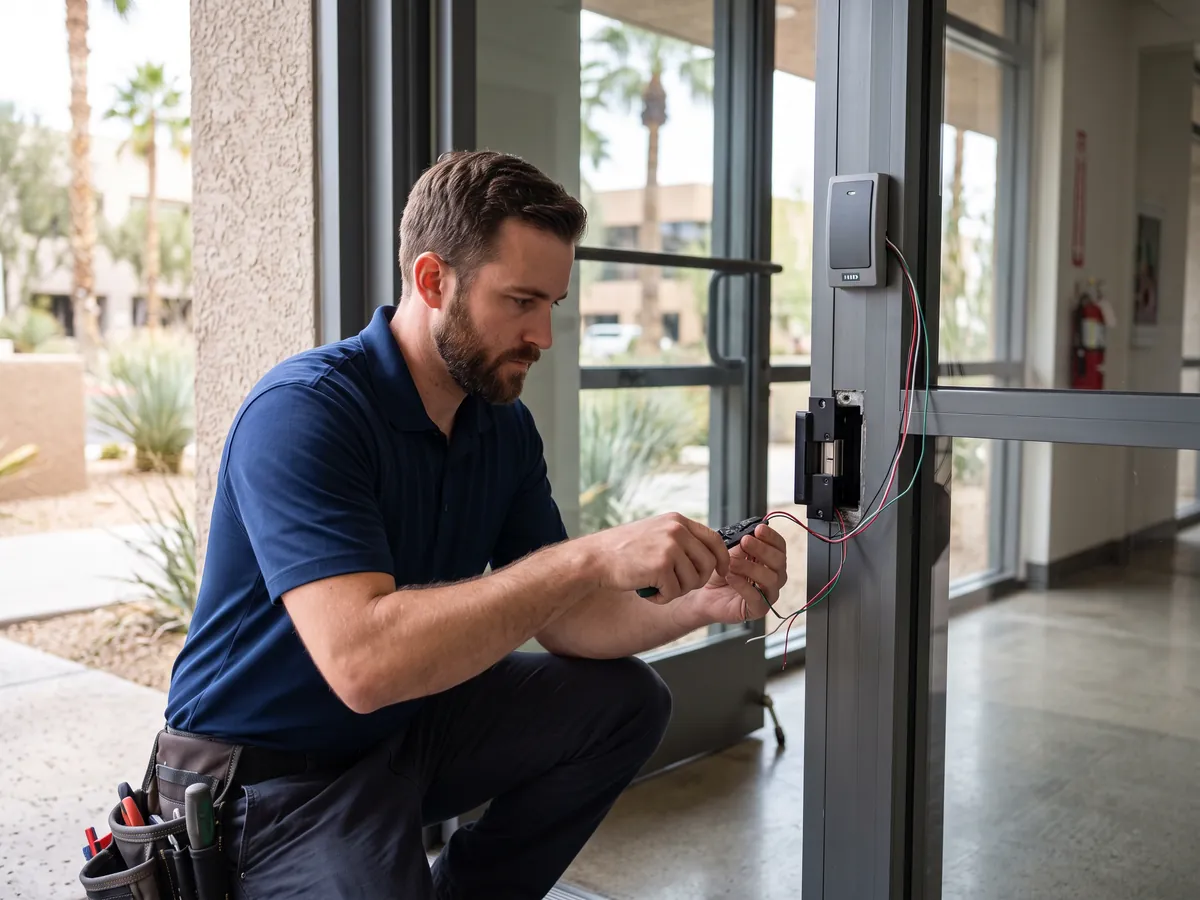
Every key you've ever handed out is still out there somewhere. Former employees, a cleaning crew from two vendors ago, the contractor who finished the remodel. Access control replaces that uncertainty with credentials you can issue in seconds and cancel just as fast, plus a record of which door opened and when. Julian's Locksmith handles the full access control installation for Orange businesses and properties: we survey the doors, pick hardware that suits each frame, run and terminate the wiring, mount readers and program the system with you. The result should feel boring in the best way. Staff badge in, the door releases, it closes and relocks, and nobody calls you at home about a key.
An access control installation begins with a site survey, not a catalog. We walk the building and check which doors need control, how each door is built, where power and network can run, and how people really move through the space. Orange buildings make that walk interesting. Old Towne brick walls and plaster ceilings make cable runs difficult to hide. Newer buildings along City Drive and Chapman Avenue allow easier pulls, but their aluminum frames limit what a strike or mag lock can mount to. The main design choice is the lock and its failure mode. An electric strike keeps the existing latch and suits doors with a standard mortise or cylindrical lock. A magnetic lock holds a door shut with magnetism and releases when power is cut, which is fail-safe. Fail-secure hardware stays locked without power. Egress rules require that people inside can always leave, often with a request-to-exit device, or REX, that releases the lock when someone approaches. Cabling, a power supply with battery backup, reader placement and credential programming all belong in the job. Integration with fire alarms and large networked systems may need a low-voltage contractor, and permits can apply.
Access Control Installation in Orange: what to expect
The controller and software decide how you'll live with the system day to day. A standalone keypad or reader with its own relay is the simplest option for one or two doors, programmed at the device, with limited logs. Battery-powered electronic locks with built-in readers skip most of the cabling and suit interior offices, though batteries need a replacement schedule and some models only receive changes when they check in. Wired controllers, either on-premise or cloud-managed, handle many doors with schedules, holiday rules, user groups, alarms and remote unlocking from a phone. Cloud platforms usually involve a per-door subscription and depend on an internet connection for management, although well-designed controllers keep enforcing the last known card list if the connection drops. For an access control installation in Orange, we recommend the smallest platform that covers your next five years, not the largest one a catalog can sell, and we make sure you own your admin credentials and your data.
Work included on a typical visit
- Electric strike installation. Most strikes we install run fail-secure: the door stays locked if power drops, while the inside lever always lets people out. Fire-rated openings require a fire-listed strike, and those are fail-secure. We check latch alignment, the deadlatch plunger position and door pressure so the strike releases cleanly every single time.
- Electrified locksets and exit devices. Doors with panic bars can be controlled by electric latch retraction, which pulls the latch in when a valid badge is read or during scheduled unlock hours. It's quiet, works well with automatic openers and reduces wear on busy entrances. These devices need a matching high-inrush power supply, which we size and install.
- Request-to-exit sensors and door position switches. Exit sensors and contacts are inexpensive compared with the trouble they prevent. Without them, logs fill with false alarms, a propped door goes unnoticed and staff learn to ignore alerts. Our Orange installs include both on every controlled door unless you choose a simpler standalone setup and understand what you're giving up.
- Power supplies, battery backup and fire alarm release. Long outages are a real planning question. A fail-secure door stays locked when batteries run down, so card holders may need a mechanical key override, while a fail-safe door releases. We size battery standby for how long you need doors working in Orange and make sure someone holds a key that still works.
- Cabling, conduit and pathways. Distance changes the wire. Wiegand readers are generally limited to a few hundred feet, while OSDP over twisted pair runs much farther. Lock power on long runs needs heavier gauge to avoid voltage drop, a common reason a strike buzzes but won't release. We calculate each run before pulling cable.
What's different about Orange
Businesses whose staff commute long distances often open early. Access control schedules can unlock a front door at 6 a.m. or let staff badge in before managers arrive. We plan schedules around shift starts and set alerts for doors left unlocked after the last person leaves, so a manager already stuck in traffic on Glassell Street doesn't need to turn around and check a door.
Storefronts in Orange shopping centers usually have aluminum narrow-stile doors with deadlatches or hookbolts and a steel rear exit with a panic bar. Card access on the front often uses a strike made for aluminum jambs or a latch retraction kit, while the rear exit gets a rim-device strike for deliveries. Property management approval is common, and landlord rules may decide where cable can run across the shared ceiling.
Older downtown buildings mix original wood doors, plaster walls and later steel frames, and many are multi-tenant with a shared lobby. For access control installation in Orange's business districts, we work within building rules, use plenum-rated cable above shared corridors, and often match the building's card format so tenants carry a single badge. Historic facades can also limit where an exterior reader may be mounted.
Common situations
An insurance office on Tustin Street wants a card reader on the front door. The door is aluminum and glass with a narrow-stile frame. We would survey the door, choose a fail-secure electric strike that suits the lock already there, run low-voltage cable above the ceiling to a power supply in the supply closet, add a REX sensor inside, and program a card for each of the eight employees. Everyone leaves through the door freely, and a lost card is turned off in minutes.
- Picture a medical clinic near The Outlets at Orange that keeps medications in a back room. The administrator wants every entry recorded and the door locked whenever it closes. We'd recommend a fail-secure electrified mortise lock, powered through a transfer hinge so nothing shows, with PIN plus card at the reader. A keyed cylinder remains for emergencies, and only two managers carry that key on their rings.
- For example, a dental office in a Fairhills Eichler strip center wants card access on its aluminum front door and steel back door. The storefront jamb is narrow, so we plan an electric strike made for aluminum frames and a slim mullion reader. The back door gets a fail-secure strike, a motion exit sensor and a door contact. Staff receive encrypted cards, and the office manager learns to cancel one from a phone.
- A retail shop's rear exit in Orange opens onto an alley and has a rim panic bar. Staff need to badge in from the alley with deliveries, but the bar must stay free for exit at all times. For example, we'd add a surface-mounted strike designed for rim exit devices, a reader beside the frame and an exit switch in the bar, leaving the door's emergency exit function exactly as it was.
Step by step with Julian's Locksmith
- Survey and authorization. Expect questions you may not have considered. Is the door fire-rated? Does the building have a fire alarm panel? Where's the nearest 120-volt circuit? Who will manage users? Those answers determine hardware, power and whether another licensed trade belongs on the project.
- Design, door schedule and written quote. You choose the platform and credentials with our input: standalone keypads, a wired controller or a cloud-managed system, and cards, fobs or phones. We flag code items, such as maglock egress devices or fire alarm release, and note any work that needs a permit or a separate licensed contractor.
- Rough-in: cable and power. Long runs get voltage-drop math before the wire is pulled, so lock power arrives at full strength. Exterior runs go in conduit rated for sun and water. Where a cable must cross a fire-rated wall, the penetration is sealed afterward with listed firestop material.
- Door hardware, readers and sensors. We set each door so the hardware can do its job: closer speed adjusted to latch every time, hinges tightened, strike alignment checked against the deadlatch plunger, maglock armatures floated to seat flat. A door that latches reliably by hand is a door that will lock reliably by badge.
- Programming and integration. Where the design calls for it, the lock power supply receives its fire alarm input, video or intrusion integrations are connected by the relevant contractor, and cloud systems are registered to your account, not ours. You own the admin credentials from the first day.
- Testing, handoff and documentation. Handoff includes the dull but valuable parts: labeled cables, a printout of every door's hardware, model numbers for future parts and a short quarterly checklist. A well-documented access control installation in Orange is far easier to expand, repair or hand over to a new manager.
How we quote the job
- Door and frame construction. Hollow metal frames take electric strikes cleanly. Aluminum storefront jambs need specific narrow strikes or a different approach. Frameless glass usually means a maglock. Wood frames may need reinforcement. Each construction changes hardware choice, labor and sometimes whether the frame needs repair before anything electrified goes in.
- Locking hardware choice. Better hardware costs more and fails less. Heavy-duty strikes with preload ratings, monitored locks that report latch status, and stainless components for exposed doors add to the initial price but cut service calls on doors that open hundreds of times a day.
- Platform, software and credentials. Think about total cost over several years, not just installation day. Subscription fees, card replacement, battery changes on wireless locks and future expansion all count. We'll help you compare a Orange quote on a five-year basis instead of looking only at the hardware line.
Every job gets a clear quote before any work starts. Call (951) 903-3193 with the details and we'll tell you what to expect for your situation in Orange.
Advice before you book
- Plan for heat on exterior readers. West- and south-facing doors in inland Southern California get extremely hot in summer, especially on dark metal frames. Check the reader's operating temperature rating, consider a hood or shade, and avoid mounting on surfaces that soak up direct afternoon sun.
- Talk to your fire authority before installing maglocks. Requirements for sensor release, push-to-exit buttons and fire alarm interlocks are specific, and some occupancies carry extra restrictions. An early conversation or plan submittal costs far less than removing a maglock after an inspector refuses to sign off.
- Get written landlord approval for leased spaces in Orange. Most commercial leases restrict alterations to doors and frames, and some buildings require you to match their lobby system or use a preferred vendor. A short email confirming approval saves disputes at move-out, when restoration clauses come into play.
- Keep a mechanical override on fail-secure doors. If the controller fails or batteries run out during a long outage, a keyed cylinder is how authorized people get in. Decide who holds that key, keep the count low, and put override keys on a restricted keyway if possible.
Common errors that cost time and money
- Mounting readers without thinking about reach and approach. Accessibility rules limit operable parts to heights a wheelchair user can manage, and readers placed on the hinge side or behind a door swing frustrate everyone. Settle placement during the survey, not with a drill already in hand.
- Letting an installer keep control of the system. Some businesses discover years later that the cloud account, admin password or panel programming belongs to someone else. Insist that you own the admin credentials, software account and documentation from the first day, in your company's name.
- Relying on a motion sensor alone to release a maglock. Motion sensors can miss short people, wheelchair users and slow movement. Code-compliant maglock egress generally requires a separate push-to-exit button that cuts lock power directly and holds the door free on its own timer, plus release on fire alarm.
Getting to Orange
Orange is about 52 miles from our San Bernardino base, roughly 60 minutes in light traffic via I-215 South through Colton and Grand Terrace to SR-91 West. When you call, you get an arrival estimate based on where the technician is and the traffic at that moment.
Stuck on the shoulder or in a parking lot along SR-55? Get somewhere safe, turn on your hazards, and give us the nearest exit or business so we can find the car without guessing.
About Orange: Alfred Chapman and Andrew Glassell held about 5,400 acres along Santiago Creek, and access to that water shaped where the original townsite was laid out.
| Neighborhoods | Olive Heights, Orange Hills, Fairhills Eichler tract, El Modena, North El Modena, Orange Park Acres |
|---|---|
| ZIP codes | 92865, 92866, 92867, 92868, 92869 |
| Main routes | I-5, SR-22, SR-55, SR-57 |
| From our San Bernardino base | about 52 miles via I-215 South through Colton and Grand Terrace to SR-91 West (Riverside Freeway) through Riverside, Corona and the Santa Ana Canyon, then SR-55 South (Costa Mesa Freeway) to the Chapman Avenue exit; west on Chapman Avenue for Old Towne and the Plaza, east on Chapman Avenue for El Modena, Santiago Canyon College and Orange Park Acres; alternate via I-10 West to SR-57 South and the Chapman Avenue exit for The City district, The Outlets at Orange and UCI Medical Center when the 91 is jammed |
Business lock or door work in Orange?
Call (951) 903-3193 with the address, the doors or hardware involved and when the site is open. We'll quote the job before any work starts and book a time within our hours that suits your schedule.
Frequently asked questions
How long does access control installation take in Orange?
It depends on scope. A standalone keypad or reader on one door with existing wiring can often be finished in a single visit. Multi-door systems usually take several days spread across survey, rough-in, hardware and programming, plus waiting time for specialty parts. We give you a realistic schedule with the quote and work around your business hours where possible.
Should I use an electric strike or a maglock?
An electric strike is usually the first choice when the frame allows it: it keeps mechanical egress, runs fail-secure and looks like standard hardware. A maglock suits frameless glass, doors without frame space and some gates, but it needs extra code-required egress devices and a fire alarm release. We recommend based on your door, not a preference for one product.
What happens if a reader or lock fails after installation?
Call us at (951) 903-3193. We troubleshoot the hardware, wiring and controller, replace failed components and retest the door. Documentation from the original installation speeds this up considerably. Mechanical overrides on fail-secure doors keep authorized people moving while the repair is arranged. Our hours are 6:30 a.m. to 11:30 p.m. every day of the week.
What kind of cards or fobs should I use?
For new systems, encrypted 13.56 MHz credentials such as DESFire EV3, HID Seos or iCLASS SE are much harder to clone than 125 kHz prox. Fobs suit residents and staff who don't wear badges. Mobile credentials on phones work with many current platforms. We help match the credential to your security needs and any reader hardware you already own.
Can you install access control on a glass storefront door in Orange?
Yes. Aluminum-framed storefront doors can usually take a narrow electric strike designed for aluminum jambs, an electric latch retraction device or a maglock. Frameless all-glass doors typically need a maglock with glass door brackets or a specialized bottom rail lock. We look at the door, frame and current lock before recommending an approach.
What is a request-to-exit device, and do I need one?
A request-to-exit device, usually called a REX, signals the controller that someone is leaving so the exit doesn't register as a forced door. It may be a motion sensor above the door, a switch in the lever or panic bar, or a push button. On maglock doors, exit devices also release the lock, and code sets specific requirements for them.
How far is Orange from your base?
Orange is about 52 miles from our San Bernardino base, roughly 60 minutes in light traffic. Arrival time depends on traffic and on the job the technician is finishing, so we give you an estimate on the phone before you commit.
Related services in Orange
- Access Control in Orange
- Electric Strike Installation in Orange
- Magnetic Lock Installation in Orange
- Commercial Keyless Entry in Orange
- Card Access System in Orange
- Panic Bar Installation in Orange
- Commercial Door Hardware in Orange
- Door Closer Repair in Orange
- Storefront Lock Repair in Orange
- Master Key System in Orange
Access Control Installation in nearby cities
- Access Control Installation in Villa ParkOrange County
- Access Control Installation in TustinOrange County
- Access Control Installation in Santa AnaOrange County
- Access Control Installation in AnaheimOrange County
- Access Control Installation in PlacentiaOrange County
- Access Control Installation in Yorba LindaOrange County
- Access Control Installation in FullertonOrange County
- Access Control Installation in Garden GroveOrange County