
Montclair, San Bernardino County
Replace Broken Lock Hardware in Montclair the Right Way
Short answer: Signs you need to replace broken lock hardware rather than adjust it: the knob spins freely, the key turns without moving the bolt, a lever droops, or the housing is cracked. If the bolt only sticks when the door is shut, the strike is usually the culprit. In Montclair, Julian's Locksmith diagnoses which problem you have before selling you anything.
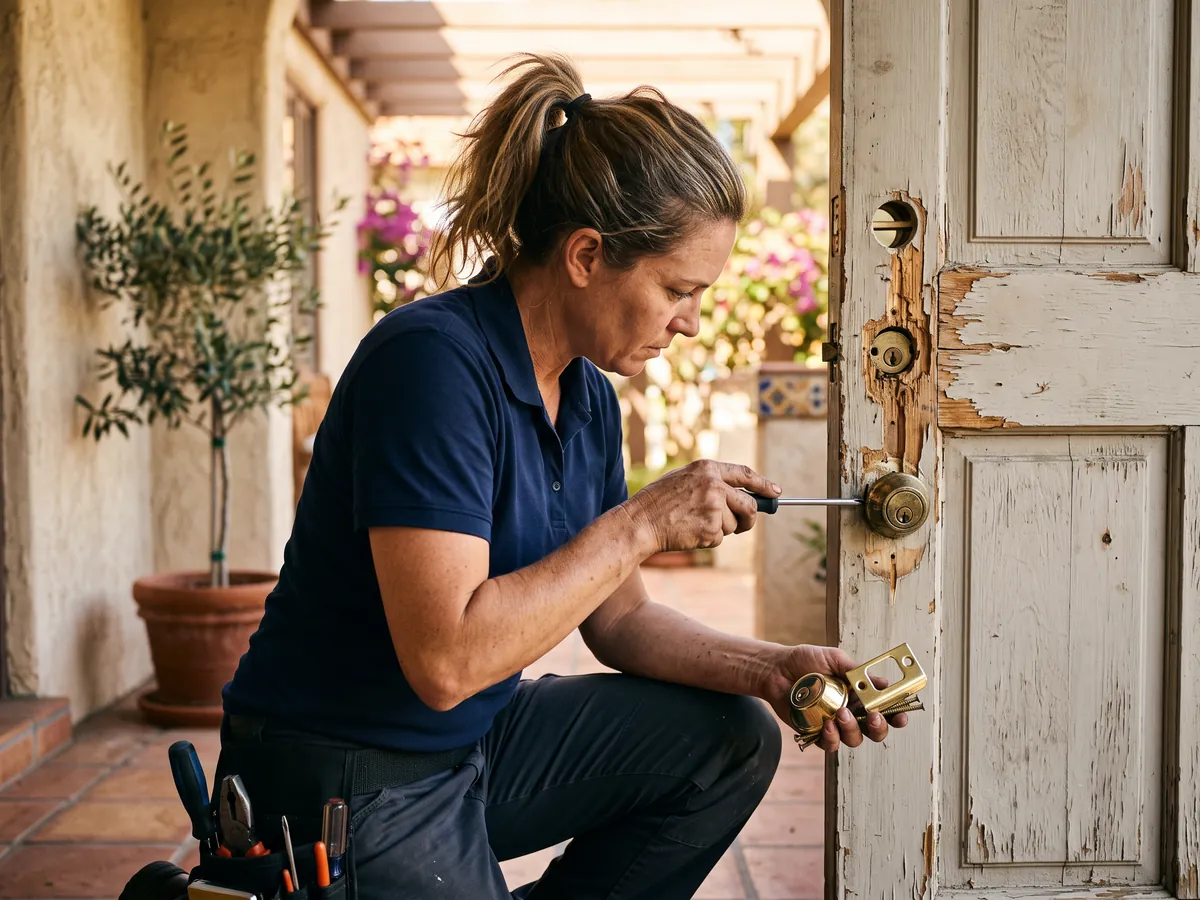
A broken lock at a business is more than a nuisance. If the front door won't lock, somebody has to stay; if the back door won't latch, there's an open door onto the alley. Julian's Locksmith replaces broken commercial locks across Montclair: storefront deadlocks, Grade 1 levers, mortise locks, panic bar trim and rim cylinders. We match the lock's function so storerooms still lock automatically and exits still open without a key, and we keep your existing key or master key system working. Tell us the door type and what's failed when you call (951) 903-3193, and we'll load the likely parts.
What to know first in Montclair
Locks rarely break from normal use alone. Doors in Montclair live through heat, dust, settling foundations and wind, and the lock absorbs the strain whenever the door moves. A door sagging on worn hinge screws drags its bolt against the bottom of the strike until the bolt mechanism cracks. A strike that has crept out of line makes you push or pull the door to turn the key, and that extra torque snaps tailpieces and keys. Commercial doors with failing closers slam the latch into the frame over and over all day. Heavy key rings, yanking the door shut by the key, and sprayed oil that collects grit all add wear. So when we replace a broken lock, we also check the hinge screws, the strike alignment, the closer if there is one, and the gap around the door, then correct what we find. Swapping the lock without fixing the cause just means another call next year.
Work included on a typical visit
- Deadbolt replacement when the bolt or tailpiece fails. A deadbolt that turns but never moves the bolt usually has a snapped tailpiece or a stripped cam inside the bolt assembly. On builder-grade sets those parts are cast zinc and aren't sold separately. We pull the old unit, check the bore and backset, and install a Grade 1 or Grade 2 deadbolt keyed to the key you already carry.
- Opening a door stuck shut by a broken lock. Out-swing doors with exposed hinges sometimes offer a cleaner path: pull the hinge pins, swing the door free from the hinge side, and replace the lock with the door open. It only works on some doors, and we'll tell you honestly whether yours is one. Afterward we can add hinge security studs so nobody else uses the same trick.
- Mortise lock body repair or replacement. Mortise locks, found in older homes and many commercial doors, have a steel case inside the door with springs and levers that eventually break. A broken mortise lock is often repairable, and the case can be swapped without re-cutting the pocket. We identify the maker, measure the case and backset, and source a compatible body.
- Exit device and panic bar trim replacement. On a panic bar door, the broken part is often the outside trim: a lever that spins, or a pull whose cylinder no longer retracts the latch. Von Duprin, Sargent and Detex trims are usually replaced as a unit. We match the device model and function so the door still opens from inside without a key, as code requires.
- Patio door, gate and French door lock replacement. Side gate locks break from sun, rust and Santa Ana gusts slamming the gate. A broken gravity latch or keyed gate lock leaves the pool, side yard and trash area open. We replace it with weather-resistant hardware sized to the gate post and frame, and key it to your house key if you want one key for everything.
Local factors in Montclair
Apartment locks get heavy use and frequent turnover, so broken levers, worn cylinders and loose deadbolts come up often. In most cases the landlord or management company should authorize the replacement. We work with property managers in Montclair to replace broken locks on occupied units, key the new cylinder to the unit's current key or a new one, and deliver keys to the office with a note about what failed.
Older homes in Montclair often have original locks that predate today's standard sizes: odd backsets, oversized bores, mortise locks from makers long out of business. When one of these breaks, the replacement question is part matching, part preservation. We look first at repairing or re-casing the original, then at modern hardware that fits the existing holes. Wood doors that have dried and shrunk over decades also shift, so we check the strike and hinge alignment before anything new goes in.
Storefront locks take punishment from constant customer traffic, delivery carts and doors that never fully close. When a hookbolt stops throwing or a deadlatch paddle breaks, the shop either can't open or can't close. For businesses along the retail strips of Montclair, we carry common Adams Rite parts, cylinders and cams, and we try to get the replacement done before your next shift so you're not leaving someone behind to guard the door.
Example situations
- Picture a short-term rental host whose keypad deadbolt stops accepting codes on a Sunday afternoon, with guests arriving that night. The lock is out of warranty and the motor is stripped. We'd install a replacement the host chose over the phone, set up the guest code, and leave the mechanical override key with the host, plus a note on where to store a backup.
- For example, a 1950s home with its original mortise entry lock: the thumb latch on the handle does nothing, and the knob turns freely. Inside the case, a spring has snapped. Because the owner loves the original brass, we'd first look at repairing or replacing just the case. If parts aren't available, a modern mortise body can often fit the same pocket and keep the look.
- Imagine a keypad deadbolt on a west-facing front door in Montclair. After a few summers in direct afternoon sun, the keypad cracks, the motor grinds, and the batteries die every few weeks. We'd open it with the backup key, check the strike, and find the bolt rubbing. The owner picks a replacement smart lock, and we correct the alignment before installing it.
- For example, a new homeowner tries the Kwikset SmartKey reset with the tool from the box. Partway through, the cylinder scrambles: now no key turns it, and the door has been left unlocked overnight. We'd remove the deadbolt from the inside, install a new cylinder or deadbolt, and key it to a fresh key that the previous owners never held.
Step by step with Julian's Locksmith
- Tell us what the lock is doing. Let us know whose door it is: your own home, a rental, a business, or a property you manage. That shapes what paperwork we'll ask for. Mention any deadline too, such as a store that needs to close tonight or guests arriving tomorrow, so we can plan around it.
- Verify authorization and open the door if needed. Property managers and landlords can authorize work remotely by email or phone with the tenant present. For businesses, we'll ask for someone with authority over the premises. These checks follow California's locksmith rules, and we won't skip them even when everyone is in a hurry.
- Find out why it broke. We take the old lock apart enough to see what failed: a cracked tailpiece, a stripped spindle, a broken spring, worn pins. That tells us whether the replacement needs to be sturdier, whether alignment caused the failure, and whether only a cylinder or part needs swapping.
- Choose the replacement and approve the quote. We measure the backset, bore, door thickness and latch style, then show you options that fit the existing holes. You'll see the differences in grade, function and finish, along with a total price for parts and labor. Nothing comes off the door until you've agreed to the quote.
- Remove, install and align. We remove the broken lock, clean up the bore, and install the new hardware with the correct latch and strike. If the strike was out of line, we move or deepen it. Short strike screws get replaced with longer ones that reach the framing behind the jamb.
- Key, test and hand over. Before we pack up, we take the old lock with us unless you want it, clean up any shavings, and walk you through the receipt. Smart locks are paired and tested with your phone and codes in place. Any follow-up part on order gets a scheduled return visit.
What affects the cost
- How well the new lock fits the old holes. Doors that were drilled more than once, or have damaged edges around the latch, sometimes need an edge plate or a wrap-around reinforcer so the new lock has solid material to mount into. We'll point it out during the measurement step and quote it as a separate line.
- Keying to your existing keys. Some people use a broken lock as the moment to change keys entirely, especially after a move or a lost key. Keying the new lock differently and rekeying the other doors to match costs more than one cylinder, and we quote each door so you can choose.
- Door, frame and alignment repairs. Heat-swollen doors, settling foundations and worn hinges all change how a door meets its frame. When the bolt has been grinding against the strike for months, the strike lip may be bent or the jamb chewed up. Replacing those pieces adds to the total, and we'll explain why it matters.
Every job gets a clear quote before any work starts. Call (951) 903-3193 with the details and we'll tell you what to expect for your situation in Montclair.
What to do before we arrive
- Stop pulling the door closed by the key. It's a habit plenty of people have, and it puts the whole weight of the door on a thin piece of brass and the cam behind it. Use the knob or handle to close the door, then turn the key.
- Skip the oil spray. Household oils attract dust, and in a dry inland climate that grit turns into paste inside the pins. A dry graphite or PTFE lock lubricant, applied sparingly at the keyway, is the usual recommendation for pin tumbler cylinders.
- Tighten loose knobs and levers when you first notice the wobble. On most residential sets the mounting screws hide under the interior rose or behind a small detent. A loose set lets the spindle shift out of line, and that is often how the internal parts eventually break.
- If one lock in the house broke from age, the others were likely installed the same year and have similar wear. Have us look at them while we're there. You don't have to replace them, but knowing which are close to failing helps you plan instead of reacting to the next one.
Common errors that cost time and money
- Reusing the short screws that came with the old strike. Many builder strikes are held by short screws that only reach the thin jamb trim. When you replace a broken lock, use longer screws that bite into the framing so the new bolt has something solid behind it.
- Using WD-40 or cooking oil to free up a lock that's getting stiff. It works for a day, then traps dust and hardens. By the time the lock seizes, the pins are packed with grime and the cylinder may need replacing instead of a simple cleaning.
- Drilling out a stuck lock yourself with a large bit or a hole saw. Without knowing where the shear line or cam is, it's easy to chew through the door face, hit the bolt, or leave the lock locked and wrecked. A locksmith can usually open it more cleanly.
Reaching Montclair
Montclair is about 29 miles from our San Bernardino base, roughly 36 minutes in light traffic via Belmont Ave and Palm Ave to I-215 North, I-15 South past Fontana and Rancho Cucamonga. When you call, you get an arrival estimate based on where the technician is and the traffic at that moment.
Once the evening commute thins out on Central Avenue, drive times usually shrink. That makes an evening call before closing a practical option for non-urgent jobs that you couldn't fit into the workday.
About Montclair: Montclair Place opened in 1968 as Montclair Plaza, took its current name in 2015, and today counts JCPenney, Macy's, an AMC dine-in theater and a Main Event among its tenants.
| Neighborhoods | Holt Boulevard corridor, Civic Center, Kingsley Street area, Mills Avenue area, Montclair Place District, North Montclair |
|---|---|
| ZIP codes | 91763 |
| Main routes | I-10, Central Avenue, Monte Vista Avenue, Mills Avenue |
| From our San Bernardino base | about 29 miles via Belmont Ave and Palm Ave to I-215 North, I-15 South past Fontana and Rancho Cucamonga, then I-10 West to the Monte Vista Avenue or Central Avenue exit; SR-210 West to Monte Vista Avenue, then south, for North Montclair |
New or replacement locks in Montclair?
Call (951) 903-3193 and tell us which doors and what kind of hardware you have in mind. If you already bought the lock, keep the box handy so we can check it fits the door, and we'll quote the install before any work starts.
Frequently asked questions
How do I tell if it's the lock or the door?
Open the door and work the key and thumbturn. If the bolt moves smoothly with the door open but drags or stops when the door is closed, the lock is probably fine and the strike or hinges need adjusting. If it's stiff or broken even with the door open, the lock itself has a problem. That quick test can save you from replacing a perfectly good lock.
Who pays to replace a broken lock in a rental?
In California, the landlord is generally responsible. Civil Code 1941.3 requires landlords to keep a working deadbolt on a rental's main swinging entry door, and tenants are expected to report when it stops working. Send your landlord a written notice with a photo. Many leases prohibit tenants from replacing locks themselves, so get permission before calling a locksmith on your own.
Is it worth upgrading when I replace a broken lock?
Often, yes, because you're paying for the labor either way. Moving from a light Grade 3 deadbolt to a Grade 1 or Grade 2 model costs more in hardware, not much more in time. Adding longer strike screws or a reinforced strike plate is a small extra that makes a meaningful difference. We'll explain the options and let you decide what makes sense.
Do you replace broken locks on commercial doors?
Yes. We replace storefront deadlocks and deadlatches, commercial levers, mortise locks, exit device trims, panic bar latches and rim cylinders. We match the lock's function, such as storeroom, office or classroom, so the door behaves the same as before, and we keep egress hardware working from the inside without a key. If you have a master key system, the replacement is keyed to fit it.
Should I repair or replace a broken lock?
It depends on which part failed. Commercial and mortise locks often have cylinders, springs and latches that can be replaced individually, which can be cheaper than a whole new lock. Residential knobs and deadbolts usually don't have parts sold separately, so replacement makes more sense. If the problem turns out to be the strike or the hinges, neither repair nor replacement is needed; we'll just correct the alignment.
How do I keep my door secure until you arrive?
If the deadbolt still works, use it. If only the deadbolt is broken but the knob latches, wedge a chair under the knob or use a portable door brace on in-swing doors. For a broken sliding door latch, drop a wooden dowel in the bottom track. Don't nail or screw the door shut; it's dangerous if you need to get out quickly.
How far is Montclair from your base?
Montclair is about 29 miles from our San Bernardino base, roughly 36 minutes in light traffic. Arrival time depends on traffic and on the job the technician is finishing, so we give you an estimate on the phone before you commit.
Related services in Montclair
- Lock Replacement in Montclair
- Replace Damaged Lock in Montclair
- Broken Lock Repair in Montclair
- Lock Not Turning in Montclair
- Jammed Door Lock in Montclair
- Deadbolt Replacement in Montclair
- Key Broken Inside Lock in Montclair
- Door Lock Replacement in Montclair
- Latch Repair in Montclair
- Smart Lock Replacement in Montclair
Replace Broken Lock in nearby cities
- Replace Broken Lock in ClaremontLos Angeles County
- Replace Broken Lock in PomonaLos Angeles County
- Replace Broken Lock in ChinoSan Bernardino County
- Replace Broken Lock in UplandSan Bernardino County
- Replace Broken Lock in OntarioSan Bernardino County
- Replace Broken Lock in La VerneLos Angeles County
- Replace Broken Lock in Chino HillsSan Bernardino County
- Replace Broken Lock in San DimasLos Angeles County