
Downey, Los Angeles County
Glass Door Lock Repair in Downey? We Fix the Lock, Not the Glass
Short answer: We're open every day, 6:30 a.m. to 11:30 p.m. We're closed between 11:30 p.m. and 6:30 a.m. For a glass door lock that fails in Downey, call (951) 903-3193 during those hours. Because glass can't take a hasp or screw-on bar, ask us about frame-mounted stopgaps and alert your landlord or alarm company while you wait.
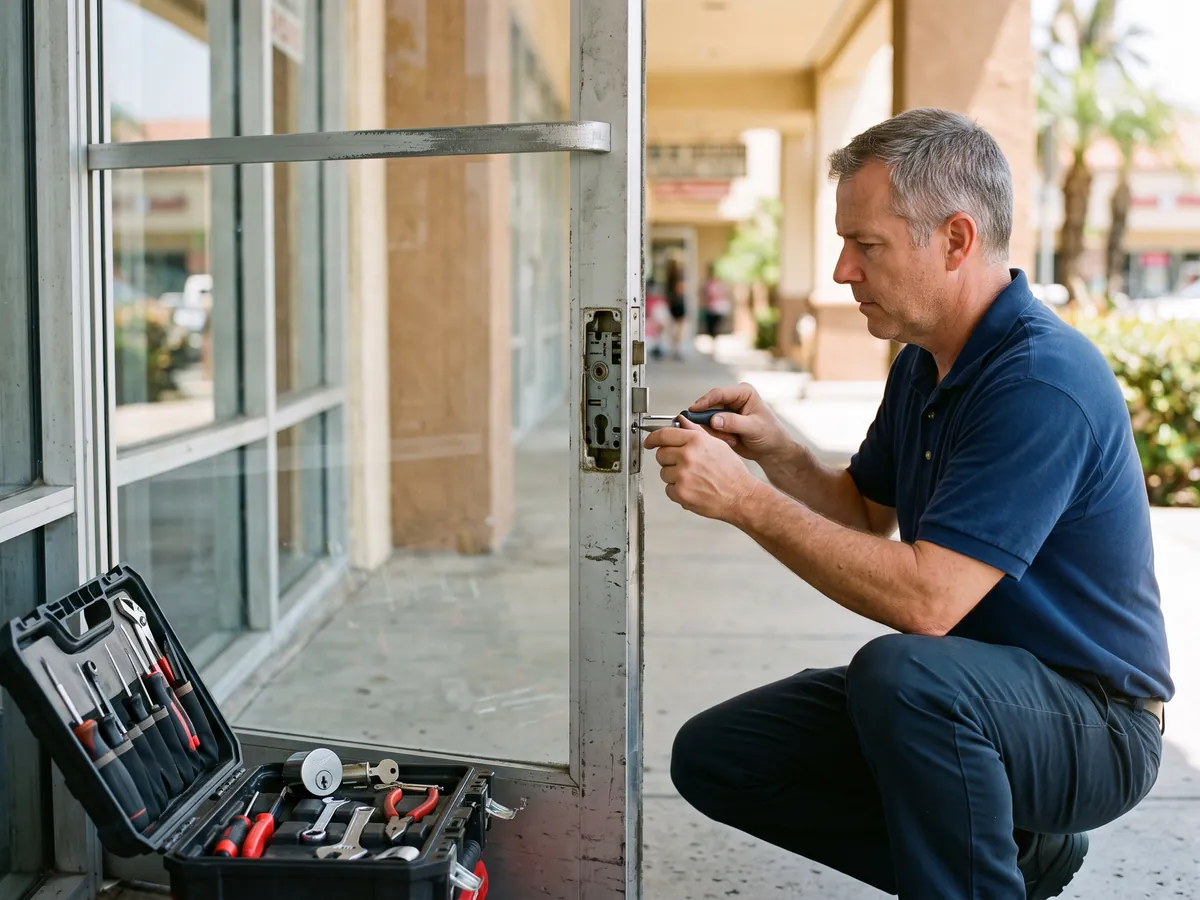
Many storefront glass doors in Downey belong to the landlord, not the tenant, so the first question in any glass door lock repair is who can authorize the work. Bring photo ID and a lease, a business license or a note from the property manager, and we'll proceed. Julian's Locksmith is open every day, 6:30 a.m. to 11:30 p.m. If a lock fails after 11:30 p.m., call your alarm company or landlord for interim coverage, then call us at (951) 903-3193 when we open at 6:30 a.m. It is also worth telling your landlord before we arrive, since their approval can shorten the visit.
Glass Door Lock Repair in Downey: what to expect
A glass door is only as secure as its weakest part, and sometimes that is the glass. A good lock still matters: it stops quiet entry, slows a thief and shows an insurer you took reasonable steps. Upgrades we can discuss include better cylinders, a longer-throw bolt, a second bolt point on pairs, and keying the door into a controlled key system. Glass upgrades, such as laminated glazing or security film, belong to a glazier. Egress matters too. A glass door that serves as an exit must open from inside without special knowledge, so key-locked exits depend on your occupancy and local rules, and we check before changing how a door locks. We verify ID and authority, hold California license LCO7891, and quote before we start. In practice we start from what you have, tell you what each improvement can and cannot achieve, and let you decide. Many owners are surprised that the most useful improvement is often key control: knowing who holds keys to the glass door matters as much as the lock inside it.
How we can help in Downey
- Bottom rail locks and floor strikes. When a rail lock fails, the cylinder, the bolt and the rail itself can all be suspects. We separate them by testing the cylinder out of the rail and the bolt on its own. That tells us whether we are replacing a cylinder, a lock body or only adjusting the door.
- Framed glass doors with stile locks. Framed doors are often easier to repair than frameless ones because the frame carries standard parts. We identify the manufacturer and lock series from the stile, order or stock the matching case and cylinder, and keep the existing trim wherever it can be reused.
- Sliding glass entry doors. Commercial sliding glass doors lock with a hook bolt that catches a strike in the jamb. When the tracks fill with grit, the door sits low and the hook misses. We clean the tracks, adjust the rollers where they allow it, and repair or replace the hook lock and its strike.
- Pull handles, push bars and thumbturns. Thumbturns on glass doors connect to the bolt through a short spindle. When it wears or slips, the door looks locked from outside but can't be secured from inside. We replace the spindle or thumbturn and test that the egress side still opens without a key when it should.
- Interior glass office and conference doors. Adding a lock to an interior glass door without drilling the glass means clamp-on locks or frame-mounted hardware. We explain what each option can and cannot do, and we don't pretend a simple privacy lock is a security lock. Either way, the glass stays intact.
What's different about Downey
Shopping centers and strip malls in Downey lean on glass: storefront entries, display doors and glass fronts that customers see from the lot. A lock that sticks or a door that won't latch is visible to everyone, and tenant turnover leaves keys scattered. We handle glass door lock repair on patch, rail and framed locks around trading hours, coordinate with the center manager and keep finishes matching.
Medical and dental offices around Kaiser Permanente Downey Medical Center often use glass entry and suite doors, which means locks that must secure records and supplies while still opening easily for patients. Privacy film is common, so the lock shouldn't be obvious. We repair glass door locks around appointment schedules, avoid noise and dust in treatment areas, and keep levers and pulls accessible. Frosted film on glass makes alignment problems harder to see, so we check the bolt directly.
Warehouse and distribution buildings in Downey usually keep their glass at the front office and reception, with framed glass doors facing the lot. Those doors take dust and delivery traffic, and shared office keys spread quickly. We repair glass door locks at the front of the building and rekey when staff change, while dock and roll-up doors use separate hardware.
Situations this covers
- Late one evening, a florist notices her glass door lock won't throw. It's 11 p.m., and we close at 11:30. We'd diagnose by phone, come out if there is time, and otherwise help plan the night: an alarm check, a call to the landlord, and our first visit at 6:30 a.m. Glass doors can't take a hasp, so the plan would rely on the alarm and a patrol.
- At a restaurant off Old River School Road, the sliding glass patio door sits low on its rollers and the hook bolt no longer catches the jamb. Staff have been wedging a bar in the track at night. We'd clean the track, adjust the rollers, repair the hook lock and rekey the cylinder, since one key has gone missing. A slider that closes and locks properly makes the bar unnecessary.
- A new tenant in a retail center finds the landlord's glass entry door is keyed differently from the rest of the suite. We'd confirm who may authorize a change, rekey the cylinder to the tenant's keys, and leave a written note for the property manager about what changed. Until that is done, the previous tenant's key still works, which is the part that worries the new owner most.
- In a large home in the Downtown Downey area, a frameless glass wine-room door has a small patch lock whose key has stopped turning. We'd verify ownership, test the cylinder and bolt, and replace the lock body with one that fits the existing glass cutouts and matches the room's hardware finish. The owner also asks for a spare key, which we'd cut after confirming the lock's keying.
Step by step with Julian's Locksmith
- Tell us what kind of glass door it is. Look at the hinges: pivots at the top and bottom point to a frameless door; side hinges or a continuous hinge point to a framed one. Look at the lock, too. A square metal box at the bottom corner is a patch lock. Tell us what you see and the address in Downey.
- Confirm you can authorize the work. California's Locksmith Act is why we ask for proof of authority: someone who isn't allowed to change a lock shouldn't be able to hire us to do it. If the building has a master key system, we may need the manager's approval before we rekey.
- Check the glass and fittings first. A short, careful look comes first: glass edges, corner fittings, rail, and any sign of earlier repairs or forced entry. We photograph what we find, which helps with landlord or insurance questions, and we proceed only when the glass looks sound. Anything that looks marginal gets a plain-language explanation.
- Diagnose the lock, cylinder and strike. We look for the simplest explanation first. Grit in the floor strike, a loose set screw on a pivot, a cylinder with the wrong cam: each is a quick fix, and each is more common than a failed lock. Only when those are ruled out do we call it a lock replacement.
- Repair or replace, quoted first. Repair makes sense when the lock body is sound and a cylinder, cam, strike or adjustment cures the problem. Replacement makes sense when the lock is worn, damaged or obsolete. You choose after hearing both, and nothing starts without your approval. Neither choice is a trap; we would rather you pick what suits the door.
- Test, key and hand over. We run the lock from both sides, with the door open and closed, and confirm every key works and old keys don't. We also check that the door opens from inside without a key when the building is occupied. Any mismatch is fixed before we hand the keys over.
How we quote the job
- Door type and hardware make. Glass door lock repair covers different jobs: frameless patch locks, rail locks, framed stile locks and sliding hook locks each involve different parts and labor. Naming the type when you call helps us quote accurately. Common brands have readily available parts; specialty or imported hardware can take longer and cost more.
- Matching existing cutouts and parts availability. Discontinued glass door hardware is the main driver of delay and cost. If your lock is out of production, we look for a compatible model that fits the existing cutouts, or tell you honestly if the glass would have to change, which is a glazier's decision.
- Cylinders, keys and the key system. Rekeying in place is often less work than replacement because the cylinder stays. If the door shares keys with a building system, we need the system's records or a master key to keep things consistent. Tell us who holds keys and who should.
Every job gets a clear quote before any work starts. Call (951) 903-3193 with the details and we'll tell you what to expect for your situation in Downey.
Mistakes to avoid
- Buying glass door lock repair parts online from a photo. Glass door locks vary in footprint, thickness, cylinder collar and bolt throw, and tempered glass can't be recut to fit the wrong part. Measure, get a model number, or ask us to confirm fit before ordering. A part that arrives and doesn't fit costs time you may not have.
- Spraying oil into the cylinder and floor strike. It runs onto the glass and tile, attracts grit and turns to paste in the pin chambers. A dry lubricant works better and stays tidy. Cleaning the strike with a stiff brush and a vacuum does more than any spray, and keeps the floor by the door dry and safe to walk on.
- Drilling tempered glass for a new lock or hasp. The pane will shatter, usually all at once, and a stopgap becomes a glazing emergency. Glass door hardware must fit the cutouts already in the glass or mount to the frame instead. The right fix is almost always a better-matched part, not a bigger hole.
Advice before you book
- Never drill, screw or glue a lock, hasp or bar to tempered glass. It can shatter the entire pane. If you need a stopgap, ask about frame-mounted or clamp-on options; they exist because the glass can't take new holes. Frame-mounted solutions can come off later without damaging anything.
- Identify your door before you call. Look at the edges: bare polished glass with metal clamps at the corners is frameless; glass inside aluminum is framed. Photograph the bottom corner, the lock and the strike. Those three pictures let us bring the right cylinder, cam and strike to your glass door lock repair.
- Use a dry lubricant, such as graphite or PTFE, in the cylinder, and avoid oil sprays that drip onto glass and floor, attract dust and gum up the pins. If a key stiffens, treat the cylinder once and, if it persists, call rather than forcing it. A few puffs is plenty.
- Don't slam it. A heavy glass door slammed shut loads the pivots, the patches and the bolt in a way a framed door shrugs off. A floor closer set too fast is the usual cause; ask us or your door contractor to check the closing speed. Many floor closers have adjustable speed valves for sweep and latch, and a small turn usually settles things.
Getting to Downey
Downey is about 59 miles from our San Bernardino base, roughly 66 minutes in light traffic via I-215 South to I-10 West through Rialto, Fontana, Ontario, Pomona and West Covina. When you call, you get an arrival estimate based on where the technician is and the traffic at that moment.
Commercial jobs on busy stretches like I-605 sometimes need a parking plan, especially for storefront doors or roll-up gates. Let us know about loading zones, red curbs or parking structures before we arrive.
About Downey: The Googie-style diner now called Bob's Big Boy Broiler at 7447 Firestone Boulevard opened in 1958 as Harvey's Broiler and became a gathering place for hot rodders and cruisers.
| Neighborhoods | South Downey, Downtown Downey, Furman Park and Rives Avenue, Imperial Highway medical district, Columbia Way and the former Rockwell plant site, North Downey |
|---|---|
| ZIP codes | 90240, 90241, 90242 |
| Main routes | I-5, I-105, I-605, I-710 |
| From our San Bernardino base | about 59 miles via I-215 South to I-10 West through Rialto, Fontana, Ontario, Pomona and West Covina (or SR-210 West) to I-605 South, then the Florence Avenue, Firestone Boulevard or Imperial Highway exit depending on the address; Firestone Boulevard reaches Stonewood Center and Downtown Downey, Imperial Highway reaches Kaiser Permanente, Rancho Los Amigos and the south end, and Florence Avenue reaches the Lakewood Boulevard corner |
Lock or door hardware trouble in Downey?
Call (951) 903-3193 with the address and what the door or lock is doing. We'll quote the repair before any work starts.
Frequently asked questions
Can you replace the lock without replacing the glass?
In most glass door lock repair jobs, yes, as long as the replacement fits the holes and notches already in the glass. We measure, photograph and match the footprint, often with the same manufacturer's current model. If an exact match is discontinued, we look for a compatible one and tell you honestly if nothing fits without changing the glass. We also leave the old lock with you, in case your insurer or landlord wants to see it.
Do I need my landlord's approval?
Often, yes. In many leases the owner controls the storefront glass system and exterior locks, while the tenant manages interior ones. We'll ask for ID and proof of authority such as a lease or a message from the property manager, and we can call the manager with you. It prevents a dispute over who approved a lock change.
Can you repair locks on commercial sliding glass doors?
Yes. Most commercial sliders use a hook-bolt mortise lock that catches a jamb strike. We clean the track, check rollers where we can, and repair or replace the lock, strike and cylinder. We don't service the operators and sensors of motorized sliders; those belong to the operator's service company, although we can handle the keyed lock on them.
Can you drill or cut the glass to fit a new lock?
No. Tempered glass can't be drilled, notched or recut after it's made; trying to will usually shatter the pane. That is why we match new locks to the holes and notches already in your door, or choose hardware that mounts to the frame. If the glass would have to change, that's a glazier's decision, not a lock repair. If someone has already drilled or notched the glass, tell us; it can shape which parts will still fit.
Is a key-locked glass door allowed as an exit?
It depends on your occupancy, the door's use and local fire and building rules. Egress doors generally must open from inside without a key or special knowledge while the building is occupied, with limited exceptions that may require signs and approval. We check before changing how a door locks and suggest you confirm with your building or fire department.
Why does my glass door key spin or the bolt not throw?
A key that spins freely usually means a worn or wrong-length cam or tailpiece in the cylinder, so the key moves but the lock does not. A bolt that moves but doesn't reach its strike is more likely alignment: a dropped door, a worn pivot or a dirty floor strike. We test the cylinder, bolt and strike separately to find which. Sometimes both are true, so we don't assume.
How far is Downey from your base?
Downey is about 59 miles from our San Bernardino base, roughly 66 minutes in light traffic. Arrival time depends on traffic and on the job the technician is finishing, so we give you an estimate on the phone before you commit.
Related services in Downey
- Storefront Lock Repair in Downey
- Storefront Door Repair in Downey
- Storefront Door Lock Replacement in Downey
- Aluminum Storefront Door Repair in Downey
- Narrow Stile Lock Repair in Downey
- Storefront Door Closer Repair in Downey
- Storefront Lockout in Downey
- Commercial Door Won't Lock in Downey
- Commercial Door Repair in Downey
- Locksmith for Retail Store in Downey
Glass Door Lock Repair in nearby cities
- Glass Door Lock Repair in BellflowerLos Angeles County
- Glass Door Lock Repair in NorwalkLos Angeles County
- Glass Door Lock Repair in Santa Fe SpringsLos Angeles County
- Glass Door Lock Repair in Pico RiveraLos Angeles County
- Glass Door Lock Repair in ArtesiaLos Angeles County
- Glass Door Lock Repair in CerritosLos Angeles County
- Glass Door Lock Repair in LakewoodLos Angeles County
- Glass Door Lock Repair in WhittierLos Angeles County
