
Downey, Los Angeles County
Aluminum Storefront Door Repair in Downey: Sags, Drags and Damage
Short answer: A storefront door that drags in the afternoon and clears in the morning is rarely a lock problem. Summer heat expands the aluminum, and a worn bottom pivot lets the door settle into the threshold. A mobile locksmith can usually reset the pivots, restore the clearances and re-seat the strike in one visit. We work every day, 6:30 a.m. to 11:30 p.m.
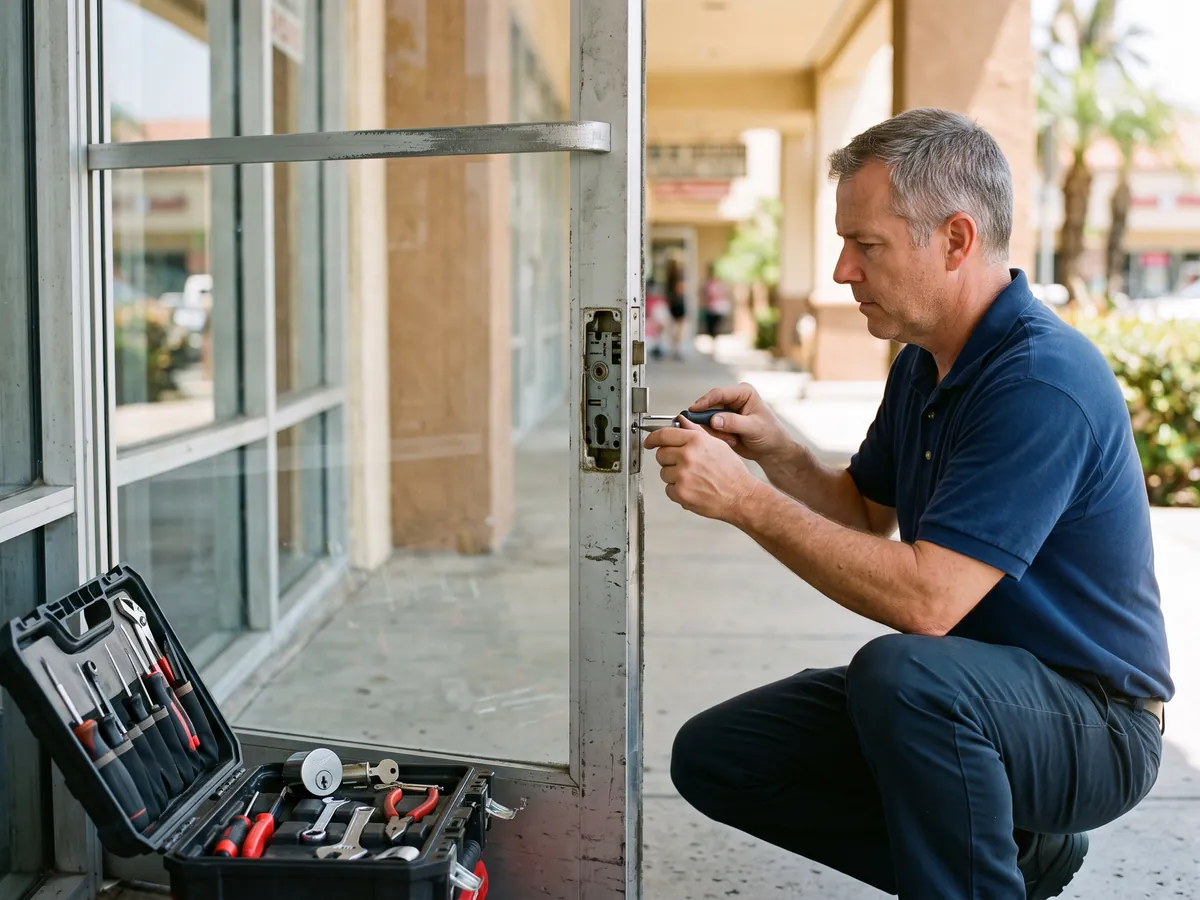
You can't send an aluminum storefront door off to a shop for repair without leaving your business wide open, which is why most of this work happens right where the door hangs. Julian's Locksmith arrives with common pivots and hinges, stainless fasteners, strikes, cylinders, weatherstripping and the gear to lift, shim and re-hang a leaf. We also know the limits. We don't cut glass or fabricate frames, and we'll say so early rather than leave you waiting on something only a glazier can do. Here is what aluminum storefront door repair involves, how a visit runs and what shapes the cost.
Aluminum Storefront Door Repair in Downey: what to expect
A storefront door has two jobs, and the second is easy to forget while you're staring at the first. Besides swinging smoothly, it has to hold the opening shut. On an aluminum door that depends on small dimensions: roughly an eighth of an inch of clearance between the lock stile and the jamb, a bolt or latch that fully engages its strike, and a frame anchored tightly enough that a pry bar doesn't spread it. When a door sags, that clearance changes in the wrong direction, and a door that looks closed may only be resting against its strike. Aluminum storefront door repair is partly a security repair. We check engagement with the door closed, test whether the leaf can be pulled away from the frame by hand, and look for the bright scrapes that mark where something has been levered. If we find damage, we note it for your insurer, secure what we can and tell you what falls outside our work.
How we can help in Downey
- Top, bottom and intermediate pivot replacement. A worn bottom pivot is the most common reason an aluminum storefront door drops. We support the leaf, unload the pivot, replace the worn bearing or the whole set, then reset the door to even reveals on every side. Top and intermediate pivots get inspected at the same time, since a loose one lets the door lean.
- Rubbing, scraping and threshold clearance. Contact leaves a trail: polished metal on the stile, scuffed anodizing, a groove in a vinyl sweep. In aluminum storefront door repair we read those marks to find where the door rubs, then fix the cause instead of filing the aluminum. Filing removes the hard anodized layer and leaves bare metal that dulls quickly and drags again.
- Racked frames and loose corner joints. If you can twist the door by hand or see a hairline gap opening at a corner, the joint is moving. Re-tightening hardware sometimes helps; it will not fix a bent rail. We tell you which you have, because chasing a lock problem on a leaf that has lost its shape just repeats the repair.
- Loose glass stops and rattling lites. Never ignore a door lite that moves when you press on it. We check how it sits, look for edge damage and test the stops. Resetting a loose stop is a quick repair; supplying new tempered glass is a glazier's trade, and tempered glass cannot be cut or reshaped after it has been made.
- After a break-in or impact: securing the opening. A forced door is often more secure than it looks, or less. We test the latch and strike under pressure, check the gap for spreading, and look at the frame's anchors. Sometimes a new strike and cylinder are enough. Sometimes the leaf has to go. Either way, you leave knowing what the door will withstand tonight.
What's different about Downey
In a retail corridor such as the strips along I-710, the storefront system usually belongs to the landlord and every suite shares the same door series. That helps aluminum storefront door repair, because parts and finishes are predictable, but it also means a repair may need the landlord's approval and a color match to neighboring doors. Doors in busy centers open and close all day, so pivots, sweeps and closers wear first. Tell us your suite number and whether the center uses a property manager.
Office entrances at warehouses and light industrial parks take a different beating: pallet jacks, hand trucks, dust from the yard and vibration from trucks. Aluminum doors there often get bumped by carts and caked with grit that chews the bottom pivot and sweep. We repair the door, check the hardware and suggest protective details, such as a kick plate or bumper, that keep the next cart from folding a stile.
Older downtown blocks in Downey often mix eras: a 1960s bronze aluminum frame beside a newer black one, or a door that has been re-hung several times. Parts for discontinued series can be hard to find, so we measure the pocket and adapt where we can. Some downtown districts review exterior changes, so check before swapping the door style. Our job is to keep the original door working safely, and to tell you when it cannot.
Example situations
- A boutique in a 1960s downtown block has bronze anodized doors from a manufacturer that stopped making that series long ago. The pivots are worn and no catalog part matches. We would measure the pocket, bring the closest available pivot set, adapt the mounting plate where the metal allows, and explain that an exact match may mean a custom order, or replacing the door in the existing frame.
- A yoga studio's landlord says the sticking door is the tenant's problem, and the tenant says it is a building defect. Both are partly right. We would inspect and write up what we found in plain terms: worn pivot hardware, which is a maintenance item, and a frame that has moved slightly, which belongs to the building. With photos and a separate hardware quote, the two can settle it.
- A boutique at the edge of the foothills catches a gust of Santa Ana wind as a customer leaves, and the door bangs against its stop. The closer arm is bent, the top pivot has shifted, and the door now hangs crooked. We would replace the arm, reset the pivot and check the glass stop for movement, then suggest a hold-open feature so the next gust has less to grab.
- A nail salon in a strip center off I-605 keeps a rubber wedge under its glass door because the bottom corner scrapes the sill and the door swings back too slowly to latch. The wedge is the clue. We would lift the leaf, find the bottom pivot bearing worn flat, replace the pivot set, reset the reveals and tune the closer so the door latches without a nudge.
Step by step with Julian's Locksmith
- Tell us what the door is doing. Start with when the problem began and what changed. A new closer, a heat wave, a delivery cart or a nearby break-in all point to different causes. Give us the address and a time that suits you, and we'll give an honest arrival estimate and quote the visit by phone.
- Confirm who can authorize the work. Ownership checks apply here, too. If the person on site is an employee, we may call the owner or manager before beginning. In shopping centers we also ask whether the landlord requires specific hardware or finishes, since matching neighboring doors can be a condition of the lease.
- Inspect the whole door, not just the lock. We start with the door open and unloaded: lifting the leaf to feel for play in the pivots, checking hinges, closer arm and glass stops, and measuring the gaps around the door. Only then do we close it and see where the latch lands relative to the strike.
- Quote the options before we start. You get plain options with the reasons behind them. A pivot set may be the whole answer. Or the leaf is bent, and new hardware on it would be wasted on a door that cannot hold it. Nothing starts until you approve a price.
- Repair, re-hang and adjust. Most repairs finish in one visit when the parts are common. We lift the door only as far as needed, protect the glass and finish, and keep the opening secure whenever we're working, so your shop is not left unlocked while a pivot is in pieces.
- Test, document and hand off. The hand-off includes a short list: what we replaced, what to check monthly, and whether anything else on the door looks marginal. Photos from the visit go to you for your lease file or insurer. We would rather you call about a small drag early than wait for a failure.
Pricing factors
- Door size, glass and weight. A wide door with insulated glass needs more hands, more care and sometimes extra equipment to lift. Pairs of doors multiply the work, as does a transom or sidelite that complicates removal. Heavier leaves also wear parts faster, which affects what we recommend.
- Condition of the frame and floor. A door can only be as true as its frame. If the jamb has moved, the floor plate has loosened in the concrete or the header has deflected, hardware alone won't fix the door. We tell you what we can and can't correct, and what a storefront contractor would need to do.
- Repair versus a new door leaf. Think about what the door has left in it. If it is straight, tight and only worn at the hardware, repair is sensible. If every fix leads to the next problem, replacement ends the cycle. We lay out the costs in plain terms so the choice is yours, not ours.
Every job gets a clear quote before any work starts. Call (951) 903-3193 with the details and we'll tell you what to expect for your situation in Downey.
Mistakes to avoid
- Turning the closer up to make a dragging door latch. The extra force slams the leaf into its strike, bends the bolt and loads a pivot that is already tired. A customer with a stroller then has to fight a heavy door. Free the drag first; closer speed is the last adjustment, not the first.
- Planing, filing or grinding the bottom of the door to stop the scraping. Aluminum filings are sharp, the anodized finish is destroyed where you cut, and the underlying sag is still there. You end up with a door that is shorter, uglier and still not latching. Find out why it hangs low instead.
- Driving longer or fatter screws into a hollow extrusion. The walls are often only about an eighth of an inch thick, so bigger fasteners strip the hole, can poke into the glass pocket and sometimes crack the profile. A stripped hinge or bracket needs backing or a different fastener, not brute force.
Practical tips before you call
- Photograph the gaps around the closed door once a month, from the same spot. The reveal should look even, about an eighth of an inch all around. A wedge that narrows toward the top corner of the lock side means the door is dropping. Dated photos also help if a landlord or insurer asks when the problem started.
- Mark the adjustment valves on your closer with a dab of paint once the speed is right. If someone turns them later, the paint line shifts and you'll know why the door suddenly slams. Teach staff that the closer is not a toy, and that a door needing more force is a repair call, not a screwdriver job.
- Plan aluminum storefront door repair around our hours. We work every day from 6:30 a.m. to 11:30 p.m., so a door that fails after 11:30 p.m. may need a temporary fix until morning. If you suspect trouble, call early in the week rather than waiting.
- Inspect the glass edges where the pane meets the stops. A small chip at the edge of tempered glass can spread without warning and shatter the whole lite after a slam. If you see a chip or a hairline crack, keep customers from leaning on the door and call a glazier promptly, then call us for the hardware.
Reaching Downey
Downey is about 59 miles from our San Bernardino base, roughly 66 minutes in light traffic via I-215 South to I-10 West through Rialto, Fontana, Ontario, Pomona and West Covina. When you call, you get an arrival estimate based on where the technician is and the traffic at that moment.
Commercial jobs on busy stretches like Paramount Boulevard sometimes need a parking plan, especially for storefront doors or roll-up gates. Let us know about loading zones, red curbs or parking structures before we arrive.
About Downey: Rancho Los Amigos National Rehabilitation Center on Imperial Highway traces its roots to the Los Angeles County Poor Farm, which opened in 1888, and is now a county rehabilitation hospital affiliated with USC.
| Neighborhoods | Columbia Way and the former Rockwell plant site, Old River School Road and Rio Hondo, North Downey, Downtown Downey, Stonewood Center area, Civic Center on Brookshire Avenue |
|---|---|
| ZIP codes | 90240, 90241, 90242 |
| Main routes | I-5, I-105, I-605, I-710 |
| From our San Bernardino base | about 59 miles via I-215 South to I-10 West through Rialto, Fontana, Ontario, Pomona and West Covina (or SR-210 West) to I-605 South, then the Florence Avenue, Firestone Boulevard or Imperial Highway exit depending on the address; Firestone Boulevard reaches Stonewood Center and Downtown Downey, Imperial Highway reaches Kaiser Permanente, Rancho Los Amigos and the south end, and Florence Avenue reaches the Lakewood Boulevard corner |
Lock or door hardware trouble in Downey?
Call (951) 903-3193 with the address and what the door or lock is doing. We'll quote the repair before any work starts.
Frequently asked questions
What does aluminum storefront door repair include?
It covers everything that makes an aluminum and glass entry door hang, swing, close and seal properly: pivots, hinges, closer arms and brackets, sweeps, weatherstripping, thresholds, strikes and the lock itself. We also check corner joints and glass stops. What we don't do is cut glass or fabricate frames; for that we point you to a glazier. Call (951) 903-3193 and tell us what the door is doing in Downey.
How long does aluminum storefront door repair take?
A closer arm or a weatherstrip swap is a short job. Replacing a pivot takes longer because the door must be supported and re-hung, and a pair of doors or a heavy insulated leaf takes more time again. Most hardware repairs finish in a single visit when parts are on hand. We give you an honest estimate once we have seen the door, rather than a number plucked from the air.
Can a sagging aluminum door be fixed without replacing it?
Usually yes, when the stiles are straight and the corners are tight. In most aluminum storefront door repair jobs, replacing the bottom pivot or hinge and resetting the reveals restores a sagging door. If the extrusion is bent, a corner joint has opened, or the pivot pocket is cracked, a new leaf in the existing frame is a better investment. We tell you which case you have before any work begins.
Can you repair a storefront door that was pried open during a break-in?
Often, yes. We test the latch, bolt and strike under pressure, replace bent hardware and cylinders, and check whether the frame has spread. If a stile is cracked or the frame has been pulled loose, we tell you honestly that those need replacement by a door or storefront contractor. Take photos first and ask the police for a report number; your insurer will want both.
When is a new door better than repair?
Replace the leaf when a stile is bent, a corner joint has opened and won't hold, the extrusion is cracked near a pivot or lock, or repeated repairs keep failing in new places. If the aluminum is straight and tight, repair is sensible. We can estimate both sides and help you decide. The door is ordered through a storefront supplier, and we handle the hardware transfer and adjustments.
How can I tell if a pivot is worn?
Hold the door partway open and lift gently on the lock-side edge. If it moves up and down, or you hear grinding or squeaking as it swings, the bearing or bushing is worn. A bright scrape on the bottom corner is another sign. You may also notice the door no longer returns to center on its own. We confirm by watching it under load.
How far is Downey from your base?
Downey is about 59 miles from our San Bernardino base, roughly 66 minutes in light traffic. Arrival time depends on traffic and on the job the technician is finishing, so we give you an estimate on the phone before you commit.
Related services in Downey
- Storefront Lock Repair in Downey
- Narrow Stile Lock Repair in Downey
- Storefront Door Repair in Downey
- Storefront Door Lock Replacement in Downey
- Glass Door Lock Repair in Downey
- Door Closer Repair in Downey
- Storefront Door Closer Repair in Downey
- Commercial Door Repair in Downey
- Commercial Door Won't Latch in Downey
- Storefront Lockout in Downey
Aluminum Storefront Door Repair in nearby cities
- Aluminum Storefront Door Repair in BellflowerLos Angeles County
- Aluminum Storefront Door Repair in NorwalkLos Angeles County
- Aluminum Storefront Door Repair in Santa Fe SpringsLos Angeles County
- Aluminum Storefront Door Repair in Pico RiveraLos Angeles County
- Aluminum Storefront Door Repair in ArtesiaLos Angeles County
- Aluminum Storefront Door Repair in CerritosLos Angeles County
- Aluminum Storefront Door Repair in LakewoodLos Angeles County
- Aluminum Storefront Door Repair in WhittierLos Angeles County
