
Downey, Los Angeles County
Downey Commercial Lock Replacement for Offices, Shops and Buildings
Short answer: Commercial lock replacement means swapping the lock on a business, office, warehouse or multi-tenant door for new commercial-grade hardware that matches the opening. In Downey, Julian's Locksmith identifies the lock type, function and keying already on each door, fits the replacement to the existing prep, and quotes the work before starting. Call (951) 903-3193 and describe the door.
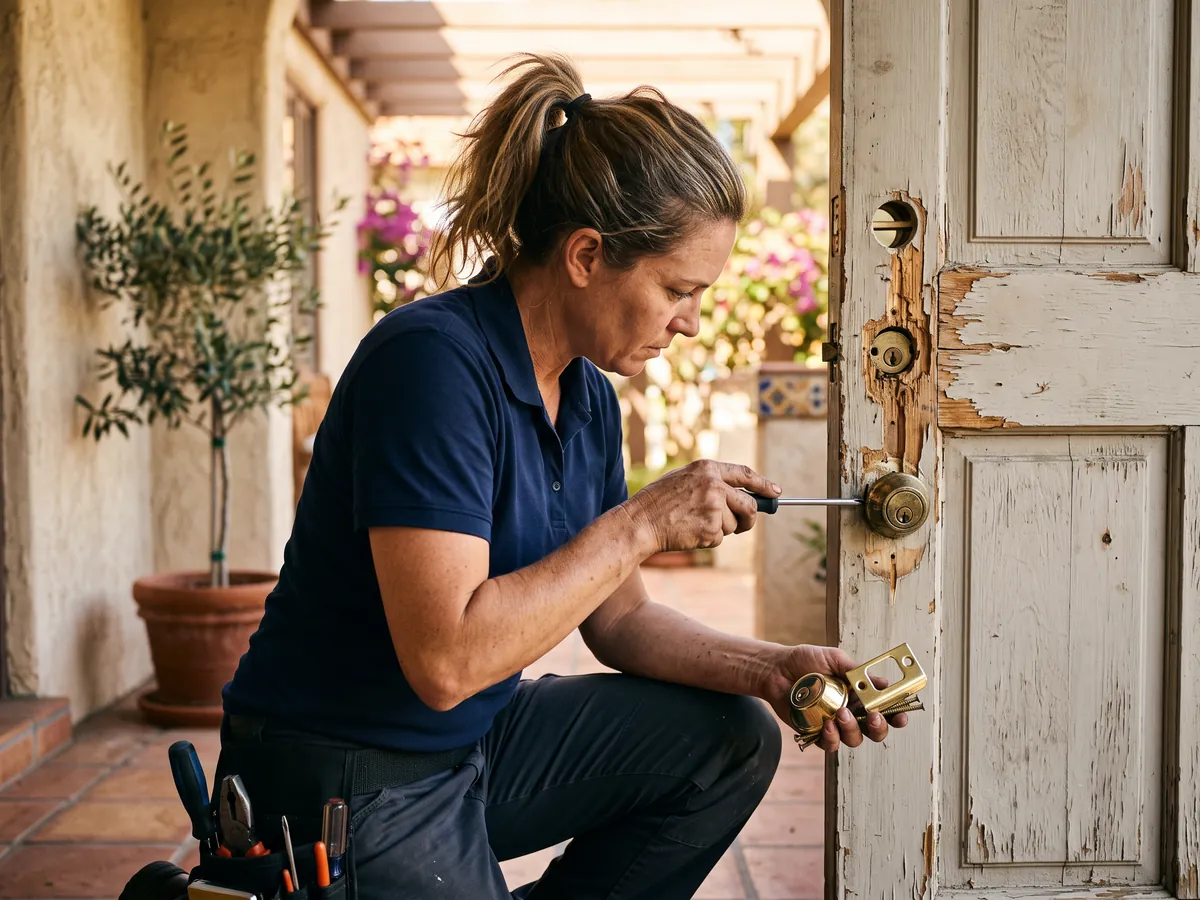
On a house, the worst outcome of a botched lock swap is a door that will not latch. On a commercial building it can be worse: an exit door that needs a key to leave, a fire door that no longer latches, or an accessible entrance fitted with a round knob. Commercial lock replacement lives inside rules that residential work mostly escapes, and getting them wrong costs more than the hardware. Julian's Locksmith replaces locks in Downey with those rules in view. We will point out problems we see, such as a labeled fire door or a missing lever, and send occupancy questions to the fire marshal or building department.
How this works in Downey
The lock body is only half of a commercial replacement; the keying is the other half. If your suite sits on a building master key system, the new lock has to accept the right cylinder or core, otherwise the property manager's keys and the emergency-access lockbox keys will not work. Many commercial locks use a small format interchangeable core, a cylinder that a control key removes in seconds so it can be swapped or rekeyed without touching the lock. Others use conventional pin-tumbler cylinders that are rekeyed on the bench. With controlled keyways such as Schlage Primus or Medeco, blanks are restricted, so extra copies come only through authorized dealers. Before we install, we ask who holds keys today, whether a master key chart exists, and how many people should reach each door. Afterward, we give you the key numbers or bitting record for the new cylinders and explain how to store it. A lost master key is the costliest mistake in building security, so we treat records seriously.
How we can help in Downey
- Cylindrical lever locks on hollow metal doors. Most office and retail doors carry a cylindrical lever lock, such as a Schlage ND, Sargent 10 Line or Corbin Russwin CL3300. These install through a standard 2-1/8 inch hole, so a like-for-like replacement drops into the existing door prep. We confirm backset, thickness and latch type first, then set the new chassis and adjust the strike.
- Mortise lock cases and trim. Converting a mortise opening to a cylindrical lever sounds tempting, but the pocket in the door edge has to be filled or covered, and the faceplate and strike change. It can be done on wood or metal doors with a filler plate. We lay out what it involves so you can compare it with a straight mortise swap.
- Exit device locking trim and cylinders. When the device itself has failed, with a stuck latch, a bar that does not spring back or a bent chassis, the whole exit device is replaced. Rim, surface vertical rod and concealed rod devices each fit differently, so we measure door width and note whether the door is single or part of a pair before sourcing.
- Interchangeable cores and master-key fit. Replacement is also a good moment to ask whether the building outgrew its keying. Offices that started as one suite and became four, or a shop that doubled its staff, often have gaps in the master chart. We can fit new locks with cores or cylinders that let you add a keying level later without replacing anything again.
- Glass doors and patch-fitting locks. All-glass entry doors use patch fittings, bottom-rail locks or cylinder-in-rail hardware, and the parts are specific to the glass system. We identify the system, confirm the part is still available and set expectations on lead time before touching a pane, because ordering the wrong patch lock helps no one.
Local factors in Downey
Shopping centers around Downey pack many storefronts into one landlord's footprint, and each tenant often controls its own entry lock. Aluminum storefront doors with narrow stiles are the norm, which narrows hardware choices to slim deadlocks and latches. If your shop sits near Bob's Big Boy Broiler, tell us the center's name and whether the landlord needs notice. We schedule around opening times and replace the lock, cylinder and strike together so the door closes cleanly.
Warehouses and light-industrial buildings tend to have a front office, rear exits, personnel doors beside the dock doors and mechanical rooms, each with different traffic. Rear and dock-adjacent doors take the most abuse and deserve Grade 1 hardware and sturdy strikes. Pallet jacks and forklifts bend frames, so we check alignment, not just the lock. Give us the door label and tell us whether the yard has a check-in gate.
Medical offices and clinics near PIH Health Hospital - Downey combine exam rooms, supply rooms, medication storage and public entrances, and each needs a different function. Storeroom and office functions are common, exits must remain free, and privacy matters. We work around patient schedules, choose quiet, durable levers suited to accessible routes, and key sensitive rooms separately. Rules for storing controlled medications are a compliance matter for your practice, so we handle the lock and leave the regulation to you.
Example situations
- Consider a community hall with a pair of double doors, where one leaf's lock failed and the other leaf has a flush bolt that no longer reaches the floor. We would identify the pair's hardware, replace the failed lock, test the bolts, and explain which parts can be matched individually and which should be updated together.
- Say a boutique owner in Downtown Downey reports that a key has snapped in the front door cylinder twice this year. We would pull the cylinder, find the lock out of alignment with its strike, replace the case with a Grade 1 model, and adjust the door. A new cylinder alone would repeat the same failure within months.
- Picture a dental practice in a medical building where the supply room door has a passage function, left over from an earlier tenant. The owner wants it locked at all times but still free to exit. A storeroom-function chassis fits the same holes, so we would swap it, key it to the practice's cylinders and hand over two keys with a written record.
- A typical call: the property manager of a small office building off Brookshire Avenue wants every suite entry matched. Three of the eight locks are different brands, two sag, and one tenant holds a master key nobody can account for. We would walk the doors with a clipboard, write a schedule, replace the worn ones with matching Grade 1 levers and pin them all to a single key plan.
Step by step with Julian's Locksmith
- Walk the doors and list them. Send photos ahead if you can: each side of the door, the lock edge and any labels. When you call (951) 903-3193, tell us the door type, the business, and whether anything is fire-rated or electrified. That helps us bring the right parts to the first visit.
- Match function, grade and prep. Next we match what the door needs. Function comes first: what should the lock do from each side? Then grade, then physical fit, including bore, backset, door thickness, handing and lever style. A replacement that fits the existing prep avoids new holes in the door.
- Quote, order and schedule. We confirm who authorizes the work and who will be on site, since a property manager, owner and tenant may each hold a different piece of the decision. Bring ID, plus a lease page or management letter if you are not the owner.
- Replace with every door secured. Old hardware leaves with us only if you want it to. Some managers keep failed locks for an insurance or warranty conversation, and others want them recycled. Tell us before we start, and we will bag and label what you want to keep.
- Adjust and test every function. Before leaving, we hand your staff a key and ask them to try it on each door. A lock that works for the installer can still hang up for someone with a different key cut, so a second tester catches problems we might miss.
- Hand over keys and records. You get the keys, the key numbers or bitting information for new cylinders, and a short written list of what we replaced, by door. Store the list somewhere locked and separate from the keys, since it can be used to order copies.
Pricing factors
- Hardware grade and series. Series matters as much as grade. Within a single maker, one cylindrical line may be built for offices and another for heavy-traffic entries. We explain the difference in plain terms and recommend the lighter line where it is truly adequate, such as interior offices that see few uses a day.
- Function and keying. Asking the new lock to do something different, such as changing from office to storeroom function or adding a classroom security function, is a chassis choice rather than extra labor, but it affects the part price. We outline function options so you can pick the right one for each room.
- Code-driven requirements. Commercial lock replacement on fire-rated doors, exit doors and accessible routes calls for listed or specific hardware. Listed parts cost more than basic equivalents, and sometimes a requirement means upgrading both lock and closer. We raise these requirements before the quote, not after the parts arrive.
Every job gets a clear quote before any work starts. Call (951) 903-3193 with the details and we'll tell you what to expect for your situation in Downey.
Practical tips before you call
- Watch how doors behave through the seasons. Inland heat expands metal doors, and a lock that fit snugly in winter may bind in August. If your latch fights the strike in summer, mention it when you book so we check alignment instead of only the lock.
- Keep the master key chart and treat it like cash. Store it locked, away from the keys, and limit who can see it. When we replace locks in a master-keyed system, the chart tells us how to pin the new cylinders. If you do not have one, tell us and we will help you start one.
- Tell your tenants or staff in advance. A notice that a locksmith will be replacing hardware on a given morning avoids confusion and lets people move belongings and plan their routes. Include the door names, the time window and who to contact in Downey if access is needed.
- Confirm who can approve the commercial lock replacement. In leased space, check whether the lease treats locks as the tenant's or the landlord's. Bring the lease page or an email from your property manager to the Downey visit. We verify authority before starting, and having it ready avoids delays.
What not to do
- Ignoring the closer, hinges and strike. A new lock on a sagging door or a worn strike will bind, rattle or fail to latch. Many lock problems are really alignment problems, so inspect the whole opening before you blame the lock.
- Fitting a keyed deadbolt on an exit door. A lock that needs a key from the inside can trap people in an emergency and usually conflicts with egress rules. Exit doors need hardware that opens from the egress side in one motion, with no key.
- Ordering by brand name alone. Two locks from one maker can differ in function, backset, hand and prep. Without the series, function and measurements, a part that looks right can arrive wrong and delay the job. Send photos and the stamped numbers.
Service in Downey
Downey is about 59 miles from our San Bernardino base, roughly 66 minutes in light traffic via I-215 South to I-10 West through Rialto, Fontana, Ontario, Pomona and West Covina. When you call, you get an arrival estimate based on where the technician is and the traffic at that moment.
Stuck on the shoulder or in a parking lot along Florence Avenue? Get somewhere safe, turn on your hazards, and give us the nearest exit or business so we can find the car without guessing.
About Downey: The city is named for John Gately Downey, an Irish immigrant who served as California's governor from 1860 to 1862 and began dividing his Rancho Santa Gertrudes into small farms in 1865.
| Neighborhoods | Downtown Downey, Old River School Road and Rio Hondo, North Downey, Imperial Highway medical district, Furman Park and Rives Avenue, Columbia Way and the former Rockwell plant site |
|---|---|
| ZIP codes | 90240, 90241, 90242 |
| Main routes | I-5, I-105, I-605, I-710 |
| From our San Bernardino base | about 59 miles via I-215 South to I-10 West through Rialto, Fontana, Ontario, Pomona and West Covina (or SR-210 West) to I-605 South, then the Florence Avenue, Firestone Boulevard or Imperial Highway exit depending on the address; Firestone Boulevard reaches Stonewood Center and Downtown Downey, Imperial Highway reaches Kaiser Permanente, Rancho Los Amigos and the south end, and Florence Avenue reaches the Lakewood Boulevard corner |
New or replacement locks in Downey?
Call (951) 903-3193 and tell us which doors and what kind of hardware you have in mind. If you already bought the lock, keep the box handy so we can check it fits the door, and we'll quote the install before any work starts.
Frequently asked questions
How do I choose between office, storeroom and classroom functions?
Think about what the lock should do from each side. An office function lets staff lock the outside with a turn button or key. A storeroom function stays locked outside and always opens from inside. A classroom function lets staff lock the outside with a key while the inside stays free. Tell us how the room is used and who needs to enter, and we will recommend a function.
How long does a commercial lock replacement take?
A single cylindrical or storefront lock is usually a short visit when parts are on hand. Mortise cases, exit devices, fire-rated openings and electrified doors take longer, and special-order parts add days before the visit. Multi-door buildings are scheduled in phases. We give you an honest estimate when you call, and we do not promise a clock time we cannot control.
What is the difference between commercial lock replacement and rekeying?
Rekeying changes the internal pins of a lock you already have so a different key operates it, and the hardware stays. Replacement removes the lock and installs new hardware. If the lock is in good shape and the concern is who holds keys, rekey. If the lever sags, the bolt sticks, the door was forced or parts are discontinued, replace it. We inspect the door in Downey and tell you which route fits.
What does Grade 1 mean on a commercial lock?
Grades come from ANSI/BHMA standards that test locks for durability, strength and abuse resistance. Grade 1 is the highest rating and belongs on busy entrances, exits and high-use doors. Grade 2 handles moderate traffic, and Grade 3, where offered, is meant for light residential use. Ask for the grade and series in writing, because the word commercial on a package does not tell you which grade you are getting.
What records do I get after a replacement?
You receive an itemized invoice listing each door, the lock installed and the work done, along with the keys. For cylinders or cores with key numbers or bitting, we record those so you can order duplicates through authorized channels. If you have a master system, we note where each new cylinder sits in the hierarchy. Keep the record locked up and away from the keys.
What if my lock model is discontinued?
That is common in older buildings. We cross-reference the maker's series using measurements, faceplate numbers and photos, then look for a current successor, an adapter or a retrofit plate that covers old holes. Sometimes the answer is a near drop-in lock. Other times a modest modification gives you a modern Grade 1 lock on the original door. We show you the proposed fit before ordering.
How far is Downey from your base?
Downey is about 59 miles from our San Bernardino base, roughly 66 minutes in light traffic. Arrival time depends on traffic and on the job the technician is finishing, so we give you an estimate on the phone before you commit.
Related services in Downey
- Lock Replacement in Downey
- Business Lock Replacement in Downey
- Commercial Lock Installation in Downey
- Commercial Lock Repair in Downey
- Commercial Door Hardware in Downey
- Commercial Rekey in Downey
- Storefront Door Lock Replacement in Downey
- Panic Bar Replacement in Downey
- Commercial Master Key System in Downey
- Commercial Locksmith in Downey
Commercial Lock Replacement in nearby cities
- Commercial Lock Replacement in BellflowerLos Angeles County
- Commercial Lock Replacement in NorwalkLos Angeles County
- Commercial Lock Replacement in Santa Fe SpringsLos Angeles County
- Commercial Lock Replacement in Pico RiveraLos Angeles County
- Commercial Lock Replacement in ArtesiaLos Angeles County
- Commercial Lock Replacement in CerritosLos Angeles County
- Commercial Lock Replacement in LakewoodLos Angeles County
- Commercial Lock Replacement in WhittierLos Angeles County