
Downey, Los Angeles County
Downey Commercial Rekey: Mortise, Rim, Storefront and IC Cores
Short answer: Commercial rekeys in Downey can be scheduled before tenants arrive or after they leave. Julian's Locksmith works every day from 6:30 a.m. to 11:30 p.m. Buildings on interchangeable cores often need far less time on site, because new cores are pinned in the van and swapped at each door with a control key.
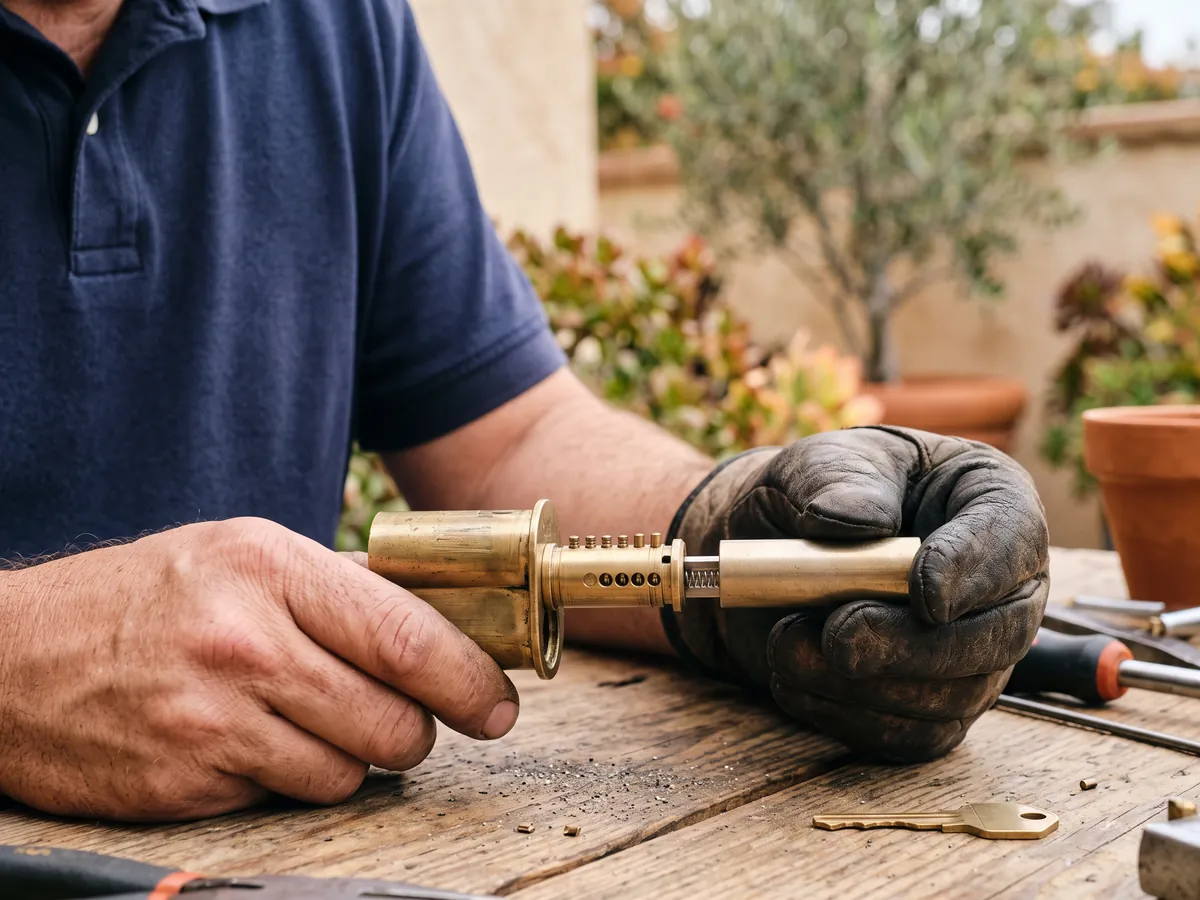
Rekeying a house usually means a few Kwikset or Schlage deadbolts and knobs. A commercial rekey in Downey is a different job. One building can hold mortise locks on the office doors, rim cylinders on the panic bars, Adams Rite cylinders in the aluminum storefront, key-in-lever locks on restrooms and storage rooms, and padlocks on the yard gate, each with its own cam, tailpiece or retaining clip. Some of those cylinders may already be master keyed, which changes how they have to be pinned. Julian's Locksmith carries pinning kits, cam assortments and blanks for the common commercial keyways, and we walk the property before quoting so nothing on the hardware list surprises anyone on rekey day.
Commercial Rekey in Downey: what to expect
A good commercial rekey starts with a door inventory, not a pinning tray. For each opening we note the hardware type, brand, keyway, cylinder style and current function. Is the door on the master? Does it need its own change key? Is it a common area that several tenants share? That list becomes the keying schedule, which decides how many distinct keys the building ends up with and who holds each one. Getting this right on paper matters more than it seems. If a suite rekey cuts the tenant off from the shared restroom or the trash enclosure, someone will be calling the next morning. If a mechanical room ends up on a tenant's change key, you've handed out access to equipment you meant to protect. Julian's Locksmith walks the property with you or your maintenance lead, flags doors whose hardware is failing or doesn't fit the plan, and quotes from the finished list. On a small office, the inventory takes a few minutes. On a multi-building center, it may be the longest step of the whole commercial rekey.
Work included on a typical visit
- Mortise cylinder rekeying. Many mortise cylinders in commercial buildings are decades old and stiff from dust and graphite buildup. During the rekey we clean the plug and shell, replace tired springs where needed, and lubricate lightly. If a cylinder's pin chambers are too worn to hold a new combination, we'll tell you and quote a replacement instead.
- Rim cylinders on exit devices and night latches. Panic bars from Von Duprin, Sargent, Detex and Precision often take a rim cylinder for the outside trim. We remove the connecting screws from the inside, re-pin the cylinder, set the tailpiece to the right length for the device, and confirm the outside trim retracts the latch with the new key before moving on.
- Interchangeable core rekeys. The control key is the most sensitive key in an interchangeable core system. As part of an IC rekey, we'll ask who currently holds it. If a control key went missing, the safe move is a new control bitting across the system, since anyone holding the old one can remove cores whenever they like.
- Tenant suite turnover rekeys. Leasing teams want a vacant suite ready to show. We can rekey it, cut a small set of keys for management and showings, and come back to cut the incoming tenant's keys once the lease is signed. That way no extra keys drift around while the space is on the market.
- Phased rekeys and keying records. Inherited a building with no records? We can rebuild them. By decoding cylinders during the rekey, we establish what the system actually is, not what someone remembers it to be, and document it going forward. That turns the next tenant change into a planned task instead of a scavenger hunt.
How Downey shapes the job
Shopping centers in Downey turn over storefronts regularly, and every turnover leaves keys behind: the storefront Adams Rite cylinder, the rear steel door with a panic bar, sometimes a roof hatch and an electrical room. A commercial rekey at each vacancy keeps the landlord in control of the unit between tenants. If the center's back doors open onto a shared service hallway, we look at that door separately so one tenant's move-out doesn't disrupt the neighbors.
Apartment communities have commercial doors of their own: the leasing office, maintenance shop, pool equipment room, laundry rooms and package rooms. When a maintenance supervisor or leasing manager leaves, those keys often leave too. A commercial rekey of a community's back-of-house doors in Downey can happen without touching residents' unit locks, and we'll keep the property's master structure intact if it's well documented.
Parts of Downey with older housing usually have older commercial buildings close by, often with original mortise hardware, brass rim cylinders and keys stamped with numbers nobody can trace. Those locks are frequently still sound and worth rekeying rather than replacing. We clean and re-pin them, replace the few cylinders that are too worn, and document the result, since older properties tend to have the thinnest key records of all.
Example situations
- Imagine a car dealership service department where a key to the parts room went missing during a busy month. The showroom and sales offices aren't affected. We'd rekey only the service-side cylinders, cut a limited number of new keys for the service manager and parts lead, and suggest restricted blanks so nobody can copy them at a hardware counter.
- A typical portfolio call: a management firm handles several small commercial buildings in Los Angeles County, each rekeyed at different times by different vendors. No two use the same keyway, and the records disagree with the doors. We'd suggest moving each building onto a standard keyway at its next turnover and documenting every property the same way, so a maintenance tech isn't carrying a pound of keys.
- A typical call from a logistics site: the facilities supervisor who carried the master ring has left the company, and nobody is sure every key came back. The building has dozens of personnel doors, several roll-up doors and a perimeter gate. We'd inventory first, then rekey in two evening phases so the day shift never shows up to a door its keys can't open.
- A typical older-building job: a single-story office from the 1970s with original mortise locks and keys stamped with a number nobody can trace. The new owner wants fresh keys and real records. During the commercial rekey we'd decode a cylinder or two, clean the gummed-up plugs, replace any seized cylinders outright, and document the new system so the next owner doesn't start from zero.
How the visit works
- Scope call. Call (951) 903-3193 and describe the property: building type, rough door count, whether it's master keyed, and why you're rekeying. Mention any padlocks, roll-up doors or cabinets you want included. Those details tell us whether to schedule a site walk first or quote from your description.
- Authorization and site walk. Larger properties get a written door list during the walk: location, hardware type, cylinder type, keyway and the key each opening should take afterward. That list becomes the keying schedule. Smaller jobs, such as a single suite, can usually be scoped and rekeyed in the same visit.
- Keying plan and quote. For buildings with existing master keying, the plan respects what already works. If your management master opens every suite today, it should still open them afterward. We'll show which keys change and which stay, so tenants and maintenance staff know what to expect before anyone's key stops working.
- Scheduling around occupants. Occupied buildings need notice. We'll suggest giving tenants a short heads-up with the date, the doors affected and how they'll receive new keys. When a suite can't spare its entrance during business hours, we rekey it first thing in the morning or after close.
- Rekeying and testing each opening. When we find a cylinder that won't hold a new combination, such as one with worn chambers, a cracked shell or a broken cam, we stop and show you before replacing it. You decide whether to swap that cylinder now or leave the door for a later visit.
- Keys, records and handoff. We cut the agreed number of keys, stamp or label them, and hand them to the person you designate, not to whoever happens to be standing nearby. The handoff includes a door-by-door list of which key operates what, so your records match the building from day one.
What affects the cost
- Master keying and keying charts. Keeping the existing master while changing suite keys is common and usually efficient when records exist. Changing the master itself means touching every cylinder in the system. If a master key was lost, that's often unavoidable, and we'll explain why before quoting the full scope.
- Keyway and key security. Standard commercial keyways like Schlage C or Sargent LA use blanks every key shop carries, which keeps keys affordable but makes copies easy. Restricted or patented keyways cost more in cylinders and keys while limiting duplication to authorized sources. Your choice here shapes both the quote and long-term key control.
- Timing, phasing and access. Urgency matters too. A same-week rekey after a master key goes missing is a different job from a planned rekey at lease turnover, especially on a large property. We give an honest price for the timing you need, and we quote before any work starts.
Every job gets a clear quote before any work starts. Call (951) 903-3193 with the details and we'll tell you what to expect for your situation in Downey.
What not to do
- Adding a key-locking deadbolt to the inside of an exit door to tighten security during the rekey. Building and fire codes generally require exits to open from inside without a key or special knowledge, with only narrow exceptions that come with signage and conditions. Egress function is a code question, not a keying choice.
- Rekeying the suite but forgetting the shared doors. The outgoing tenant's key no longer opens their old space, but it still opens the back corridor, the roof hatch or the trash enclosure because those were on the same key. Always check what else the old key operates before settling the scope.
- Ignoring hardware condition while the locks are apart. A rekey is the cheapest moment to catch a cracked cylinder, a stripped set screw or a worn storefront hook bolt. Skipping that inspection means paying for a second trip when the part fails a few months later.
What to do before we arrive
- Keep the number of masters small. Every master in circulation multiplies the cost of losing one, since a lost master usually means rekeying every cylinder it opens. Give supervisors sub-masters for their own areas and keep the top-level master in a locked cabinet with a sign-out log.
- Before calling for a commercial rekey, walk the property with a notepad and list every keyed thing: doors, panic bar trims, storefront locks, roll-up padlocks, gates, cabinets, mailbox compartments. Most owners undercount by a few. A complete list makes the quote accurate and keeps forgotten locks from undermining the new key plan.
- Check the exit side of every door after a rekey. Panic bars, levers and thumb turns should let people out without a key, exactly as before. If anything changed, call us back right away, because egress hardware that doesn't release is a safety and code problem, not a key problem.
- Ask for Do Not Duplicate stamping if you like, but don't treat it as protection, since plenty of key counters ignore it. Real duplication control comes from restricted or patented keyways whose blanks are sold only through authorized channels, paired with a signed record of who requested each copy.
Getting to Downey
Downey is about 59 miles from our San Bernardino base, roughly 66 minutes in light traffic via I-215 South to I-10 West through Rialto, Fontana, Ontario, Pomona and West Covina. When you call, you get an arrival estimate based on where the technician is and the traffic at that moment.
Once the evening commute thins out on Imperial Highway, drive times usually shrink. That makes an evening call before closing a practical option for non-urgent jobs that you couldn't fit into the workday.
About Downey: Every Apollo Command and Service Module was built at the Downey plant run by North American Aviation and later Rockwell, and the Space Shuttle was conceived there before the plant closed in 1999.
| Neighborhoods | Imperial Highway medical district, South Downey, Furman Park and Rives Avenue, Downtown Downey, Columbia Way and the former Rockwell plant site, Stonewood Center area |
|---|---|
| ZIP codes | 90240, 90241, 90242 |
| Main routes | I-5, I-105, I-605, I-710 |
| From our San Bernardino base | about 59 miles via I-215 South to I-10 West through Rialto, Fontana, Ontario, Pomona and West Covina (or SR-210 West) to I-605 South, then the Florence Avenue, Firestone Boulevard or Imperial Highway exit depending on the address; Firestone Boulevard reaches Stonewood Center and Downtown Downey, Imperial Highway reaches Kaiser Permanente, Rancho Los Amigos and the south end, and Florence Avenue reaches the Lakewood Boulevard corner |
Planning a rekey in Downey?
Call (951) 903-3193 and tell us how many doors you want on the new key and the brand of the locks if you know it. We'll quote the rekey before any work starts.
Frequently asked questions
Can you rekey high-security cylinders like Medeco or Mul-T-Lock?
Often, but it depends on the system. High-security cylinders use patented keys and sometimes special pins or sidebars, and blanks may be restricted to the original dealer or the registered holder of the key system. Tell us the brand and whether you have a key card or registration. We'll explain what can be done on site and what has to go through the manufacturer's channel.
What happens if a master key is lost?
A lost master usually means every cylinder that master operates needs attention, because whoever finds it can open all of those doors. Sometimes we can rekey to a new master while keeping change keys the same, which avoids recutting every tenant's key. Other times the whole system needs new bittings. We'll review your chart and explain the options before quoting.
Can you rekey one suite and keep the building master working?
Yes, as long as we can work from the existing keying chart or decode the system reliably. The suite's cylinders get a new change key that fits inside the current master structure, so management and maintenance keys still open the suite. If records are missing, we'll explain what decoding involves before quoting, since guessing at a master system produces keys that open the wrong doors.
Do you rekey office furniture and file cabinets?
Yes. Many desks and file cabinets use cam locks or removable-core furniture locks that can be rekeyed or replaced. We can key them individually, key them alike within a department, or put them under a master. Cabinets holding personnel files, patient records or cash are good candidates to move off generic stamped codes during a commercial rekey.
Do you rekey padlocks, gate locks and roll-up doors?
Yes, where the lock has a rekeyable cylinder, as many commercial American Lock and Abus padlocks do. Cheap laminated padlocks usually can't be rekeyed and are better replaced with rekeyable units on the new key. Roll-up door locks with standard cylinders can be rekeyed, while proprietary parts from a door manufacturer may need replacing. We sort all of this out during the inventory.
Should we switch to restricted keys during the rekey?
It's worth considering if unauthorized copies concern you. Restricted keyways use blanks that ordinary key shops can't buy, so copies go through an authorized source with a signature on file. It means new cylinders or cores rather than re-pinning existing ones, so the upfront cost is higher. For buildings with frequent turnover or valuable inventory, it often makes sense.
How far is Downey from your base?
Downey is about 59 miles from our San Bernardino base, roughly 66 minutes in light traffic. Arrival time depends on traffic and on the job the technician is finishing, so we give you an estimate on the phone before you commit.
Related services in Downey
Commercial Rekey in nearby cities
- Commercial Rekey in BellflowerLos Angeles County
- Commercial Rekey in NorwalkLos Angeles County
- Commercial Rekey in Santa Fe SpringsLos Angeles County
- Commercial Rekey in Pico RiveraLos Angeles County
- Commercial Rekey in ArtesiaLos Angeles County
- Commercial Rekey in CerritosLos Angeles County
- Commercial Rekey in LakewoodLos Angeles County
- Commercial Rekey in WhittierLos Angeles County
