
Cerritos, Los Angeles County
Aluminum Storefront Door Repair in Cerritos: Sags, Drags and Damage
Short answer: A storefront door that drags in the afternoon and clears in the morning is rarely a lock problem. Summer heat expands the aluminum, and a worn bottom pivot lets the door settle into the threshold. A mobile locksmith can usually reset the pivots, restore the clearances and re-seat the strike in one visit. We work every day, 6:30 a.m. to 11:30 p.m.
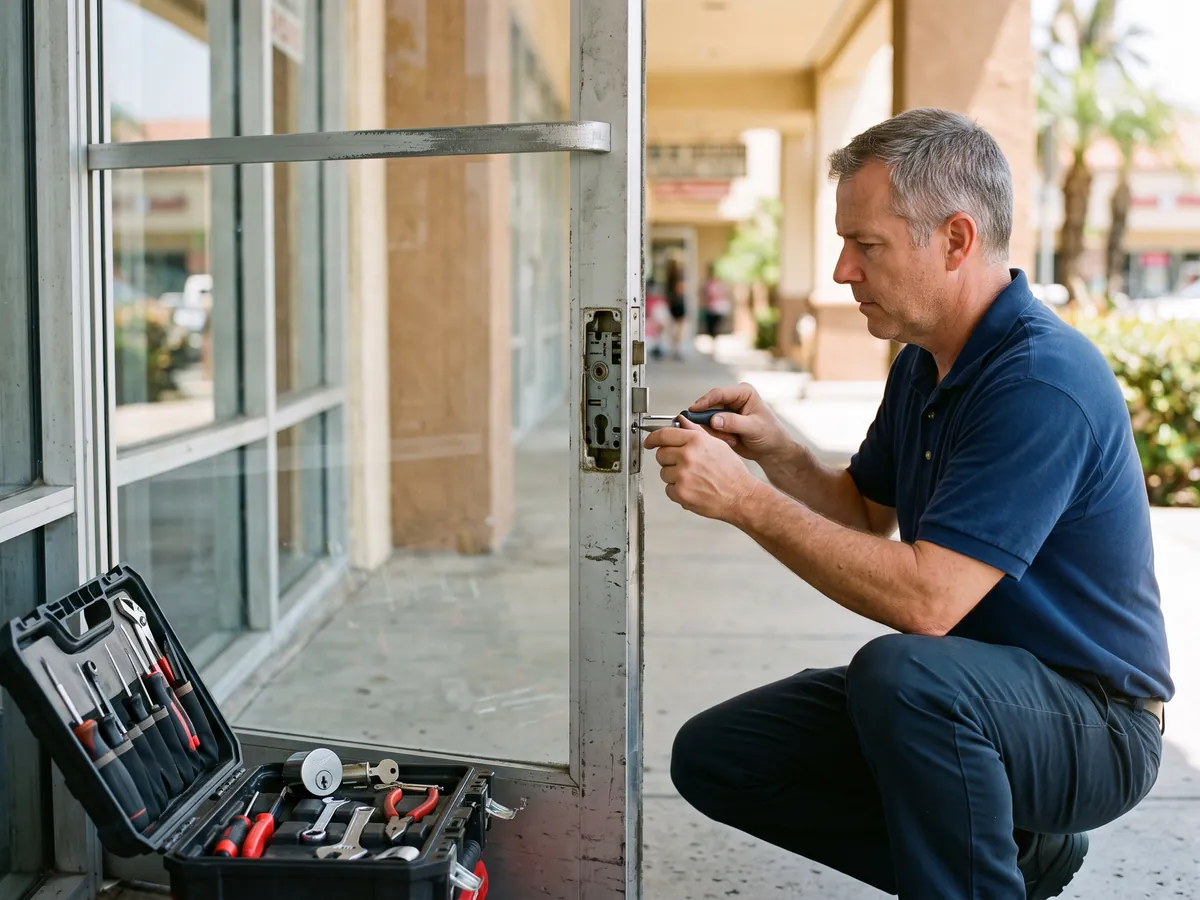
In a leased space, the first question about a damaged storefront door is often not how to fix it but whose job it is. Many leases leave the frame and glass with the landlord while the tenant handles locks, keys and everyday wear, and that line can run straight through a worn pivot. For aluminum storefront door repair in Cerritos, Julian's Locksmith tells you plainly what we found, takes photos you can forward to your property manager, and quotes the hardware work separately from anything that belongs to a glazier or the building owner. That keeps the paperwork moving and the door usable in the meantime.
Aluminum Storefront Door Repair in Cerritos: what to expect
A storefront door has two jobs, and the second is easy to forget while you're staring at the first. Besides swinging smoothly, it has to hold the opening shut. On an aluminum door that depends on small dimensions: roughly an eighth of an inch of clearance between the lock stile and the jamb, a bolt or latch that fully engages its strike, and a frame anchored tightly enough that a pry bar doesn't spread it. When a door sags, that clearance changes in the wrong direction, and a door that looks closed may only be resting against its strike. Aluminum storefront door repair is partly a security repair. We check engagement with the door closed, test whether the leaf can be pulled away from the frame by hand, and look for the bright scrapes that mark where something has been levered. If we find damage, we note it for your insurer, secure what we can and tell you what falls outside our work.
Work included on a typical visit
- Top, bottom and intermediate pivot replacement. A worn bottom pivot is the most common reason an aluminum storefront door drops. We support the leaf, unload the pivot, replace the worn bearing or the whole set, then reset the door to even reveals on every side. Top and intermediate pivots get inspected at the same time, since a loose one lets the door lean.
- Hinge and continuous geared hinge repair. Doors hung on butt hinges or a continuous geared hinge fail when screws strip out of the thin aluminum wall. We repair that with fresh fasteners sized for the extrusion, backing where the profile allows it, or a replacement hinge set. A full-length hinge that has bent or cracked is replaced rather than straightened.
- Correcting a dropped or sagging door. Think of a dropped door as a measurement problem. We compare the gap at the head, the lock side and the hinge side, check the leaf with a level, and see which way it has moved. That tells us whether to adjust, replace a part, or flag a frame problem that hardware can't solve.
- Rubbing, scraping and threshold clearance. In summer the door may fit in the morning and bind by afternoon. If heat is the trigger, we make sure the clearances have room to expand, which usually starts with worn pivots and ends with a slightly eased strike side. We would rather return the clearance than fit a bigger closer to fight the drag.
- Closer arm, bracket and speed adjustment. A closer fights a dragging door and loses, usually by slamming it or leaving it open an inch. We free the door first, then set the closing speed so it latches without banging. Overhead arms and floor-closer spindles are checked for bends, since a bent arm quietly changes the whole swing.
What's different about Cerritos
Office entrances at warehouses and light industrial parks take a different beating: pallet jacks, hand trucks, dust from the yard and vibration from trucks. Aluminum doors there often get bumped by carts and caked with grit that chews the bottom pivot and sweep. We repair the door, check the hardware and suggest protective details, such as a kick plate or bumper, that keep the next cart from folding a stile.
Dealership showrooms and service lanes along Carmenita Road have large glass doors that cycle constantly and collect fingerprints, dust and the occasional cart bump. The service-side doors take the abuse, while showroom doors need to look right and close quietly. We work around the sales floor, repair pivots and closers without a fuss, and are glad to quote any lock work on the same visit so you only have to schedule one appointment.
Coffee shops, bakeries and service counters that open before the commute need doors that work at sunrise. Our day starts at 6:30 a.m. every day, which suits an owner who wants a drag or latch problem fixed before the morning line forms. If you open earlier than that, call the evening before and we'll plan the work around your closing time rather than your opening rush.
Example situations
- A boutique at the edge of the foothills catches a gust of Santa Ana wind as a customer leaves, and the door bangs against its stop. The closer arm is bent, the top pivot has shifted, and the door now hangs crooked. We would replace the arm, reset the pivot and check the glass stop for movement, then suggest a hold-open feature so the next gust has less to grab.
- A yoga studio's landlord says the sticking door is the tenant's problem, and the tenant says it is a building defect. Both are partly right. We would inspect and write up what we found in plain terms: worn pivot hardware, which is a maintenance item, and a frame that has moved slightly, which belongs to the building. With photos and a separate hardware quote, the two can settle it.
- A taqueria with a pair of aluminum doors finds the inactive leaf drifting open whenever the kitchen exhaust pulls air through the dining room. The flush bolt is intact, but the keeper in the floor has pulled loose from the concrete. After confirming the owner's authority, we would anchor a new floor keeper, square the meeting stiles and test that both leaves line up when the active door is pulled shut.
- A barber shop's glass door rattles every time a bus passes on Norwalk Boulevard. The glass is fine, but the vinyl gasket has shrunk and a snap-in stop has worked loose. We would reseat the stop, replace the gasket and check the glass edge for chips. If a chip had started a crack, we'd tell the owner it is time to call a glazier before the next slam finishes the job.
From your call to the finished job
- Tell us what the door is doing. Start with when the problem began and what changed. A new closer, a heat wave, a delivery cart or a nearby break-in all point to different causes. Give us the address and a time that suits you, and we'll give an honest arrival estimate and quote the visit by phone.
- Confirm who can authorize the work. We ask who is authorized to approve repairs and, in a multi-tenant center, who owns the storefront system. That avoids surprises such as a landlord who must approve changes to the door, or a tenant unaware of a lease clause. Have ID and something that ties you to the business ready.
- Inspect the whole door, not just the lock. We start with the door open and unloaded: lifting the leaf to feel for play in the pivots, checking hinges, closer arm and glass stops, and measuring the gaps around the door. Only then do we close it and see where the latch lands relative to the strike.
- Quote the options before we start. You get plain options with the reasons behind them. A pivot set may be the whole answer. Or the leaf is bent, and new hardware on it would be wasted on a door that cannot hold it. Nothing starts until you approve a price.
- Repair, re-hang and adjust. The sequence matters. The door gets square first, the closer is tuned second, and the lock and strike come last, because a lock set to a crooked door only fails again. Where we replace parts, we match finish and size to what is already on the door.
- Test, document and hand off. The hand-off includes a short list: what we replaced, what to check monthly, and whether anything else on the door looks marginal. Photos from the visit go to you for your lease file or insurer. We would rather you call about a small drag early than wait for a failure.
How we quote the job
- Which part has failed. Small adjustments are the lightest part of the work, and replacing load-bearing parts is the next step up. A sag caused by a loose fastener costs far less to fix than one caused by a cracked pivot pocket. We separate those possibilities for you and quote accordingly.
- Door size, glass and weight. Size also decides whether one technician can do the work safely. A tall, glass-heavy door may need support while a pivot is replaced. We say so when you call, so the price reflects the real job rather than an optimistic one.
- Condition of the frame and floor. A door can only be as true as its frame. If the jamb has moved, the floor plate has loosened in the concrete or the header has deflected, hardware alone won't fix the door. We tell you what we can and can't correct, and what a storefront contractor would need to do.
Every job gets a clear quote before any work starts. Call (951) 903-3193 with the details and we'll tell you what to expect for your situation in Cerritos.
Common errors that cost time and money
- Planing, filing or grinding the bottom of the door to stop the scraping. Aluminum filings are sharp, the anodized finish is destroyed where you cut, and the underlying sag is still there. You end up with a door that is shorter, uglier and still not latching. Find out why it hangs low instead.
- Turning the closer up to make a dragging door latch. The extra force slams the leaf into its strike, bends the bolt and loads a pivot that is already tired. A customer with a stroller then has to fight a heavy door. Free the drag first; closer speed is the last adjustment, not the first.
- Driving longer or fatter screws into a hollow extrusion. The walls are often only about an eighth of an inch thick, so bigger fasteners strip the hole, can poke into the glass pocket and sometimes crack the profile. A stripped hinge or bracket needs backing or a different fastener, not brute force.
What to do before we arrive
- Plan aluminum storefront door repair around our hours. We work every day from 6:30 a.m. to 11:30 p.m., so a door that fails after 11:30 p.m. may need a temporary fix until morning. If you suspect trouble, call early in the week rather than waiting.
- Look for a manufacturer name or series number on the closer body, the pivot, the glass stop or the door edge, and photograph it. Replacement parts depend on the door series, and a clear picture saves guessing. Also photograph the finish in daylight; clear, bronze and black anodized can look alike indoors.
- Try the lift test before you book aluminum storefront door repair. Hold the door about halfway open and lift gently on the lock-side edge. If the leaf rises and drops under your hand, the bottom pivot bearing is worn, and that is the usual source of a sagging door. Tell us how much play you feel when you call so we can bring the right pivot set.
- Keep notes on when the door misbehaves. If it only drags after the afternoon sun hits it, heat expansion is part of the story. If it sticks every morning, think of grit or a worn bearing. Written down, those observations let a technician narrow the cause before arriving, which often saves a second visit.
Getting to Cerritos
Cerritos is about 65 miles from our San Bernardino base, roughly 66 minutes in light traffic via I-215 South through Colton and Riverside to SR-91 West. When you call, you get an arrival estimate based on where the technician is and the traffic at that moment.
We plan the drive the way a delivery route gets planned: freeway first, 183rd Street where it makes sense, then the side streets you describe. A landmark or the color of your building helps the technician spot you.
About Cerritos: Dairy Valley once counted more than 400 dairies and about 100,000 cows, outnumbering its 3,439 residents roughly 29 to 1.
| Neighborhoods | Cerritos Towne Center, Cerritos Park East and 166th Street, Brookhaven Street and Acoro Street area, Cerritos Auto Square district, Heritage Park area, Pat Nixon Park and South Street |
|---|---|
| ZIP codes | 90703 |
| Main routes | SR-91, I-605, I-5, Bloomfield Avenue |
| From our San Bernardino base | about 65 miles via I-215 South through Colton and Riverside to SR-91 West (Artesia Freeway) through Corona, the Santa Ana Canyon and north Orange County into Cerritos, exiting at Valley View Street, Bloomfield Avenue, Pioneer Boulevard, Norwalk Boulevard or Studebaker Road depending on the address; alternate via I-10 West to I-605 South, exiting at South Street for Los Cerritos Center and Cerritos Auto Square |
Lock or door hardware trouble in Cerritos?
Call (951) 903-3193 with the address and what the door or lock is doing. We'll quote the repair before any work starts.
Frequently asked questions
Do you service automatic door operators?
We repair the manual hardware: pivots, hinges, locks, strikes and sweeps, and we can work on a door that has an operator, but we do not service the operator itself. Power operators, sensors and safety beams belong to an automatic door technician. If your door suddenly stops opening automatically, call the company that installed it, and call us if it also drags or won't latch.
Is it safe to leave a damaged door overnight?
Only if it actually latches or can be secured. A door resting against its strike without engaging is not locked. If you can't get it closed and held, call us during our hours, every day from 6:30 a.m. until 11:30 p.m. Outside those times, ask your property manager about temporary securing or board-up, and call us as soon as we open.
Do you replace the glass or only the hardware?
Hardware and adjustment are our work. We can reseat glass stops and replace gaskets, but new glass has to be made and fitted by a glazier, especially tempered or insulated glass that cannot be cut after manufacture. If the glass is broken, we can help secure the opening and then repair the lock, pivots or closer once the glass shop has done its part.
Does door weight or closer speed matter for accessibility?
Yes. California's building code sets limits on how much force a public entrance door should need to open, and on threshold height, so a heavy, dragging door or a raised sill can be a compliance issue as well as an annoyance. We can free up the hardware and adjust the closer, but we recommend checking the details with your building department or an accessibility consultant.
What hours can you come, and do you do emergency repairs?
We work every day from 6:30 a.m. to 11:30 p.m. We're not a 24/7 service. If your door fails while we're closed, secure the opening as best you can, document it, and call when we open. We give you an honest ETA when you phone (951) 903-3193.
Who pays for aluminum storefront door repair, my landlord or me?
It depends on your lease. Commonly the landlord owns the frame, glass and structural parts of the storefront, while the tenant is responsible for locks, keys and routine wear such as closers and sweeps. A worn pivot can fall in either camp. We separate hardware from frame in our report and send photos, so you have clear facts when you talk with your property manager.
How far is Cerritos from your base?
Cerritos is about 65 miles from our San Bernardino base, roughly 66 minutes in light traffic. Arrival time depends on traffic and on the job the technician is finishing, so we give you an estimate on the phone before you commit.
Related services in Cerritos
- Storefront Lock Repair in Cerritos
- Narrow Stile Lock Repair in Cerritos
- Storefront Door Repair in Cerritos
- Storefront Door Lock Replacement in Cerritos
- Glass Door Lock Repair in Cerritos
- Door Closer Repair in Cerritos
- Storefront Door Closer Repair in Cerritos
- Commercial Door Repair in Cerritos
- Commercial Door Won't Latch in Cerritos
- Storefront Lockout in Cerritos
Aluminum Storefront Door Repair in nearby cities
- Aluminum Storefront Door Repair in ArtesiaLos Angeles County
- Aluminum Storefront Door Repair in La PalmaOrange County
- Aluminum Storefront Door Repair in Hawaiian GardensLos Angeles County
- Aluminum Storefront Door Repair in NorwalkLos Angeles County
- Aluminum Storefront Door Repair in LakewoodLos Angeles County
- Aluminum Storefront Door Repair in BellflowerLos Angeles County
- Aluminum Storefront Door Repair in Buena ParkOrange County
- Aluminum Storefront Door Repair in CypressOrange County
