
Brea, Orange County
Locked Out and It Can't Wait? Emergency Car Lockouts in Brea
Short answer: In an emergency car lockout in Brea, settle one question first: is a person or animal at risk? If a child or pet is inside, especially on a warm day, call 911 before anyone else. For urgent lockouts without that danger, like an engine left running or a car stuck somewhere unsafe, call Julian's Locksmith at (951) 903-3193 and we'll prioritize your call.
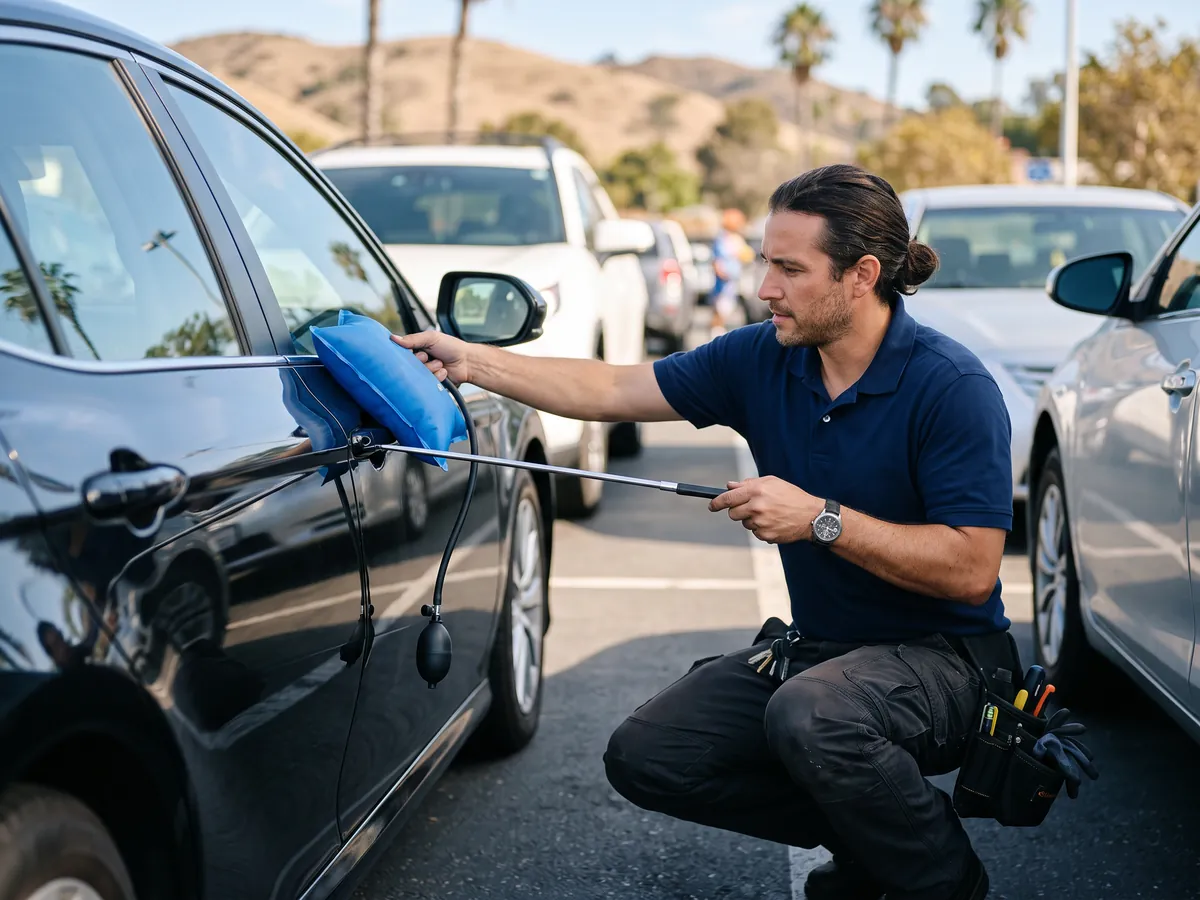
Sometimes the car isn't the emergency; what's inside it is. Insulin in a cooler on the passenger seat, a child's inhaler in the door pocket, the phone holding your boarding pass, the laptop you need for a nine o'clock presentation. Details like those turn an ordinary lockout into an emergency car lockout, and they're worth mentioning the moment you call (951) 903-3193. We weigh them when we decide which call goes next, and we'll be candid if our honest ETA runs longer than your deadline allows. If your wallet is inside as well, that's fine: we open the car, then check your ID or registration before you drive off in Brea.
Emergency Car Lockout in Brea: what to expect
Speed during an emergency car lockout comes from preparation, not force. When your call reaches Julian's Locksmith, our questions are practical: what are you driving, where exactly is it, what's inside, and is anyone at risk? The vehicle tells us which tools to grab, whether that's an air wedge and coated long-reach rod for the common case or a Lishi pick cut for your keyway when the door layout or a side curtain airbag makes a reach tool awkward. The location tells us which technician can get there first and what traffic on Central Avenue looks like right now. What's inside tells us how to rank you against other waiting calls. Then we quote, give you an honest arrival estimate, and stay reachable by phone. On scene, a typical vehicle opens within a few minutes once the tools are in place. The slower part is usually ownership verification, which we never skip, even in a hurry, because a quick look at your ID beside the registration is what stops a stranger from talking a locksmith into your car tomorrow.
What we can do on-site
- Priority dispatch for urgent lockouts. When an emergency car lockout comes in, we look at who can reach you soonest, not who called first. A technician finishing a rekey near Brea Mall may be redirected to you while a routine job waits. We'll tell you plainly where that technician is and how long the drive realistically takes, so you can decide whether to wait for us or make another plan.
- Freeway shoulders and roadside stops. Roadside lockouts usually start innocently: you pull over to check a tire, the door swings shut behind you, and the auto-lock does the rest. Before calling, note the nearest exit, mile marker or cross street, plus your direction of travel. Those details are the difference between our van pulling up beside you and circling an interchange twice looking for you.
- Phone, wallet or medication locked inside. A wallet locked inside creates a verification puzzle, not a dead end. We open the car, then you hand us the registration from the glove box and the license from your console before anything else leaves the vehicle. If those papers aren't in the car, an insurance card in your email or the registered owner on the phone can usually settle it.
- Parking structures, garages and gated lots. Underground levels block cell signal, and they can also block your car's connected-services modem, so a remote unlock from the automaker's app may fail down there. Walk up to street level, note the level and stall number, and call from there. Tell us about any posted height limit at the entrance; it helps our technician plan the approach.
- Early-morning and late-evening lockouts. Late-evening lockouts deserve extra thought about where you wait. Lots empty out, lighting gets patchy and stores close their doors. Pick a spot near light and people, give us a callback number, and if the business sheltering you is about to lock up, tell us so we can agree on a new meeting spot before you lose touch.
Local factors in Brea
Shopping center lots off Brea Boulevard are classic lockout territory, because that's where people juggle bags, carts and kids at the same time. A lockout there turns urgent when the engine is running, a pet is inside, or groceries are spoiling on a hot afternoon. Wait inside the store if you can, and tell us which entrance or storefront you're near so we can spot the car without circling the lot.
Canyon roads and foothill trailheads raise the stakes of a lockout: patchy cell coverage, narrow turnouts and long gaps between help. If you lose signal, walk toward the main road or higher ground until you can call. During fire season or a red flag warning, don't wait alone beside a car parked in dry brush; get to a populated area, and call 911 if you see smoke or flames.
Downtown lockouts often happen at metered spaces or in garages with posted closing times. A car locked inside a garage that shuts at a set hour turns a nuisance into a deadline, so tell us when the gates come down. We can't make a parking ticket disappear, but we will move a car that's about to be cited or towed higher on our list.
Common situations
- An illustrative case: a hiker with type 1 diabetes returns to the trailhead lot near Brea Olinda High School to find the fob locked inside along with the insulin cooler. It's late morning and warming up, and the next dose is due soon. Calling (951) 903-3193 and mentioning the medication right away moves the call up our list, and the ETA we give helps them decide whether to involve paramedics too.
- Imagine a shopper loading bags at a home-improvement store while a large dog paces the back seat. One paw lands on the armrest switch, and every door locks with the engine off. On a cool morning with the windows cracked, the dog is calm, so the owner calls us and waits in the shade beside the car. On a hot afternoon, the same scene is a 911 call.
- A driver pulls onto the shoulder of a busy freeway to look at a thumping tire, and the door closes and auto-locks behind them. With trucks passing close, they climb behind the guardrail and call 911, and the Highway Patrol arranges a tow to a lot off the next exit. We meet them there, open the car on solid pavement, and verify ownership with the registration inside.
- A parcel driver steps out of a cargo van to scan a package, the sliding door closes, and the cab locks with the handheld scanner and keys inside. Dispatch is calling every few minutes. The driver calls us with the van model and the fleet manager's number, we confirm authorization during the drive, and on arrival we open the cab first so the route can resume.
How the visit works
- Decide whether it's a 911 call. Look through the glass and check the occupant: alert, comfortable and in shade, or flushed, quiet and sweaty? Touch the roof or window to judge the heat. Signs of distress mean 911 right now. A calm passenger on a cool morning gives you a little room to call us first.
- Get somewhere safe and save your battery. Move away from traffic and toward light, people or a staffed business. Dim your screen and close apps you don't need, because your phone is now your link to us and to anyone else helping you. If it's hot, find shade and water; if it's late, find a lit doorway.
- Call with the details that set priority. Lead with what's inside and whether the engine is running. Then give us the exact location, the year, make and model, and a callback number that works. Those four facts let us rank your call, pick the right tools and send the closest technician in one conversation.
- Hear the price and a real ETA. You approve the quote before we roll. If the situation changes on site, such as a lost key instead of a locked-in one or a jammed lock, we stop and requote before doing any additional work. Nothing gets added once the job is done.
- Open the car without force. If a child or pet is inside, we position you at the door before it opens so you're the first person they see. If the engine has been running, we leave it on until you're seated, then help you check the fuel level before you drive anywhere.
- Verify, hand over and check everything. Once the door is open, you show us your ID and the registration or other proof before taking the car. Then we test the locks, the fob and the key so you don't get stranded again a mile down the road.
Pricing factors
- How urgent the call is. Handling an emergency car lockout sometimes means pulling a technician off another job or driving farther than we normally would. If priority handling affects the price, you'll hear that before you agree, along with the option of waiting for the next open slot instead. You choose, and nothing gets tacked on after the door opens.
- Where the car is stranded. Access rules matter too. A hospital lot, a secured office garage or a guarded community may require us to check in, wait for an escort, or move the car before working. Clearing those steps ahead of time, by alerting security or meeting us at the gate, keeps the visit shorter and the cost predictable.
- Whether the key is inside or gone. A dead fob locked inside, a key snapped off in the door cylinder, or a fob that's present but ignored by the car each need slightly different work. Describe what you know and we'll price it from there. Some vehicles need dealer-only programming for a new key, and we'll say so if yours is one of them.
Every job gets a clear quote before any work starts. Call (951) 903-3193 with the details and we'll tell you what to expect for your situation in Brea.
Practical tips before you call
- When you pull onto a shoulder or stop at a pump, take the key with you before your feet touch the pavement. That few-second habit at the start of every stop removes the most common way drivers end up locked out beside traffic or a busy fuel island.
- Save (951) 903-3193 in your phone under a name you'll find under stress, and memorize one other number, a partner's or a neighbor's. If your phone ends up locked in the car, you'll still be able to borrow one and reach someone who can help or bring a spare key.
- Teach older kids how to pop the locks from the inside and how to honk the horn if they ever get stuck. Practice it in the driveway with the engine off. A child who knows where the lock switch and the horn are can turn a frightening moment into a short one.
- Never warm up a car inside a garage, even with the door partly open. Back it out first, then let it idle in the driveway. That habit protects you from carbon monoxide and also prevents the worst version of a running-engine lockout, the kind where the exhaust has nowhere to go.
Mistakes to avoid
- Waiting inside an attached garage while a locked car idles. Carbon monoxide has no smell, and it builds up faster in a closed space than most people realize. Open the garage door, step outside, and keep the door into the house shut until the engine is off.
- Letting a stranger with a coat hanger or slim jim have a go. Modern doors hide wiring, cable-operated latches and side airbag sensors, and blind fishing can disconnect a latch cable or nick a harness. You still end up calling for help, now with a door that may not open from the inside.
- Draining your phone while you wait. Scrolling, streaming or posting about the lockout eats the battery you need for calls with us, with 911 and with whoever is bringing a spare. Dim the screen, switch on low-power mode, and save what's left for the calls that matter.
Reaching Brea
Brea is about 51 miles from our San Bernardino base, roughly 55 minutes in light traffic via I-215 South briefly to SR-210 West. When you call, you get an arrival estimate based on where the technician is and the traffic at that moment.
We plan the drive the way a delivery route gets planned: freeway first, SR-90 where it makes sense, then the side streets you describe. A landmark or the color of your building helps the technician spot you.
About Brea: Brea's Art in Public Places program began in 1975 and has placed more than 140 sculptures and other artworks around the city.
| Neighborhoods | City Hall Park area, Arovista, La Floresta, Country Hills, Blackstone, Downtown Brea |
|---|---|
| ZIP codes | 92821, 92823 |
| Main routes | SR-57, SR-90, SR-142, Brea Boulevard |
| From our San Bernardino base | about 51 miles via I-215 South briefly to SR-210 West (Foothill Freeway) through Rialto, Fontana, Rancho Cucamonga and La Verne, then SR-57 South (Orange Freeway) through Pomona and Diamond Bar and over the Puente Hills to the Lambert Road or Imperial Highway (SR-90) exits; alternate via I-15 South and SR-60 West to SR-57 South, or SR-60 West to SR-71 South and Carbon Canyon Road (SR-142) through Chino Hills for Olinda Village and Olinda Ranch |
Friday is a full day for us. We begin at 6:30 a.m. and close at 11:30 p.m., the same as every other day, Saturday included. If a lock fails after 11:30 p.m., call us when we reopen at 6:30 a.m., and in the meantime fall back on a neighbor's spare key, a night with family, or a door you can secure from inside.
For businesses, the person who calls isn't always the person who can approve the work. Expect us to ask for an employee ID, a business card or a quick call to the owner or manager before we open, rekey or change locks on a storefront, office or warehouse. Property managers can set up an authorized-contact list with us ahead of time.
Locked out of your car in Brea?
Call (951) 903-3193 with the year, make and model and where the car is parked. You'll get an arrival estimate and a quote before anyone heads out. If a child or pet is shut inside a hot car or building, call 911 first.
Frequently asked questions
If responders break my window, who pays for it?
Usually the owner does, often through auto insurance if the policy covers glass. Comprehensive coverage frequently includes window replacement, sometimes with a deductible, so check your policy or call your insurer afterward. A broken window is a small price when a life may be at stake, and responders choose the window carefully. An auto glass shop handles the replacement; we can help if a key went missing in the confusion.
What if the keys aren't in the car after you open it?
Then we've solved half the problem. We'll stop and explain the options before doing anything else: retracing your steps, waiting for a spare, or having us make a new key on site. Many vehicles can get a key cut and programmed on the same visit, but some require dealer-only programming, and we'll tell you honestly if yours is one of them.
My baby is locked in the car. Should I call 911 or a locksmith?
Call 911 first, every time. Responders are trained to judge the danger, can force entry immediately, and can treat a child who has overheated. A locksmith, however close, can't offer the medical side. Once you've called 911, you can call us at (951) 903-3193 as backup, and if we're nearby we'll head over. Stay at the window and keep your child calm until help arrives.
Can you help if I'm locked out on a freeway shoulder?
Yes, as long as the spot is safe to work in. Get behind a barrier first, and if the shoulder is narrow or traffic is close, call 911 so the Highway Patrol can manage the scene. Often the safest plan is moving the car to a lot near the next exit, where we can open it with room to work. Tell us your direction of travel, the nearest exit and any mile marker.
My medication is locked in the car. Will you move me up the list?
Tell us exactly what's inside and when your next dose is due, and we'll factor that into the order of our calls. If you or someone with you is already having symptoms, such as signs of low blood sugar or trouble breathing, call 911 right away; paramedics can treat many of those situations immediately. Never wait on a locksmith for a medical emergency.
Can you open my car if my ID and registration are locked inside?
Yes. We open the car first, then ask you to show your license and the registration or other proof of ownership before you drive away. If your name isn't on the registration, have the owner's number ready or paperwork showing you're authorized, such as a rental contract or a lease. We verify every time because that same rule protects your car from strangers.
How far is Brea from your base?
Brea is about 51 miles from our San Bernardino base, roughly 55 minutes in light traffic. Arrival time depends on traffic and on the job the technician is finishing, so we give you an estimate on the phone before you commit.
Related services in Brea
Emergency Car Lockout in nearby cities
- Emergency Car Lockout in La HabraOrange County
- Emergency Car Lockout in PlacentiaOrange County
- Emergency Car Lockout in Rowland HeightsLos Angeles County
- Emergency Car Lockout in FullertonOrange County
- Emergency Car Lockout in La Habra HeightsLos Angeles County
- Emergency Car Lockout in Yorba LindaOrange County
- Emergency Car Lockout in AnaheimOrange County
- Emergency Car Lockout in City of IndustryLos Angeles County