
Arcadia, Los Angeles County
Storefront Lock Repair in Arcadia
Short answer: Most storefront locks that suddenly 'quit' in Arcadia aren't broken inside. The usual causes are a door that has dropped on its pivots so the hookbolt drags on the strike, a mortise cylinder that worked loose and rotated in the stile, or a cam that no longer reaches the lock mechanism. All three can be checked on-site in one visit and are often fixed with adjustment and small parts.
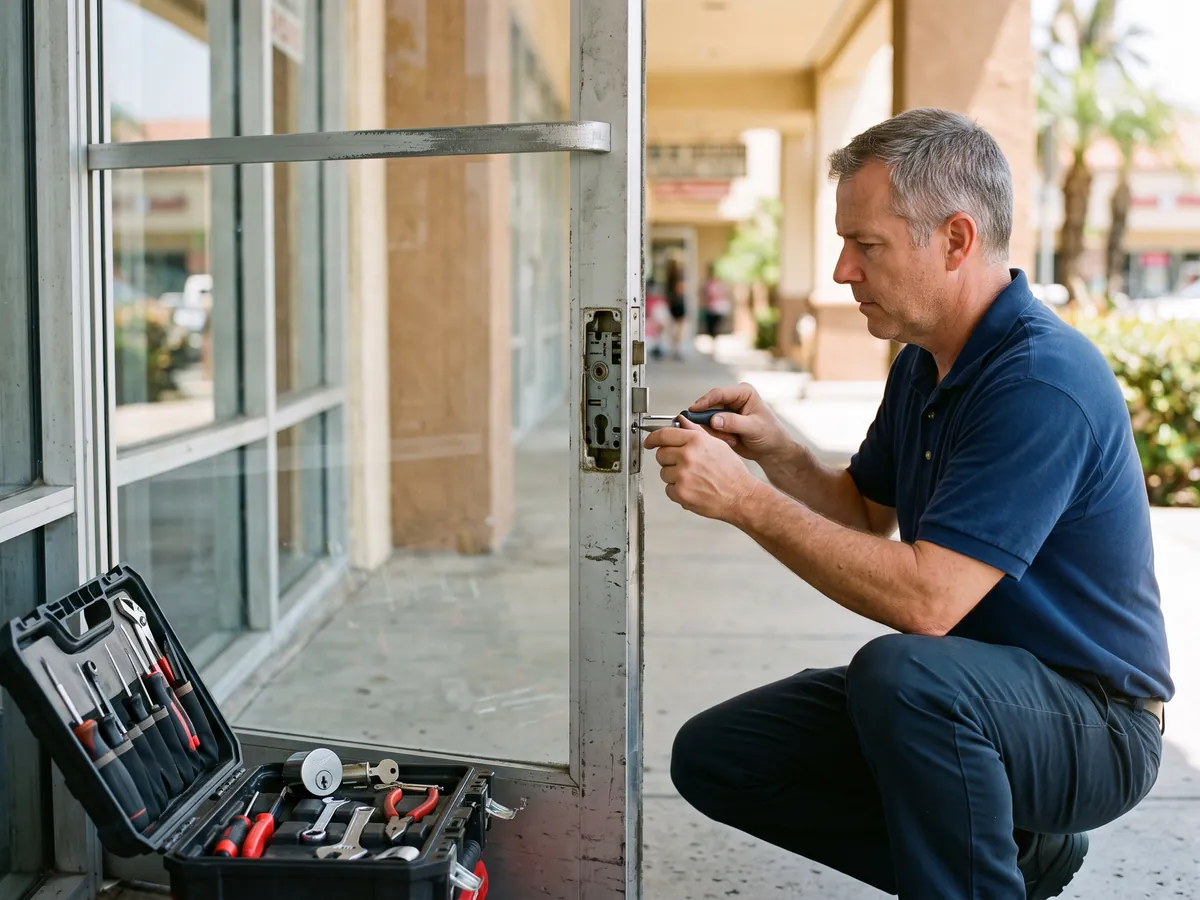
Narrow-stile storefront doors are a world of their own. The lock is a slim mortise case slid into a hollow aluminum frame, operated by a threaded mortise cylinder whose cam has to match the lock maker, and secured by a pivoting hookbolt instead of a straight deadbolt. Get one of those details wrong and the door half-works, which is often how we find it. Around Arcadia, many doors end up patched with a residential cylinder or the wrong cam. Our job is to identify each part, correct what's mismatched, and leave you with a door that locks on the first try, every time.
Storefront doors are the thin-framed aluminum and glass doors seen in nearly every plaza in Arcadia, from the shops along First Avenue and Huntington Drive in the downtown core to restaurants and offices on Live Oak Avenue and in the Baldwin Avenue centers. They look simple, but their locks are packed into a very narrow stile. A common lock inside is an Adams Rite from the MS1850 family, with a deadlatch that keeps the bolt from being pushed back and, on some models, a hookbolt that grips the keeper. A cylinder in the face works it, and a thumbturn or a second cylinder sits on the other side. Failures come from a few causes. The door sags and the bolt misses its keeper. A cam on the cylinder wears or breaks, so the key turns without moving the bolt. Paddle handles loosen. A deadlatch plunger gets gummed with dirt or silicone spray. Often the cause is the door itself, because pivots and rails need adjustment before a new lock will work. We repair or replace the cylinder, adjust or swap the deadlatch, fit a cam to suit your lock, realign the keeper in the frame, and tighten or replace handles. Landlord rules may apply at The Shops at Santa Anita and other managed centers, so check your lease and we'll work with the property manager.
How this works in Arcadia
Matching parts is half of storefront work. A replacement deadlock has to share the original's backset, the distance from the stile edge to the center of the cylinder, with common sizes including 31/32, 1-1/8 and 1-1/2 inch. The faceplate must be flat or radiused to suit the stile edge, and the finish (clear anodized, dark bronze, black) should match the door so the repair doesn't look like a patch. Cylinders are the next puzzle. Storefront deadlocks use threaded mortise cylinders, but the cam on the back differs between lock makers, and the length has to suit the stile depth plus any trim ring. A cylinder an eighth of an inch too short leaves the cam floating; one that's too long can't seat. On older doors in Arcadia, the original lock may come from a brand that's no longer made. In that case we look for a direct replacement with the same case dimensions, an adapter faceplate, or a modest re-prep of the stile pocket, and we explain the tradeoffs before cutting anything. Getting these details right is why a careful repair lasts years instead of weeks.
What we can do on-site
- Mortise cylinder and cam correction. Storefront deadlocks need a mortise cylinder of the correct length with the right cam on the back. Too short, and the cam barely brushes the lock; wrong cam profile, and it slips under load. We measure stile depth and trim ring, fit the right cylinder and cam, and snug the set screw down properly.
- Paddle handle repair and replacement. Paddle handles are handed and built to work with a specific latch, so a replacement has to match swing, latch type and stile. We identify the existing paddle, fit the correct replacement or a compatible set, and adjust it so customers in Arcadia can open the door with one easy motion.
- Strike, jamb and alignment work. When the bolt hits the edge of the strike instead of sliding into it, the key turns stiffly or not at all. We trace the cause, whether a worn bottom pivot, a racked frame, or a strike that shifted, and correct it. Fixing alignment usually saves the lock from failing early.
- High-security and anti-pry upgrades. If a pry bar is your worry, focus on the bolt and the gap. Options include an astragal across the meeting stiles of a pair, a multi-point lock that throws rods top and bottom, and a properly anchored hookbolt strike. We explain what each upgrade resists and recommend the one your door actually needs.
- Pairs of doors: flush bolts and inactive leaves. Bottom flush bolt holes in the floor fill with grit, gum and mop water, so the bolt only goes in partway or not at all. We clear and replace dust-proof floor strikes, fix bent or seized bolt rods, and check the top bolt engages the header so the inactive leaf stands firm.
What's different about Arcadia
Medical and dental offices near Arcadia County Park often use aluminum entrance doors with paddles, a deadlatch and an MS1850-style deadlock, sometimes plus an electric strike for buzz-in entry. We handle the mechanical locks and cylinders, and we're upfront when an electrified component needs the low-voltage installer who wired it. Accessibility matters here, so we keep paddle action light and confirm the door releases with one easy push.
Strip centers and shopping plazas around Arcadia are full of aluminum storefronts, and their locks get cycled hundreds of times a week. Wear shows up first in paddle springs, deadlatch tongues and strikes loosened by constant slamming. Because neighboring units often share the same door system, the parts are familiar and usually on the van. Tell us the plaza name and which end of the center you're in, and we'll arrive equipped for that door style.
Hotel lobbies, restaurant entrances and gift shops in the Arcadia area run long hours on aluminum doors that rarely rest. Pivots wear, latches stick and paddles crack under constant use. We schedule repairs around your service hours where we can, carry common deadlatch and paddle parts, and focus on keeping guest entrances moving while staff can still lock the door quickly at closing.
Common situations
Imagine a salon in a Live Oak Avenue plaza whose glass door has begun to need a hip bump to lock. The key turns, but the bolt barely moves. We find that the door has dropped slightly, the keeper is out of line and the cylinder's cam is worn. We adjust the pivot to lift the door back to square, replace the cam, move the keeper a hair and test the lock from both sides. The owner can lock up without a shove.
- After a smash-and-grab where someone broke glass and reached the thumbturn, a restaurant near Downtown Arcadia asks for a key cylinder on the inside. We'd explain the posted-sign requirement for key-locked exits, suggest confirming with the local fire authority, then fit a second mortise cylinder with the correct cam and length once the owner decides which way to go.
- A typical call from a nail salon whose glass door faces west: the deadlock works perfectly at opening, but by late afternoon the key barely turns. Heat swells the dark bronze door and frame, and a slightly worn pivot leaves no margin at the strike. We'd adjust pivot height, reset the strike, and test the hookbolt while the door is still warm, so the fix holds through the summer.
- For example: a coffee shop opens at 6:30 a.m. and the owner's key turns a full circle in the storefront deadlock without moving the hookbolt. The mortise cylinder's set screw has loosened over months, letting the cylinder rotate so its cam no longer meets the lock. After confirming the owner's authority, we'd get the door open, reposition and secure the cylinder, and check the cam for wear before the first customer walks up.
How the visit works
- Describe the door and the symptom. A photo of the lock's faceplate edge with the door open helps a lot. The maker and model are usually stamped there, and the backset is easy to judge from the cylinder position. Send it if you can, and we'll load matching parts before heading to Arcadia.
- Verify authority to work on the door. Before we open, rekey or replace a business lock, we confirm you're entitled to authorize it. Photo ID plus a business license, lease, utility bill in the business name, or a letter from the owner usually covers it. This step protects you as much as anyone.
- Diagnose with the door open and closed. We also look past the reported symptom. A sticky key might be the complaint, but a stripped strike, a deadlatch plunger that isn't deadlocking, or a loose inactive-leaf flush bolt could matter more for security. We point those out with their costs, and you decide.
- Quote, then repair or replace. You get a price for each option before work starts: adjust and clean, replace a cylinder or cam, or install a new deadlock body. Most repairs happen on the spot with van stock. If an odd part must be ordered, we secure the door temporarily first.
- Key the cylinders and test every function. We cut and try every key we hand over in every lock it's meant to operate. A key that works the front deadlock but sticks in the back door gets corrected on the spot, not left for staff to discover at closing time.
- Hand off keys and notes. If you converted to a key-operated inside cylinder, we'll remind you about the required sign and leave the door working for free exit during business hours. If parts are on order, we schedule the return visit before leaving.
How we quote the job
- Adjustment versus replacement parts. We start with what's simplest to correct and work up. A thorough diagnosis tells us whether a modest adjustment will hold or whether you'd be paying twice by putting off replacement. You approve the approach, and the price is set before the work starts.
- Matching hardware, backsets and finish. Doors from the original build of an older center may carry hardware no supplier stocks anymore. Retrofitting a current lock into an old pocket takes careful measuring and sometimes filing or machining. That extra labor shows up in the quote, and we explain it rather than surprise you.
- Cylinders, keys and key systems. If your key needs to fit an existing master system, we need the system's key or bitting information from the owner. Working within a documented system is straightforward. Reverse-engineering an undocumented one takes longer and costs more, and sometimes a fresh system is the better value.
Every job gets a clear quote before any work starts. Call (951) 903-3193 with the details and we'll tell you what to expect for your situation in Arcadia.
What not to do
- Replacing the lock when the door is the problem. If the hookbolt throws smoothly with the door open, a new deadlock won't cure a sagging door or misaligned strike. Diagnose first, or you'll pay for hardware and still fight the key.
- Chaining or padlocking push paddles while people are inside. It blocks the required exit path and can violate fire codes. If the lock won't secure the door at night, call for a proper fix or a temporary lock instead of improvising.
- Ignoring the inactive leaf on a pair of doors. A strong deadlock on the active leaf means little if the inactive leaf's flush bolts never engage. Check both bolts at closing; a pair that shifts when pushed is effectively unlocked.
Practical tips before you call
- Know where your storefront keys meet the code. If you lock the main exit with a key on the inside, building and fire codes generally require a clearly posted sign that the door stays unlocked while the space is occupied. Check with your fire authority before converting a thumbturn.
- Count your storefront keys once a quarter and write down who holds each one. When a key can't be accounted for, rekeying is far cheaper than dealing with an unexplained after-hours entry. Restricted keyways make that count meaningful, because copies can't be made casually.
- Push the door after you lock up each night. If it moves more than slightly, the hookbolt isn't fully engaged or the strike is loose. Tell your locksmith exactly what you felt, because that small detail speeds up diagnosis considerably.
- Never use oily spray in a storefront cylinder. Wet lubricants hold the dust and grit blown in from the parking lot, and the mix gums up the pins. Use a dry graphite or PTFE lock lubricant sparingly, work the key a few times, and wipe off any excess.
Service in Arcadia
Arcadia is about 46 miles from our San Bernardino base, roughly 50 minutes in light traffic via Palm Avenue to I-215 North, I-15 South to the SR-210/I-210 Foothill Freeway. When you call, you get an arrival estimate based on where the technician is and the traffic at that moment.
We plan the drive the way a delivery route gets planned: freeway first, Orange Grove Avenue where it makes sense, then the side streets you describe. A landmark or the color of your building helps the technician spot you.
About Arcadia: The Los Angeles County Arboretum and Botanic Garden on Baldwin Avenue covers about 127 acres of the old Baldwin ranch and includes the Queen Anne Cottage and the Hugo Reid Adobe.
| Neighborhoods | Lower Rancho, Upper Rancho, Santa Anita Oaks, Santa Anita Village, Downtown Arcadia, Longley Way |
|---|---|
| ZIP codes | 91006, 91007 |
| Main routes | I-210, Foothill Boulevard, Huntington Drive, Colorado Boulevard and Colorado Place |
| From our San Bernardino base | about 46 miles via Palm Avenue to I-215 North, I-15 South to the SR-210/I-210 Foothill Freeway, then west through Rancho Cucamonga, Glendora, Azusa and Monrovia to the Santa Anita Avenue, Baldwin Avenue or Michillinda Avenue exits |
Lock or door hardware trouble in Arcadia?
Call (951) 903-3193 with the address and what the door or lock is doing. We'll quote the repair before any work starts.
Frequently asked questions
Someone opened our latched shop door with a card. How?
If only the deadlatch was engaged, its small deadlocking plunger probably wasn't held in by the strike. That happens when the door sits too far from the jamb, so the plunger drops into the strike opening and the latch can be pushed back. Throwing the deadlock prevents it, and we can correct the gap or strike so the latch deadlocks as designed.
Do you work on all-glass doors without aluminum frames?
Frameless glass doors use different hardware, such as patch locks clamped to the bottom rail that bolt into a floor strike, or center locks between pairs. We service many of these, including cylinder replacement and rekeying. Repairs involving the glass itself or the glazing of the patch fittings are for a glazier, and we'll tell you if that's where the problem lies.
How long does a storefront lock repair take?
Most cylinder, cam and strike fixes take well under an hour once we're on-site, and deadlock or deadlatch replacements a bit longer. Re-prepping a stile for a different lock, or repairing pry damage, takes more. We'll give you an estimate on the phone and confirm it after diagnosis, so you know when the door will be back in service.
What should I do if the storefront lock fails and I can't lock up?
Call (951) 903-3193 while you're still on-site and describe the symptom. Don't chain the paddles while anyone is inside, and try not to leave the shop unattended until the door is secured. If a part has to be ordered, we can install a temporary lock or secure the opening another way until the correct hardware arrives.
Will a regular deadbolt fit my aluminum shop door?
No. Narrow stiles are too thin for a standard bored deadbolt, which needs a large cross bore and more backset than the frame allows. Storefront doors use mortise-style deadlocks made for the hollow aluminum stile, operated by threaded mortise cylinders. Trying to fit residential hardware weakens the stile and rarely works properly for long.
Do I need permission from my landlord to repair the storefront lock?
For like-for-like repairs, usually not, but check your lease. Rekeying, changing cylinders or adding hardware often requires approval, and some landlords keep exterior doors on a master key. Calling the property manager first avoids redoing work. We'll also ask for documents showing your authority over the business before we start.
How far is Arcadia from your base?
Arcadia is about 46 miles from our San Bernardino base, roughly 50 minutes in light traffic. Arrival time depends on traffic and on the job the technician is finishing, so we give you an estimate on the phone before you commit.
Related services in Arcadia
- Narrow Stile Lock Repair in Arcadia
- Storefront Door Repair in Arcadia
- Storefront Door Lock Replacement in Arcadia
- Glass Door Lock Repair in Arcadia
- Locksmith for Retail Store in Arcadia
- Door Closer Repair in Arcadia
- Panic Bar Installation in Arcadia
- Commercial Door Hardware in Arcadia
- Business Lockout in Arcadia
- Commercial Lock Rekey in Arcadia
Storefront Lock Repair in nearby cities
- Storefront Lock Repair in North El MonteLos Angeles County
- Storefront Lock Repair in MonroviaLos Angeles County
- Storefront Lock Repair in Sierra MadreLos Angeles County
- Storefront Lock Repair in Temple CityLos Angeles County
- Storefront Lock Repair in East San GabrielLos Angeles County
- Storefront Lock Repair in BradburyLos Angeles County
- Storefront Lock Repair in El MonteLos Angeles County
- Storefront Lock Repair in DuarteLos Angeles County
