
El Monte, Los Angeles County
Storefront Lock Repair in El Monte
Short answer: Most storefront locks that suddenly 'quit' in El Monte aren't broken inside. The usual causes are a door that has dropped on its pivots so the hookbolt drags on the strike, a mortise cylinder that worked loose and rotated in the stile, or a cam that no longer reaches the lock mechanism. All three can be checked on-site in one visit and are often fixed with adjustment and small parts.
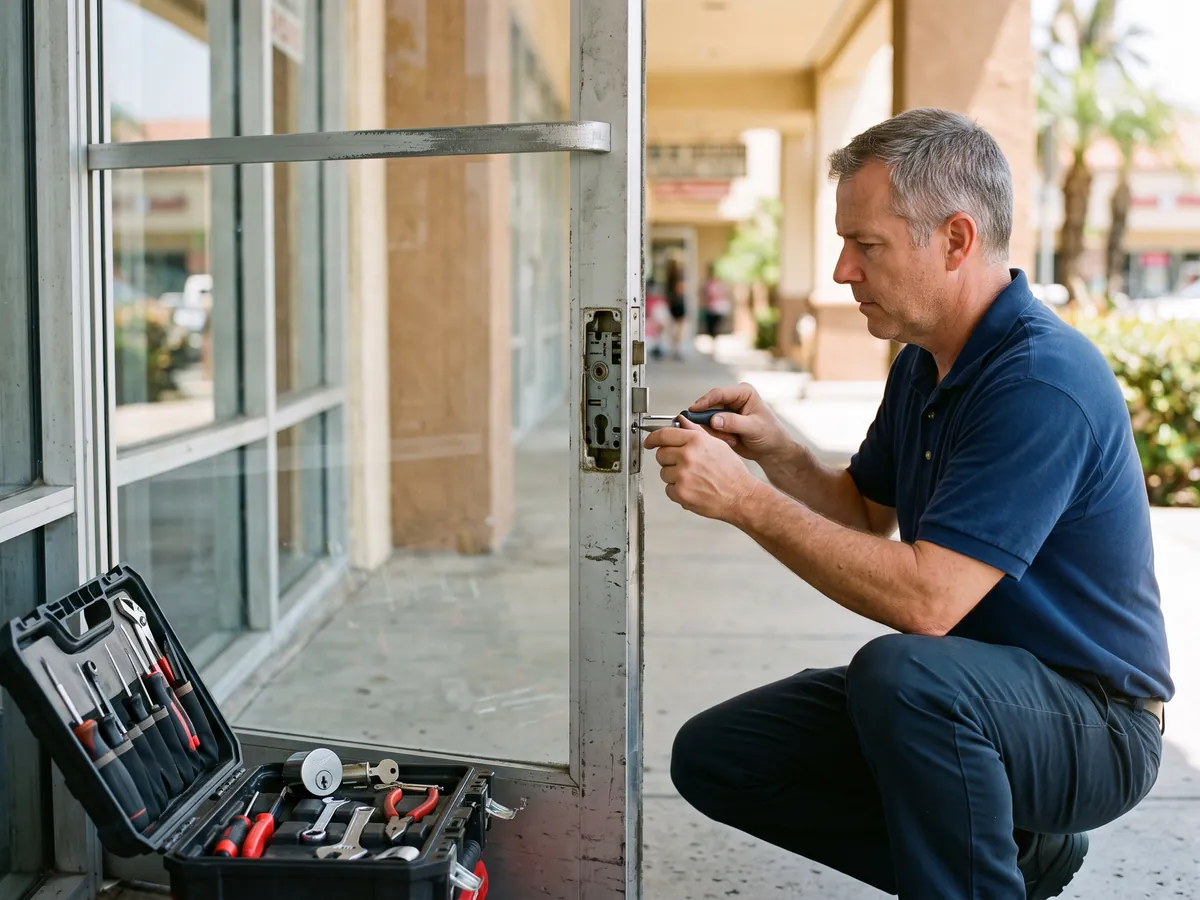
Narrow-stile storefront doors are a world of their own. The lock is a slim mortise case slid into a hollow aluminum frame, operated by a threaded mortise cylinder whose cam has to match the lock maker, and secured by a pivoting hookbolt instead of a straight deadbolt. Get one of those details wrong and the door half-works, which is often how we find it. Around El Monte, many doors end up patched with a residential cylinder or the wrong cam. Our job is to identify each part, correct what's mismatched, and leave you with a door that locks on the first try, every time.
Storefront doors in El Monte's shopping strips, such as the units at Five Points Plaza and Santa Fe Trail Plaza, share one design: an aluminum frame with a narrow stile, a glass panel and a lock made to fit a very thin edge. The classic hardware is the Adams Rite MS1850 series, a deadlatch with a hookbolt that swings out when the key turns. Storefront lock repair concentrates on a handful of parts. The cylinder cam comes first. Daily use wears the small cam on the back of the cylinder, so the key spins without throwing the bolt. The bolt can drag if the door has dropped or the hookbolt no longer meets its strike. Paddle handles loosen and bind, and the interior thumb-turn or cylinder corrodes. Many problems are solved by replacing the cam, tightening the lock case or adjusting the strike and door. Security matters too. A hookbolt only protects if it engages fully, so we check that the door sits square and the bolt reaches its pocket, and we recommend a pry guard when the frame allows. If the lock hasn't been rekeyed since the last tenant, we do that during the visit. We confirm you're the owner or manager before changing a business lock.
How this works in El Monte
Matching parts is half of storefront work. A replacement deadlock has to share the original's backset, the distance from the stile edge to the center of the cylinder, with common sizes including 31/32, 1-1/8 and 1-1/2 inch. The faceplate must be flat or radiused to suit the stile edge, and the finish (clear anodized, dark bronze, black) should match the door so the repair doesn't look like a patch. Cylinders are the next puzzle. Storefront deadlocks use threaded mortise cylinders, but the cam on the back differs between lock makers, and the length has to suit the stile depth plus any trim ring. A cylinder an eighth of an inch too short leaves the cam floating; one that's too long can't seat. On older doors in El Monte, the original lock may come from a brand that's no longer made. In that case we look for a direct replacement with the same case dimensions, an adapter faceplate, or a modest re-prep of the stile pocket, and we explain the tradeoffs before cutting anything. Getting these details right is why a careful repair lasts years instead of weeks.
Work included on a typical visit
- Mortise cylinder and cam correction. Storefront deadlocks need a mortise cylinder of the correct length with the right cam on the back. Too short, and the cam barely brushes the lock; wrong cam profile, and it slips under load. We measure stile depth and trim ring, fit the right cylinder and cam, and snug the set screw down properly.
- Deadlatch repair. Paddle-operated deadlatches keep a shop door latched during business hours while letting people out with a push. Worn springs, chipped latch tongues and strikes that let the deadlocking plunger drop into the opening are the usual faults. We repair or replace the latch body and set the strike so the plunger stays depressed.
- Strike, jamb and alignment work. A storefront strike is screwed into a thin-walled aluminum jamb, and those screws strip out over time. We re-anchor loose strikes with threaded rivet nuts or reinforcement, re-align the opening so the hookbolt enters cleanly, and check pivots or hinges when the door has dropped. Most hard-turning keys are fixed right here.
- Rekeying storefront and back-door cylinders. We can key your storefront deadlock, deadlatch cylinder and rear exit to one key, or set up a small master system so managers open everything and staff open only what they need. If your landlord controls a building master key, we coordinate so the new pinning fits their system.
- Opening a storefront lock that has failed. When a deadlock jams with the bolt thrown, you can't open the shop and staff are waiting outside. After verifying you're authorized, we work through the least destructive option first, usually picking or cylinder removal; drilling is a last resort. Then we replace whatever was damaged so you can lock up tonight.
How El Monte shapes the job
Where El Monte has older housing, the neighborhood commercial strips usually date from the same era, with storefront frames that have seen several tenants and several lock swaps. We often find original deadlocks next to mismatched cylinders and strikes moved more than once. We identify what's installed, replace what's worn, and explain when a frame has been modified so many times that a fresh strike location makes more sense.
Older downtown buildings in El Monte often mix original storefront frames with newer replacement doors, and the hardware doesn't always agree. We find discontinued deadlocks, cylinders swapped in with the wrong cam, and strikes shimmed with whatever was handy. Sorting these out takes careful measuring, but it's doable on-site. If your building has a property manager or facade rules, let us know so the repair stays within them.
Dealership showrooms around El Monte use wide expanses of aluminum and glass, often with pairs of entrance doors and service-lane doors that see constant traffic. Inactive-leaf flush bolts, deadlatches and paddles wear quickly. We repair the locking hardware, key showroom and service doors to the dealership's system, and check that pairs lock solidly at both leaves, since a shifting pair is an easy target overnight.
Example situations
A tenant in Santa Fe Trail Plaza at Valley Boulevard and Santa Anita Avenue finds that the key spins in the storefront cylinder without throwing the bolt, and the last employee to close up propped the door with a chair. The cam on the back of the cylinder has worn round. We would replace the cylinder and cam, check that the Adams Rite deadlatch moves freely, adjust the strike so the hookbolt seats and rekey to a new key for the staff. The door is secure that night.
- A typical call from a nail salon whose glass door faces west: the deadlock works perfectly at opening, but by late afternoon the key barely turns. Heat swells the dark bronze door and frame, and a slightly worn pivot leaves no margin at the strike. We'd adjust pivot height, reset the strike, and test the hookbolt while the door is still warm, so the fix holds through the summer.
- Consider a pair of entrance doors at a furniture store where the owner notices the pair shifts inward when pushed, even with the deadlock locked. The inactive leaf's bottom flush bolt hole is packed with debris, so the bolt barely engages. We'd clear and replace the floor strike, free the bolt rod, and add an astragal if the gap between leaves is wide.
- A typical discovery: an employee at a phone repair shop slides a gift card into the door gap and the latch pops back. The deadlatch plunger is dropping into the strike opening because the door sits too far from the jamb, so the latch never deadlocks. We'd close up the gap, reposition the strike, and try the card trick ourselves before leaving.
From your call to the finished job
- Describe the door and the symptom. Call (951) 903-3193 and tell us what happens when you use the key: does it turn hard, spin freely, or not go in at all? Mention whether it's a single door or a pair and whether the deadlatch and paddles still work. Those answers point us to the likely part.
- Verify authority to work on the door. Storefront locks often belong to the landlord under the lease. If you're a tenant, we'll ask whether the property manager controls exterior keys or a master system. A quick call to them first avoids rekeying something you'd later have to redo.
- Diagnose with the door open and closed. Diagnosis covers the full chain: key and cylinder, cam engagement, lock body, strike position, and the door's hang on its pivots or hinges. We check each link in order so we don't replace a good deadlock to fix a sagging door.
- Quote, then repair or replace. Repairs aim to keep what's sound. If the lock case is fine, we fix the cylinder, cam or strike instead of selling a new lock. When replacement makes more sense, we match backset, faceplate and finish so it fits the existing stile cutout without new cutting.
- Key the cylinders and test every function. Testing happens with the door closed, not just on the bench. We throw and retract the hookbolt repeatedly, push on the door to load the strike, and confirm the deadlatch catches whether the door closes slowly or with a hard swing.
- Hand off keys and notes. If you converted to a key-operated inside cylinder, we'll remind you about the required sign and leave the door working for free exit during business hours. If parts are on order, we schedule the return visit before leaving.
Pricing factors
- Adjustment versus replacement parts. Many storefront locks that look dead only need cleaning, lubrication and alignment, which keeps the bill modest. When a part is truly worn, such as a bent hookbolt or a cracked latch tongue, replacement is the honest answer, and we show you the worn part before swapping it.
- Cylinders, keys and key systems. Rekeying an existing mortise cylinder costs less than replacing it. Restricted or high-security cylinders, such as Medeco or Mul-T-Lock, cost substantially more but control key copying. The number of cylinders keyed alike, and whether they must fit a landlord master system, also affects the total.
- Timing, access and number of doors. Calls late in our evening hours or right at our 6:30 a.m. start may cost more than a scheduled weekday visit. Several doors done in one trip cost less per door than separate calls. If the problem isn't urgent, booking ahead in El Monte can lower the total.
Every job gets a clear quote before any work starts. Call (951) 903-3193 with the details and we'll tell you what to expect for your situation in El Monte.
Common errors that cost time and money
- Installing a residential-style or generic cylinder in a storefront deadlock. Storefront locks need a mortise cylinder with the correct cam and length; the wrong one may turn the bolt sometimes and slip other times, which is how shops end up locked out or unable to lock up.
- Spraying penetrating oil into the keyway every time the key sticks. It may help for a day, but it washes out factory lubricant and collects dust. Within a few months the pins stick worse, and the cylinder needs a proper cleaning or replacement anyway.
- Leaving a pry-damaged lock in service because it still turns. A bent hookbolt or distorted stile pocket may lock tonight and fail tomorrow, often stuck closed. After any break-in attempt, have the deadlock, strike and cylinder inspected before trusting them.
Advice before you book
- Keep the floor strike for your inactive leaf clean. Mop water, gravel and gum collect in that small hole, and a flush bolt that can't drop fully leaves the whole pair weak. A quick vacuum or pick-out during closing checks keeps it working.
- Never use oily spray in a storefront cylinder. Wet lubricants hold the dust and grit blown in from the parking lot, and the mix gums up the pins. Use a dry graphite or PTFE lock lubricant sparingly, work the key a few times, and wipe off any excess.
- Test your storefront deadlock with the door open once a month. Turn the key and watch the hookbolt swing out and back. If it moves smoothly with the door open but drags with the door shut, the lock is fine and the door needs alignment, which is cheaper to fix early.
- Teach staff the warning signs: a key that needs jiggling, a bolt that sounds different, or a latch that doesn't click. The person closing usually notices first, and an early report often turns a stressful lockout into a routine daytime visit.
Service in El Monte
El Monte is about 47 miles from our San Bernardino base, roughly 55 minutes in light traffic via I-215 South briefly to SR-210 West. When you call, you get an arrival estimate based on where the technician is and the traffic at that moment.
We plan the drive the way a delivery route gets planned: freeway first, I-10 where it makes sense, then the side streets you describe. A landmark or the color of your building helps the technician spot you.
About El Monte: El Monte incorporated on November 18, 1912, and covers about 9.65 square miles of the San Gabriel Valley between the Rio Hondo and the San Gabriel River.
| Neighborhoods | Norwood Cherrylee, Tyler Avenue civic area, Five Points, Airport area off Santa Anita Avenue, Garvey Avenue corridor, Rio Hondo and Santa Fe Trail area |
|---|---|
| ZIP codes | 91731, 91732, 91733 |
| Main routes | I-10, I-605, Rosemead Boulevard, Santa Anita Avenue |
| From our San Bernardino base | about 47 miles via I-215 South briefly to SR-210 West (Foothill Freeway), continuing on I-210 West to I-605 South, then exit Ramona Boulevard or I-10 West into central El Monte; alternate route is I-10 West the whole way, exiting at Peck Road or Santa Anita Avenue |
Lock or door hardware trouble in El Monte?
Call (951) 903-3193 with the address and what the door or lock is doing. We'll quote the repair before any work starts.
Frequently asked questions
What does storefront lock repair cover?
It covers the locking hardware built into aluminum narrow-stile doors: MS1850-style deadlocks and their hookbolts, deadlatches, mortise cylinders and cams, thumbturns, paddle handles, strikes, and flush bolts on pairs of doors. We also correct door alignment where it affects locking. Closers, panic hardware and glass are related but separate jobs, and we'll tell you if one of those is the real problem in El Monte.
Will a regular deadbolt fit my aluminum shop door?
No. Narrow stiles are too thin for a standard bored deadbolt, which needs a large cross bore and more backset than the frame allows. Storefront doors use mortise-style deadlocks made for the hollow aluminum stile, operated by threaded mortise cylinders. Trying to fit residential hardware weakens the stile and rarely works properly for long.
Someone opened our latched shop door with a card. How?
If only the deadlatch was engaged, its small deadlocking plunger probably wasn't held in by the strike. That happens when the door sits too far from the jamb, so the plunger drops into the strike opening and the latch can be pushed back. Throwing the deadlock prevents it, and we can correct the gap or strike so the latch deadlocks as designed.
Why is my storefront key hard to turn only in the afternoon?
Heat. Aluminum doors and frames expand as they warm, and if the hookbolt already had tight clearance at its strike, afternoon expansion makes it bind. Worn pivots that let the door sag make it worse. We adjust the strike and door alignment so there's enough margin for summer temperatures in El Monte, then test with the door warm.
What's the difference between a deadlock and a deadlatch on a storefront?
The deadlock throws a hookbolt with the key or thumbturn and stays thrown until someone retracts it; it's your overnight lock. The deadlatch springs into the strike automatically whenever the door closes and is released by the paddles or a key, which keeps the door latched during business hours. Many storefronts have both, each with its own cylinder.
What should I do if the storefront lock fails and I can't lock up?
Call (951) 903-3193 while you're still on-site and describe the symptom. Don't chain the paddles while anyone is inside, and try not to leave the shop unattended until the door is secured. If a part has to be ordered, we can install a temporary lock or secure the opening another way until the correct hardware arrives.
How far is El Monte from your base?
El Monte is about 47 miles from our San Bernardino base, roughly 55 minutes in light traffic. Arrival time depends on traffic and on the job the technician is finishing, so we give you an estimate on the phone before you commit.
Related services in El Monte
- Narrow Stile Lock Repair in El Monte
- Storefront Door Repair in El Monte
- Storefront Door Lock Replacement in El Monte
- Glass Door Lock Repair in El Monte
- Locksmith for Retail Store in El Monte
- Door Closer Repair in El Monte
- Panic Bar Installation in El Monte
- Commercial Door Hardware in El Monte
- Business Lockout in El Monte
- Commercial Lock Rekey in El Monte
Storefront Lock Repair in nearby cities
- Storefront Lock Repair in North El MonteLos Angeles County
- Storefront Lock Repair in South El MonteLos Angeles County
- Storefront Lock Repair in Temple CityLos Angeles County
- Storefront Lock Repair in Avocado HeightsLos Angeles County
- Storefront Lock Repair in RosemeadLos Angeles County
- Storefront Lock Repair in Baldwin ParkLos Angeles County
- Storefront Lock Repair in West Puente ValleyLos Angeles County
- Storefront Lock Repair in ArcadiaLos Angeles County
