
Arcadia, Los Angeles County
Home Locks Acting Up in Arcadia? We Repair Them On Site
Short answer: Residential lock repair in Arcadia means fixing the lock you already own instead of buying a new one. Much of the time the door is the real culprit: a sagging top hinge or a shifted strike makes a deadbolt drag. Julian's Locksmith repairs deadbolts, knobs, levers, handlesets, patio sliders and security-door locks at your house and quotes before starting. Call (951) 903-3193.
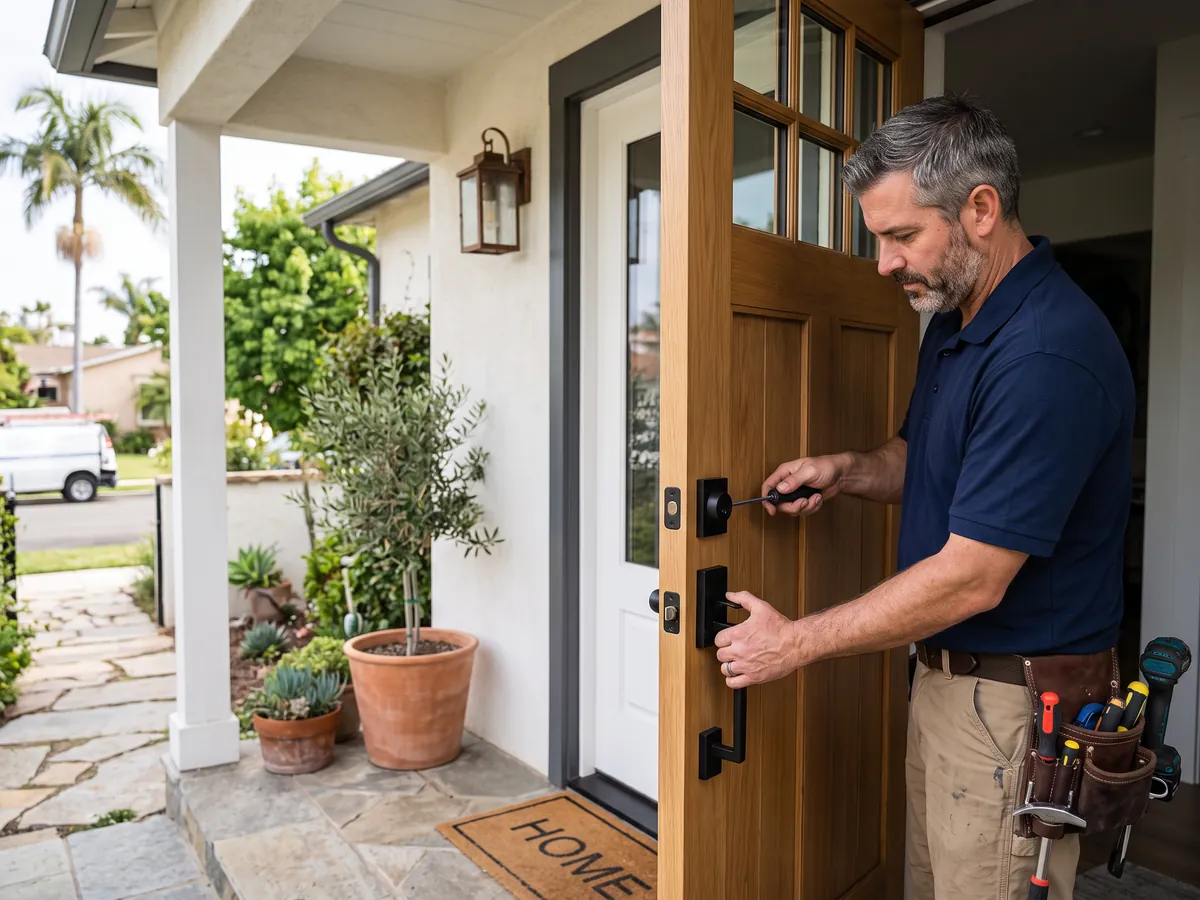
Here's something most homeowners in Arcadia don't expect: when a deadbolt gets hard to turn, the deadbolt is often fine. Doors move. Hinge screws loosen in soft jamb wood, slab foundations shift slightly with the seasons, and new weatherstripping pushes the door outward. The bolt then rubs the edge of the strike instead of sliding into its hole, and it feels like a failing lock. Swapping in a new deadbolt doesn't help, because the new one hits the same spot. Good residential lock repair starts by testing the lock with the door open, then closed, to see where the friction really lives. We fix the door when the door is the problem and the lock when it's the lock, and we tell you which before touching anything.
Residential Lock Repair in Arcadia: what to expect
Not every lock is worth saving, and an honest repair visit says so. Hardware from the major residential lines, such as Schlage, Kwikset, Baldwin, Emtek and Yale, has replacement latches, strikes, cylinders and spring parts available for years, so repairing it is usually straightforward. Locks from discontinued or off-brand lines are harder: the latch may use an odd faceplate shape, and nobody stocks the internal spring. Construction matters too. Solid brass and forged hardware can be rebuilt many times, while thin die-cast zinc housings tend to crack, and a cracked housing isn't repairable. Older mortise locks from early twentieth-century houses are a pleasant surprise; their insides are simple steel levers and flat springs that a locksmith can often clean, re-spring and put back in service. Electronic locks sit somewhere in between. We can fix the mechanical side, meaning the bolt, strike and backup cylinder, but a failed circuit board or motor usually means a manufacturer replacement. The goal is to keep your keys, your finish and your door intact when that makes sense, and to tell you plainly when it doesn't.
Work included on a typical visit
- Cylinder cleaning, lubrication and re-pinning. Oil and spray lubricants turn into a gummy paste inside a keyway once wind-blown dust and yard grit get in. Cleaning a cylinder properly means taking it out of the lock, not spraying more into it. We disassemble it, clean it, inspect each pin stack, then reassemble with graphite or a PTFE dry lube.
- Knob and lever latch repair. A latch that rattles, a knob that spins loosely or a lever that wobbles on its rose usually means loose through-bolts or a worn spindle. We tighten, shim or replace the worn piece and check that the latch springs fully into the strike. A latch that only half extends can be slipped open with a card.
- Handleset and thumb-latch repair. If pressing the thumb latch on your front entry does nothing, or the latch only retracts halfway, the linkage between the outside grip and the latch is usually worn or bent. Handlesets from Schlage, Kwikset, Baldwin and Emtek have serviceable parts, and repairing them keeps your door's finish, look and keying exactly as they were.
- French door and multipoint lock repair. On a pair of French doors, the inactive leaf is held by flush bolts at the top and bottom, and the active leaf locks into it. When the flush bolts don't seat, the whole pair rattles and the lock won't throw. We clean and adjust the flush bolts, fix the strikes in the head and sill, and realign the active leaf's lock.
- Hinge and door-sag correction. Many lock problems are really hinge problems. Short screws in the top hinge loosen, the door drops on the latch side, and the bolt rubs the strike. We replace at least one screw per hinge with a three-inch screw that reaches the stud behind the jamb, which pulls the door back into position and often cures the lock.
How Arcadia shapes the job
Foothill homes face wind-driven dust during Santa Ana events and the slow movement that comes with building on slopes. Dust packs into keyways and latch housings, and settling twists frames enough to misalign strikes. We clean and dry-lubricate cylinders, correct strike alignment and confirm exterior doors still latch firmly, which matters when you may need to secure the house quickly and leave during fire season.
Family homes put locks through constant use: kids slam doors, hang backpacks on levers, lock themselves into bathrooms and leave sliders half-latched. Residential lock repair in suburban Arcadia usually means level levers, latches that catch on a gentle close, privacy locks that release from outside and patio doors that lock properly. We also look at the garage entry door, since that's the one most families use every day.
Condos and townhomes add a twist: the unit's entry door may be the owner's responsibility while the building entry, garage or shared gate belongs to the association. We help sort out which is which before repairing anything shared. Townhome patio sliders often open onto small yards that drop leaves and grit into the track, so roller and latch repairs are frequent requests around Arcadia.
Example situations
- Picture a front door key that has been copied from a copy for fifteen years. It now turns only with a jiggle, and the spare from the kitchen drawer doesn't work at all. We pull the cylinder, find worn pins and a key cut so shallow it barely lifts them, re-pin the lock and cut new keys by code, so every future copy starts from correct depths.
- A common slider call: a dog has learned to nose the patio door open because the latch no longer catches. The hook still swings out when the handle drops, but it passes beneath the keeper. Worn bottom rollers have let the panel sag. We raise the door with new rollers, reset the keeper and add a foot lock, and the slider latches with a light push.
- For example, a family's back-door lever has drooped for months, and now it doesn't fully retract the latch, so the kids get stuck out on the patio. Inside the lockset, the return spring cassette has cracked. Because that Kwikset model is common, a matching chassis is likely on the van, so the lever comes back level the same afternoon and the existing keys still fit.
- For example, a steel security screen door on a stucco house off Santa Anita Avenue has its lock facing the lawn sprinklers. Mineral crust has frozen the latch, and the key won't turn past halfway. We remove the lock body, soak and clean it, replace the corroded cylinder, and suggest redirecting one sprinkler head so the new parts don't end up the same way by next summer.
How the visit works
- Tell us what the lock is doing. Call (951) 903-3193 and describe the symptom in plain terms: the key sticks, the bolt stops halfway, the handle droops, the slider won't catch. Tell us which door, roughly how old the hardware is, and the brand if you can see it on the latch faceplate. That helps us load the right parts.
- Arrival and verification. Before opening any locked home, we check ID or proof of residence. That's how a California-licensed locksmith (ours is LCO7891, issued by BSIS) works under the state's Locksmith Act. Tenants should expect a question about the landlord's approval for changes to hardware they don't own. It takes a moment and protects you.
- Diagnose lock versus door. A stiff lock can come from five or six different places, so we narrow it down methodically: key condition, cylinder, tailpiece, bolt, strike, then the door's hang. Each check is quick. The result is an explanation you can see for yourself, like a bright scuff mark on the strike or a cracked spring in our hand.
- Quote the repair and the alternative. Sometimes the honest answer is that repair isn't worth it: a cracked die-cast housing, a discontinued brand with no parts, or a budget lock whose parts cost nearly as much as a better lock. We'll say so and quote a replacement that fits your existing door prep.
- Make the repair. Most repairs happen at your door with parts from the van: cleaning and re-pinning cylinders, replacing latches and spring cassettes, re-mortising strikes, swapping hinge screws, adjusting slider rollers. We protect floors and finishes, keep the door secure throughout, and put back every screw we remove, tight and into solid wood.
- Test and walk through care. We test the repaired lock several times with the door open and closed, try every key you have, and confirm the deadbolt reaches full throw. Then we show you what we did and how to keep it running: which lubricant to use, what not to spray, and when to snug up the trim screws.
Pricing factors
- Brand and parts availability. Common residential lines such as Schlage, Kwikset, Baldwin, Emtek and Yale have parts that are easy to source, which keeps repair costs reasonable. Discontinued or imported brands may need a substitute part, extra fitting time or a replacement if nothing compatible exists. Reading the brand off the latch faceplate when you call helps us quote accurately.
- Number of locks and doors. Repairing several locks in one visit costs less per lock than separate calls, because the trip and setup happen once. If you have a list, like a front deadbolt, a slider and a garage-entry latch, tell us when you call so we can quote the whole job and bring parts for each.
- Lock type and complexity. Electronic locks add steps: battery and contact checks, app recalibration, mechanical alignment and testing of the backup key. If the fault is in the circuit board or motor, we don't charge you to chase it further; we point you to the manufacturer and quote only the mechanical work we can actually do.
Every job gets a clear quote before any work starts. Call (951) 903-3193 with the details and we'll tell you what to expect for your situation in Arcadia.
Common errors that cost time and money
- Spraying WD-40 or household oil into a sticky keyway. It frees things up for a few days, then mixes with dust into a gum that binds the pins. By the time a locksmith opens the cylinder, it needs a full cleaning instead of a light lubrication. Use a dry lock lubricant instead.
- Taking a cylinder apart without the right tools. Pin tumbler cylinders hold tiny springs and pins under tension, and once the plug slides out without a follower, they scatter across the floor in an order nobody can reconstruct. The lock then has to be re-pinned from scratch.
- Filing the deadbolt or grinding the key to make them fit. Shortening a bolt reduces how far it reaches into the frame, and a filed key wears the pins unevenly. The real issue is almost always strike position or a worn cylinder, and both can be corrected without weakening anything.
Advice before you book
- Make sure your deadbolt extends all the way. Turn it with the door open and measure: most residential bolts throw about an inch. If the bolt stops short with the door closed, the pocket behind the strike is too shallow and the bolt isn't deadlocking, so it may be forced back from outside.
- Twice a year, tighten the screws that hold your knobs, levers and deadbolt trim together through the door. Loose through-bolts let the whole lock shift, which bends the tailpiece and makes the key or thumb-turn feel gritty. A screwdriver and a couple of spare moments per door can head off many lock problems.
- Keep the emergency release tool for your interior privacy locks somewhere predictable, such as on top of the bathroom door casing. Most push-button privacy locks open from outside with a small pin or flat key, and searching drawers with a child crying on the other side is no fun.
- With a smart deadbolt, suspect alignment before you suspect the electronics. If the lock jams, logs errors or drains batteries quickly, try it with the door open. A bolt that runs freely when open but strains when closed is rubbing the strike, and correcting that usually ends the battery drain.
Getting to Arcadia
Arcadia is about 46 miles from our San Bernardino base, roughly 50 minutes in light traffic via Palm Avenue to I-215 North, I-15 South to the SR-210/I-210 Foothill Freeway. When you call, you get an arrival estimate based on where the technician is and the traffic at that moment.
If you're close to Baldwin Avenue, tell us which exit or cross street you're nearest. It trims the last mile and keeps the van from circling a block that looks right on the map but isn't.
About Arcadia: Arcadia incorporated on August 5, 1903, and Elias "Lucky" Baldwin, whose Rancho Santa Anita covered much of today's city, served as its first mayor.
| Neighborhoods | Arcadia Highlands, Santa Anita Oaks, Longley Way, Camino Grove, Upper Rancho, Downtown Arcadia |
|---|---|
| ZIP codes | 91006, 91007 |
| Main routes | I-210, Foothill Boulevard, Huntington Drive, Colorado Boulevard and Colorado Place |
| From our San Bernardino base | about 46 miles via Palm Avenue to I-215 North, I-15 South to the SR-210/I-210 Foothill Freeway, then west through Rancho Cucamonga, Glendora, Azusa and Monrovia to the Santa Anita Avenue, Baldwin Avenue or Michillinda Avenue exits |
Home lock work in Arcadia?
Call (951) 903-3193 with the address and a quick description of the doors and locks involved. We'll quote the job before any work starts.
Frequently asked questions
What hours can you come out for a lock repair?
Julian's Locksmith works every day from 6:30 a.m. to 11:30 p.m. We're closed between 11:30 p.m. and 6:30 a.m. We aren't a 24/7 service, so if a lock fails while we're closed and the door won't secure, use a secondary lock or a door bar overnight and call us when we open.
Can a home lock be repaired, or does it have to be replaced?
Most can be repaired. Stiff keys, dragging bolts, sagging levers, loose knobs and latches that don't catch are usually fixable with cleaning, re-pinning, a new spring or latch, or adjustment of the strike and hinges. Replacement makes sense when a housing is cracked, the brand has no parts available, or you want a higher security grade. We'll tell you which applies before any work begins.
Can you repair a lock after a break-in?
Yes. Forced entries often damage the jamb and strike more than the lock itself. We repair or reinforce the jamb, install a heavy-duty strike with long screws and test the lock. If the cylinder was picked, drilled or twisted, we replace or rekey it. If you're filing a police report or an insurance claim, photograph the damage before we start.
Will my current keys still work after the repair?
In most cases, yes. Strike adjustment, latch replacement and spring work don't touch the key. When we re-pin a worn cylinder, we pin it to your existing key or cut a new key by code that operates it, whichever gives the cleaner result. If you'd prefer new keys because some are unaccounted for, we can rekey during the same visit.
Do you repair old mortise locks with skeleton keys?
Yes, in many cases. Original mortise locks in older homes are built from steel levers and flat springs that can be cleaned, re-sprung and adjusted, and we can often fit a key to the existing lever tumblers. Keep in mind that skeleton-key locks offer little security, so on exterior doors we may suggest pairing the original look with a modern deadbolt or mortise cylinder.
My landlord hasn't fixed my broken lock. What can I do?
Put the request in writing and keep a copy. California requires landlords to provide and maintain operable deadbolts on main entry doors and working locks on windows designed to open (Civil Code §1941.3), and that duty generally applies once they know about the problem. If it's urgent, ask whether the landlord will authorize a locksmith directly. A local tenant resource center can explain other options.
How far is Arcadia from your base?
Arcadia is about 46 miles from our San Bernardino base, roughly 50 minutes in light traffic. Arrival time depends on traffic and on the job the technician is finishing, so we give you an estimate on the phone before you commit.
Related services in Arcadia
Residential Lock Repair in nearby cities
- Residential Lock Repair in North El MonteLos Angeles County
- Residential Lock Repair in MonroviaLos Angeles County
- Residential Lock Repair in Sierra MadreLos Angeles County
- Residential Lock Repair in Temple CityLos Angeles County
- Residential Lock Repair in East San GabrielLos Angeles County
- Residential Lock Repair in BradburyLos Angeles County
- Residential Lock Repair in El MonteLos Angeles County
- Residential Lock Repair in DuarteLos Angeles County