
Arcadia, Los Angeles County
A House Locksmith in Arcadia Who Looks at the Whole Building
Short answer: Julian's Locksmith is a licensed (LCO7891) mobile house locksmith serving Arcadia. We work every day, 6:30 a.m. to 11:30 p.m., weekends included. Before opening or changing locks, we verify ownership or residence. Call (951) 903-3193 with the number of exterior doors, and we'll explain options and cost factors.
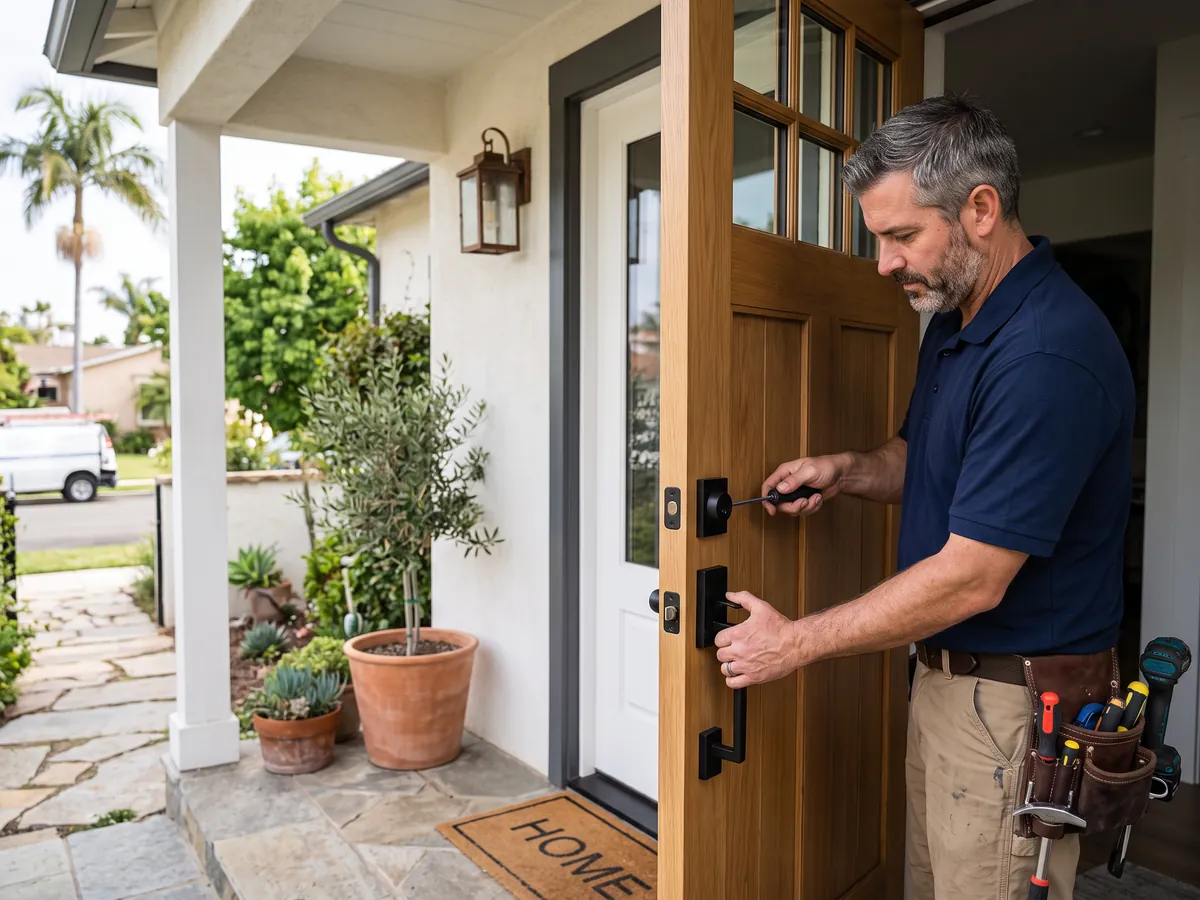
Walk around your house in Arcadia and count the ways in: front door, back door, the door from the garage, the garage's side door, a slider or two, the side gates, a dozen windows. Most people only think about the first one. A house locksmith looks at all of them, because a burglar who meets a strong front door simply walks around to the side yard. Julian's Locksmith comes out, checks each entry point with you, and hands you a prioritized list: what's fine, what's weak, and what each fix costs. You decide what gets done and when.
What to know first in Arcadia
When a house door is kicked in, the lock almost never breaks. The wood around it does. A standard deadbolt's strike is fastened with short screws into a jamb that's often just a thin strip of softwood, with a gap behind it before the wall framing. A hard kick drives the bolt through that strip and the door swings open with the lock still extended. Reinforcement fixes the weak link. Three-inch screws through the strike reach the framing behind the jamb, and a heavy-gauge strike box or a longer reinforcement plate spreads the force along the frame. The same treatment on the hinge side prevents the door being forced from that edge. On older houses with stucco walls, settling can push the frame out of square, so we adjust the strike to keep the bolt aligned. None of this changes how the door looks from the street, and a house locksmith in Arcadia can usually do it in the same visit as a rekey or new lock.
What we can do on-site
- Front entry handlesets and deadbolts. A front door with a sidelight or a glass panel needs extra thought about the deadbolt's thumbturn. We'll talk through options such as security glazing, a captured thumbturn or relocating hardware, so the door resists a reach-through without turning into an exit you can't open from inside in an emergency.
- Back and side doors. A side door tucked behind a fence is private, which is exactly why it needs a solid deadbolt. We replace knob-only setups, add a deadbolt to doors that never had one, and fill old misaligned holes so the door looks finished rather than patched.
- Sliding patio doors and French doors. Worn slider latches are among the most common house locksmith repairs. We replace mortise latches and handle sets on sliding glass doors, adjust rollers enough that the latch engages, and add a keyed or foot-operated secondary lock. Anti-lift blocking keeps the panel from being raised off its track.
- Whole-house rekey and keying alike. Some owners prefer two keys: one for the house, another for detached structures like a workshop or pool equipment room. We can set that up during the same rekey, along with a high-security cylinder on the doors that justify it. Each key gets labeled so nobody has to guess which one opens what.
- Side gates, sheds and detached structures. Heat, sprinklers and dust are hard on outdoor hardware. We choose gate and shed locks with weather-resistant finishes, adjust sagging gates so latches line up again, and recommend stainless or brass padlocks over cheap steel ones that rust shut by summer. A little lock lubricant before summer keeps them turning freely.
How Arcadia shapes the job
Houses on slopes and foothill lots tend to move. Soil settles, stucco cracks and frames shift slightly out of square, so deadbolts that once slid freely start catching on the strike. We realign strikes, deepen bolt pockets and tighten hinges with long screws. In wildfire areas we also look at gates and access, so firefighters can reach the back of the house through a gate that opens without a struggle.
Attached homes have fewer doors but shared walls, small patios and garages that often open onto common drives. We focus on what the owner controls: the entry door, the patio slider, the garage-entry door and patio gates. Association rules may govern exterior hardware appearance, so we check before swapping visible handlesets, while interior-side reinforcement is usually your call. Shared-wall units also benefit from a solid deadbolt on the door to the attached garage.
Larger houses mean more entry points: multiple French doors, pool houses, wine rooms, garages for several cars and staff entrances. A house locksmith can design a key plan for the property, use restricted keyways so copies need your authorization, add high-security cylinders on the most exposed doors, and service multipoint hardware on custom doors. Reinforcement matters on tall, heavy doors just as on ordinary ones.
Common situations
- Suppose a house's garage side door is a lightweight slab with a cheap knob and no deadbolt, facing an alley. The door into the house is often left unlocked. We add a deadbolt and reinforced strike to the side door, put a deadbolt on the garage-entry door, and make sure its spring hinges still pull it shut and latched. Both doors now open with the same key the family already carries for the front.
- A recently built house has a fiberglass patio door with a multipoint lock, and the handle no longer lifts to engage the hooks. We remove the hardware, identify the gearbox model and confirm it has failed. Some multipoint systems need a factory part, so we order it, secure the door temporarily, and come back to install it. The temporary fix holds the door closed and locked with the deadbolt until the part arrives.
- One older house has wooden sash windows whose locks were painted over during a remodel. Two won't latch at all. We free the locks, replace the broken ones, and add ventilation stops on the ground-floor windows so the owners can keep them cracked open on warm nights without leaving them wide open. Before leaving, we show them how to confirm each sash lock is engaged with a quick tug on the lower sash.
- For example, a homeowner wants a double-cylinder deadbolt because the front door has a glass sidelight. We explain the fire-escape concern, then offer alternatives: a captured or removable thumbturn, a single-cylinder deadbolt paired with security film on the sidelight, or relocating the deadbolt farther from the glass. The owner picks the option that fits the house. Whichever route they choose, the door still opens from inside without hunting for a key.
How the visit works
- Describe the house and the problem. We'll ask whether anyone is locked out, whether there's been a break-in, and whether you want a whole-house check or just one door looked at. Then you'll get an honest ETA and an idea of what drives the cost before anyone heads your way.
- Arrival and ownership check. On arrival we confirm the job and check that you own or live in the house. A driver's license with the address works; so does a deed, lease, utility bill or property tax statement. It's required before opening a locked house or changing who can get in.
- Walk the perimeter. We go door by door around the house: front entry, back door, garage-entry and garage side doors, sliders, French doors and side gates. At each one we test the latch and deadbolt, check strike and hinge screws, and look at the frame. Ground-floor windows get a quick check too.
- A prioritized quote. When a repair and a replacement would cost about the same, we tell you, along with which one should last longer on your particular door. Sometimes keeping the old hardware is the better value; sometimes it isn't. Either way, the decision stays with you.
- Do the work, door by door. If a part has to be ordered, such as a multipoint gearbox or a high-security cylinder, we secure the door in the meantime and schedule a return visit. You'll know before we leave exactly what's pending and roughly when it will arrive.
- Final check from both sides. We finish by handing over the counted keys, noting which key fits which door, and pointing out any item we recommended but you chose to defer. That way the whole-house picture stays clear even if you tackle the rest later.
Pricing factors
- Frame and strike condition. Reinforcing a sound frame is a modest add-on: longer screws, a heavier strike, perhaps a reinforcement plate. A frame already split by a forced entry or softened by rot costs more, because the wood has to be repaired or replaced before any hardware can hold properly.
- Age of the house and parts availability. Newer houses tend to be the simplest to work on, with standard bores and widely used builder hardware. The exception is premium entry and patio doors with proprietary multipoint systems, where parts may come only from the door's manufacturer.
- Timing and travel. Travel from our San Bernardino base to your house in Arcadia is part of the visit. We'll mention it when you call, along with an honest ETA, so the quote covers everything. Combining several fixes into one trip spreads that travel across all of them.
Every job gets a clear quote before any work starts. Call (951) 903-3193 with the details and we'll tell you what to expect for your situation in Arcadia.
Common errors that cost time and money
- Buying a lockset based on looks, then discovering its backset or bore doesn't match the door. The result is new holes overlapping old ones and hardware that sits crooked. Measure the backset, bore and door thickness first, or ask a house locksmith to bring matching options.
- Painting over window locks, strikes and hinge pins during a remodel. Painted sash locks stop latching, painted strikes bind deadbolts, and painted hinges make doors sag over time. Masking or removing hardware takes a few extra minutes and saves a repair call later.
- Installing a pet door in the lower panel right beside a deadbolt's thumbturn, or in a door to the garage. A pet door large enough for a dog can let an arm or a tool through to reach the lock. Position pet doors away from hardware and use the locking cover when you're away.
Advice before you book
- Treat the garage-entry door as an exterior door. Lock its deadbolt at night and when you're away, even with the overhead door closed. Make sure its spring hinges or closer still pull it shut and latched; if the door now stops short, have it adjusted.
- Test each deadbolt's throw with the door open: turn it fully and note how far the bolt extends. Then close the door and try again. If the thumbturn stops short, the bolt isn't fully seating, so the strike pocket needs deepening or the strike needs to move.
- Pull one screw from your front door's strike plate and measure it. If it's under an inch long, it reaches only the jamb. Replacing both strike screws with three-inch screws that bite into the framing is one of the cheapest, most effective upgrades a house can get.
- Once a year, walk your house's perimeter and operate every lock: each deadbolt, slider latch, window lock and gate. Locks that are rarely used tend to seize, and you'll want to find that out on a calm afternoon rather than the night you actually need them.
Service in Arcadia
Arcadia is about 46 miles from our San Bernardino base, roughly 50 minutes in light traffic via Palm Avenue to I-215 North, I-15 South to the SR-210/I-210 Foothill Freeway. When you call, you get an arrival estimate based on where the technician is and the traffic at that moment.
We plan the drive the way a delivery route gets planned: freeway first, Huntington Drive where it makes sense, then the side streets you describe. A landmark or the color of your building helps the technician spot you.
About Arcadia: North Santa Anita Avenue becomes Santa Anita Canyon Road, which climbs about three miles into the Angeles National Forest to Chantry Flat and the Sturtevant Falls trail.
| Neighborhoods | Baldwin Stocker, Downtown Arcadia, Santa Anita Oaks, Live Oak Avenue area, Arcadia Highlands, Camino Grove |
|---|---|
| ZIP codes | 91006, 91007 |
| Main routes | I-210, Foothill Boulevard, Huntington Drive, Colorado Boulevard and Colorado Place |
| From our San Bernardino base | about 46 miles via Palm Avenue to I-215 North, I-15 South to the SR-210/I-210 Foothill Freeway, then west through Rancho Cucamonga, Glendora, Azusa and Monrovia to the Santa Anita Avenue, Baldwin Avenue or Michillinda Avenue exits |
Home lock work in Arcadia?
Call (951) 903-3193 with the address and a quick description of the doors and locks involved. We'll quote the job before any work starts.
Frequently asked questions
Do you install window locks?
Yes. We replace broken sash locks, install sliding-window locks and pin locks, and add ventilation stops so windows can stay partly open. For bedroom windows we choose locks that release quickly from inside, since those windows may be fire escape routes. Rental owners should know that California Civil Code §1941.3 requires security devices on openable windows in rental units.
Can you check my house after a break-in?
Yes. After the police report is made, we secure damaged doors, replace or rekey locks, reinforce split frames when the wood allows, and check every other entry point, since a burglar may have tested more than one. If a frame needs carpentry first, we secure the door temporarily and return for the permanent fix.
Will you need proof that I own or live in the house?
Yes, before we open a locked house or change who can get in. A driver's license showing the address works, as does a lease, utility bill, deed or property tax statement. If you're having work done while you're away, we'll arrange in advance how to confirm your authorization. It's a basic safeguard for every house we work on. Our license, LCO7891, is listed with BSIS if you want to check us first.
Which door on a house is usually the weakest?
Rarely the front door. More often it's the garage's side door, the door from the garage into the house, a back door with only a knob lock, or a sliding glass door with a worn latch. Those doors face fenced or hidden areas. A whole-house walkthrough in Arcadia identifies yours, and the fixes are usually modest. Most of those weaknesses take an hour or two of work, not a remodel.
Do you repair sliding glass door locks?
We do. We replace worn mortise latches and handle sets, adjust rollers so latches engage, add keyed or foot-operated secondary locks, and install anti-lift blocking so the panel can't be raised off its track. If the frame itself is badly bent or the glass is damaged, a glass and door company may be needed first, and we'll tell you so. Most slider fixes are completed in the same visit.
What does a house locksmith do that a handyman doesn't?
A house locksmith rekeys cylinders, keys doors alike, opens locked houses without damage, rebuilds mortise locks, services multipoint and slider hardware, and assesses how each entry point resists forced entry. A handyman may install a lockset from a box, but usually can't rekey, decode or repair the mechanism. In California, locksmith work also requires a BSIS license; ours is LCO7891.
How far is Arcadia from your base?
Arcadia is about 46 miles from our San Bernardino base, roughly 50 minutes in light traffic. Arrival time depends on traffic and on the job the technician is finishing, so we give you an estimate on the phone before you commit.
Related services in Arcadia
House Locksmith in nearby cities
- House Locksmith in North El MonteLos Angeles County
- House Locksmith in MonroviaLos Angeles County
- House Locksmith in Sierra MadreLos Angeles County
- House Locksmith in Temple CityLos Angeles County
- House Locksmith in East San GabrielLos Angeles County
- House Locksmith in BradburyLos Angeles County
- House Locksmith in El MonteLos Angeles County
- House Locksmith in DuarteLos Angeles County