
Commercial Master Key System Mistakes in Downey, CA
By Julian's Locksmith, , 7 min read
A commercial master key system can simplify access control or create serious security gaps. Here are the mistakes Downey business owners should avoid.
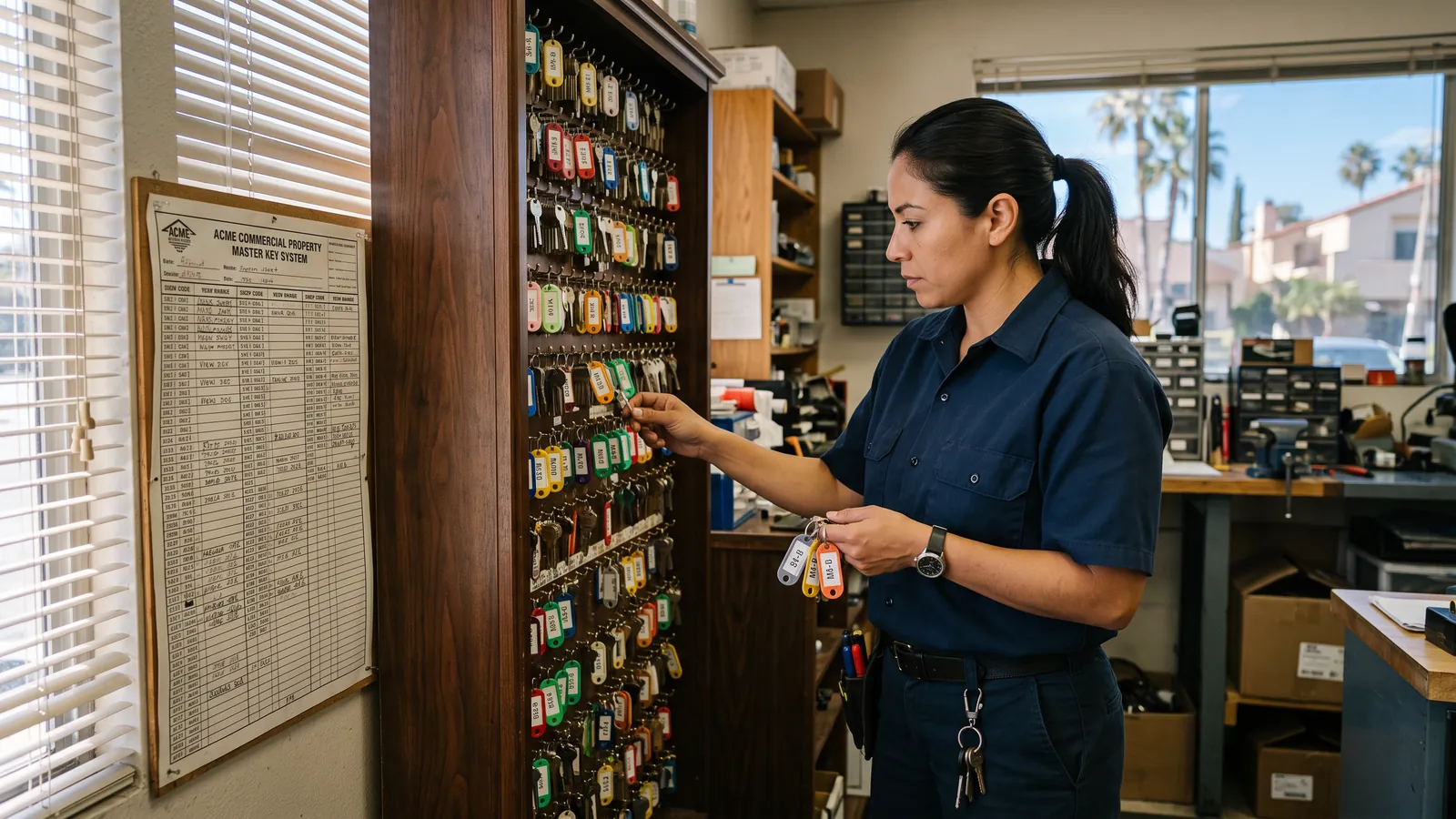
A commercial master key system lets you control access across multiple doors with a logical hierarchy of keys, but it only works if it's designed and installed correctly from the start. The most common mistakes in Downey businesses involve poor planning, ignoring key control, and treating the system as a one-time purchase instead of something that needs ongoing management. Below are the mistakes to avoid, and the reasoning behind each one.
Skipping a Proper Key Hierarchy Plan
Business owners sometimes ask a locksmith to "just make all the keys work the same way" without thinking through who actually needs access to what. That shortcut creates problems later.
A well-designed system separates access into logical levels:
- A top-level master key for owners or facility managers
- Sub-master keys for department heads or floor supervisors
- Individual change keys for specific rooms or offices
Without this structure, you end up issuing a key that opens everything to someone who only needed access to a supply closet. That's not a minor inconvenience — it's a security gap that's expensive to fix once dozens of keys are already in circulation.
Before you order any hardware, map out your building: how many doors, how many access tiers, and who falls into each group. A commercial master key system in Downey should start with this plan, not with a visit to a hardware counter.
Choosing Standard Keyways Instead of Restricted Keys
Standard, off-the-shelf keyways can be duplicated at nearly any hardware store or kiosk. That convenience is exactly the problem. If an employee leaves and doesn't return their key, or a key gets copied without authorization, you have no way to track it or stop it.
A restricted key system in Downey uses a patented keyway that can only be cut by an authorized dealer, usually requiring a signature or authorization card before a duplicate is made. This doesn't eliminate every risk, but it closes the biggest one: uncontrolled duplication.
For businesses with high employee turnover, multiple tenants, or sensitive areas like server rooms or cash-handling offices, restricted keys are worth the extra planning. Standard keyways are fine for low-risk doors, like a storage shed with nothing valuable inside, but mixing the two without a clear strategy defeats the purpose of having a master system at all.
Not Documenting Who Holds Which Key
This is the mistake that causes the most headaches months or years later. A business installs a system, hands out keys, and never writes down who has what. Then someone leaves the company, or a key goes missing, and nobody can say with confidence which locks are compromised.
Keep a simple log:
- Key identifier (not the actual bitting code, just an internal reference number)
- Who it was issued to and the date
- Which doors or key level it corresponds to
- Date returned, if applicable
This log doesn't need to be complicated — a spreadsheet works. What matters is that it exists and someone is responsible for updating it. Without it, you're relying on memory, and memory fails exactly when you need it most, like during an employee dispute or after a break-in.
Ignoring Turnover and Forgetting to Re-key
Downey businesses often experience seasonal staffing changes, especially heading into the holiday season when retail and hospitality add temporary workers. Fall brings back-to-school schedule shifts too, which often means part-time staff turnover for businesses near schools or family-oriented retail centers.
Every time someone with key access leaves, and you don't recover or deactivate their key, the system's security value erodes a little more. A master key system is not "set it and forget it" — it requires a re-key or key replacement whenever access needs to change.
If you're bringing on seasonal help this fall, decide in advance which level of key they'll carry, and make a plan to collect it when the season ends. A commercial rekey in Downey for just the affected cylinders is usually faster and less disruptive than people assume, especially when the system was designed with this kind of change in mind.
Treating Fire and Wind Season as Irrelevant to Key Control
Santa Ana winds and the elevated fire risk that comes with them aren't usually top of mind when people think about master key systems, but there's a real connection. If your business has an emergency evacuation plan, fire department access, or shared storage with neighboring tenants, the people who need access during an emergency should already be accounted for in your key hierarchy.
Some things worth checking before fire season peaks:
- Does your property manager or facilities team have a master key that opens all exterior doors, in case first responders need rapid access?
- Are any master keys stored somewhere that would be unreachable during a power outage or evacuation, like inside a locked desk?
- If daylight saving time ending means earlier darkness and more after-hours staff movement, do your current keyholders match who's actually on site during those hours?
These aren't dramatic risks, but they're the kind of planning gaps that only become obvious after something goes wrong.
Over-Engineering the System for a Small Business
On the opposite end, some business owners overbuild. A single-location retail shop with four employees doesn't need a five-tier grand master system with restricted keys on every interior door. That level of complexity adds cost and administrative overhead without a matching security benefit.
Match the system to your actual risk and footprint:
- Single location, small staff: a basic master key system with two or three levels is often enough
- Multi-tenant commercial building: a business master key system in Downey with department-level sub-masters makes more sense
- Residential rental property with shared access needs: an apartment master key system in Downey addresses common areas, unit doors, and maintenance access separately
A locksmith who walks your property before recommending hardware should be able to tell you honestly whether you need three key levels or just one. If someone proposes a complex system without asking about your staff size or floor plan first, that's worth questioning.
Not Verifying the Locksmith's License Before Work Begins
California requires locksmiths to hold a license issued by the Bureau of Security and Investigative Services under the Locksmith Act (Business and Professions Code 6980 et seq.). This matters more for commercial master key systems than for a simple lockout, because the locksmith will have detailed knowledge of your building's entire key hierarchy, including which keys open which doors.
Before hiring anyone for a project this sensitive:
- Ask for the license number and verify it at search.dca.ca.gov
- Confirm they carry insurance, in case hardware installation damages a door or frame
- Expect them to ask for proof that you own or manage the property before they design or cut anything
A legitimate locksmith will also give you a quote before starting work, rather than an estimate that changes once the job is underway. If a company is vague about licensing or skips the identity and ownership verification step, that's a sign to look elsewhere.
Forgetting About Holiday Season Access Changes
Heading into the holidays, many Downey businesses extend hours, bring on seasonal staff, or temporarily open areas that are normally locked, like a back stockroom now doubling as overflow inventory space. These temporary changes often get made informally — someone props a door, or a manager lends out a master key "just for the season" — and then the informal workaround never gets reversed.
A better approach is to build temporary access into your key system deliberately:
- Issue a limited-use sub-master key for seasonal staff instead of handing out a full master key
- Set a calendar reminder to collect seasonal keys and re-key or deactivate access in January
- Avoid propping fire doors or master-keyed exterior doors open for convenience during busy periods, which creates both a security and a safety issue
Planning this in October or November, before the holiday rush, is much easier than trying to untangle who has which key after the season ends.
Working With a General Locksmith Instead of One Experienced in Commercial Systems
Residential and automotive locksmith work overlaps with commercial key systems, but they're not the same skill set. Designing a master key hierarchy requires understanding keying charts, cylinder compatibility, and how to expand the system later without re-keying everything from scratch.
If your Downey property needs a master key system and the locksmith you're talking to mostly handles car lockouts and home re-keys, ask directly about their experience with commercial systems specifically. A locksmith familiar with commercial locksmith work in Downey should be able to show you a sample keying chart or explain how expansion works if you add doors or tenants later.
This matters because a poorly designed initial system is expensive to unwind. Cylinders may need to be replaced rather than simply re-keyed if the original keying chart wasn't built with room to grow.
How to Reach Julian's Locksmith in Downey
If you're planning a commercial master key system for a Downey property, or need an existing system reviewed, re-keyed, or expanded, Julian's Locksmith is available around the clock. The team verifies identification and proof of ownership or management authority before any work begins, and provides a quote before cutting a single key.
Call (951) 903-3193 any time, day or night, including weekends and holidays, or reach out through the contact page to schedule a walkthrough of your property. Julian's Locksmith holds California locksmith company license LCO7891, verifiable at search.dca.ca.gov, and serves Downey along with 118 other cities across San Bernardino, Riverside, Los Angeles, and Orange counties.
Frequently asked questions
How much does a commercial master key system cost?
Cost depends on the number of keyed-alike and keyed-different cylinders, the hardware grade, whether you need a restricted keyway, and how many master and sub-master levels your business requires. A locksmith can walk your Downey property and provide a written quote before any work begins, so you know the full scope and cost factors ahead of time.
Can any locksmith cut keys for a restricted master key system?
No. Restricted keyways are patent-protected and tied to a specific dealer or manufacturer agreement. Only an authorized locksmith with that dealership can cut or duplicate those keys, which is the entire point of choosing a restricted system over a standard one.
What's the difference between a master key system and a grand master key system?
A master key system typically has one master key that opens all locks, with individual keys opening only their own doors. A grand master or multi-level system adds layers, letting you control access by department, floor, or building while keeping a single top-level key for full access across a larger property or portfolio.
Do I need to re-key my whole building if one key goes missing?
Not necessarily. A properly designed master key system lets you re-key or replace just the affected cylinder and reissue a new key, without touching the rest of the system. This is one of the main reasons businesses in Downey invest in a structured key hierarchy instead of identical keys for every door.
Is a master key system required by California law for commercial buildings?
No specific statute mandates master key systems for commercial properties. However, landlords of residential rental units have separate legal obligations, such as Civil Code 1941.3 requiring certain deadbolts. Commercial key control is a business security decision, not a legal requirement, though lease terms may address it.
More locksmith advice
- Home Lockout Decision Guide: Wildomar Service Options Compared
- Your On-the-Spot Checklist for Keys Locked in Trunk in Cypress
- Cypress Multi-Door Access Control: Detailed Compliance Checklist
- Smart Deadbolt Installation in La Mirada: Deep-Dive FAQ
- Transponder Key Replacement in Glendora: Step-by-Step Guide
- High Security Key Duplication Checklist for Perris Homes