
Devore, San Bernardino County
Business Lockout Service in Devore for Storefronts, Offices and Warehouses
Short answer: A locksmith can open almost any commercial door, but the hard part of a business lockout in Devore is usually authorization, not the lock. Expect to show photo ID plus something tying you to the business: a lease, business license, Statement of Information or a signed manager letter. If you're staff rather than the owner, have the owner reachable by phone.
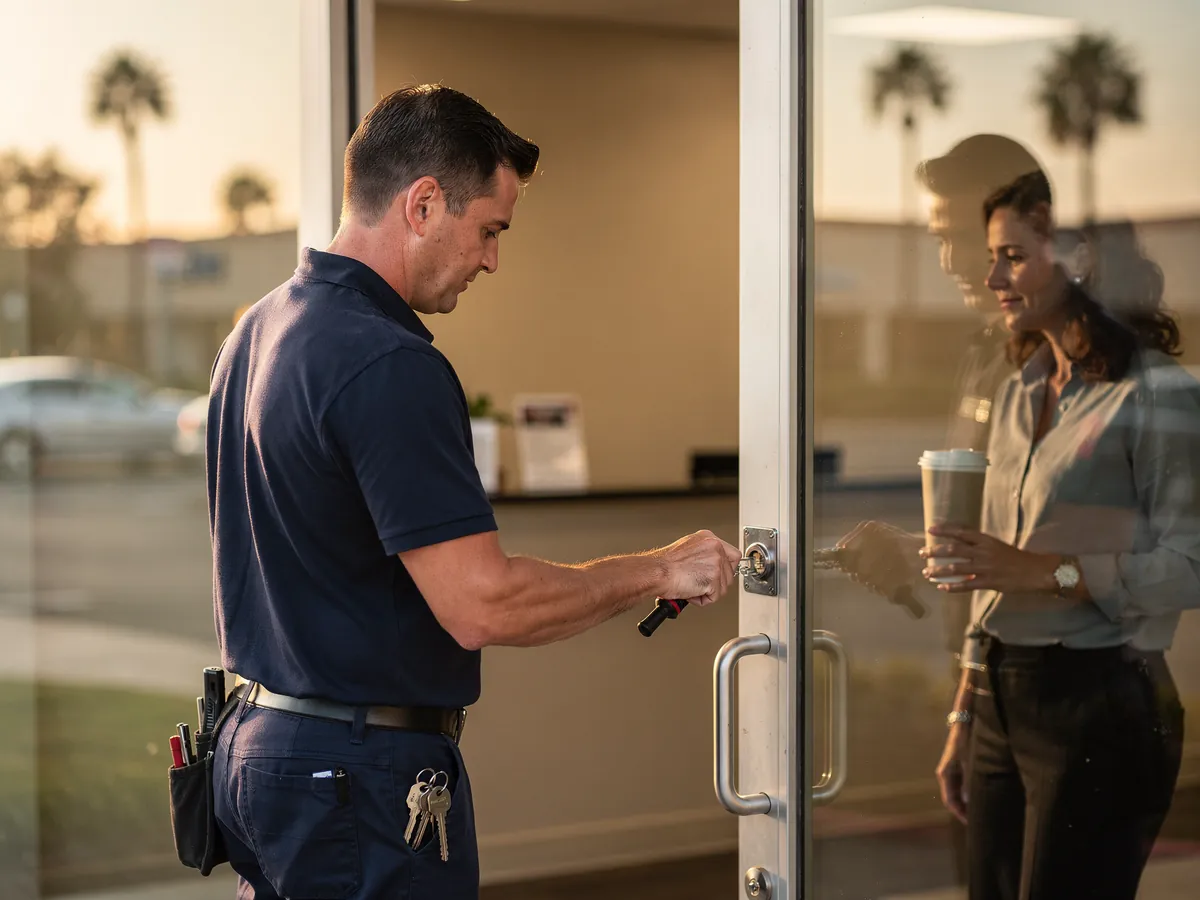
Most retail and restaurant fronts in Devore use the same basic door: a narrow aluminum stile, a tempered glass panel, and a swinging hookbolt driven by a small threaded mortise cylinder. It's tough hardware, which is exactly why a storefront lockout should never turn into a smashed pane or a pry bar jammed into the frame. We pick the cylinder in most cases, work around a snapped key when one is stuck in the keyway, and replace the cylinder on site when picking isn't practical. Before we leave, we check that the bolt throws cleanly into the strike, because a door that opened this morning but won't lock tonight is only half solved.
Business lockouts in Devore usually involve a yard, a shop or a roadside storefront rather than an office tower. The typical locked-out customer is a contractor with a steel shop building off Cajon Boulevard, a small-business owner with a glass door on old Route 66, or a vendor whose container is padlocked near a Glen Helen event site. We need to know you're authorized before we open. That means ID plus something that ties you to the business, such as a business license, a lease, a utility account, or the owner on the phone confirming you. A new employee with no authority can't ask us to open a building, and we'll explain why. Most of these doors fall into one of three kinds: aluminum storefront with a narrow-stile Adams Rite lock, a steel man-door with a commercial cylindrical lock, or a roll-up or sliding door secured with a padlock or slide bolt. Each has a non-destructive way in. Grit and wind complicate things, since a lock that hasn't been turned in months may bind even after we pick it. We clean it and note anything that needs repair. Crews often start before sunrise, and our 6:30 a.m. start every day of the week means a locked shop door doesn't have to delay the day's first job for long.
How this works in Devore
The typical aluminum storefront door is engineered to resist exactly what an impatient person might try. Its lock sits inside a stile only a couple of inches wide, so manufacturers use a pivoting hookbolt that swings into the strike and grabs the frame rather than a straight bolt that could be pried past. A threaded mortise cylinder, held by a set screw inside the stile, turns a cam that throws and retracts that hookbolt. Many doors pair it with a deadlatch and paddle or push handles for daytime traffic. Professional entry focuses on the cylinder: picking it with tension tools sized for commercial keyways, or, when the door has been abused or the cylinder is high-security, drilling it and threading in a new one keyed to your existing key or a fresh one. Alignment matters too. When pivots wear or the frame settles, the hookbolt binds against the strike, and a key that turned last month now refuses. Sometimes the fix for a business lockout in Devore is simply relieving that pressure while the cylinder turns, then adjusting the door so it stops happening.
Work included on a typical visit
- Keypad and access-control door lockouts. Mechanical pushbutton locks, such as the battery-free Simplex style, cause their own lockouts when a code change goes wrong or nobody wrote the new combination down. Many have a key override. We work that override to get you in, then help you reset the combination and decide who on the team should know it.
- Broken keys in commercial cylinders. Worn commercial keys break more often than people expect, especially copies of copies that were cut too shallow or too deep. After pulling the fragment, we can cut a fresh key from your code or from the cylinder itself, so the team stops passing around a cracked, bent key that's waiting to fail.
- Drill-and-replace when picking won't work. If your building runs on a restricted keyway, a replacement cylinder matched to your system may have to come from the dealer holding your key records. We'll open the door and fit a temporary cylinder so the business is secure overnight, then you can order the matching restricted cylinder through the proper channel.
- Rekeying and recoring after the lockout. If the missing keys left with a former employee or were lost somewhere public, opening the door is only half the job. We can rekey the exterior cylinders on the same visit so the old keys stop working. Interior offices, file rooms and cash rooms can follow later if the budget calls for phasing the work.
- Securing the door when you can't lock up. The reverse lockout happens at closing time: the key turns but the hookbolt won't throw, or the cylinder spins freely. You can't leave the store unlocked overnight. We diagnose whether it's a loose cam, a backed-out set screw, a failed lockbody or a sagging door, then make the door lockable before the night ends.
How Devore shapes the job
Plenty of owners and managers live a long freeway drive from their shops, so when the opener forgets keys, the person holding the spare may be an hour away. For businesses in Devore, a locksmith visit is sometimes faster than that round trip. Call us early, since our day starts at 6:30 a.m., and arrange owner authorization by phone. Long term, a second key holder who lives nearby solves the problem for good.
Inland summer heat causes its own business lockouts. Aluminum storefront doors and frames expand in afternoon sun, pinching the hookbolt so the key won't turn. Keypad locks drain batteries faster, and electronics behind sunny glass can glitch. If your Devore storefront key works in the morning but fights you in late afternoon, that's thermal binding. We'll open the door and adjust the strike so it locks through the hottest weeks.
Foothill businesses live with Santa Ana winds and wildfire seasons. High winds can slam and twist doors, knocking strikes out of line, and evacuation days close businesses in a hurry, sometimes with keys left behind. When a Devore owner returns after an evacuation and can't get in, we'll verify authorization, open the door, and check that windblown doors still latch and lock properly before you restock.
Situations this covers
A typical call comes from the owner of a small repair shop on Cajon Boulevard who arrives at 6:45 on a Monday and finds the aluminum storefront door won't turn. The deadlatch inside is stiff with dust. We'd check that he owns or manages the business, work the latch free, then clean and lubricate it, tighten the strike, and warn him that the same lock will need replacement if it keeps sticking. His crew is working before the morning is half over.
- Consider a newly promoted manager at a franchise sandwich shop who has a front door key but has never needed the back office. The office key is missing, and the cash drawer and schedules are inside. Corporate facilities emails a work order number, we'd match it to her ID, open the storeroom-function lever, and note the authorization on our paperwork.
- Imagine a tenant in a three-story office building near Devore Animal Shelter whose suite key has gone missing over a holiday weekend. The building engineer's master key doesn't fit, because the tenant installed its own lock years ago. With the lease and the property manager's confirmation, we'd pick the suite lock, then rekey it and leave a copy with management if the lease requires one.
- Here's a summer situation: a nail salon's battery-powered keypad lever goes dark on a hot afternoon, and the override key was last seen in a former manager's car. With the owner on site holding her license and city business license, we'd pick the override cylinder, replace the batteries, and suggest the team keep the override key off the premises but reachable.
How the visit works
- Call with the door and lock details. The first call is mostly questions. What kind of business is it, which door matters most, is anyone already waiting, and do you know the lock brand? Answers like Adams Rite, Schlage, Medeco or Best tell us which picks, cores and replacement cylinders to load before the van leaves.
- Line up authorization. Before we drive, we confirm who is approving the entry. Owners need photo ID and a document naming the business. Managers and staff need the owner, district manager or property manager reachable for confirmation. Getting that call or email arranged while we're on the road keeps the visit short.
- Get a quote and an honest ETA. You'll hear a price for the job as described and a realistic arrival estimate based on where our van actually is. If something changes on site, like a high-security cylinder that needs drilling or a second locked door, we stop and requote before doing extra work.
- Assess the door before touching it. We check the surroundings too. Is there a second door with simpler hardware? Is the alarm keypad near the entrance, and does someone have the code? Is a grille or gate padlock in the way? Choosing the easiest legitimate path often turns a slow job into a short one.
- Open the door and verify on the spot. Most commercial openings are quick once we're at the door, though high-security cylinders and multi-layer buildings take longer. We work carefully on glass storefronts and finished office doors, because a scratched frame or cracked panel costs more than a few extra minutes of patience.
- Restore key control before we leave. You get a written work order showing what we opened, who authorized it, what we replaced and how the doors were left. Keep it with your business records. It's useful for insurance questions, landlord conversations and internal reviews when keys or access go missing.
How we quote the job
- When you call within our hours. Late-evening calls run up against our 11:30 p.m. close, and we're closed overnight until 6:30 a.m. If a late lockout can't be finished in time, we'll tell you upfront instead of rushing. Planning around those limits, like booking a Thursday visit for a known key problem, helps keep costs predictable.
- Number of doors and layers. A single storefront door is one task. A security grille, a front door, an inner suite door and a locked office add up to four. We quote each layer you need opened, and we'll help you work out whether opening one or two gets you to a spare key that handles the rest.
- Work after the door opens. The opening is priced on its own. Rekeying exterior locks, replacing a drilled cylinder, cutting extra keys, adjusting a sagging storefront door or swapping keypad batteries are separate line items. You approve each one, and you can choose to handle the essentials today and schedule the rest for a quieter week.
Every job gets a clear quote before any work starts. Call (951) 903-3193 with the details and we'll tell you what to expect for your situation in Devore.
What not to do
- Forcing a key that won't turn. Twisting harder with pliers or a wrench is the fastest way to snap the key inside the cylinder, which turns a simple opening into an extraction plus a replacement. If the key won't turn, stop, check the door's alignment, and call for help.
- Calling for entry without anyone who can authorize it. A shift lead with no way to reach the owner or district manager leaves the locksmith unable to proceed, and everyone waits. Before you call, line up a decision-maker by phone or get a work order number from facilities.
- Prying a narrow-stile aluminum door with a bar or screwdriver. The stile bends easily, the hookbolt is designed to grab harder when pried, and a bent door may never align with its strike again. You end up paying for door repair or replacement on top of the lockout itself.
What to do before we arrive
- Give a second trusted manager a full set of exterior keys and keep it with that person, not in the building or a company car. Most business lockouts happen because the only working key is on one person's ring. A second key holder who lives reasonably close to Devore turns a locksmith visit into a short drive.
- If your business opens before 6:30 a.m., plan around the fact that we're closed between 11:30 p.m. and 6:30 a.m. Confirm the night before that the opener has keys and the alarm code. A two-minute check before closing prevents a lockout that would otherwise wait until 6:30 a.m.
- Tell your locksmith exactly where to go: which side of the building, the suite number, the dock door number or the name of the neighboring business. Shopping centers and business parks off Devore Road often hide entrances behind other buildings. Clear directions save time for everyone standing outside on the clock.
- Stamp keys with a code number instead of 'front door' or 'office.' A key labeled with the door it opens is a gift to whoever finds it. Keep a key log recording which code went to which employee and when, so you know immediately what's compromised if a ring goes missing.
Getting to Devore
Devore is about 8 miles from our San Bernardino base, roughly 14 minutes in light traffic via Kendall Drive or Palm Avenue to I-215 North, through the Devore junction onto I-15 North, exit Kenwood Avenue for Devore Heights. When you call, you get an arrival estimate based on where the technician is and the traffic at that moment.
Our path into Devore depends on where the previous job wrapped up. Sometimes that's a straight run via Glen Helen Parkway; other times it's surface streets the whole way. Either way, you get a heads-up call when the technician is close.
About Devore: The Devore Animal Shelter on Shelter Way is the San Bernardino County shelter for unincorporated areas of the county as well as Highland and Yucaipa.
| Neighborhoods | Cajon Boulevard corridor, Glen Helen, Keenbrook, Kimbark Canyons, Cable Canyon, Lytle Creek |
|---|---|
| ZIP codes | 92407 |
| Main routes | I-15, I-215, Cajon Boulevard, Kenwood Avenue |
| From our San Bernardino base | about 8 miles via Kendall Drive or Palm Avenue to I-215 North, through the Devore junction onto I-15 North, exit Kenwood Avenue for Devore Heights; Devore Road exit for Glen Helen and lower Cajon Boulevard |
Here are our real hours: 6:30 a.m. to 11:30 p.m., every day of the week, weekends included. We aren't a 24/7 locksmith and won't pretend to be. If you're locked out while we're closed, your auto club or your property manager's emergency line may get you in sooner, and we're glad to book you for the moment we reopen.
Safes get the same scrutiny. Before drilling or manipulating one, we need reason to believe it's yours: a purchase record, the fact that it sits in your home or business, or estate paperwork if you inherited it. A safe exists to keep people out, so proof of ownership isn't optional.
Locked out in Devore?
Call (951) 903-3193 with the address and what's locked. You'll get an arrival estimate and a quote before anyone heads out, and when we arrive we'll ask for ID that ties you to the property. If a child or pet is shut inside a hot car or building, call 911 first.
Frequently asked questions
How do I know your locksmith company is licensed?
California licenses locksmith companies through the Bureau of Security and Investigative Services under the Locksmith Act. Our company license is LCO7891, and you can look it up at search.dca.ca.gov before we arrive. On site, we'll identify ourselves, show you the work order and record who authorized the opening. Be cautious of anyone who won't give a company name or license number.
My storefront key goes in but won't turn. Is that a lockout?
Often it's a misaligned door rather than a bad key. When pivots wear or heat expands the aluminum, the hookbolt binds on the strike and the cylinder won't rotate. Try pushing or pulling the door firmly while turning the key. If that fails, call us; we'll open it without force and adjust the door so it stops happening.
What if we're locked out between 11:30 p.m. and 6:30 a.m., when you're closed?
We're closed between 11:30 p.m. and 6:30 a.m., so we can't help during those hours. Your options are a second key holder, building management for multi-tenant properties, or waiting for Sunday, when we start at 6:30 a.m. If your business opens early, confirm the night before that the opener has keys and the alarm code. Remember that we're closed overnight.
What documents prove I own or run the business?
Photo ID plus anything that ties your name to the business and address: a commercial lease, a city business license, a fictitious business name statement, a Statement of Information from the California Secretary of State, or a utility bill in the business name alongside a company card. Phone photos are fine. If the documents are inside, we can check them right after opening.
Should we rekey after a business lockout?
It depends on where the keys went. If they're simply at home or locked inside, no. If they were lost in public, went with a former employee or disappeared with an ID badge or company tag attached, rekey the exterior locks the same visit. Interior doors can follow later. We can quote both so you can decide on the spot.
Our card reader or keypad stopped working. Can you get us in?
Yes, in most cases. Keypad levers and access-controlled doors usually have a mechanical key override, and if nobody has that key, we can pick the override cylinder. Dead batteries we can replace on the spot. Problems with the controller, power supply, wiring or software belong with your access control vendor or a licensed low-voltage contractor, and we'll tell you when that's the case.
How far is Devore from your base?
Devore is about 8 miles from our San Bernardino base, roughly 14 minutes in light traffic. Arrival time depends on traffic and on the job the technician is finishing, so we give you an estimate on the phone before you commit.
Related services in Devore
- Storefront Lockout in Devore
- Office Lockout in Devore
- Commercial Building Lockout in Devore
- Locked Out of Business in Devore
- Storefront Lock Repair in Devore
- Commercial Lock Rekey in Devore
- Commercial Locksmith in Devore
- Access Control Repair in Devore
- Master Key System in Devore
- Emergency Locksmith in Devore
Business Lockout in nearby cities
- Business Lockout in Glen HelenSan Bernardino County
- Business Lockout in MuscoySan Bernardino County
- Business Lockout in North FontanaSan Bernardino County
- Business Lockout in RialtoSan Bernardino County
- Business Lockout in FontanaSan Bernardino County
- Business Lockout in EtiwandaSan Bernardino County
- Business Lockout in San BernardinoSan Bernardino County
- Business Lockout in BloomingtonSan Bernardino County