
Walnut, Los Angeles County
Pick-Resistant Locks for Walnut Homes and Businesses: What Works
Short answer: Pick-resistant locks make it hard to manipulate the pins or discs inside a cylinder without the correct key. Common defenses include spool and serrated security pins, tight tolerances, restricted keyways and sidebars. Nothing is pick-proof, but better designs demand far more skill and time. Julian's Locksmith upgrades cylinders across Walnut; call (951) 903-3193 and we'll identify what your door uses now.
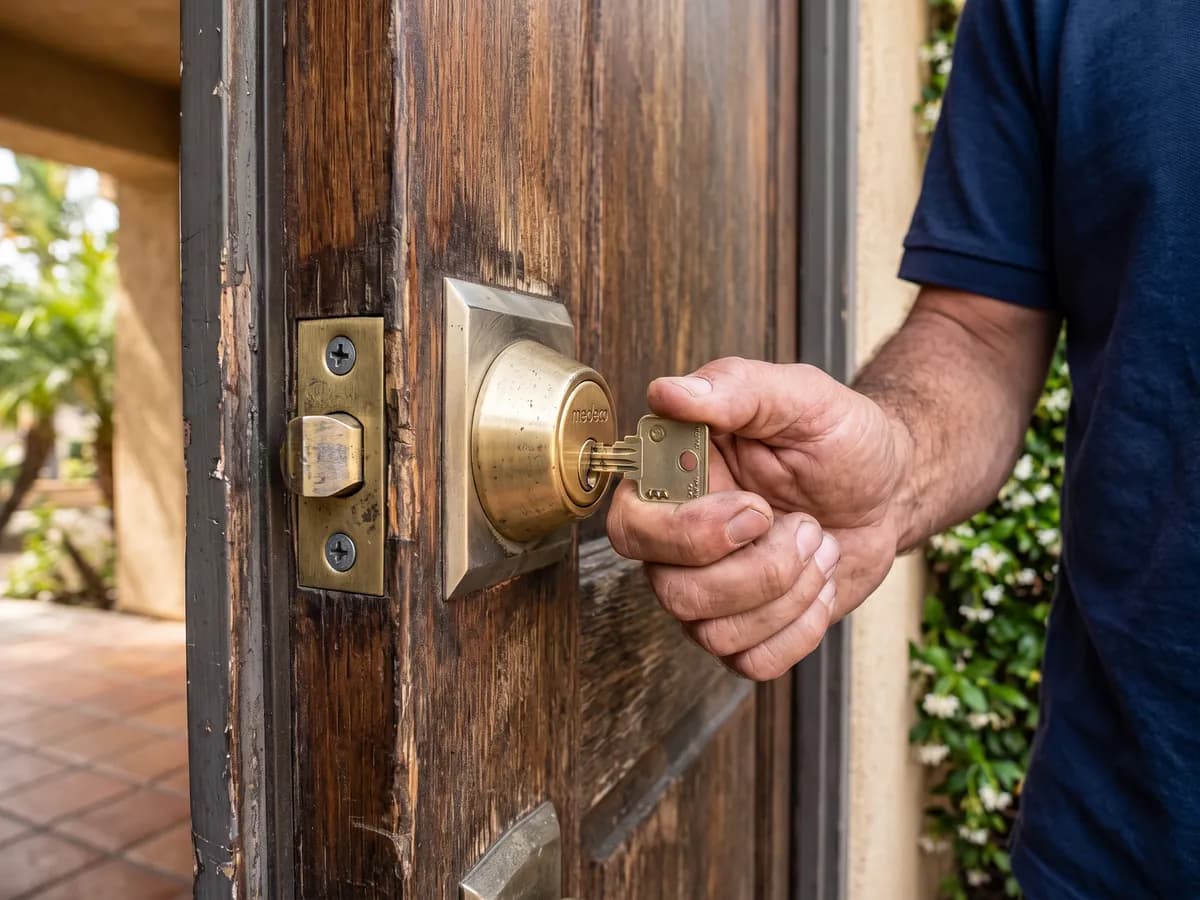
Cylinders face four classic attacks: picking, bumping, drilling and key copying. Pick-resistant locks answer the first, and the better ones help with the others, though not automatically. A cylinder can resist picking beautifully and still use a common keyway that any kiosk in Walnut can copy. Another can have a protected keyway and ordinary pins. This page is about picking specifically: how it works, which designs defend against it and what to expect from your locksmith. Keypad locks sidestep the issue for the main entry, but they hide cylinders of their own, which we cover too. Julian's Locksmith can help you sort out the rest at (951) 903-3193.
What to know first in Walnut
Picking is a simple idea. A pin tumbler cylinder holds spring-loaded pin stacks that block rotation until the correct key lifts each stack to the same line. A picker applies light turning pressure with a tension wrench, which makes one pin bind slightly harder than the others, then lifts that pin to the line and moves to the next. On a loosely made, plain-pin cylinder, each pin gives clear feedback and the lock opens quickly. Pick-resistant locks attack that feedback. Spool and serrated security pins catch at the line and give a false set, so the plug rotates a little and then locks while the picker must reverse pressure to free the pin. Tighter, more consistent machining blurs the binding order. Narrow, curved keyways limit tool access. Beyond that sit mechanisms that change the game: sidebars that need a second set of positions, pins that must rotate as well as lift, telescoping pins and disc detainers with no pins at all. Each layer adds time, skill and tools to the attack. A good set of pick-resistant locks stacks several of them.
Work included on a typical visit
- Security-pin cylinder upgrades. For many Schlage, Kwikset and similar deadbolts, the most practical step is a replacement cylinder with spool and serrated security pins and tighter machining. It keeps your existing hardware and finish, takes little time on a standard format, and noticeably slows the common picking methods.
- Disc-detainer cylinders and padlocks. Outdoor locks face rain, dust and heat as well as attackers. Disc detainer designs have no springs to weaken and tolerate weather well, which makes them popular for gates and utility doors. They need specialized tools to service, so we talk through ongoing care before you commit.
- Storefront, mortise and rim cylinders. Interchangeable cores let a business pull and swap a cylinder in moments with a control key, with no disassembly of the lock. Pairing pick-resistant cores with a clear key log helps a small business respond quickly to staff changes without replacing whole locks, and the removed core can be rekeyed at leisure.
- Rekeying and servicing tight-tolerance cylinders. Pick-resistant cylinders can be rekeyed and serviced, but they need more care. Security pins must be seated in the right order, sidebars cleaned and springs checked. We perform the work on-site where possible and send cylinders to the manufacturer when needed.
- Opening pick-resistant locks when keys are lost. Prevention is cheaper than a drilled cylinder. Register your keys, store a spare off-site and photograph your cylinder faces. If you do get locked out, a clear description of the lock lets us decide quickly whether to bring replacement parts.
Local factors in Walnut
Student rentals near Walnut City Hall and Walnut Library on La Puente Road see keys pass among roommates, friends and partners, and cheap cylinders accumulate copies quickly. For landlords and parent owners, a pick-resistant restricted cylinder limits copying and slows entry. Tenants should get landlord approval first. Keypad entry is another option for semester turnover, as long as the override cylinder is also a decent one. We rekey between lease cycles so each group starts fresh.
Higher-value homes in Walnut often have multiple entries, guest houses, wine rooms and offices. Patented pick-resistant cylinders with registered keys suit the interior rooms where valuables live, while exterior doors benefit from Grade 1 hardware and strong frames. Staff, contractors and vendors make key control as important as pick resistance, so we set up numbered keys and an authorization list at the same time.
Family homes in Walnut need locks that adults can use at 6 a.m. with a coffee in one hand and a child in the other. Pick-resistant cylinders in common formats work like any other lock day to day. We upgrade the front and garage entry doors, keep the same key across the main doors, and suggest a keypad for kids and caretakers so nobody has to hide a key under a planter.
Example situations
- A retired couple near Schabarum-Skyline Trail wants better locks but worries about hard-to-turn keys. We choose lever-style handles, a pick-resistant cylinder with a comfortable key head and a keypad on the garage entry. They test each key at the door before we finish, and we adjust the strike so the bolt throws without effort. Security that's hard to use gets left unlocked.
- A rural workshop outside Walnut has a side door facing open fields. The owner, who stores welding equipment, wants a deadbolt that resists picking and prying. We install a Grade 1 pick-resistant deadbolt with a steel strike box anchored into the frame, plus a latch guard. Distance from neighbors means the door has to hold up on its own.
- A self-storage tenant keeps tools and equipment in a unit closed with a hasp. The padlock on it is a common keyed model with a thin, exposed shackle. We recommend a disc-detainer padlock with a hardened, shielded shackle and explain why cylinder and shackle both matter, since a weakness in either one defeats the other.
- A small architecture studio on Amar Road shares a rear door with the neighboring tenant. The front lock is old but fine; the back cylinder is a basic one that both firms' employees can copy. With the landlord's approval, we install a pick-resistant restricted cylinder, issue numbered keys to each firm and document who may order more. Cooperation between tenants is part of the job.
How the visit works
- Tell us what worries you. Start with the questions you'd ask a friend who knew locks. Can mine be picked? Is it worth upgrading? Which door first? Phone (951) 903-3193 and we'll talk through your situation before anything gets scheduled.
- Verify who you are and what you own. We confirm ID and proof of ownership or tenancy before opening, rekeying or upgrading any lock. Tenants should bring landlord approval. It's a safeguard for you; our license, LCO7891, is issued by BSIS, and you can verify it at search.dca.ca.gov.
- Identify and test what's on the door now. Some locks tell their own story through wear marks, scratches around the keyway or a sticky key. We note those and ask about past problems. Those clues help us tell whether to repair, rekey, upgrade the cylinder or replace the lock entirely.
- Choose the right level. Most people want the strongest protection at the doors that matter and sensible hardware elsewhere. We propose a mix, such as patented cylinders on a workshop and security pins on bedrooms, and itemize it so you can adjust.
- Fit, align and reinforce. We install the cylinder or lock, set the cam correctly and adjust the strike so the bolt slides without drag. Misaligned bolts wear pick-resistant cylinders faster, so alignment is part of the security, not just convenience.
- Test, explain care and hand over keys. Before we leave, we show you the right way to maintain a tight-tolerance cylinder: a light dry lubricant, clean keys and no forcing. If something feels off in the following weeks, call us early; small adjustments are simple.
How we quote the job
- The level of pick resistance you choose. Standards matter to price. A cylinder listed to UL 437 or BHMA A156.30 has been tested and carries a higher cost than one that simply claims pick resistance. We explain which listings exist for your lock and whether your door can benefit from them.
- Rekeying difficulty. Sometimes a rekey is all you need. If your existing cylinder is well made and simply has too many keys floating around, rekeying costs less than a full upgrade. We'll tell you honestly when the cylinder is fine and the keys are the issue.
- Timing, special orders and travel. Because we come to you, the distance from San Bernardino to Walnut is part of the price of a visit. We factor it in honestly. Several small jobs on one trip, such as cylinders, a strike plate and a padlock, spread that travel cost across more work.
Every job gets a clear quote before any work starts. Call (951) 903-3193 with the details and we'll tell you what to expect for your situation in Walnut.
Common errors that cost time and money
- Paying for a better cylinder in a flimsy opening. A hollow door, a cracked jamb or a strike on short screws will fail long before a good cylinder does. Walk the entire entry first, fix the weakest link and then upgrade the lock.
- Ignoring key copying. A cylinder full of security pins on a common keyway can still be duplicated at any kiosk in Walnut. If copies concern you, pair pick resistance with a protected keyway or restricted blanks, and keep a record of who holds keys.
- Spraying penetrating oil into a sticky cylinder. It may help for a day, then attracts dust and turns into paste that jams pins. Use a light dry lubricant sparingly, or call us if the key resists. Persistent stiffness usually means wear or misalignment.
What to do before we arrive
- Ask what feature creates the 'pick resistant' claim. Security pins, a sidebar, rotating pins and a disc detainer are real answers. 'Advanced technology' or 'anti-pick design' without details is not. A knowledgeable seller or locksmith will name the mechanism and cite a standard if one applies.
- Look at the opening around the lock. Pick resistance does nothing for a door with a split jamb, a short-screwed strike or a window next to the handle. Fix these first, or at the same visit, so your new cylinder isn't the strongest part of a weak entry.
- Choose padlocks with both a good cylinder and a hardened, shielded shackle. A pick-resistant padlock with a thin exposed shackle can be cut in seconds with bolt cutters. Weather rating matters outdoors, because dust and moisture dull any mechanism over time.
- Be wary of absolute claims. 'Unpickable' and 'burglar-proof' are sales talk, not engineering. Honest sellers talk about time, tools and standards. If someone is willing to demonstrate on a sample lock, even better; a good pick-resistant cylinder can stand being tested.
Getting to Walnut
Walnut is about 40 miles from our San Bernardino base, roughly 46 minutes in light traffic via I-215 South briefly to SR-210 West. When you call, you get an arrival estimate based on where the technician is and the traffic at that moment.
Commercial jobs on busy stretches like I-10 sometimes need a parking plan, especially for storefront doors or roll-up gates. Let us know about loading zones, red curbs or parking structures before we arrive.
About Walnut: The city takes its name from Rancho de los Nogales, a Mexican land grant whose name means ranch of the walnut trees, and native California black walnuts still grow in the San Jose Hills.
| Neighborhoods | Lemon Creek, Snow Creek, West Valley, Ridge Estates, Walnut Hills, Timberline |
|---|---|
| ZIP codes | 91789 |
| Main routes | SR-60, SR-57, I-10, Valley Boulevard |
| From our San Bernardino base | about 40 miles via I-215 South briefly to SR-210 West (Foothill Freeway) through Rialto, Fontana, Rancho Cucamonga and La Verne, then SR-57 South to the Temple Avenue exit and west past Mt. SAC to Grand Avenue, Amar Road and La Puente Road; I-10 West to SR-57 South as the alternate, and SR-60 West through the 57/60 confluence to Lemon Avenue, Fairway Drive or Nogales Street for Valley Boulevard and West Valley |
Business lock or door work in Walnut?
Call (951) 903-3193 with the address, the doors or hardware involved and when the site is open. We'll quote the job before any work starts and book a time within our hours that suits your schedule.
Frequently asked questions
How can I tell whether my lock is pick-resistant?
Check for a UL 437 or BHMA A156.30 mark, a named patented system such as Medeco, Mul-T-Lock, ASSA or Primus, or a manufacturer spec sheet that lists security pins or a sidebar. Packaging alone isn't enough. Send us photos of the cylinder face and keyway, or have us inspect it at the door, and we'll tell you what you have.
Is there such a thing as an unpickable lock?
No. Skilled hobbyists have publicly opened almost every mainstream design, including premium ones, though it typically takes practice, special tools and time. What good pick-resistant locks do is raise the effort and skill required, which discourages most intruders. Anyone promising an unpickable lock is overselling, and we won't make that promise. Honest sellers talk about time and tools instead.
What does pick-resistant mean for a lock?
It means the cylinder includes features that make it hard to manipulate without the correct key: security pins such as spools and serrations, tight machining, restricted keyways, sidebars or disc mechanisms. It doesn't mean pick-proof. A standard like UL 437 or BHMA A156.30 tells you the resistance was tested; a bare claim on a box doesn't tell you much.
Can a standard deadbolt in Walnut be picked?
Many builder-grade deadbolts use plain pins and loose tolerances, which a practiced picker can open quickly. Some include security pins, and a few are better. A Grade 1 label doesn't change this, since it measures durability. We can identify yours and, with your permission, show how it behaves. Then you can decide whether an upgrade is worth it.
Can pick-resistant locks be rekeyed?
Yes, though the work is slower than on a plain cylinder. Security pins must be seated in the right order, and sidebar or patented designs may need factory parts or authorization. Plan for it if you'll rekey often. We tell you up front how easy or hard rekeying will be for the product we recommend.
What is the difference between pick-resistant and bump-resistant?
Picking manipulates the pins one at a time with tools; bumping uses a specially cut key and a sharp tap to jolt the pins. Some designs resist both, especially those with sidebars or disc mechanisms, but a cylinder can be strong against one and weak against the other. If bumping worries you, ask about it directly when choosing.
How far is Walnut from your base?
Walnut is about 40 miles from our San Bernardino base, roughly 46 minutes in light traffic. Arrival time depends on traffic and on the job the technician is finishing, so we give you an estimate on the phone before you commit.
Related services in Walnut
- High Security Locks in Walnut
- High Security Locksmith in Walnut
- Bump-Resistant Locks in Walnut
- Duplicate-Protected Keys in Walnut
- Restricted Keyway in Walnut
- Security Lock Upgrade in Walnut
- Home Security Locks in Walnut
- High Security Lock Installation in Walnut
- Deadbolt Installation in Walnut
- Smart Lock Installation in Walnut
Pick-Resistant Locks in nearby cities
- Pick-Resistant Locks in West CovinaLos Angeles County
- Pick-Resistant Locks in Diamond BarLos Angeles County
- Pick-Resistant Locks in ValindaLos Angeles County
- Pick-Resistant Locks in Rowland HeightsLos Angeles County
- Pick-Resistant Locks in CovinaLos Angeles County
- Pick-Resistant Locks in City of IndustryLos Angeles County
- Pick-Resistant Locks in Charter OakLos Angeles County
- Pick-Resistant Locks in La PuenteLos Angeles County