
Orange, Orange County
Orange Condo Locksmith: Your Unit, Your Locks, the HOA's Rules
Short answer: Condo entry doors that open onto an interior hallway are often fire-rated, with a label on the hinge edge. Their locks should be replaced only with hardware listed for fire doors so the door still closes and latches on its own. A condo locksmith from Julian's Locksmith checks the label before swapping anything in Orange and tells you when the HOA should be involved.
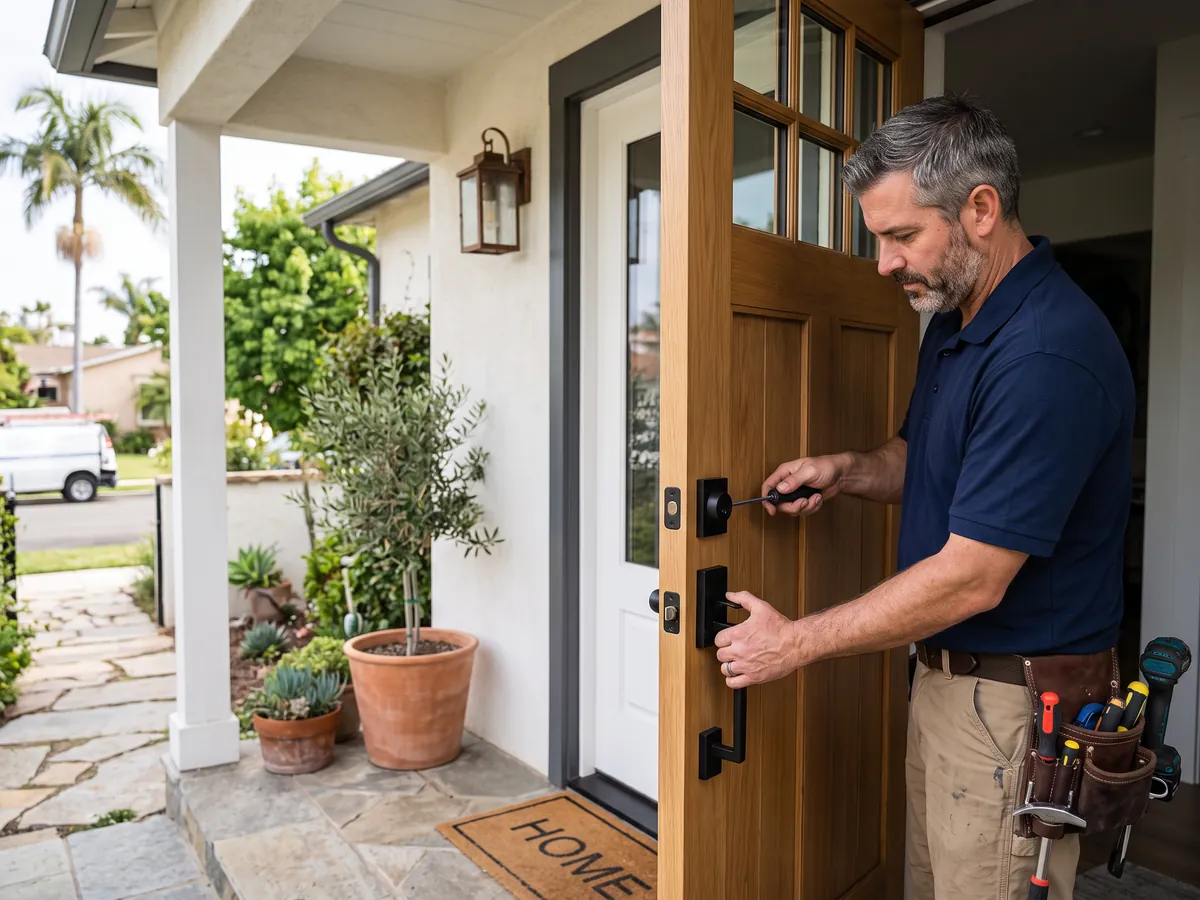
If you rent out your condo, you're a landlord as well as an HOA member, and that changes your lock checklist. California requires landlords to provide a working deadbolt on the main entry door and working locks on windows that open. Between tenants, the locks should be rekeyed, the deadbolt tested, and the new tenant given keys while you keep one for lawful entry. Fobs and gate remotes usually transfer through the association. A condo locksmith in Orange can handle the unit side of every turnover, check the slider and window latches while there, and leave you an itemized invoice for your records.
How this works in Orange
Condo hardware across Southern California spans several decades of building. Units from the 1970s and 1980s often have Schlage or Kwikset knobsets with separate deadbolts, sometimes older Weiser hardware that's harder to find parts for. Mid-rise buildings may use heavier cylindrical or mortise locks on fire-rated corridor doors. Newer tracts commonly arrive with consumer-rekeyable cylinders such as Kwikset SmartKey, which anyone holding a working key can reset, convenient for owners and worth knowing as a weakness. Patio sliders use hook latches that wear, and many owners have added steel security screen doors with keyed locks of their own. A condo locksmith works with all of it: rekeying pin tumbler cylinders to one key, adjusting or replacing latches, and upgrading to Grade 1 deadbolts with reinforced strikes where it makes sense. We bring common parts on the van, and for less common hardware we identify the exact model before quoting, so you aren't paying for a second trip.
Work included on a typical visit
- Clearing old master keys. Condos converted from apartments sometimes still have cylinders pinned to the old management master key. We take the cylinder apart, look for master wafers stacked in the pin chambers, and repin it to your key alone. After that, no maintenance key from the building's rental days can open your door.
- HOA-approved hardware replacement. If a visible hardware change needs architectural review, we give you the brand, model number, finish and a photo or spec sheet to attach to the form. The install waits until approval comes back. That small delay is better than paying twice when a violation letter asks you to restore the original.
- Fire-rated corridor door hardware. Condo doors opening onto interior hallways are often fire-rated, marked by a metal or embossed label on the hinge edge. Their latching hardware must be listed for use on fire doors, and the door must still close and latch on its own. We check the label first and quote only hardware that keeps the rating intact.
- Patio slider and balcony door security. Condo patio sliders take heavy use and their hook latches wear. When the latch no longer catches, we adjust the rollers and keeper or replace the latch with a compatible part. Most slider hardware is model-specific, so a photo of the latch and the brand label on the frame speeds things up.
- Turnovers for owner-landlords. Renting out your condo? Between tenants, we rekey the unit, confirm the deadbolt throws fully and the window latches work, and cut keys for the new tenant while you keep one for lawful entry. A written invoice records the date, which is useful if a former tenant's key ever comes up.
How Orange shapes the job
Parents sometimes buy condos near St. Joseph Hospital for students to live in during college, often with roommates paying rent. That makes the parent a landlord, with a landlord's lock duties. Rekey between roommates and at the end of each school year, keep a record of who holds keys, and consider a keypad deadbolt so codes can be changed when roommates rotate instead of chasing down lost keys. Parents can manage those codes remotely from home.
Townhome condos in family neighborhoods of Orange have attached garages, patio sliders opening onto small yards and plenty of comings and goings. A deadbolt on the garage-to-house door, a slider bar for nights and keypad codes for older kids who forget keys cover most of what families need. Keep the release tool for interior privacy locks handy for the inevitable locked bathroom door. Teach older children to throw the deadbolt behind them, not just the knob lock.
Condos in mixed-use and downtown buildings around Orange often sit above shops or offices, with shared entries, buzzer systems and heavier commercial-style hardware on corridor doors. Mortise locks and fire-rated doors are more common here than in suburban complexes. A condo locksmith working in these buildings checks fire labels, coordinates with building management for access, and rekeys mortise cylinders without disturbing the door's rating. Tell us about every door between the street and your unit.
Situations this covers
- Picture a mid-rise condo where the lever on a fire-rated corridor door has cracked and no longer retracts the latch. We confirm the label on the hinge edge, replace the lever and latch with listed hardware in the same finish, and check that the door still closes and latches on its own. The hallway closer stays on the HOA's maintenance list.
- An owner wants to replace a worn front handleset with a matte black design, but the association's guidelines call for a bronze finish across the building. We source a Grade 1 handleset in the approved finish, send the owner model and spec details for the architectural form, and install it once approval arrives, keyed to the existing key.
- A family adds a steel security screen door to their ground-floor condo after HOA approval, but the screen's lock is keyed on both sides. Her father, who visits often, can't find the key quickly when he wants to step out. We swap the screen lock for one with a thumbturn inside and key its cylinder to the front door.
- A typical find: a new owner in a 1980s complex that was converted from apartments notices the front door key has an odd number stamped on it. When we pull the cylinder, it holds master wafers from the building's rental days. We repin it to a new key, do the same for the deadbolt, and the old maintenance master no longer turns either lock.
From your call to the finished job
- Tell us about the property. We ask whether you own the unit, rent it, or manage it for someone else, and whether the HOA has rules about contractors or hardware. Those answers shape the paperwork and the parts we bring. You get an honest ETA and a price range before we leave.
- Confirm who can authorize the work. Owners authorize work on their own unit with ID showing the address, or a deed or tax bill if the ID is outdated. Tenants need the owner's approval for anything beyond a lockout. Common-area work needs authorization from the HOA board or manager, never just a resident.
- Check the rules and the door. Before recommending hardware, we look at the HOA's requirements on exterior finish and style and at whether the door is fire-rated. Rekeying needs no review. Visible replacements may. We'll tell you which category your job falls into and what the association might ask to see.
- Quote before any work. When the scope changes mid-job, such as a cylinder that turns out to be damaged, we stop and update the quote before continuing. You never find out about an added part from the invoice; you hear about it at the door first.
- Do the work cleanly. Every lock gets tested with each new key, from both sides, with the door closed in its normal position. On fire-rated doors and garage-to-house doors, we confirm the door still closes and latches by itself before we consider the job finished.
- Keys, records and HOA follow-up. If you rent the unit out, record which keys went to the tenant and which stayed with you. That log, plus our invoice, answers most questions at the next turnover. When that turnover comes, call us back and we'll pick up from our notes.
Pricing factors
- Hardware grade and required finish. Rekeying reuses your hardware; replacement adds the cost of the lockset. Grade 2 residential hardware is a solid everyday choice, and Grade 1 deadbolts cost more but stand up to heavier use and forced-entry attempts. If the association specifies a finish, availability in that finish can affect which models fit the budget.
- Timing within our hours. Most condo work can be scheduled: rekeying after closing, hardware upgrades, smart locks and slider security. Planned appointments are easier to price and to fit within HOA work hours. Lockouts and failed locks are the urgent exceptions, and we handle those as quickly as our schedule allows.
- Smart locks and security add-ons. Secondary slider locks, track bars, reinforced strikes and a deadbolt on the garage entry door are modest additions when we're already on site. Bundling them with a rekey costs less than separate visits, and we'll only suggest the ones that address real gaps in your unit.
Every job gets a clear quote before any work starts. Call (951) 903-3193 with the details and we'll tell you what to expect for your situation in Orange.
Mistakes to avoid
- Hiring a locksmith from an ad that won't name the business or give a license number. Ask for the legal company name, a California locksmith license number and a full price before work starts, and check the license at search.dca.ca.gov. Julian's Locksmith holds license LCO7891.
- Disconnecting the self-closing hinges on a garage-to-house door, or propping open a fire-rated corridor door because it's heavy. Those features slow the spread of fire and smoke between spaces. If a door is hard to use, have the closer or hinges adjusted instead of defeating them.
- Living for years in a converted condo without checking for old master pins. If your community was built as apartments, a management master key from that era could still open some unit doors. Rekeying removes master wafers, and it's one of the least expensive security fixes available to an owner.
What to do before we arrive
- When selling a condo, gather every key, fob, remote, mailbox key and storage key, label them, and hand them over at closing in one bag. Tell the buyer which ones exist. A clean handoff protects you from questions later and gives the new owner a clear starting point for their rekey.
- At closing, ask the manager to deactivate every fob and remote registered to the seller and issue new ones to you. Fobs often control the garage, lobby, pool and gym, and a seller who forgot one in a jacket pocket shouldn't still be able to walk into your building next month.
- Photograph the hinge edge of your corridor-facing entry door before shopping for a new lock. A fire label there means the hardware must be listed for fire doors. Sending that photo when you call helps us quote compatible hardware right away and keeps you from buying a lock that can't legally go on.
- If your condo is a second home or sits empty for long stretches, use a keypad lock with an access log and give the HOA an emergency contact who lives nearby. Ask a neighbor to collect packages, and set lights on timers. An unoccupied unit looks occupied when nothing piles up at the door.
Getting to Orange
Orange is about 52 miles from our San Bernardino base, roughly 60 minutes in light traffic via I-215 South through Colton and Grand Terrace to SR-91 West. When you call, you get an arrival estimate based on where the technician is and the traffic at that moment.
Most trips into Orange use Main Street for at least part of the drive, and the technician keeps an eye on live traffic along the way so the arrival estimate you heard on the phone stays honest.
About Orange: Alfred Chapman and Andrew Glassell held about 5,400 acres along Santiago Creek, and access to that water shaped where the original townsite was laid out.
| Neighborhoods | Fairhaven Eichler tract, Orange Hills, Fairhills Eichler tract, El Modena, Fairmeadow Eichler tract, Chapman University area |
|---|---|
| ZIP codes | 92865, 92866, 92867, 92868, 92869 |
| Main routes | I-5, SR-22, SR-55, SR-57 |
| From our San Bernardino base | about 52 miles via I-215 South through Colton and Grand Terrace to SR-91 West (Riverside Freeway) through Riverside, Corona and the Santa Ana Canyon, then SR-55 South (Costa Mesa Freeway) to the Chapman Avenue exit; west on Chapman Avenue for Old Towne and the Plaza, east on Chapman Avenue for El Modena, Santiago Canyon College and Orange Park Acres; alternate via I-10 West to SR-57 South and the Chapman Avenue exit for The City district, The Outlets at Orange and UCI Medical Center when the 91 is jammed |
Home lock work in Orange?
Call (951) 903-3193 with the address and a quick description of the doors and locks involved. We'll quote the job before any work starts.
Frequently asked questions
How do I know if my condo entry door is fire-rated?
Look at the hinge edge of the door with it open. Fire-rated doors carry a metal or embossed label showing the rating. Doors opening onto interior hallways in mid-rise buildings commonly have one. If yours does, replacement latching hardware must be listed for fire doors, and the door must continue to close and latch on its own. Doors between an attached garage and the living space are a separate case, so ask us about those when you call.
Does my HOA keep a key to my condo?
Some do, especially in buildings where water leaks or other emergencies may require entry. Your CC&Rs or the association's rules explain whether owners must provide a key or access method. Ask the manager in writing. After a rekey, give them a new key only if the rules require it, and keep a record of what you provided. A sealed envelope or a code shared only with the manager keeps that emergency access controlled.
Can you rekey the lobby door, pool gate or garage gate for me?
Not at an individual owner's request. Those doors and gates belong to the association, so the board or property manager has to authorize the work. If the HOA hires us, we can rekey or repair common-area locks and gate hardware. As an owner, your best step is reporting the problem to the manager in writing. Include dates, times and what happened, such as a gate that fails to latch, so the vendor knows what to look for.
Should I rekey my condo after buying it?
Yes. Sellers, former tenants, contractors, agents and sometimes the association may hold keys, and you have no way to know how many copies exist. A condo locksmith rekeys your unit's cylinders so old keys stop working, usually without replacing hardware. Do it on the day you take possession, and ask the HOA to deactivate the seller's fobs at the same time. If the unit has an attached garage, include the garage-to-house door and any garage side door in the same rekey.
Can you copy my condo fob or garage gate remote?
We refer owners to the association for those. Fobs and gate remotes are registered in the HOA's access system, copies may be deactivated, and unauthorized duplicates can violate the rules. Extra credentials from the manager are the reliable route. We can cut standard keys for your unit, storage closets and other locks that are yours. If you need access for a caregiver or contractor, ask the manager about temporary credentials.
Can I add a security screen door to my condo?
Many associations allow them but specify style, color or placement, so check the guidelines and submit any required form. Once approved, choose a lock with an inside thumbturn rather than one keyed on both sides, so anyone inside can get out quickly. We can key the screen door's cylinder to match your front door. Remember that a screen door lock adds to your main deadbolt; it does not replace it.
How far is Orange from your base?
Orange is about 52 miles from our San Bernardino base, roughly 60 minutes in light traffic. Arrival time depends on traffic and on the job the technician is finishing, so we give you an estimate on the phone before you commit.
Related services in Orange
- Condo Lockout in Orange
- Residential Locksmith in Orange
- Rekey Locks after Buying a House in Orange
- Locksmith for New Homeowners in Orange
- Apartment Locksmith in Orange
- Smart Lock Installation in Orange
- Deadbolt Installation in Orange
- Cluster Mailbox Lock in Orange
- Keyed Alike Locks in Orange
- Locksmith for Rental Property in Orange
Condo Locksmith in nearby cities
- Condo Locksmith in Villa ParkOrange County
- Condo Locksmith in TustinOrange County
- Condo Locksmith in Santa AnaOrange County
- Condo Locksmith in AnaheimOrange County
- Condo Locksmith in PlacentiaOrange County
- Condo Locksmith in Yorba LindaOrange County
- Condo Locksmith in FullertonOrange County
- Condo Locksmith in Garden GroveOrange County