
Montclair, San Bernardino County
Patented, Pick-Resistant High Security Locks for Montclair Doors
Short answer: In Montclair, upgrading to high security locks usually means swapping the cylinder rather than the whole lock. We fit a patented, drill-resistant cylinder into your existing deadbolt, mortise lock, exit device or storefront deadlock when the hardware allows it, and you get registered keys no kiosk can copy. We verify ownership, confirm compatibility, then quote. Call (951) 903-3193.
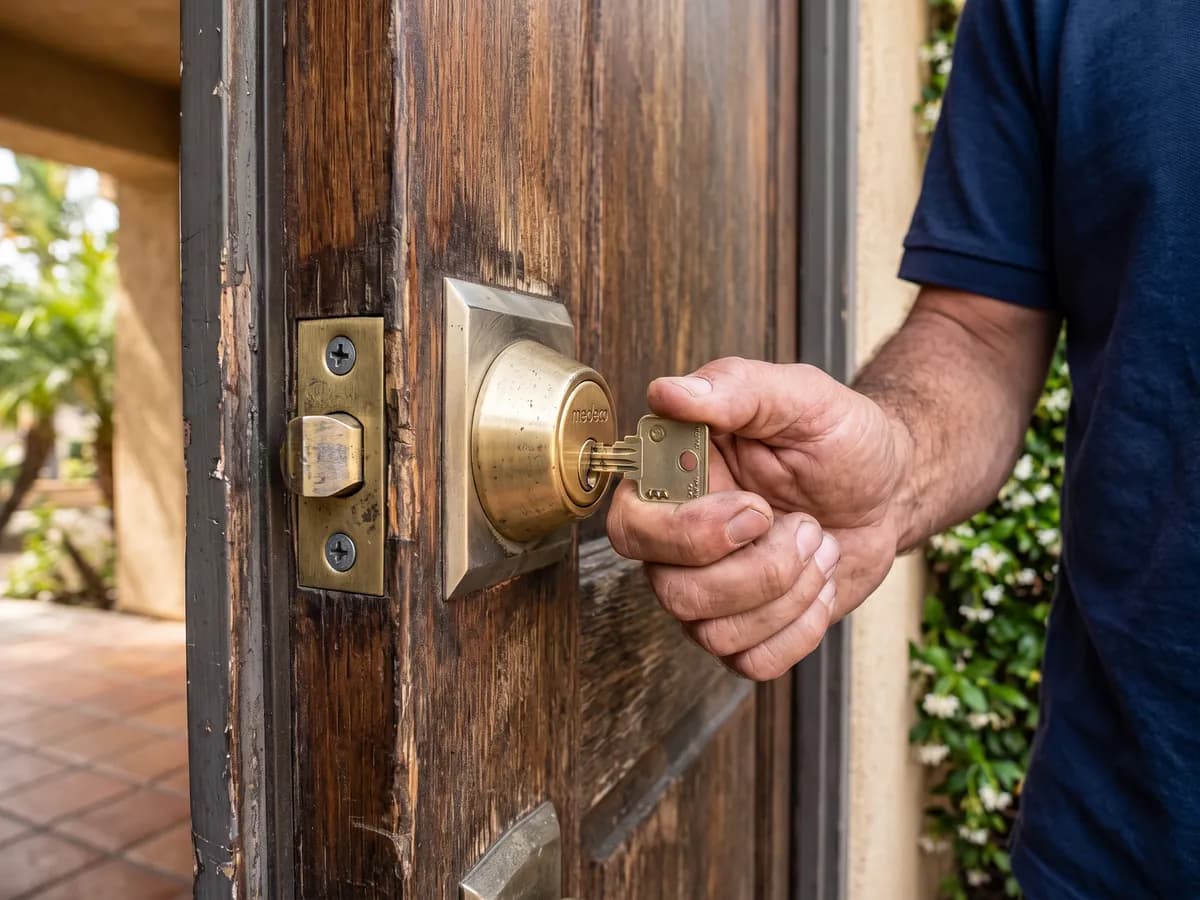
Inside an ordinary five-pin cylinder, a single row of spring-loaded pins is all that stands between a tension wrench and an open door. A high-security cylinder adds layers a pick can't easily read: pins that must twist as well as lift, a sidebar that drops only when every pin is turned to the right angle, telescoping pins nested inside other pins, hardened steel inserts that dull a drill bit. In Montclair, Julian's Locksmith fits these mechanisms into homes and businesses, explains which layer does what, and matches the product to the actual risk rather than to the most expensive box on the shelf. Sometimes a restricted keyway is enough, and we'll tell you when.
High security locks in Montclair make sense for people with something particular to protect, not as a blanket upgrade. A shop that keeps cash on site, a medical office with patient records and controlled supplies, or a landlord who wants copies of a key to stay under control might each qualify. These locks usually offer three things: resistance to picking, bumping and drilling; a patented keyway whose blanks aren't sold over the counter; and a controlled process for cutting new keys. Standards help you compare. UL 437 tests how well a cylinder resists picking, drilling and forced attack, and ANSI/BHMA Grade 1 rates the strength of the lock body itself. Medeco, Mul-T-Lock and ASSA Abloy all make cylinders and deadbolts in those categories. A Grade 1 deadbolt with an ordinary cylinder is strong but still pickable, so the cylinder matters as much as the bolt. Hardware only helps if it is installed correctly. A door frame that flexes, a short strike screw or a hollow-core door can undo the best lock. In Montclair's older homes we often reinforce the frame and set a long strike plate before mounting the lock, and we explain how key control works with the system you choose.
What to know first in Montclair
A standard pin-tumbler cylinder has one line of defense: a row of pin stacks that must all split at the shear line. Picking works by applying light turning pressure and setting those pins one at a time. Bumping works by striking a specially cut key so the pins jump and the plug turns in the instant they separate. High security locks add a second, independent condition that neither trick satisfies. In a Medeco cylinder, each pin must rise to the right height and also rotate to the right angle so a sidebar can drop into slots on the pins. Schlage Primus and ASSA Twin cylinders add a sidebar driven by finger pins that read cuts milled into the side of the key. Mul-T-Lock nests an inner pin inside an outer pin, creating two shear lines per chamber. Abloy Protec2 abandons pins entirely in favor of rotating discs. A picker who sets every pin height in these designs still faces a locked plug. Specialists have defeated some models under lab conditions, but not quickly or quietly in a doorway, and that is the practical difference for a Montclair home or business.
How we can help in Montclair
- Exit device and rim cylinder upgrades. Rear service doors with exit devices are favorite targets because they face alleys and loading areas. Along with a high-security rim or mortise cylinder, we look at the latch guard, the strike and whether a cylinder guard plate can be added to keep pry bars and pipe wrenches off the outside trim.
- Patented key systems and key registration. We set up a patented key system so duplicates require your authorization. Keys are cut to a registered profile, stamped with control numbers and logged. You choose who can request copies, and that list is recorded with the system, so a former manager can't simply order a new key in your business's name.
- High-security padlocks and hasps. Hidden-shackle puck padlocks are standard on roll-up doors and storage units, and several high-security makers produce them on patented keyways. We can key them alike to your building, so one registered key opens the warehouse doors and the yard gate padlock at your Montclair site.
- Strike, frame and cylinder guard reinforcement. Most forced entries attack the frame, not the cylinder. We install heavy-gauge strike plates and box strikes anchored with three-inch screws into the stud, so a high-security deadbolt has something solid to lock into. On out-swinging doors we add non-removable hinge pins or hinge security studs.
- Rekeying and servicing existing high-security cylinders. Older high-security cylinders wear like any lock. Sidebars gum up with dust, springs tire, and keys copied from copies drift off spec. We clean and service the cylinders, arrange keys cut to code from the registration, and tell you plainly when a cylinder has worn beyond adjustment.
How Montclair shapes the job
Apartment owners turn over keys constantly, and every tenant who copies a key creates risk for the next. A patented keyway on unit doors stops kiosk copies, and California law already expects a working deadbolt on each unit's main entry. In Montclair buildings, we pair high security locks with interchangeable cores or quick rekeys so turnover stays fast, and we treat mail rooms, laundry rooms and roof access as part of the same key plan.
Strip-center shops along Ramona Avenue usually have an aluminum storefront in front and a steel service door in back. Both deserve high-security cylinders: the front resists pullers and drills, the back resists quiet entry from the alley. We also put the cash office and stockroom on a separate key so floor staff can't reach them. When an employee leaves, a patented keyway means the key they kept can't simply be copied.
Inland summers are hard on exterior doors. Doors facing afternoon sun expand, bolts start dragging and the extra friction often gets blamed on a new high-security cylinder. In Montclair, we set strikes with a little seasonal allowance, use the lubricant the manufacturer specifies rather than oil, and confirm that any key-powered electronic cylinders are rated for the heat. A door that closes smoothly is part of a secure door.
Situations this covers
A typical request: the owner of a cash-handling business on Mission Boulevard has had one attempted pry at the back door and wants the entry to be much harder to beat. We would assess the steel door and frame, fit a Grade 1 deadbolt with a pick-resistant cylinder on a restricted keyway, add a long strike with heavy screws and a pry guard, and explain how new keys can be ordered only with the owner's authorization.
- Here's a common situation: an adult daughter manages care for her father at his home in Montclair, and home-health aides rotate through on weekly schedules. Several keys have gone missing over the past year. We install a high-security deadbolt keyed to a registered system, issue numbered keys to the agency and family, and set the daughter as the authorized signer, so a lost key is a known number rather than a mystery.
- One example: a boutique's aluminum storefront door shows a ragged hole where the cylinder used to be, the work of a slide hammer threaded into the keyway. Its Adams Rite style deadlock survived. We fit a high-security mortise cylinder with hardened inserts and the correct cam, add a free-spinning guard ring, and recommend a matching cylinder for the rear service door so both entries resist the same attack.
- Picture a distribution yard off I-10 where padlocks on the roll-up doors keep getting cut. The hasps are thin and the shackles hang exposed. We fit shrouded, boron-alloy padlocks on a patented key, add welded lock boxes that cover the shackle on the busiest doors, and key the yard gate to the same registered key, so the night supervisor carries one key instead of nine.
From your call to the finished job
- Talk through the risk. Every job begins with a threat list, not a catalog. A storefront that's been pried, a home where keys went missing and a medical office storing medications each need something different. Tell us the story, and we'll suggest a product line and explain why the others don't fit.
- Verify ownership and authorization. High-security systems exist to control who gets keys, so we confirm who you are first. Homeowners show photo ID with a deed, tax bill or utility statement; tenants need the landlord's written approval; businesses need an owner, officer or manager authorized to make security decisions.
- Assess the door and hardware. We identify each lock's format: knob, lever, deadbolt, mortise, rim, interchangeable core or cam. Then we measure door thickness, check the cam or tailpiece, and inspect the strike, frame and hinges. That inspection decides whether we retrofit cylinders or replace the lock.
- Choose the product and key plan. Together we pick the product line, the key tier and how many keys you need. We explain the patent status of each option, whether doors should be keyed alike or individually, and who will be registered as the system owner and authorized signer.
- Install and reinforce. We install cylinders or complete locks, set screws and cams to specification, and tighten trims so nothing can be pried loose. Where the frame needs it, we add reinforced strikes with long screws into the stud, cylinder guards or a guard plate, and adjust the door so the bolt throws smoothly.
- Test, hand off keys and document. Before we leave, you try each key yourself. We walk through how to request duplicates, what to do if a key is lost and how to care for the cylinders. Old cylinders are returned to you or disposed of, and a written summary of the system stays with you.
What affects the cost
- Product line and security tier. Price follows protection. Cylinders with sidebars, rotating pins, telescoping pins or added sliders take more precise manufacturing, and their keys come from controlled sources. Mixing tiers across a property, such as UL 437 on exterior doors and restricted keys inside, keeps the total sensible.
- Retrofit versus complete hardware. We look for the least expensive path that actually works. A good Grade 1 lever or commercial mortise lock rarely needs replacing; a loose, light-duty knob usually does. Your quote separates cylinder cost from any hardware we recommend, so you can see exactly where the money goes.
- Special-order parts and scheduling. Urgent work, such as replacing a cylinder damaged in a break-in, may call for a temporary standard cylinder until the patented one arrives. We quote both steps up front, so a second charge for the permanent cylinder never comes as a surprise.
Every job gets a clear quote before any work starts. Call (951) 903-3193 with the details and we'll tell you what to expect for your situation in Montclair.
Practical tips before you call
- Number every key and keep a written log of who holds it. When someone leaves, you'll know which key to collect, and if it doesn't come back you'll know exactly which doors to rekey. Patented keys are only as controlled as your records are.
- Keep at least one registered spare off the property with someone you trust. Patented keys can't be copied at a kiosk in a hurry, so losing every key means a controlled order. A spare with a relative or in a safe deposit box avoids that wait.
- Ask when the key patent expires. Once protection ends, aftermarket blanks can appear and key control weakens. A newer product generation often carries protection for years longer, which matters if you plan to keep the same system for a decade or more.
- Protect exposed cylinders on storefronts and back doors with a free-spinning guard ring or a guard plate. A cylinder standing proud of the door can be gripped with locking pliers or struck with a hammer; a spinning collar gives those tools nothing to hold.
What not to do
- Ordering cylinders before measuring the door. Mortise cylinders come in several lengths and cam styles, and rim cylinders need the right tailpiece. An order based on a guess leaves the cylinder sticking out, sitting too deep or failing to throw the bolt.
- Upgrading only the front door. Burglars skip the door with the visible high-security deadbolt and try the side, back or garage-entry door instead. Every exterior door facing the same threat deserves the same protection, ideally on one registered key, along with matching strikes.
- Buying high-security cylinders from online marketplaces. Some listings are counterfeit, some are older generations with expired patents, and many arrive with keys registered to nobody, which defeats key control entirely. Authorized channels tie the system and its keys to you.
Getting to Montclair
Montclair is about 29 miles from our San Bernardino base, roughly 36 minutes in light traffic via Belmont Ave and Palm Ave to I-215 North, I-15 South past Fontana and Rancho Cucamonga. When you call, you get an arrival estimate based on where the technician is and the traffic at that moment.
Our path into Montclair depends on where the previous job wrapped up. Sometimes that's a straight run via Moreno Street; other times it's surface streets the whole way. Either way, you get a heads-up call when the technician is close.
About Montclair: Montclair Place opened in 1968 as Montclair Plaza, took its current name in 2015, and today counts JCPenney, Macy's, an AMC dine-in theater and a Main Event among its tenants.
| Neighborhoods | Civic Center, Arrow Highway corridor, Holt Boulevard corridor, Mission Boulevard corridor, Central Avenue corridor, Monte Vista Avenue corridor |
|---|---|
| ZIP codes | 91763 |
| Main routes | I-10, Central Avenue, Monte Vista Avenue, Mills Avenue |
| From our San Bernardino base | about 29 miles via Belmont Ave and Palm Ave to I-215 North, I-15 South past Fontana and Rancho Cucamonga, then I-10 West to the Monte Vista Avenue or Central Avenue exit; SR-210 West to Monte Vista Avenue, then south, for North Montclair |
Business lock or door work in Montclair?
Call (951) 903-3193 with the address, the doors or hardware involved and when the site is open. We'll quote the job before any work starts and book a time within our hours that suits your schedule.
Frequently asked questions
Which brand is best: Medeco, Mul-T-Lock, ASSA or Schlage Primus?
Each is a strong system with a different mechanism: Medeco's rotating pins and sidebar, Mul-T-Lock's telescoping pins, ASSA's twin locking rows and Primus's finger-pin sidebar. The better choice depends on the formats your doors need, whether you're joining an existing system, key availability through authorized channels and remaining patent life. We compare options for your doors rather than pushing one brand.
Are high security locks worth it for an ordinary house?
It depends on the risk. If you've lost track of keys, rent out rooms, have staff or caregivers coming and going, or keep valuables at home, key control alone can justify the upgrade. If your main worry is forced entry, reinforcing the frame and strike may come first. We'll tell you which addresses your actual concern in Montclair.
How should I maintain high security locks in heat and dust?
Keep oil and penetrating sprays out of them. Use the manufacturer's recommended dry lubricant once or twice a year, wipe your keys clean occasionally, and keep strikes adjusted so the bolt doesn't drag when doors swell in summer. If a key starts sticking or needs jiggling, have the cylinder cleaned and checked before it fails.
Are there high security padlocks for gates and roll-up doors?
Yes. Several patented-key manufacturers make padlocks with shrouded or hidden shackles that resist bolt cutters and prying, and many can be keyed to the same system as your doors. The hasp or lock box matters as much as the padlock itself. We fit both and key them so your Montclair property runs on one registered key.
Can a high security system be master keyed?
Yes. Most major high-security platforms support master keying, so an owner or manager key opens several doors while individual keys open only their own. Master keying adds complexity and must be designed carefully so it doesn't weaken the cylinders. We can set up a high-security master key system that follows the same registration and authorization rules.
What makes a lock 'high security' rather than just heavy-duty?
Two features: tested resistance to covert and forced attack, and control over key duplication. A true high-security cylinder resists picking, bumping, impressioning, drilling and pulling under standards such as UL 437, and it uses patented keys that can't be copied without authorization. Heavy-duty or Grade 1 hardware may be strong and durable while still using an ordinary, copyable keyway.
How far is Montclair from your base?
Montclair is about 29 miles from our San Bernardino base, roughly 36 minutes in light traffic. Arrival time depends on traffic and on the job the technician is finishing, so we give you an estimate on the phone before you commit.
Related services in Montclair
- Master Key System in Montclair
- Commercial Locksmith in Montclair
- High Security Lock Installation in Montclair
- High Security Lock Replacement in Montclair
- Pick-Resistant Locks in Montclair
- Bump-Resistant Locks in Montclair
- Duplicate-Protected Keys in Montclair
- Restricted Keyway in Montclair
- High Security Key Duplication in Montclair
- Key Control System in Montclair
High Security Locks in nearby cities
- High Security Locks in ClaremontLos Angeles County
- High Security Locks in PomonaLos Angeles County
- High Security Locks in ChinoSan Bernardino County
- High Security Locks in UplandSan Bernardino County
- High Security Locks in OntarioSan Bernardino County
- High Security Locks in La VerneLos Angeles County
- High Security Locks in Chino HillsSan Bernardino County
- High Security Locks in San DimasLos Angeles County