
Eastvale, Riverside County
Eastvale Commercial Lock Replacement for Offices, Shops and Buildings
Short answer: Replace or rekey? If a commercial lock still works but too many people hold keys, rekeying the existing cylinders is usually the faster fix. Replace the lock when the lever sags, the latch drags, the key sticks, the door was forced, or parts are no longer made. Julian's Locksmith can inspect the hardware at your Eastvale door and tell you which applies.
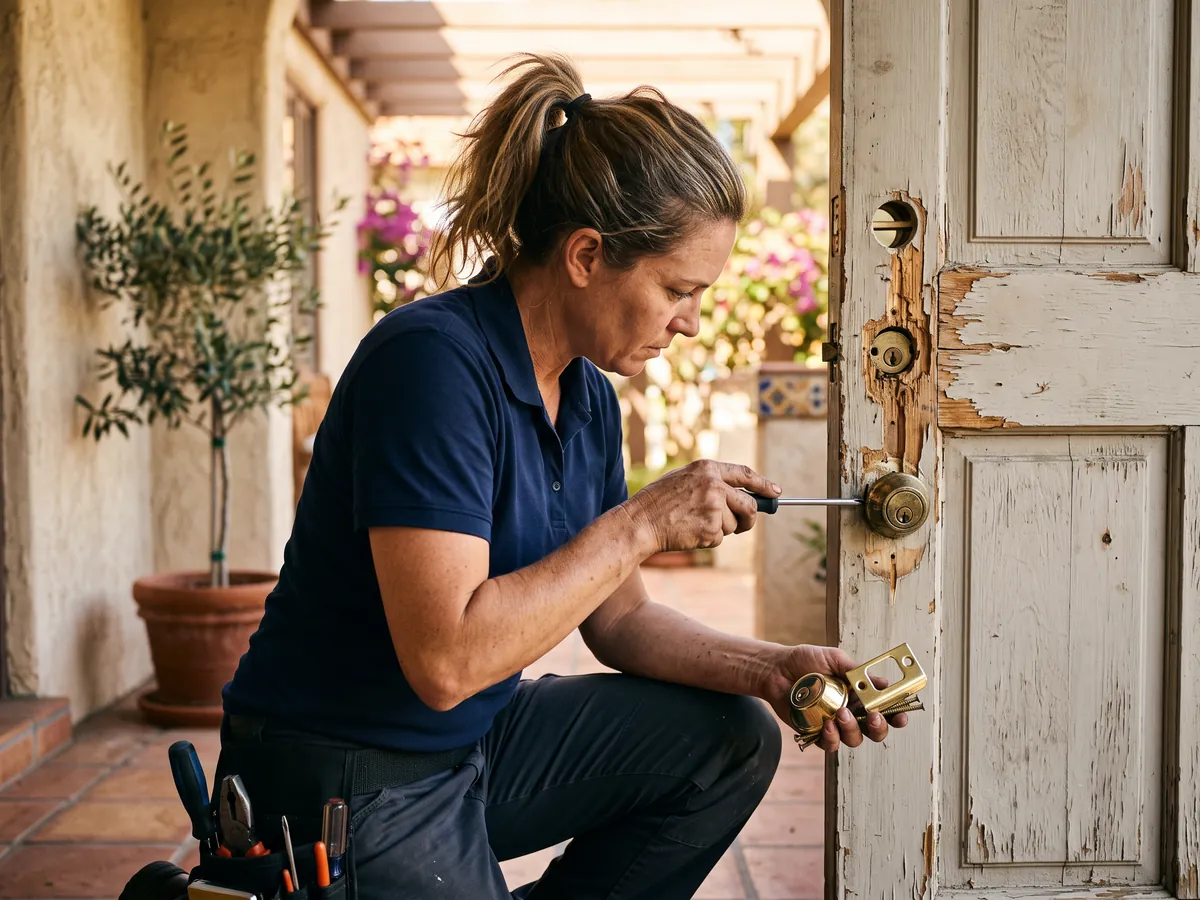
On a house, the worst outcome of a botched lock swap is a door that will not latch. On a commercial building it can be worse: an exit door that needs a key to leave, a fire door that no longer latches, or an accessible entrance fitted with a round knob. Commercial lock replacement lives inside rules that residential work mostly escapes, and getting them wrong costs more than the hardware. Julian's Locksmith replaces locks in Eastvale with those rules in view. We will point out problems we see, such as a labeled fire door or a missing lever, and send occupancy questions to the fire marshal or building department.
Commercial Lock Replacement in Eastvale: what to expect
The lock body is only half of a commercial replacement; the keying is the other half. If your suite sits on a building master key system, the new lock has to accept the right cylinder or core, otherwise the property manager's keys and the emergency-access lockbox keys will not work. Many commercial locks use a small format interchangeable core, a cylinder that a control key removes in seconds so it can be swapped or rekeyed without touching the lock. Others use conventional pin-tumbler cylinders that are rekeyed on the bench. With controlled keyways such as Schlage Primus or Medeco, blanks are restricted, so extra copies come only through authorized dealers. Before we install, we ask who holds keys today, whether a master key chart exists, and how many people should reach each door. Afterward, we give you the key numbers or bitting record for the new cylinders and explain how to store it. A lost master key is the costliest mistake in building security, so we treat records seriously.
What we can do on-site
- Cylindrical lever locks on hollow metal doors. Cylindrical locks offer many functions on one chassis style, so a commercial lock replacement can often keep the same lever and change only how the lock behaves. Swapping a failed office lock for a storeroom function, or the reverse, is a chassis and cylinder change that needs no new holes. We carry common chassis and order the rest.
- Storefront deadlocks and latches. Storefront cylinders mount in the stile with a cam that must match the lock case. When replacement is needed after years of daily use, we bring cylinders in common lengths and cams, then key them to your existing key or to a new one, depending on who needs access to the front door.
- Exit device locking trim and cylinders. When the device itself has failed, with a stuck latch, a bar that does not spring back or a bent chassis, the whole exit device is replaced. Rim, surface vertical rod and concealed rod devices each fit differently, so we measure door width and note whether the door is single or part of a pair before sourcing.
- Fire-rated and labeled openings. Fire-rated doors limit field changes. Drilling oversized holes, removing factory prep or adding unlisted parts can void the opening's rating. For that reason, we try to replace a fire door's lock with a listed product that fits the existing prep. If a different lock would need new holes, we explain what the label allows before touching the door.
- Interchangeable cores and master-key fit. Conventional master-keyed systems need the new cylinder pinned to the existing chart. If no chart survives, we can often work out the master pinning from the keys you have, or build a fresh system door by door. Either way, we write down what we installed so the next replacement starts with facts.
Local factors in Eastvale
Shopping centers around Eastvale pack many storefronts into one landlord's footprint, and each tenant often controls its own entry lock. Aluminum storefront doors with narrow stiles are the norm, which narrows hardware choices to slim deadlocks and latches. If your shop sits near Providence Ranch Park, tell us the center's name and whether the landlord needs notice. We schedule around opening times and replace the lock, cylinder and strike together so the door closes cleanly.
Inland summer heat does real damage to commercial doors. Metal doors expand, closers thicken or leak, lubricants dry out and plastic parts turn brittle. A lock that worked in February may drag in August. In Eastvale, we check door alignment and closer settings after every lock swap, favor hardware with metal internals, and suggest dry lubricant on latch bolts. Sun-facing glass doors are usually the first to show wear.
Warehouses and light-industrial buildings tend to have a front office, rear exits, personnel doors beside the dock doors and mechanical rooms, each with different traffic. Rear and dock-adjacent doors take the most abuse and deserve Grade 1 hardware and sturdy strikes. Pallet jacks and forklifts bend frames, so we check alignment, not just the lock. Give us the door label and tell us whether the yard has a check-in gate.
Common situations
- Consider a community hall with a pair of double doors, where one leaf's lock failed and the other leaf has a flush bolt that no longer reaches the floor. We would identify the pair's hardware, replace the failed lock, test the bolts, and explain which parts can be matched individually and which should be updated together.
- Say a boutique owner in Citrus Ranch reports that a key has snapped in the front door cylinder twice this year. We would pull the cylinder, find the lock out of alignment with its strike, replace the case with a Grade 1 model, and adjust the door. A new cylinder alone would repeat the same failure within months.
- Suppose a self-storage office has an electric strike on its customer entrance that clicks but will not release. The keeper is worn. We would confirm whether the door is fail-secure, replace the strike with a matching model, and test the release from the keypad with the owner, so the wiring does not get blamed unfairly.
- For example, a salon in a strip center near Santa Ana River reports that its glass front door only locks if staff lift the handle. On inspection, the Adams Rite deadlock is worn, but the real culprit is a dropped door rubbing on the jamb. We would adjust the pivot, replace the lock case and cylinder, and test the door shut a dozen times before leaving.
Step by step with Julian's Locksmith
- Walk the doors and list them. For a single door, this is a few minutes of looking and measuring. For a multi-suite building, it is a systematic pass. Either way, we check the lock, strike, hinges and closer together, because a new lock on a door that drags will not last long.
- Match function, grade and prep. We pick the replacement from the maker's catalog by cross-referencing your lock's series and function. If the model is discontinued, we suggest a successor or retrofit and show you the differences in finish, trim and keying before anything is ordered.
- Quote, order and schedule. We confirm who authorizes the work and who will be on site, since a property manager, owner and tenant may each hold a different piece of the decision. Bring ID, plus a lease page or management letter if you are not the owner.
- Replace with every door secured. During the swap we watch for hidden issues behind the lock: a cracked door edge, a stripped screw hole, a strike mounted with short screws, or a latch that never reaches its keeper. We fix small problems on the spot and quote bigger ones separately.
- Adjust and test every function. The closer decides whether a good lock keeps working. We check sweep and latching speed, tighten loose hardware, and make sure the strike lines up with the latch so the door does not bind in summer heat when metal expands.
- Hand over keys and records. You get the keys, the key numbers or bitting information for new cylinders, and a short written list of what we replaced, by door. Store the list somewhere locked and separate from the keys, since it can be used to order copies.
What affects the cost
- Number of doors and how they are grouped. Grouping helps. Doors with the same lock model can share one order, one keying plan and one test routine. Mixed buildings take longer because every opening needs its own parts and fit check. A door schedule shows where matching hardware would save work.
- Function and keying. Plain keyed-different locks take less setup than master-keyed or core-based systems. When cylinders must fit into an existing hierarchy, we need the chart or the keys, and the pinning work adds time. Restricted keyways add part cost but give you real key control.
- Code-driven requirements. Commercial lock replacement on fire-rated doors, exit doors and accessible routes calls for listed or specific hardware. Listed parts cost more than basic equivalents, and sometimes a requirement means upgrading both lock and closer. We raise these requirements before the quote, not after the parts arrive.
Every job gets a clear quote before any work starts. Call (951) 903-3193 with the details and we'll tell you what to expect for your situation in Eastvale.
Common errors that cost time and money
- Ordering by brand name alone. Two locks from one maker can differ in function, backset, hand and prep. Without the series, function and measurements, a part that looks right can arrive wrong and delay the job. Send photos and the stamped numbers.
- Starting a commercial lock replacement without a key plan. New locks keyed at random leave you with a pile of keys that do not relate to each other, no master and no record. Decide who needs access to which doors before ordering, and keep the plan in writing.
- Drilling or cutting a fire-rated door without checking its label. Extra holes, oversized bores or unlisted hardware can void the rating and fail an inspection. Read the label first, and ask whether the lock you want is listed for that opening.
What to do before we arrive
- Keep the master key chart and treat it like cash. Store it locked, away from the keys, and limit who can see it. When we replace locks in a master-keyed system, the chart tells us how to pin the new cylinders. If you do not have one, tell us and we will help you start one.
- Watch how doors behave through the seasons. Inland heat expands metal doors, and a lock that fit snugly in winter may bind in August. If your latch fights the strike in summer, mention it when you book so we check alignment instead of only the lock.
- Do not mix hardware brands on fire-rated openings without checking the listing. A lever from one maker on a mortise case from another may not be listed as an assembly. Ask us to confirm the combination, and keep the door's label unpainted and legible.
- Confirm who can approve the commercial lock replacement. In leased space, check whether the lease treats locks as the tenant's or the landlord's. Bring the lease page or an email from your property manager to the Eastvale visit. We verify authority before starting, and having it ready avoids delays.
Getting to Eastvale
Eastvale is about 27 miles from our San Bernardino base, roughly 34 minutes in light traffic via Little Mountain Drive and Highland Avenue to SR-210 West. When you call, you get an arrival estimate based on where the technician is and the traffic at that moment.
Most trips into Eastvale use Limonite Avenue for at least part of the drive, and the technician keeps an eye on live traffic along the way so the arrival estimate you heard on the phone stays honest.
About Eastvale: Eastvale households are large: the 2020 census averaged 3.94 people per household, and about 57 percent of households included children under 18.
| Neighborhoods | Stoneridge, Avonlea, Riverstone, Carrington, Providence Ranch, Chandler Ranch |
|---|---|
| ZIP codes | 91752, 92880 |
| Main routes | I-15, SR-60, Limonite Avenue, Hamner Avenue |
| From our San Bernardino base | about 27 miles via Little Mountain Drive and Highland Avenue to SR-210 West (Foothill Freeway), then I-15 South to the Limonite Avenue exit (Exit 103) for central and south Eastvale, or Cantu-Galleano Ranch Road (Exit 105) for Hamner Avenue and Goodman Way; I-215 North to I-15 South at Devore, or I-10 West to I-15 South, are the alternates |
New or replacement locks in Eastvale?
Call (951) 903-3193 and tell us which doors and what kind of hardware you have in mind. If you already bought the lock, keep the box handy so we can check it fits the door, and we'll quote the install before any work starts.
Frequently asked questions
Do I need my landlord's approval to replace a lock?
Check your lease before ordering a commercial lock replacement. In many leases the tenant controls the suite entry lock and the landlord controls exterior and common doors, but terms vary, and some buildings require a building-standard keyway or a set of keys for emergency access. We verify who has authority before starting, so bring ID and the lease page or an email from the property manager.
Can you replace the lock on a fire-rated door?
Yes, with listed hardware. A fire door's lock must be rated for fire use, latch every time the door closes, and fit the existing prep or an allowed modification. We read the label on the hinge edge, choose a compatible lock and check the closer. We will not drill beyond what the label permits. Whether an opening needs a rating at all is a question for your fire marshal or building department.
Are you licensed to do commercial work?
Julian's Locksmith holds California locksmith company license LCO7891, issued by the Bureau of Security and Investigative Services, and you can verify it at search.dca.ca.gov. We also verify your authority to approve work on the building before replacing any lock, which protects owners and tenants alike. For electrical or fire-alarm work outside locksmithing, we coordinate with licensed trades.
How do I choose between office, storeroom and classroom functions?
Think about what the lock should do from each side. An office function lets staff lock the outside with a turn button or key. A storeroom function stays locked outside and always opens from inside. A classroom function lets staff lock the outside with a key while the inside stays free. Tell us how the room is used and who needs to enter, and we will recommend a function.
What does Grade 1 mean on a commercial lock?
Grades come from ANSI/BHMA standards that test locks for durability, strength and abuse resistance. Grade 1 is the highest rating and belongs on busy entrances, exits and high-use doors. Grade 2 handles moderate traffic, and Grade 3, where offered, is meant for light residential use. Ask for the grade and series in writing, because the word commercial on a package does not tell you which grade you are getting.
Do keypad and electronic locks need an electrician?
Battery-powered keypad and lever locks usually do not. Hard-wired systems with electric strikes, electrified levers, magnetic locks or card readers involve low-voltage wiring, power supplies and sometimes fire-alarm release, which may belong to another trade. We replace the mechanical parts, test the door with the system, and coordinate with your access vendor or electrician when wiring or programming is needed.
How far is Eastvale from your base?
Eastvale is about 27 miles from our San Bernardino base, roughly 34 minutes in light traffic. Arrival time depends on traffic and on the job the technician is finishing, so we give you an estimate on the phone before you commit.
Related services in Eastvale
- Lock Replacement in Eastvale
- Business Lock Replacement in Eastvale
- Commercial Lock Installation in Eastvale
- Commercial Lock Repair in Eastvale
- Commercial Door Hardware in Eastvale
- Commercial Rekey in Eastvale
- Storefront Door Lock Replacement in Eastvale
- Panic Bar Replacement in Eastvale
- Commercial Master Key System in Eastvale
- Commercial Locksmith in Eastvale
Commercial Lock Replacement in nearby cities
- Commercial Lock Replacement in NorcoRiverside County
- Commercial Lock Replacement in Mira LomaRiverside County
- Commercial Lock Replacement in PedleyRiverside County
- Commercial Lock Replacement in Glen AvonRiverside County
- Commercial Lock Replacement in CoronaRiverside County
- Commercial Lock Replacement in Jurupa ValleyRiverside County
- Commercial Lock Replacement in Home GardensRiverside County
- Commercial Lock Replacement in OntarioSan Bernardino County