
Eastvale, Riverside County
Commercial Lock Repair in Eastvale: Fix the Part That Failed
Short answer: If a commercial door won't lock or latch, secure the building first: pull the door fully closed, check that the bolt really throws, and never prop it or tape the latch. Then call Julian's Locksmith at (951) 903-3193. We confirm you have authority over the space, repair or temporarily secure the door, and test every function before we leave Eastvale.
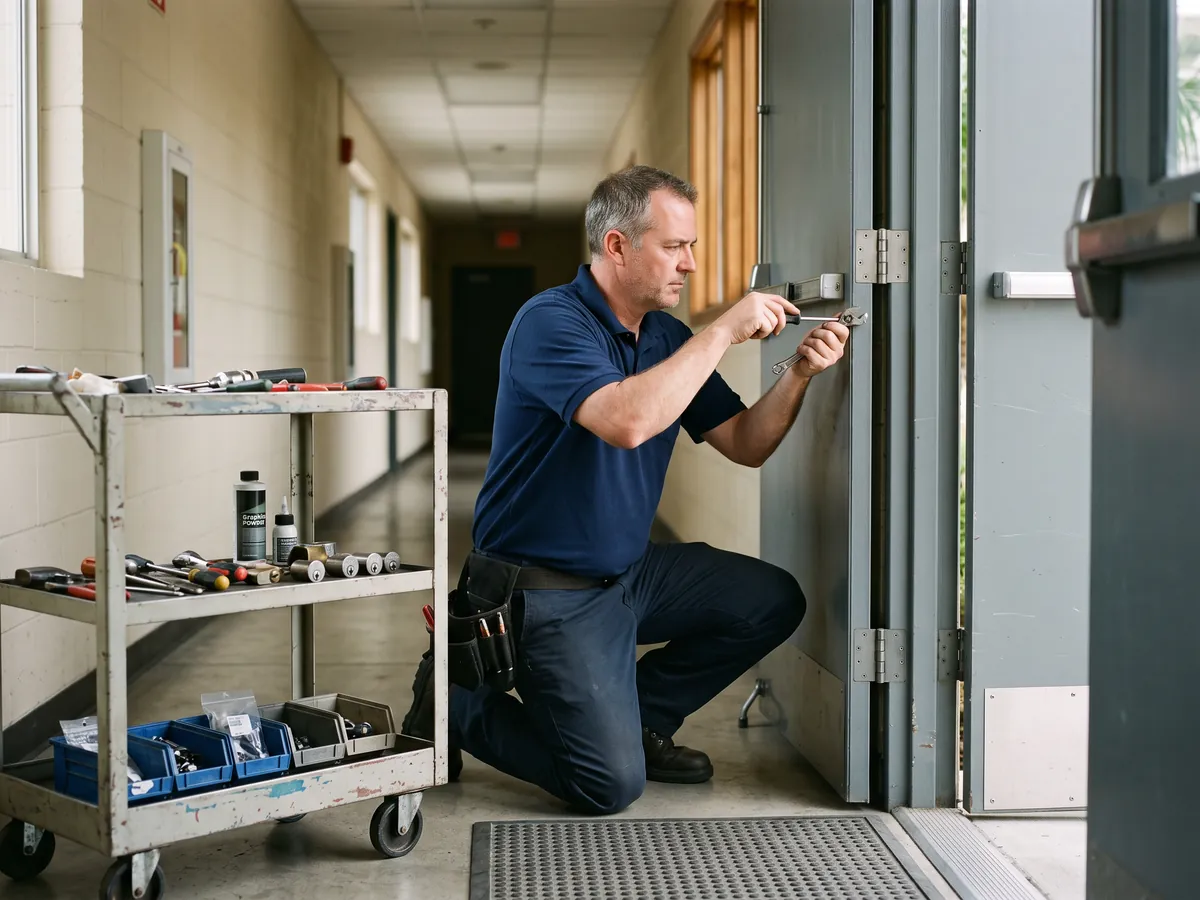
A front door lock in a busy office or shop is used far more than any home lock. Staff open it in the morning, customers push through it all day, and somebody locks it again at night, which adds up fast. That is why commercial lock repair is mostly about wear: a lever that droops, a latch that sticks halfway, a key that turns only if you jiggle it. In Eastvale, Julian's Locksmith diagnoses these problems at the door, repairs the part that actually wore out, and tells you plainly when a lock has reached the end of its life. Call (951) 903-3193 with the symptom and we will tell you what to expect.
How this works in Eastvale
Some of what a business expects from a lock repair is limited by codes that exist for good reasons. Doors in a path of exit generally have to open from the inside without a key, special knowledge or extra effort, so we won't convert a lever to a keyed-only inside cylinder or defeat panic hardware to stop a door being used. Fire-rated doors carry labels on the edge and frame; their hardware must be listed for the rating, they must close and latch on their own, and we don't cut new holes that void the label. Accessible routes call for lever handles rather than knobs, because a lever can be worked with a closed fist. These rules rarely stand in the way of a good repair, but they do shape it. If a door in Eastvale needs something your building or fire official must approve, such as a change in how an exit door locks, we'll tell you up front and help you describe the work to them.
Work included on a typical visit
- Cylinders, cams and worn keys. When a key needs jiggling or turns hard, the cylinder is wearing, not just dirty. We test with a fresh key cut by code, because a worn copy can fool you. Depending on the result, we clean and re-pin the cylinder, replace a worn cam or tailpiece, or swap the cylinder and key it to your existing system.
- Strikes, latches and door alignment. A surprising share of commercial lock repair isn't about the lock. A door that has sagged on worn hinges or taken a hit from a loaded dolly can drop a few sixteenths of an inch, and the latch stops finding the strike. We tighten or replace hinges, shift the strike and file the opening before declaring the lock bad.
- Exit device locking trim and cylinders. Panic bars rarely fail where you can see it; the outside locking trim and cylinder often do. We repair night latches, lever trim and dogging cylinders on Von Duprin, Sargent and similar devices, making sure the door still opens freely from inside. The bar mechanism itself has its own repair page.
- Electrified locks and electric strikes. Electric strikes and electrified levers add power to a lock, and power adds new ways to fail. When a strike won't release or keeps buzzing, we check for door pressure binding the latch, a loose connection, the wrong fail-safe or fail-secure setting and strike alignment. Power supplies and wiring may belong to a low-voltage contractor.
- Break-in damage and emergency securing. After a burglary or attempted break-in, the lock is often the least of it: the frame may be pried, the strike torn out, the cylinder drilled or pulled. We make the door secure first, with a repaired or temporary lock, then lay out the permanent fix. Take photos and file your report before we change anything.
Local factors in Eastvale
In warehouse and industrial districts, lock repair often involves hollow-metal doors, side entries next to roll-up doors and offices with plain knobs. Forklift traffic knocks frames out of square, and dust works into cylinders fast. Give us the unit number, the dock side and whether a yard gate needs a code. We check frame alignment before replacing a lock, because a bent frame defeats any hardware you put in it.
Inland summers are hard on commercial hardware. Aluminum doors expand and bind in the frame, lubricants dry out, closers behave differently as hydraulic fluid thins, and a latch that cleared the strike in April may drag in August. If your Eastvale business sees triple-digit afternoons, schedule a pre-summer check of strikes, closers and cylinders, and tell us which doors face the afternoon sun.
Shopping centers and strip malls around Eastvale put many doors in a row, usually storefront aluminum out front and a steel service door at the back. Front doors take the heaviest use, but back doors tend to fail first because delivery carts and nightly locking are rough on them. Tell us which unit and which side of the center, and whether the landlord handles building-standard hardware, so we confirm authority and avoid doubling up on repairs.
Situations this covers
- Consider a medical suite where the outside trim on the exit door spins freely and the key no longer pulls the latch back. Staff can still leave, but they can't get back in after lunch. The trouble is the trim's retraction link, not the exit bar. We replace the link and cam, confirm the bar still pushes freely, and set the cylinder so the suite stays secure and legal to exit.
- Say a property manager calls about a warehouse office door in an industrial park in Eastvale. The knob is residential grade, three years old and already on its second repair. We would explain that another repair is possible, quote it, then quote a Grade 1 lever with a closer beside it. The manager compares the two numbers and decides with the facts in hand.
- A property manager with twelve suite doors and one page of hardware notes asks for a maintenance visit. We operate each lock from both sides, note which ones rattle, and flag the knob a tenant swapped onto a master-keyed door. She receives a short priority list and a quote for the first three repairs, and the remaining doors wait for next quarter's budget.
- Picture a small law office in a Eastvale office building where the suite key began sticking last month and now works on the third try. A technician would test with a new key and find the old one is a copy of a copy, while the cylinder turns smoothly with a fresh key. The fix is a properly cut key, and nobody buys a new lock.
Step by step with Julian's Locksmith
- Describe the door and the symptom. Tell us the business type, the address, which door is failing and what it does or doesn't do. 'The lever droops,' 'the key spins' and 'the door won't latch unless slammed' all point to different parts. A photo of the lock face and the edge of the door saves a lot of guessing.
- Confirm who can authorize the work. Before we touch a business door, we confirm you can approve the work. A manager's ID and business license, a lease, or a note from the property manager usually settles it. Tenants in a building with landlord-controlled hardware should loop in management first so keys and records stay in order.
- Diagnose with the door open and closed. A good diagnosis often settles an argument: is it the lock or the door? We check hinges for play, closer speed, strike position and frame squareness. If electronics are involved, we confirm the lock works mechanically with power removed, which separates the two kinds of problem.
- Repair or replace, with the numbers. We quote before starting and explain what we found in plain terms. If a repair is sensible, we price the part and labor. If replacement is wiser, we say why and price that too. If something is outside what we do, like glazing or access control software, we name who should handle it.
- Fix it with the door secured. Parts on the van go in immediately; special-order items get scheduled. When a delay is unavoidable, we leave a lock that holds and note what is outstanding. At the end we operate every function several times, including key, thumbturn, lever and any electric release.
- Test everything and hand off notes. Before we leave, we test each function with you or your staff: key, lever, deadbolt, closer, any electric release. Then you get the notes: what we repaired, which parts are new, which keys work and which doors need attention next. Keep them with your lease or hardware paperwork.
What affects the cost
- Door and frame condition. A tidy door is quick to service. One that has been pried, patched with putty or reinforced with mismatched screws takes longer. Checking hinges, strike screws and the closer is part of any good lock repair, and fixing what we find affects the total. We itemize it so you can see why.
- Number of doors and how we group them. Batching helps. If we're already at the property to repair one lock, adding a second or third costs less than a separate trip. We encourage property managers to keep a short running list and schedule repairs in groups when no single door is an emergency.
- Timing, access and travel. We work every day from 6:30 a.m. to 11:30 p.m. Early-morning and late-evening visits may price differently from midday ones. Tell us when you can give us access, and whether the work must happen before you open or after you close.
Every job gets a clear quote before any work starts. Call (951) 903-3193 with the details and we'll tell you what to expect for your situation in Eastvale.
Mistakes to avoid
- Ignoring a sagging door and replacing the lock. If the latch misses the strike because the door has dropped, a new lock will miss it too. Check hinges, strike position and the closer first, because the cheapest fix is often tightening screws and moving a strike plate.
- Taping, wedging or chaining a failing latch to keep a door shut. Those fixes can create fire-code problems, trap people inside and mask the failure. If the lock can't be repaired immediately, use a proper temporary measure that keeps the door secure from outside and open from inside.
- Waiting for the lock to fail completely. Locks that grind, stick or need jiggling are asking for attention. Wait, and you may be locked out of a supply room or stuck with an unsecured door at closing time. A small repair now is easier than an emergency later.
Practical tips before you call
- Ask your landlord or property manager who owns the lock before you pay for repairs. In many leases the landlord keeps responsibility for building-standard hardware, while the tenant handles anything added later. A short email confirming who approves and who pays prevents disputes and gets us on site faster.
- Keep a spare, labeled key for every critical door in a locked box, not under a doormat or in an unmarked drawer. If the working key snaps or goes missing, the spare turns an emergency into a minor delay. Record who holds each key and when it was issued.
- Use dry lubricant, never household oil sprays, on cylinders. Oil attracts dust and gums up pins, so a lock that feels better today can seize in three months. A puff of dry PTFE or graphite in the keyway and a light film on the latch edge keeps things moving without the mess.
- Take photos of any damaged lock or frame before anyone touches it, especially after a break-in attempt. Date-stamped photos help your insurer, your landlord and us. Pry marks, torn strikes and drill holes also show how the door was attacked, so we can repair the weak point rather than only the visible damage.
Reaching Eastvale
Eastvale is about 27 miles from our San Bernardino base, roughly 34 minutes in light traffic via Little Mountain Drive and Highland Avenue to SR-210 West. When you call, you get an arrival estimate based on where the technician is and the traffic at that moment.
Traffic matters more than mileage. We check conditions on I-15 and its connecting routes before quoting you a time, and we don't pretend a long drive through heavy congestion is a short one.
About Eastvale: The city is bounded by Hellman Avenue on the west, Interstate 15 on the east, the Santa Ana River and Norco on the south, and SR-60 at its northern tip.
| Neighborhoods | Avonlea, Providence Ranch, Citrus Ranch, Steeplechase, Chandler Ranch, Stoneridge |
|---|---|
| ZIP codes | 91752, 92880 |
| Main routes | I-15, SR-60, Limonite Avenue, Hamner Avenue |
| From our San Bernardino base | about 27 miles via Little Mountain Drive and Highland Avenue to SR-210 West (Foothill Freeway), then I-15 South to the Limonite Avenue exit (Exit 103) for central and south Eastvale, or Cantu-Galleano Ranch Road (Exit 105) for Hamner Avenue and Goodman Way; I-215 North to I-15 South at Devore, or I-10 West to I-15 South, are the alternates |
Lock or door hardware trouble in Eastvale?
Call (951) 903-3193 with the address and what the door or lock is doing. We'll quote the repair before any work starts.
Frequently asked questions
Are there code limits on what you can do to exit doors?
Yes. Doors on a path of exit generally must open from the inside without a key or special knowledge, so we won't make a change that blocks free egress or defeats panic hardware. Some occupancies have narrow exceptions, and your local building or fire official decides. We repair to keep the door safe and legal, and we tell you if a request needs their approval.
Can a failing commercial lock be repaired, or must it be replaced?
Often it can be repaired. Springs, latch retractors, cams, cylinders and strikes are replaceable parts on most Grade 1 and Grade 2 commercial locks. Replacement makes sense when the lock is consumer-grade, parts are discontinued, the body is damaged or it has been repaired repeatedly. We inspect, show you the failed part and quote both options before you decide.
My key sticks in a commercial lock. Is it the key or the lock?
Test with a second key, preferably one cut by code or a clean original. If the fresh key turns smoothly, the old key is worn. If both drag, the cylinder is dirty or worn. Never force it. Dry lubricant sometimes helps, and a re-pin or new cylinder fixes the rest. Forcing a stubborn key can snap it, which becomes a different and more expensive problem.
What does a commercial lock repair visit include?
We diagnose the problem, quote the repair, fix or replace the failing part, adjust the door and strike if needed, and test every function. We can also rekey or cut keys if the cylinder is involved, and we leave short notes on what we did. For multi-door jobs we work door by door so the building stays secure throughout.
Do I need to prove I'm allowed to authorize repairs on the door?
Yes. We ask for photo ID and something that ties you to the business or space, such as a business license, lease, utility bill or a note from your property manager. Multi-tenant buildings may need landlord approval for building-standard hardware. The check is quick, it protects you, and it is part of how a licensed locksmith, LCO7891, should work.
What should I do if my business door won't lock and I need to leave?
Make sure the door is fully closed and the latch meets the strike, then try the key from outside while someone holds the door. If it still won't secure, call us at (951) 903-3193. Keep valuables out of sight and don't tape the latch. If we're closed, ask your landlord, a security provider or a staff member to watch the door rather than leaving it unattended.
How far is Eastvale from your base?
Eastvale is about 27 miles from our San Bernardino base, roughly 34 minutes in light traffic. Arrival time depends on traffic and on the job the technician is finishing, so we give you an estimate on the phone before you commit.
Related services in Eastvale
- Commercial Lock Replacement in Eastvale
- Storefront Lock Repair in Eastvale
- Commercial Door Repair in Eastvale
- Commercial Latch Repair in Eastvale
- Commercial Door Won't Lock in Eastvale
- Commercial Door Hardware in Eastvale
- Office Door Lock Repair in Eastvale
- Warehouse Door Lock Repair in Eastvale
- Door Hardware Repair in Eastvale
- Commercial Rekey in Eastvale
Commercial Lock Repair in nearby cities
- Commercial Lock Repair in NorcoRiverside County
- Commercial Lock Repair in Mira LomaRiverside County
- Commercial Lock Repair in PedleyRiverside County
- Commercial Lock Repair in Glen AvonRiverside County
- Commercial Lock Repair in CoronaRiverside County
- Commercial Lock Repair in Jurupa ValleyRiverside County
- Commercial Lock Repair in Home GardensRiverside County
- Commercial Lock Repair in OntarioSan Bernardino County
