
Downey, Los Angeles County
Locked Out of Business? Mobile Locksmith Help in Downey
Short answer: Most business doors open without breaking anything, using picks, decoders, bypass tools and shims matched to the lock. What changes the job is the reason you're locked out. Keys inside or lost keys are entry work. A failed lock or reader may need repair. A landlord-changed lock needs the landlord's authorization first. Tell us which in Downey at (951) 903-3193.
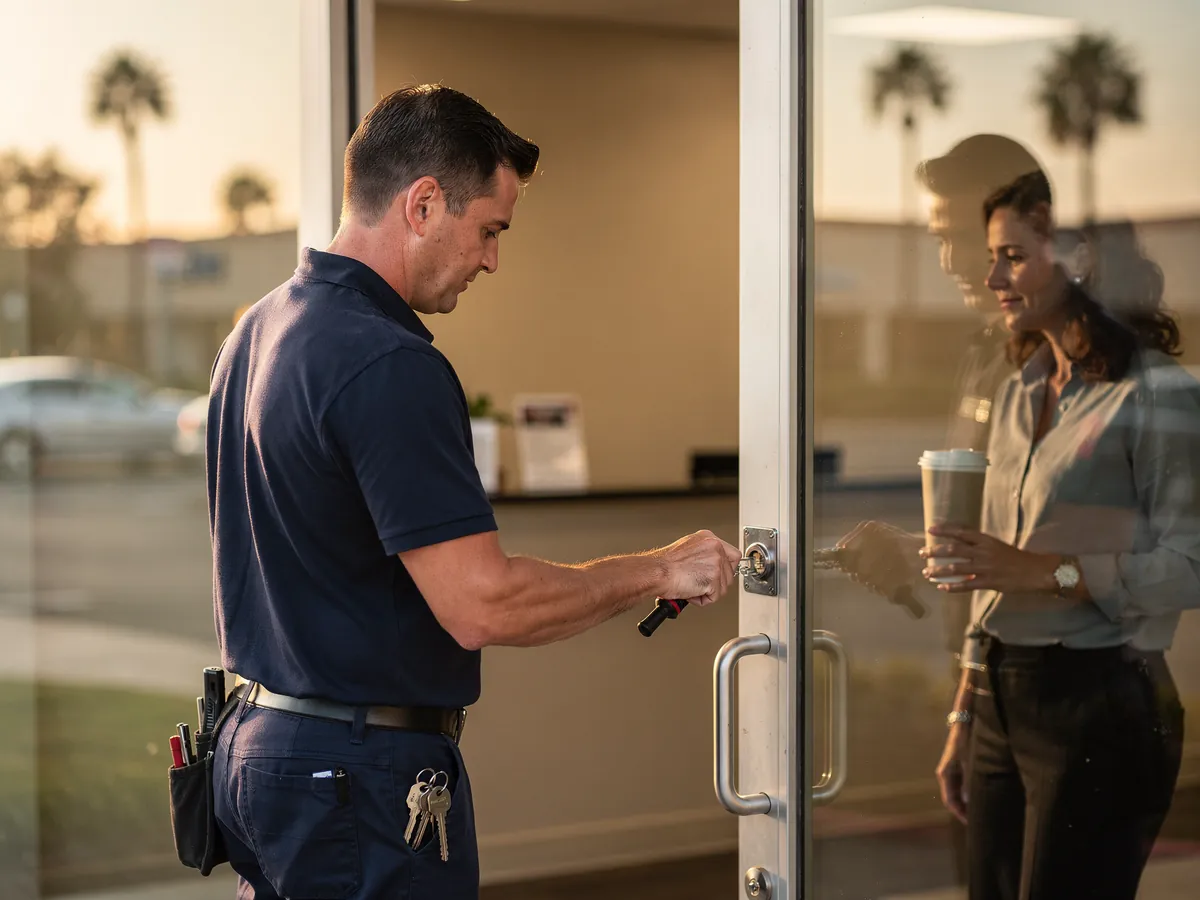
Business hours and locksmith hours rarely match, so here is ours in plain terms. Julian's Locksmith works every day from 6:30 a.m. to 11:30 p.m. We're closed overnight, and we aren't a 24/7 service. For a Downey business that opens at 7 a.m. on a weekday, a 6:30 a.m. call can work. For a shop that opens before 6:30 a.m. or closes after 11:30 p.m., a lock problem needs attention during our hours, because we won't be reachable overnight. Early calls leave us the most room to plan around your morning. Call (951) 903-3193 and we'll tell you honestly what fits your schedule.
What to know first in Downey
Commercial doors are built differently from house doors, and so are the ways in. Aluminum storefront doors usually hide a narrow-stile deadlock or a hookbolt; we open these by picking the cylinder, passing a bypass tool through the gap or working the thumbturn side. Hollow metal back doors often carry a Grade 1 cylindrical lock or a mortise lock that responds to picking or decoding. Roll-up gates and padlocks call for picking or shimming, not cutting. Electric strikes and magnetic locks need power or an override. Breaking glass is the last resort and seldom the cheapest, since a smashed storefront can mean a glazier, a board-up crew and a closed business for hours. We choose the least destructive route first, and if only one route remains, we explain it and ask for your decision before we use it. Alarm contacts and door position switches add another wrinkle, because forcing a latch or lifting a door can trip them, so we work around the sensors and tell you if one is damaged.
Work included on a typical visit
- Lost, stolen or unreturned keys. Theft changes the priority. If keys were taken along with a wallet or a bag, or a break-in may have happened, call the police first, then us. We'll rekey or replace right away, since a thief holding your key and your address doesn't need tools to walk in. If you file a report, keep the report number for your records.
- New owner, new tenant, no keys. Move-in day is the best time for key control. Once we've opened the door, we can rekey all cylinders to one new key or a small set, tag them and hand you a simple log. From day one you know who holds what, and the old keys open nothing. That small bit of paperwork pays off the first time someone asks who has access.
- Back doors, roll-up gates and padlocked entrances. Warehouse and industrial sites add forklifts, dock levelers and truck traffic to the picture. Give us a check-in point and a safe place to stage the van. Roll-up and dock doors are often chain- or motor-operated, so we check whether a manual release is part of the problem. Trucks and forklifts stay clear of the work area while we pick.
- Interior doors, cash rooms and file cabinets after you're in. File cabinets, desk drawers and cash drawers use small wafer locks that pick quickly and rekey easily. If a manager left and took the key, we can open the furniture without damaging it and cut a new key. We quote before starting, so you know the number before we touch anything.
- Rekeying, spare keys and key control afterward. Once you're in, we recommend one fix tied to the cause, not a stack of upgrades. Lost key: rekey. Worn cylinder: replace. Single key ring: cut spares. Disorganized keys: label and log them. You choose, we quote each item separately, and the door isn't left unsecured while you decide.
How Downey shapes the job
Clinics and medical offices carry confidentiality concerns on top of the lockout. A locked records room or exam suite means authorization matters, and patients may be waiting. Tell us the building and suite near Wilderness Park, and have the practice manager available. We open doors without touching records, and for anything holding patient files, we suggest a staff member watch the work. Expect us to ask for a staff escort in restricted areas.
Older downtown buildings often mix historic storefronts, upper-floor suites and shared lobbies, each with its own generation of lock. A locked-out suite may sit behind a street door the landlord controls. Give us the address, floor and the building manager's number when you call from Downey. Street parking and loading zones affect where the van can stop, so we plan for that and avoid blocking your neighbors. Historic storefronts sometimes have original hardware we'll try to save.
Warehouses and distribution yards add guard shacks, roll-up doors, dock locks and trucks that can't wait. If you're locked out of business property in an industrial park, tell the gate staff to expect us and give us the dock or unit number. We open man doors, padlocked roll-ups and gates, and rekey after a lost key. Forklift traffic means we'll ask where it's safe to set up.
Common situations
- Say it's 6:45 on a Monday morning and a bakery owner is standing outside with a produce delivery waiting. The keys are at home on the kitchen counter, and the opener's phone goes straight to voicemail. Our day starts at 6:30 a.m., so this is a call we can take. We'd ask for the address near Florence Avenue, check ID against the business license, open the door and quote any spare keys while the driver unloads.
- An accountant in a multi-tenant office building near Oldest McDonald's at Florence Avenue and Lakewood Boulevard finds her suite key no longer turns during tax season. The building manager's master key opens the door, which points to a worn cylinder. We'd confirm her lease and ID, replace or rebuild the cylinder, cut keys, and test the master key so the building's system still works with the new lock.
- Two business partners disagree, and one of them changed the lock over the weekend. The other calls us from the sidewalk, sure she has every right to be inside. We'd explain that we need the operating agreement or the lease, and the authorization of the person with legal right. We'd stay polite, stay out of the argument, and leave the door as it is until that's settled.
- A restaurant's back-door keypad dies on a hot afternoon, the battery drained, and the cooks are waiting outside with a food delivery. The keyed override sits behind a small cap that nobody remembers. We'd talk them through finding it, head over if that fails, open the door, replace the batteries and reset the code so anything shared with former line cooks stops working.
How the visit works
- Name the cause of the lockout. Call (951) 903-3193 and tell us why you can't get in: keys inside, keys lost, key won't turn, keypad dead, or someone changed the lock. The cause sets the tools and the quote. Add the door type, such as aluminum storefront, hollow metal back door or roll-up gate, and the lock brand if you can read it.
- Try the free routes first. Check the other doors, but only to see whether they're unlocked. Walk the rear and side entries, look for a loading door that wasn't secured, and ask neighboring tenants whether they saw anyone close up. Don't climb, pry or break anything. If a door you didn't expect is open, mention it, because it might mean someone entered.
- Authorize the entry. If the owner isn't answering, check the lease. It often names a landlord contact who can verify tenancy. Franchise units may route authorization through the franchisor. We understand the delay is painful, and we move the moment the right person confirms, but we won't open a business on a hunch.
- Choose the route and protect the building. Before touching the lock, we look at the door, frame, glass and any alarm contacts. Then we choose the least destructive route: picking the cylinder, bypassing the latch, working a thumbturn or opening a different door. Doors with alarm contacts, magnetic locks or closers need extra care so nothing is damaged on the way.
- Open, test and make the door usable. A door that got you into trouble once may do it again unless something changes. We look for the cause: a worn cylinder, a loose strike, a dying battery, a bad power supply or a latch dragging on a frame that has settled. We tell you what we found and quote only what the cause calls for.
- Close the loop on keys and codes. A final walk-through covers every door that uses the same key or code. We test each one and show you where problems are likely to appear next, such as a stiff cylinder or a door that rubs. Then you get the work order, which records who authorized entry, what we did and what we recommend.
How we quote the job
- Why you're locked out. Keys left inside is the simplest reason, because it needs entry only. Lost or unreturned keys add rekeying. A worn or broken lock adds repair or replacement. A failed keypad or reader adds diagnosis and programming. We ask for the cause on the first call and requote if what we find at the door is different.
- Door type, lock grade and number of locks. Hardware grade matters for both effort and follow-up. Higher-grade commercial locks are tougher to pick and, once opened, tougher to replace on the spot. Medeco and Mul-T-Lock cylinders may need the manufacturer's key card for a copy. We tell you what your hardware means for time and parts.
- Rekeying, spares, credentials and follow-up. Rekeying a single door is a small job; rekeying every door in a multi-tenant suite or a warehouse with a dozen entries is larger, and a master key system larger still. We price per cylinder where possible so you can phase the work, starting with the doors that matter most.
Every job gets a clear quote before any work starts. Call (951) 903-3193 with the details and we'll tell you what to expect for your situation in Downey.
Advice before you book
- Rekey the same day a key is lost or an employee leaves without returning theirs. Treat an unreturned key as an open door, even if you trust the person. It's business hygiene, not an accusation, and good employees understand. Waiting turns a small, planned job into a doubt that hangs over every closing.
- Store authorization papers on your phone: a lease page showing your suite, a business license, a utility bill and a letter from the owner naming authorized staff. When a locksmith asks for proof, you can show it from the sidewalk instead of waiting for someone to bring documents from the office.
- Write a keyholder list this week: names, roles and mobile numbers for everyone who can open the business, plus the property manager's after-hours line. Keep one copy in your phone and one with a second manager. When a lockout hits, that list is the first thing you reach for, and it's often the fastest fix.
- Give your vendors a second contact. If a delivery driver finds nobody at the door, a backup number can save the delivery window. A quick message from your phone saying you're running late and a locksmith is on the way often keeps a driver from leaving with your order.
Common errors that cost time and money
- Overstating your authority. Telling a locksmith you're the owner when you're an employee may save a minute, but it undermines everyone. An honest answer gets a quick phone check with the real owner. A locksmith who opens doors for any claim is one you shouldn't want near your business. We verify before we open for exactly this reason.
- Opening the door without calling the alarm company. A door that opens with the system armed triggers the siren and often a dispatch. False alarms can mean fines in many cities and a long, awkward wait for a patrol. A short call first prevents the whole mess. Tell the monitoring center who you are and when to expect the entry.
- Choosing a locksmith by price alone. A teaser quote that grows once the van arrives is a familiar pattern with commercial locks. Ask for the license number, the company name and the total, including drilling and parts. Ours is LCO7891, and you can verify it at search.dca.ca.gov. A clear total up front is the mark of a careful company.
Service in Downey
Downey is about 59 miles from our San Bernardino base, roughly 66 minutes in light traffic via I-215 South to I-10 West through Rialto, Fontana, Ontario, Pomona and West Covina. When you call, you get an arrival estimate based on where the technician is and the traffic at that moment.
Commercial jobs on busy stretches like I-710 sometimes need a parking plan, especially for storefront doors or roll-up gates. Let us know about loading zones, red curbs or parking structures before we arrive.
About Downey: Downey incorporated on December 17, 1956, as the 50th city in Los Angeles County, and city records describe its roughly 90,000 residents as the largest population ever to incorporate in the United States.
| Neighborhoods | South Downey, Downtown Downey, North Downey, Furman Park and Rives Avenue, Columbia Way and the former Rockwell plant site, Civic Center on Brookshire Avenue |
|---|---|
| ZIP codes | 90240, 90241, 90242 |
| Main routes | I-5, I-105, I-605, I-710 |
| From our San Bernardino base | about 59 miles via I-215 South to I-10 West through Rialto, Fontana, Ontario, Pomona and West Covina (or SR-210 West) to I-605 South, then the Florence Avenue, Firestone Boulevard or Imperial Highway exit depending on the address; Firestone Boulevard reaches Stonewood Center and Downtown Downey, Imperial Highway reaches Kaiser Permanente, Rancho Los Amigos and the south end, and Florence Avenue reaches the Lakewood Boulevard corner |
Planning a non-urgent job like a rekey, a smart lock install or a safe combination change? Every day of the week, appointments are available from first thing in the morning into the late evening, with 11:30 p.m. as closing time. Fridays and Saturdays follow the same schedule.
We won't open a door for someone who can't show they live or work there, however convincing the story. That includes a person who has moved out, a former partner, or anyone caught up in an eviction dispute. The rule protects you the same way it protects every other household we serve: no proof, no entry.
Locked out in Downey?
Call (951) 903-3193 with the address and what's locked. You'll get an arrival estimate and a quote before anyone heads out, and when we arrive we'll ask for ID that ties you to the property. If a child or pet is shut inside a hot car or building, call 911 first.
Frequently asked questions
A former employee still has a key. Should I rekey?
Usually yes. Rekeying changes the pins so the old key stops working, and it's less work than replacing hardware. Include every cylinder that key opened, not only the front door. If you have a restricted keyway, copies need your authorization, which helps. We can cut new keys and write down who holds each one.
I'm an employee and the owner isn't answering. What now?
Try the owner's other numbers, a manager, the bookkeeper or the property manager listed in the lease. Many businesses keep an emergency contact on file. If an authorized person confirms by phone, we can proceed, with your ID checked at the door. We understand the pressure to open, but we won't open a business on an employee's word alone.
What should I do first if I'm locked out of my business?
Work out the cause, then use the free routes: call every keyholder, the property manager and your alarm company. Don't break glass or pry the door. If none of that works, call Julian's Locksmith at (951) 903-3193 with the door type, the lock brand if you can see it, and what happened. We'll quote and give you an honest ETA for Downey.
Do you have to drill the lock?
Not usually. Most commercial doors open by picking, decoding or bypassing the latch. Drilling comes up when a cylinder is damaged, hardened or already tampered with. We try non-destructive entry first, explain why if drilling is the next step, and replace the cylinder if you approve. Nothing gets drilled without your say-so. Drilling is the exception, not the routine.
The keypad on my door won't take the code. Can you get me in?
Usually. Fresh batteries fix many keypads, so try them first. If that fails, most commercial keypad locks also have a keyed override cylinder, and we can open through it or pick it. Then we test the lock, reset the master code and reprogram user codes. Networked access control may need the system vendor as well.
Can you open a multi-tenant building or a shopping center suite?
Yes, with the right authorization. For a suite, we need you to show that you lease or operate it. For shared doors such as lobbies or service corridors, the building manager must approve. Tell us the suite number, the building and who manages the property, and we'll plan the visit. We try not to disturb neighboring tenants.
How far is Downey from your base?
Downey is about 59 miles from our San Bernardino base, roughly 66 minutes in light traffic. Arrival time depends on traffic and on the job the technician is finishing, so we give you an estimate on the phone before you commit.
Related services in Downey
- Business Lockout in Downey
- Office Lockout in Downey
- Storefront Lockout in Downey
- Commercial Building Lockout in Downey
- Business Lock Rekey in Downey
- Commercial Lock Repair in Downey
- Business Locksmith in Downey
- Locksmith for Retail Store in Downey
- Locksmith for Office Building in Downey
- Commercial Lock Rekey in Downey
Locked Out of Business in nearby cities
- Locked Out of Business in BellflowerLos Angeles County
- Locked Out of Business in NorwalkLos Angeles County
- Locked Out of Business in Santa Fe SpringsLos Angeles County
- Locked Out of Business in Pico RiveraLos Angeles County
- Locked Out of Business in ArtesiaLos Angeles County
- Locked Out of Business in CerritosLos Angeles County
- Locked Out of Business in LakewoodLos Angeles County
- Locked Out of Business in WhittierLos Angeles County


