
Diamond Bar, Los Angeles County
Door Latch Repair in Diamond Bar: Find the Real Problem
Short answer: Try this first: close the door slowly and watch whether the latch tongue lines up with the opening in the strike plate. If it lands high or low by more than a sixteenth of an inch, that's alignment, not a broken latch. If the tongue sticks inside the door or the knob spins free, the mechanism has failed. We fix either one on site in Diamond Bar.
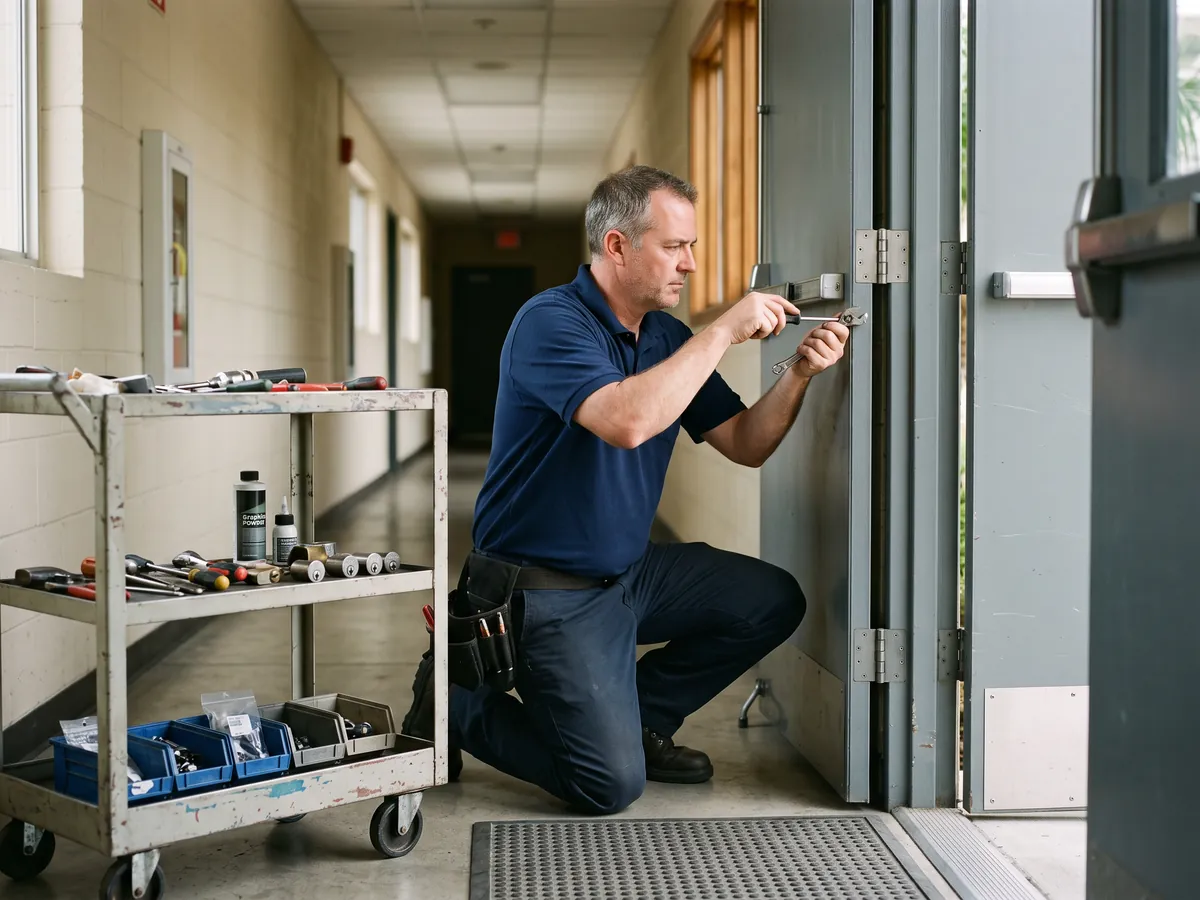
Doors are wood, and wood moves. Damp winter weather swells a door in its frame; dry spells and Santa Ana winds shrink it back. A latch that lines up perfectly in March can scrape in August, or the other way around. Stucco houses settle, hinge screws loosen, and the gap between tongue and strike shifts by a few hundredths of an inch. That's all a latch needs to miss. If your door in Diamond Bar sticks only at certain times of day or year, say so when you call (951) 903-3193. Seasonal binding points to alignment, and alignment is usually a quick fix.
How this works in Diamond Bar
The word latch covers more hardware than most people expect. Interior passage and privacy sets use a simple tubular spring latch. Entry knobs and levers add a deadlatching plunger beside the tongue. Older doors, and some nicer new ones, use a mortise latch inside a rectangular steel case. Pocket doors have a hook or a flat edge pull. French doors pair a latch with flush bolts. Patio sliders pull shut on a hook, screen doors use a surface latch, and gates have their own families of drop bars and gravity latches. Repairing a latch begins with knowing which family you have, because the parts aren't interchangeable. Tubular latches are the easiest to swap, and we usually carry what's needed. Mortise cases take more thought. Gate latches are a separate repair with their own weather and sag problems. Whatever you have in Diamond Bar, describe it or send a photo and we'll bring the right parts.
How we can help in Diamond Bar
- Sticking and gummed-up latch bolts. If you've sprayed oil into a sticking latch, it may feel better for a week and then turn to paste, because oil traps lint and grit. We flush the barrel, dry it and use a dry lubricant instead. Where the tongue still hesitates after cleaning, the latch is worn out and a new one is the honest answer.
- Knobs and levers that turn without retracting the latch. A knob that fails from one side only usually has a sheared spindle or a loose set screw on the dead side. Try both handles and tell us which one fails. That single detail often tells us whether to bring a spindle, a latch or a complete replacement handle.
- Strike plate and latch alignment. Strike alignment is a small-tolerance job. The tongue has to enter the opening without scraping, then seat in a pocket deep enough for the plate to sit flush. We enlarge or reposition the opening, chisel the pocket cleanly, and plug old screw holes with hardwood dowels before driving longer screws.
- Replacing the latch assembly. Most residential latches are interchangeable within a brand. Measure the backset, 2-3/8 or 2-3/4 inches, the bore in the door edge and the faceplate shape, either a round drive-in or a square plate. Adjustable latches cover both backsets. We carry common sizes and match your brand so the spindle, knob and key stay put.
- Freeing a door that a failed latch has jammed shut. A latch stuck in the extended position, with a handle that's limp or spinning, can leave a door that won't open from either side. We open it without cutting the door whenever possible, working the tongue through the gap or removing the hardware, and then repair the cause.
What's different about Diamond Bar
Hillside homes often have doors on sloped lots and uneven foundations. Settling shifts hinges, canyon winds blow dust into latch barrels, and fire-season smoke leaves residue. Doors that face open slopes get more weather. We chalk-test, clean barrels with dry methods and tighten the hinges that move first. Fire-safety guidance for evacuations often includes closing interior doors behind you, which only helps if the doors actually latch.
Older houses in Diamond Bar have doors that have been painted a dozen times and hung on hinges that have moved with the house. Latches there fail from paint layers in the strike, tongues filed to fit, and original knobs whose parts are no longer made. We try cleaning and realigning first, since original hardware is part of the home's character, and we replace latches inside old knobs where we can. Old mortise latches get their own care, and we'll tell you honestly when a part is simply gone.
Condo and townhome front doors often face shared corridors or HOA-controlled facades, so the exterior door, its frame and the look of its hardware may be the association's business, while interior doors are yours. Before swapping an exterior latch, check the rules on finish and brand. We can fit a matching latch inside your existing handle to avoid visible changes. Fire-rated unit doors need careful handling, and we won't drill or alter them without checking the label.
Situations this covers
- Consider a rental turnover where a painter sprayed every interior door with the knobs still on. Three latches won't retract because paint has cemented the tongue to the faceplate. We'd score the paint, free the tongues, clean the barrels and swap any that stay sticky. Doing the whole unit in one visit beats the next tenant calling about door after door.
- Home sellers hit this one: an inspection report in Diamond Bar flags four doors that don't latch, and escrow closes soon. A locksmith can often handle every interior door in one visit by realigning strikes, swapping two dead latches and tightening hinges. We'd test the entry doors with extra care. Escrow dates are your clock, so call early; we're open every day.
- A typical call: a family in a newer tract home near Willow Heights has a bedroom door that drifts open every night because the latch tongue no longer springs out fully. The knob looks fine, so they assume the whole set is dying. We'd test the spring by hand, find the tongue hesitating, and replace the latch inside the existing knob, and the door clicks shut again with the original handle and finish.
- For example, a parent in Diamond Bar hears a toddler crying behind a bathroom door whose privacy button has jammed. If the child seems hurt or panicked, 911 comes first. Otherwise, keep the child talking, try the emergency hole with a small screwdriver, and call us at (951) 903-3193 if it fails. We'd open the door from the hall side and replace the broken mechanism.
How the visit works
- Tell us what the door is doing. Call (951) 903-3193 and tell us what you see and hear. Does the door stay shut? Does the knob feel springy or loose? Is the tongue stuck out? Which side fails? Two or three details narrow the field, and a phone photo of the door edge and the knob helps us bring the right latch.
- Confirm who we're working for. We ask whoever is at the door to show ID matching the property, or we confirm authorization from the owner or manager. For rentals, the manager's approval or a work order covers it. It's quick, and it protects the occupant as much as the owner.
- Test the door open and closed. We work the handle with the door open to see whether the tongue extends fully and retracts crisply. Then we close the door slowly, checking tongue and strike alignment, hinge play and gaps. Chalk on the tongue shows where it lands. After a few minutes we usually know which part is at fault.
- Quote the repair and the alternative. You'll hear what we found and usually two options: clean and adjust, or replace the latch. We give you the price for each before starting. A twenty-year-old knob that is rough in other ways may deserve a new lockset, and we'll say so, but you decide.
- Repair, adjust or replace the latch. We remove the knob or lever, pull the old latch and fit the new one with the right backset and faceplate. If alignment is the issue, we reset hinges and reposition the strike. We clean up after ourselves, fill old screw holes and finish the work so it looks tidy.
- Test everything and hand off. Before leaving we ask you to try the door yourself, because your hand knows it better than ours does. We note what we replaced and the brand of the new part, so you or the next locksmith can find a match later. A short care list covers what to lubricate and what to avoid.
What affects the cost
- Tune-up versus new latch. A worn latch will often work for a while after cleaning, then stop again. We say so when a quick fix is only a delay, so you can weigh the short-term cost against the lasting one, and decide whether the door is worth a fresh latch now.
- How many doors need attention. Property managers with several units, or homeowners doing a pre-sale tune-up, can save money by grouping the work. Latches of the same brand speed things up. Give us a list of doors and symptoms when you call, and we will quote the whole batch together.
- Timing, travel and access. We drive to you from San Bernardino, so distance across Los Angeles County plays a part, as does the time of your call within our hours, 6:30 a.m. to 11:30 p.m. every day. We build the drive into the quote, so there's no separate surprise at the door.
Every job gets a clear quote before any work starts. Call (951) 903-3193 with the details and we'll tell you what to expect for your situation in Diamond Bar.
Common errors that cost time and money
- Buying the cheapest universal latch without checking the backset. If the spindle sits a quarter inch off or the tail is the wrong shape, the handle droops or binds. Match the brand, the backset and the faceplate, or let us bring the correct part.
- Overtightening the knob or lever screws. Squeezing the two halves together can pinch the latch and spindle, so the handle feels stiff and the tongue drags. Snug is enough; if loosening the screws frees the latch, the lockset is misaligned or worn.
- Spraying a penetrating oil or general-purpose lubricant into the latch. It frees the tongue for a short while, then collects dust and lint and hardens into a sticky film. A dry PTFE or graphite lubricant lasts longer and doesn't turn the barrel into paste.
Advice before you book
- Rub chalk, lipstick or a soft pencil on the latch tongue, close the door and open it again. The mark on the strike shows where the latch lands. If it's high or low by more than a sixteenth of an inch, you're looking at alignment, not a broken latch.
- Spring and fall are good times for a door tune-up in Diamond Bar. Temperature and humidity swings move wood the most, so a visit then catches loose hinges and early swelling before they become a stuck door in the middle of a heat wave.
- Remove the knob and latch before painting a door edge, or at least tape the faceplate. Paint on the tongue and in the strike pocket is the top reason a latch sticks after a DIY repaint or a quick turnover. Fifteen minutes of masking saves a service call in Diamond Bar.
- Pay attention to when a door sticks. If it catches fine in the morning and binds after a hot afternoon, wood movement is involved, and the cure is alignment rather than a new latch. Telling your locksmith the pattern changes what we bring and what we try first.
Getting to Diamond Bar
Diamond Bar is about 43 miles from our San Bernardino base, roughly 46 minutes in light traffic via I-215 South briefly to SR-210 West. When you call, you get an arrival estimate based on where the technician is and the traffic at that moment.
Rush hour on Chino Hills Parkway can stretch a drive considerably. We'd rather give you a realistic arrival window than an optimistic one, and we'll call you if a closure or a crash changes the plan.
About Diamond Bar: Diamond Bar takes its name from the diamond-over-a-bar cattle brand that ranch owner Frederic E. Lewis registered with the state in 1918.
| Neighborhoods | Vantage Drive, Golden Springs Drive corridor, Brea Canyon Road corridor, South Pointe, Pathfinder Road tracts, North Diamond Bar |
|---|---|
| ZIP codes | 91765, 91789 |
| Main routes | SR-57, SR-60, Diamond Bar Boulevard, Grand Avenue |
| From our San Bernardino base | about 43 miles via I-215 South briefly to SR-210 West (Foothill Freeway) through Rancho Cucamonga, Upland and La Verne, then SR-57 South (Orange Freeway) through Pomona to the Grand Avenue, Diamond Bar Boulevard or Pathfinder Road exits; alternate via I-10 West to SR-57 South at the Kellogg interchange, continuing on SR-60 West to Brea Canyon Road or Lemon Avenue for the west side |
Lock or door hardware trouble in Diamond Bar?
Call (951) 903-3193 with the address and what the door or lock is doing. We'll quote the repair before any work starts.
Frequently asked questions
Could a thief slip my latch open with a card?
A plain spring latch can often be pushed back from the gap, which is why locked doors rely on deadbolts. Entry-door latches include a deadlatching plunger meant to stop this once the door is closed and properly aligned. We check that on every entry door, but the deadbolt is the lock you should rely on. A reinforced strike with long screws helps too.
Why does my door latch fine in the morning and stick in the afternoon?
Wood swells and shrinks with temperature and humidity, and a house shifts slightly as the day warms. A door that's snug in its frame can start to bind by late afternoon, especially on sun-facing walls, and a loose hinge makes it worse. The fix is alignment: tighten hinges, adjust the strike, sometimes ease the door edge. A new latch rarely helps.
The knob turns but the latch doesn't move. What broke?
Usually one of three small parts: the retractor tab on the latch, the spindle that connects the two handles, or a loose set screw holding a lever to the spindle. Test both sides. If only one side fails, suspect the spindle or set screw. We take the handle off, find the failed part and replace it, often without replacing the whole set.
Can you fix a latch that's stuck out and won't retract?
Yes. A tongue stuck out of the door edge is usually jammed with paint or grime, or its retractor is broken. If the door is closed, we release it by working the tongue through the gap or removing the hardware, without cutting the door. Then we clean or replace the latch. If someone is trapped and in distress, call 911 first.
How do I know which replacement latch fits my door?
Measure the backset, the distance from the door's edge to the center of the large hole in the face: usually 2-3/8 or 2-3/4 inches. Check the faceplate shape, round or square, and note the knob brand. Adjustable latches cover both backsets. A photo of the latch removed from the door edge, beside a ruler, tells us nearly everything.
Will my keys still work after you replace the latch?
Yes. On a knob or lever set with a key cylinder, the latch and the cylinder are separate parts, so replacing the latch doesn't affect the key. The cylinder stays in the handle. Your deadbolt is also separate. If a key sticks as well, we can check the cylinder during the same visit and quote any additional work before touching it.
How far is Diamond Bar from your base?
Diamond Bar is about 43 miles from our San Bernardino base, roughly 46 minutes in light traffic. Arrival time depends on traffic and on the job the technician is finishing, so we give you an estimate on the phone before you commit.
Related services in Diamond Bar
- Door Hardware Repair in Diamond Bar
- Residential Lock Repair in Diamond Bar
- Door Lock Repair in Diamond Bar
- Deadbolt Repair in Diamond Bar
- Jammed Door Lock in Diamond Bar
- Loose Door Lock in Diamond Bar
- Lock Not Turning in Diamond Bar
- Mortise Lock Repair in Diamond Bar
- Gate Latch Repair in Diamond Bar
- Commercial Door Won't Latch in Diamond Bar
Latch Repair in nearby cities
- Latch Repair in Chino HillsSan Bernardino County
- Latch Repair in WalnutLos Angeles County
- Latch Repair in Rowland HeightsLos Angeles County
- Latch Repair in PomonaLos Angeles County
- Latch Repair in BreaOrange County
- Latch Repair in ValindaLos Angeles County
- Latch Repair in West CovinaLos Angeles County
- Latch Repair in City of IndustryLos Angeles County
