
Devore, San Bernardino County
Storefront Lockout Help for Devore Shops, Salons and Restaurants
Short answer: Two things get a locked shop in Devore open: proof that you're allowed in and the right entry method for the hardware. Have photo ID plus a lease, business license or a call from the owner ready. Price depends on the lock's security level, whether a cylinder must be drilled and replaced, how many locks stand between you and the counter, and when you call.
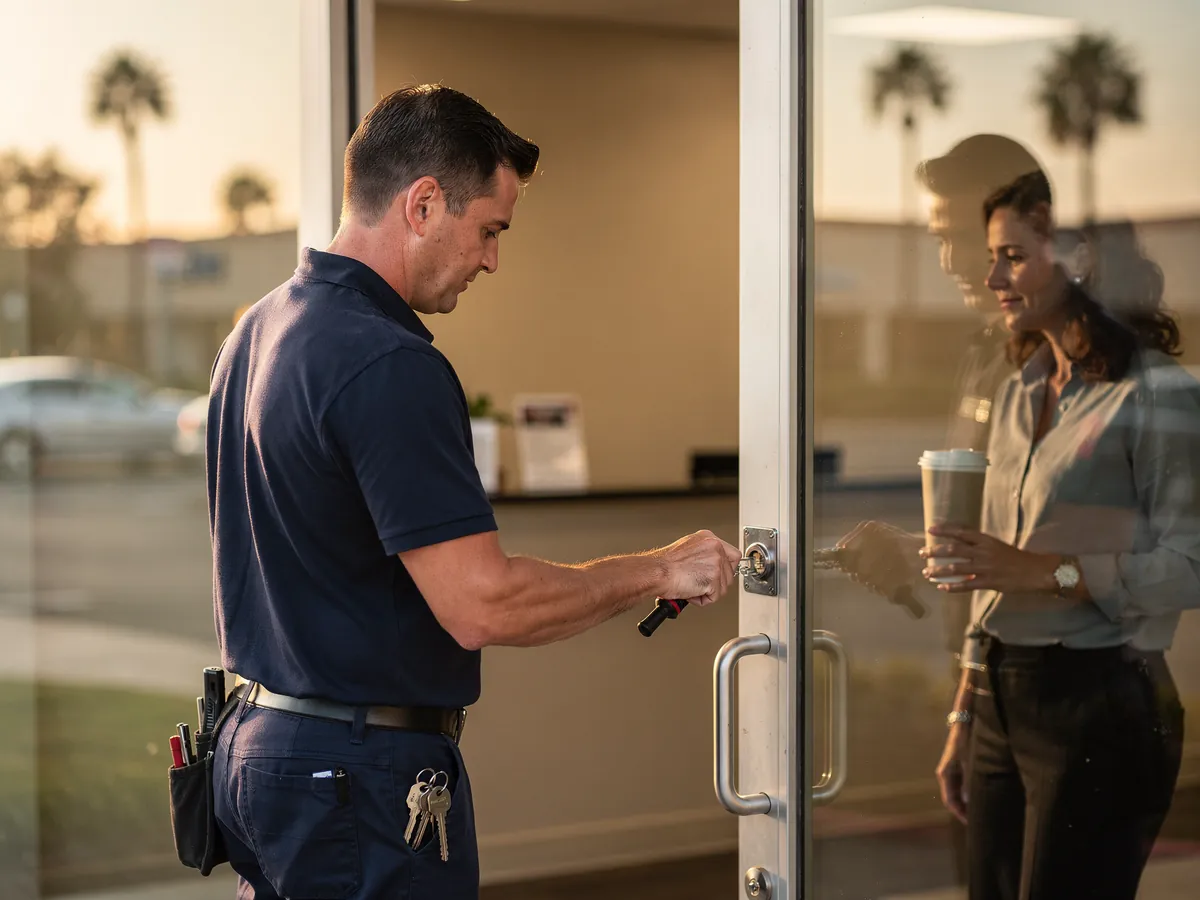
Not every storefront lockout involves a lost key. Plenty of shop owners in Devore have the right key in hand, slide it in, turn it, and feel nothing happen. The plug spins but the hookbolt stays put, or the key won't turn at all because years of dust, heat and daily slamming have worn the pins. Either way the door is locked and you're on the wrong side of it. Julian's Locksmith sorts out which problem you have on site: a slipped cam or a cylinder that has backed out of its threads behaves very differently from a seized lock. Call (951) 903-3193 and describe exactly what the key does, because that detail shapes the quote.
How this works in Devore
The temptation during a storefront lockout is to find the fastest way in, and the fastest way is usually the most expensive. Glass in a shop door has to be safety glazing, and it's almost always tempered, which doesn't crack in a tidy line. It collapses into pebbles. That means a board-up, a glazier's visit and a day or two with plywood where your display used to be. Prying isn't much better. Aluminum stiles are thin-walled extrusions, and forcing a bar between door and frame bends the lock stile, the strike, or both, so the door may not lock properly again until it's repaired. Then there's the alarm. Many shops have contacts on the door and glass-break sensors, and forced entry looks exactly like a burglary to the monitoring center. Calling your alarm company before anyone touches the door, with your passcode ready, avoids a pointless police response. Professional entry in Devore is quieter, less dramatic to watch and far cheaper to recover from, because the worst realistic outcome is a new cylinder rather than a new door.
What we can do on-site
- Picking the storefront cylinder. Picking is less dramatic to watch than a crowbar but far cheaper to live with. We work the cylinder face with a tension wrench and pick, read how each pin responds, and adjust for worn or dirty locks. When the plug finally rotates, the door opens with its finish, glass and hardware exactly as they were.
- Rear service door entry. Before we go to work on an expensive high-security front cylinder, we walk around back. A rear door with a standard keyway, a padlocked hasp or a keypad you know the code to can be the cheaper path. Once inside, you can release the front hookbolt with the thumbturn, provided the front lock has one.
- Keypad and electronic shop locks. Some keypad locks have contacts on the outside for a 9-volt battery that briefly powers the lock so you can enter your code. We check whether yours does before anything else. Otherwise we open the key override, swap the batteries and suggest a replacement schedule so the lock doesn't quietly fade out again.
- Cam, hookbolt and lock body repair. A hookbolt that retracts only halfway or drags on the strike is a lockout waiting to repeat. Once the shop is open we check bolt throw, strike alignment and the way the door hangs. Small fixes such as moving the strike, cleaning the lock body or replacing a cracked cam head off the next call.
- Securing a door after a forced attempt. Sometimes the lockout happens because someone tried to break in overnight and mangled the cylinder or bent the stile. We open the door, assess what still works, and install a replacement cylinder or temporary lock so the shop can be secured that night. Take photos first, since police and your insurer may want them.
What's different about Devore
In neighborhoods built before 1980, the corner storefronts often carry decades of hardware layered together: a newer cylinder in an old lock body, a second deadbolt added later, a mail slot sealed shut. Original mechanisms can be worn enough that even a picked cylinder needs extra care. When we open an older storefront in Devore, we also tell you honestly whether that vintage hardware is worth keeping or is quietly reaching the end of its life.
Feed stores, farm supply shops and small-town hardware stores often sit far from the owner's home. If the only key is back at the house, that drive can take longer than a locksmith's trip. In Devore, we'd open the storefront and, if you'd like, add a keypad or a mounted key lockbox at the back door, so a long drive home isn't the only answer the next time a key goes missing.
Inland summers are hard on storefront hardware. Aluminum doors facing the afternoon sun expand enough to make a hookbolt bind against its strike, keypad electronics bake behind dark covers, and padlocks on roll-down grilles get too hot to hold. In Devore, a lockout on a scorching afternoon is sometimes really a door that has swelled out of alignment. We open it, then check the strike and the door's hang so the bolt moves freely once the evening cools.
Example situations
- Suppose the owner of a phone repair shop is out of state and her manager arrives to find his key no longer turns. He has photo ID but isn't on the lease. We'd call the owner, have her confirm by phone and text a photo of the business license, then open the door. If his key proves to be a worn copy of a copy, fresh keys cut by code fix the real problem.
- A typical early call: a coffee shop opener reaches the front door just before 6:30 a.m., turns her key, and the bow snaps off in her fingers. The blade stays buried in the cylinder while the espresso machine warms up on its timer inside. We'd confirm the owner's approval by phone, draw the broken blade out with an extractor, open the plug with a pick, and cut a replacement key by code before the line forms.
- During tax season, a preparer at a storefront office arrives to find the keypad on her front door dark. The batteries quit overnight, and the override key sits in a desk drawer inside. Appointments start at eight. We'd pick the override cylinder, change the batteries while she watches, reprogram her codes, and talk through keeping that override key with the owner rather than behind the very door it opens.
- Picture a family restaurant near San Bernardino National Forest where the night manager took the padlock keys home by mistake and now lives a long drive away. The front door key works, but the roll-down grille in front of the glass is padlocked at both ends of the bottom rail. We'd pick both padlocks, confirm they still lock cleanly, and suggest a third padlock key kept with the owner.
How the visit works
- Call with the details. Call (951) 903-3193 with the business name, the address and what's locked: the glass door, a gate padlock, the back door or all three. If you can see the face of the cylinder, read us any brand stamped on it. That tells us whether to expect an ordinary keyway or a high-security one.
- Authorization at the door. We won't open a storefront for someone who can't connect themselves to the business, and we won't open a lock the landlord changed on purpose. That can feel strict on the sidewalk, but it's the same rule that keeps a stranger from talking a locksmith into your shop.
- Alarm call and door inspection. A quick inspection saves time. We look for a rear entrance with an easier lock, signs of tampering, a cylinder that spins in the door, or a stile bent by an earlier pry attempt. What we find decides whether picking, extraction or another route makes the most sense.
- Non-destructive entry. We pick, extract or bypass, depending on what the inspection found. A cylinder spinning in its housing can be held with a grip tool so the plug drives the cam. A dead keypad gets its override picked. Each technique leaves the lock usable once you're inside.
- Approved fallback: drill and replace. Drilling takes a mortise cylinder out of service permanently, so we have a replacement in hand before starting. We choose the drill point carefully to spare the lock body, then turn the cam with a tool to swing the hook clear and get you inside.
- Test, secure and plan ahead. Once you're inside, we finish properly: tighten the cylinder set screw, test any gate padlocks and the rear door, and cut spare keys if you want them. You get an itemized receipt showing the entry method, parts used and who authorized the work.
How we quote the job
- Time of the call. Our hours run 6:30 a.m. to 11:30 p.m. every day, Sunday through Saturday. Early-morning and late-evening openings can carry a different rate than midday work, and we tell you before dispatch. We are closed between 11:30 p.m. and 6:30 a.m., so we can't take work in that window.
- Entry method. The cheapest storefront lockout is one solved without parts: a picked cylinder or a shimmed padlock. Costs climb when a lock has to be destroyed and replaced. That's why we try non-destructive methods first and explain any switch to drilling, with the new total, before it happens.
- Distance and site access. Julian's Locksmith is a mobile service based in San Bernardino, so drive distance to your shop in Devore figures into the quote. A storefront in a crowded center with tight parking is fine, but tell us where to pull in so we don't lose time circling the lot.
Every job gets a clear quote before any work starts. Call (951) 903-3193 with the details and we'll tell you what to expect for your situation in Devore.
Practical tips before you call
- Teach your openers to describe the problem precisely: key won't enter, won't turn, turns freely, or snapped. Saying which one is happening when you call helps the locksmith load the right tools and give an accurate quote, which shortens the time your doors stay shut.
- Keep a photo of your business license and the first page of your lease on your phone. When a locksmith asks for proof that you run the business, that photo plus a driver's license usually settles it in moments, even if the paper copies are hanging on the wall inside.
- Because Julian's Locksmith is closed between 11:30 p.m. and 6:30 a.m., shops with early or late hours need their own backup. Make sure the opener has a working key, a second keyholder is reachable by phone, and the rear entrance has its key on a separate ring. A quick test during our open hours catches surprises while help is still available.
- Give a second key to someone who lives near the shop and doesn't commute with you. Co-owners who carpool, or two managers who always arrive together, tend to lose access at the same moment. Distance and separate routines are what make a spare useful during a storefront lockout.
Mistakes to avoid
- Prying the door at the lock stile. Thin aluminum extrusions bend easily, and a hookbolt that has grabbed its strike won't let go because you pulled harder. You end up with a bent stile, a damaged strike and a door that won't lock properly once it finally opens.
- Hiring the first ad that promises a rock-bottom price without checking the license. Some lead-generation outfits quote low on the phone and raise it at the door. Ask for the California locksmith license number, look it up at search.dca.ca.gov, and get the price before work starts.
- Getting back inside and leaving the cause unfixed. If a key snapped, the cylinder is probably worn. If the key spun, the cam or set screw slipped. If a ring was lost, someone may have your key. Skipping the follow-up usually means a second lockout, often at a worse moment.
Service in Devore
Devore is about 8 miles from our San Bernardino base, roughly 14 minutes in light traffic via Kendall Drive or Palm Avenue to I-215 North, through the Devore junction onto I-15 North, exit Kenwood Avenue for Devore Heights. When you call, you get an arrival estimate based on where the technician is and the traffic at that moment.
Rush hour on I-215 can stretch a drive considerably. We'd rather give you a realistic arrival window than an optimistic one, and we'll call you if a closure or a crash changes the plan.
About Devore: The community sits at an elevation of roughly 2,510 feet, just outside the boundary of the San Bernardino National Forest.
| Neighborhoods | Verdemont, Keenbrook, Devore Heights, Glen Helen, Cajon Boulevard corridor, Kenwood Avenue corridor |
|---|---|
| ZIP codes | 92407 |
| Main routes | I-15, I-215, Cajon Boulevard, Kenwood Avenue |
| From our San Bernardino base | about 8 miles via Kendall Drive or Palm Avenue to I-215 North, through the Devore junction onto I-15 North, exit Kenwood Avenue for Devore Heights; Devore Road exit for Glen Helen and lower Cajon Boulevard |
Friday is a full day for us. We begin at 6:30 a.m. and close at 11:30 p.m., the same as every other day, Saturday included. If a lock fails after 11:30 p.m., call us when we reopen at 6:30 a.m., and in the meantime fall back on a neighbor's spare key, a night with family, or a door you can secure from inside.
California's Locksmith Act requires a signed work order when a locksmith opens a residence or commercial property, recording the requester's name, address, phone number, date of birth and ID number. Business and Professions Code §6980.55 has us keep those records for two years, available to BSIS and peace officers on request.
Locked out in Devore?
Call (951) 903-3193 with the address and what's locked. You'll get an arrival estimate and a quote before anyone heads out, and when we arrive we'll ask for ID that ties you to the property. If a child or pet is shut inside a hot car or building, call 911 first.
Frequently asked questions
Can you open a high-security lock like Medeco or Mul-T-Lock?
Those cylinders are built to resist picking, so we don't promise a quick pick. First we look for another way in, such as a rear door or a roll-up door with a standard lock. If the high-security cylinder is the only option, drilling and replacing it may be necessary. Replacements for some patented systems come through authorized dealers, so a temporary cylinder may bridge the gap.
Can you open the padlocks on my roll-down security gate?
Yes. Most shutter and grille padlocks can be picked or bypassed, and we cut them only with your permission. Shrouded and hardened padlocks resist bolt cutters anyway, so picking is often the better route. If you want new padlocks, we can supply weather-resistant models and, where the keyway allows, key them to your door so your opener carries one key instead of three.
What do I need to show before you open my shop?
Photo ID plus something connecting you to the business: a lease, business license, seller's permit, or a utility or phone bill in the company's name. A photo of those documents on your phone is fine. If everything is locked inside, we verify the moment the door opens, with you present. We keep a record of who authorized each commercial opening.
My key turns but the door won't open. Is that a lockout?
It's one of the most common storefront problems. If the key turns freely, the cam on the back of the cylinder may be worn, broken or no longer reaching the bolt, or the whole cylinder may be spinning in the lock body because its set screw let go. If the key won't turn at all, the pins may be worn or jammed. Describe which it is when you call.
Will you have to drill my lock?
Usually not. Most storefront cylinders use common keyways that can be picked, and broken keys can usually be extracted. Drilling is reserved for patented high-security cylinders, keyways filled with glue or debris, and cylinders that have been damaged. If it comes to that, we explain why, quote the drilling and a replacement cylinder, and wait for your approval before starting.
Can you get in through my back door instead?
Often, if it has an outside cylinder. Many rear service doors carry a standard rim or mortise cylinder that's easier to open than a high-security front lock. Once you're inside, the front hookbolt releases with the inside thumbturn or key. If the back door is exit-only with no outside hardware, it can't be used for entry, and we work on the front instead.
How far is Devore from your base?
Devore is about 8 miles from our San Bernardino base, roughly 14 minutes in light traffic. Arrival time depends on traffic and on the job the technician is finishing, so we give you an estimate on the phone before you commit.
Related services in Devore
- Business Lockout in Devore
- Locked Out of Business in Devore
- Commercial Building Lockout in Devore
- Office Lockout in Devore
- Storefront Lock Repair in Devore
- Storefront Locksmith in Devore
- Locksmith for Retail Store in Devore
- Commercial Lock Rekey in Devore
- Broken Key Extraction in Devore
- Narrow Stile Lock Repair in Devore
Storefront Lockout in nearby cities
- Storefront Lockout in Glen HelenSan Bernardino County
- Storefront Lockout in MuscoySan Bernardino County
- Storefront Lockout in North FontanaSan Bernardino County
- Storefront Lockout in RialtoSan Bernardino County
- Storefront Lockout in FontanaSan Bernardino County
- Storefront Lockout in EtiwandaSan Bernardino County
- Storefront Lockout in San BernardinoSan Bernardino County
- Storefront Lockout in BloomingtonSan Bernardino County