
Devore, San Bernardino County
Smart Lock Repair in Devore: Repair or Replace?
Short answer: Smart lock repair is a call-out, not a shop drop-off. Julian's Locksmith comes to your door in Devore, seven days a week, 6:30 a.m. to 11:30 p.m. Tell us the brand, the symptom and what you've tried. We quote repair or replacement before starting, and we check the door too, since a lot of broken locks turn out to be binding doors.
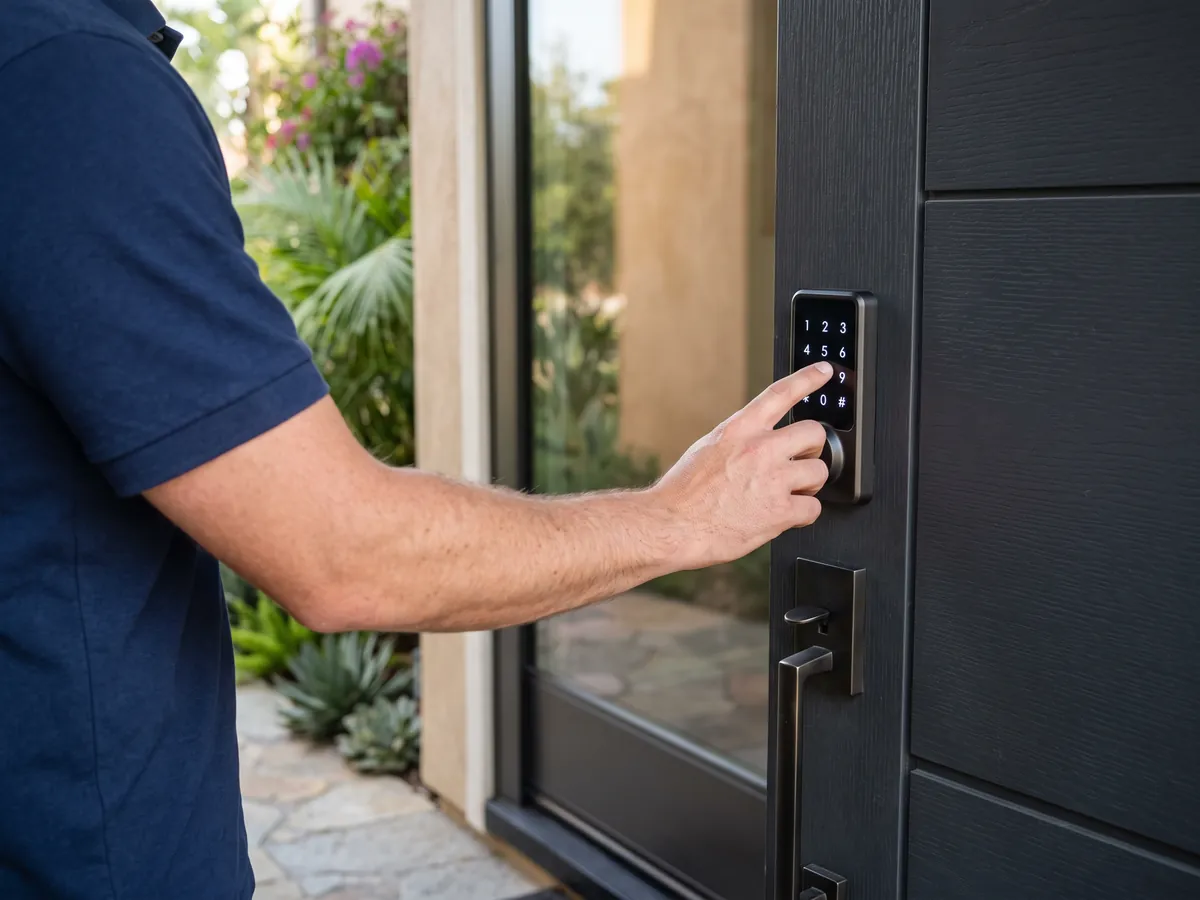
A smart lock that won't lock is more than an annoyance. It's an open invitation, and a lock that won't unlock can strand your family just as surely. Whether the bolt is stuck extended, won't extend or can't be trusted to hold, the priority is security first and the repair second. Julian's Locksmith brings your door to a secure state in Devore, even if that means a temporary fix, before moving on to proper smart lock repair. We verify ownership first, because we're working on the lock that protects your home.
How this works in Devore
The repair-or-replace decision turns on five things. Age: older models have more wear and may have lost app support. Parts: some manufacturers sell interior assemblies, keypads or hardware kits, and others sell nothing short of a whole lock. Damage type: a bent bolt, a cracked housing or water inside is worse than a loose screw. Security: a lock with a worn latch or a forced bolt may deserve a stronger replacement. Platform: if the lock depends on a cloud service the manufacturer has changed, a new model may be wiser. We lay the facts out in plain terms and let you choose. Sometimes a modest repair gets years of extra life. Sometimes it only delays the day you buy a new lock. Some owners simply prefer to replace for newer features such as Matter support or fingerprint entry. That is a fair reason, and we will install the new lock properly on the door you already have.
What we can do on-site
- Jammed, stalling or half-thrown bolts. A half-thrown bolt is a security risk and a drain on batteries. As part of smart lock repair, we trace the point where the bolt binds, then adjust or reshape the strike, tighten hinge screws and clear paint buildup. After that we recalibrate the lock so it learns the true bolt travel.
- Grinding, clicking and slow motors. Motors slow down for two reasons: they're being asked to push too hard, or the batteries can't supply enough current. We test both. If the bolt moves easily and fresh batteries don't help, we check the motor's supply and the gear teeth, and we're honest about whether a part is available.
- Pinched, worn or broken cables. Cable faults can mimic dead electronics: keypad lights flicker, buttons act up, the lock responds only sometimes. We disconnect and reseat the connectors, inspect the cable for creases or cuts and replace it when the model allows. A new cable is a small part that often saves a whole lock.
- Locks that lock or unlock on their own. Ghost behavior has causes: a door-position magnet that slid, mis-calibrated bolt travel, an auto-lock timer set too aggressively or a firmware glitch. We eliminate each in turn and make sure the lock knows what its door is doing before we call it fixed.
- Bridges, hubs and radio faults. Locks that keep dropping offline might have a failing radio, a hub in the wrong place or a router that changed since installation. We separate those causes, reposition or replace the bridge, and re-register the lock under your account. It's the hardware side of troubleshooting, with the tools in hand.
How Devore shapes the job
Heat is the main reason smart locks fail early in the Inland Empire. Dark doors in afternoon sun push battery compartments past comfortable temperatures, which speeds leaking, softens plastic gears and fades touchscreens. Doors also swell, tightening the bolt against the strike. Smart lock repair in Devore should check alignment at the hottest part of the day, replace tired batteries with fresh alkalines and consider shade or a lighter finish. Heat damage is cumulative, so an earlier repair costs less.
Older houses in Devore give smart locks a tough start: original doors that have moved, painted-over strikes, worn jambs and bores cut to older standards. When a smart lock fails here, the lock often isn't the root problem. We re-hang or shim doors, replace stripped screw holes with longer screws into the stud, enlarge strikes and repair splintered wood before judging the lock itself. A well-prepared old door will run a smart lock for years.
Hillside and foothill homes live with dust, wind and sudden temperature swings. Fine grit works into keyholes and battery compartments, and uneven lots can leave entry doors out of level with their frames. We clean and check the cylinder, rebalance a sagging slab and make sure the bolt clears the strike. Utility power shutoffs in high-wind fire weather won't stop a battery-powered lock, but they do knock out the router, so remote features pause until power returns.
Situations this covers
- A homeowner is standing outside with groceries. The smart lock is stuck in the locked position, the keypad is dead and the key hasn't turned the cylinder in three years because it never needed to. We'd verify residency, open the door without damage, free up the cylinder, and then look at why the lock died so it doesn't happen again.
- A keypad responds to only half its buttons since the sprinklers started hitting the front door of a house near Cajon Pass. The button coating has soaked up water and the connection behind it is damp. We'd dry and test the keypad, redirect the sprinkler head and replace the keypad module if the manufacturer sells one, since the motor and board inside are healthy.
- A teenager slams the door and the lock goes dark. The keypad doesn't light and the thumbturn feels slack. The ribbon cable running through the door bore has cracked at its fold. We'd replace the cable, reseat the connectors and check the mounting screws, then suggest a door closer or a quick family talk about slamming so the new cable lasts.
- A fingerprint reader rejects the owner's finger half the time. Dry skin, dust on the sensor and a worn spot on the glass are the usual culprits. We'd clean the sensor, re-enroll prints from several angles and check the reader's cable. If the glass is scratched or the sensor is failing, we'd be straight with you that replacing the keypad module is next.
Step by step with Julian's Locksmith
- Tell us the symptom and what you've tried. Give us the lock's brand and model and, if you can, photos of the exterior keypad, the interior housing and the door edge. We'll check that we can service that model, explain what we plan to bring and tell you honestly whether the likely fix is an adjustment, a part or a replacement.
- Secure the door and confirm who you are. Before we open the door or the lock, we check ID and proof of residence or management. A repair means access to the weakest point of the door, so we confirm who we're helping. Then we make the opening secure while we work.
- Diagnose from the door inward. With the interior cover off and the bolt free of the lock, we watch the motor run, measure how freely the bolt moves, test the cable and keypad and check the radio link. In the end you get a plain explanation, not a hunch.
- Quote a repair, a part or a replacement. Our quote reflects what we found. A binding bolt costs a different amount than a drive module or a full swap, and the lock's age and brand matter. We explain the difference, mention manufacturer warranty options if they apply and wait for your yes.
- Repair, recalibrate and reassemble. After the fix, the lock must be taught what it is now doing. We reseat the cable, retighten the assembly, rerun the handing or calibration routine and test auto-lock, the door sensor and the motor sound. A repair that hasn't been recalibrated isn't finished.
- Test, reset codes and hand it back. The last check is yours. You lock and unlock it a few times, from inside and out. We confirm the lock is registered to your account, make sure no stray codes remain from the repair and leave notes for the next battery change.
How we quote the job
- What actually failed. Cost follows the fault. Adjustments, cleaning and mounting fixes are usually the most modest. Replacing modules costs more, depending on whether the maker sells them. A full lock swap sits at the top of the range, and sometimes it's the wisest money.
- Age, brand and whether parts exist. A lock's age affects the decision as much as the fault does. Repairing a newer lock is easier to justify, while repairing an old one that has lost app support may only postpone a replacement by a few months. We say so plainly.
- Repair against replacement. The sensible limit on repairs is the cost of a comparable new lock plus the value of your door's security. When repair approaches that line, or the lock is old, replacement tends to win. We lay out the comparison honestly rather than steering you.
Every job gets a clear quote before any work starts. Call (951) 903-3193 with the details and we'll tell you what to expect for your situation in Devore.
Mistakes to avoid
- Forcing the thumbturn or the key against a motor that has stalled or a bolt that is binding. You can strip the gears, bend the tailpiece or snap a key in the cylinder. Stop at the first sign of resistance and diagnose instead of pushing harder.
- Reassembling the lock with the tailpiece in the wrong orientation or the cable pinched. Taking a lock apart is easy. Putting it back so the motor, bolt and thumbturn agree is not. If you're unsure, stop before you strip a screw or crush a cable.
- Factory resetting without saving settings. A reset can erase codes, schedules and pairings, and it sometimes leaves the lock still tied to your account. Screenshot your settings and note your codes before you press that button, not after, because the reset cannot be undone.
Advice before you book
- Use lubricant sparingly. Never spray oil or penetrating fluid into a smart lock body, because it attracts dust and can reach the electronics. A tiny amount of dry lubricant made for lock cylinders, applied to the key slot and the bolt, is plenty.
- Test the physical key once a year. Smart-lock cylinders often go untouched for years and then seize. Turn the key with the door open, so you know the emergency path works well before the day you actually have to rely on it.
- Check where the sprinklers point. A front-door keypad that gets sprayed daily will fail early. Redirecting one sprinkler head is far cheaper than a new keypad, and it keeps the lock's seals and contacts away from constant moisture and mineral-rich water spots.
- Shield the lock from afternoon sun if you can. A dark door in direct sun bakes batteries, fades screens and stiffens seals. A lighter finish, a porch cover or an awning reduces the heat stress that shortens a smart lock's working life.
Service in Devore
Devore is about 8 miles from our San Bernardino base, roughly 14 minutes in light traffic via Kendall Drive or Palm Avenue to I-215 North, through the Devore junction onto I-15 North, exit Kenwood Avenue for Devore Heights. When you call, you get an arrival estimate based on where the technician is and the traffic at that moment.
Once the evening commute thins out on I-215, drive times usually shrink. That makes an evening call before closing a practical option for non-urgent jobs that you couldn't fit into the workday.
About Devore: A two-story Santa Fe depot served Devore as a railroad station from 1908 to 1930 and was demolished around 1958.
| Neighborhoods | Cajon Boulevard corridor, Devore Heights, Kenwood Avenue corridor, Kimbark Avenue area, Lytle Creek, Keenbrook |
|---|---|
| ZIP codes | 92407 |
| Main routes | I-15, I-215, Cajon Boulevard, Kenwood Avenue |
| From our San Bernardino base | about 8 miles via Kendall Drive or Palm Avenue to I-215 North, through the Devore junction onto I-15 North, exit Kenwood Avenue for Devore Heights; Devore Road exit for Glen Helen and lower Cajon Boulevard |
Smart lock help in Devore?
Call (951) 903-3193 with the lock's brand and model and what it's doing, or what you'd like installed. We'll tell you what can be done on-site and quote it before any work starts.
Frequently asked questions
Do you repair every brand of smart lock?
We handle smart lock repair on the common deadbolt and lever brands sold in the United States, including Schlage, Kwikset, Yale and August, and on the mechanical side of most models. Parts for the electronics depend on the manufacturer. If a brand is outside what we can responsibly repair, we say so quickly and point you to the maker's support or a replacement.
Can you fix a smart lock that got wet?
Sometimes. If water only reached the keypad exterior, drying, cleaning and replacing the keypad can restore it. If moisture reached the circuit board or battery compartment, corrosion can keep spreading even after the lock seems fine. We inspect for residue, test the electronics and tell you honestly whether the lock is likely to be reliable.
My smart lock says 'jammed' but the door moves fine. What's wrong?
The lock senses resistance or a position mismatch. Common causes include a bolt that grazes the strike when the door is fully closed, a door that swells in heat, mis-calibrated bolt travel and a door-position magnet that has moved. We test with the door open and closed, adjust the strike or hinges and recalibrate the lock so it reads its own travel correctly.
The keypad lights up but ignores my code. Is the lock broken?
Not necessarily. Check that the code is still valid and that the batteries aren't weak, since low power can wake the keypad but fail to drive the motor. If the lock accepts your code but nothing happens, the motor, cable or bolt is at fault. If the keypad doesn't register presses, the keypad or its cable may be damaged. We trace which one applies.
Why does my smart lock drain batteries so quickly?
Common causes are a bolt that binds, so the motor works too hard, constant reconnecting from a weak Wi-Fi signal, heat, mixed or poor-quality cells and a failing component drawing current. We check alignment and bolt travel, signal strength, battery type and contact condition. Fixing the cause usually restores normal battery life.
My smart lock keeps dropping its connection. Is that a smart lock repair job?
Sometimes. If the lock's radio has failed, or the lock is too far from the router or hub, the fix is physical: a repositioned bridge, a mesh node, a repeater or a replacement module. If the lock is healthy and your router changed, it's a setup issue. We test the signal at the door and tell you which side the fault is on.
How far is Devore from your base?
Devore is about 8 miles from our San Bernardino base, roughly 14 minutes in light traffic. Arrival time depends on traffic and on the job the technician is finishing, so we give you an estimate on the phone before you commit.
Related services in Devore
Smart Lock Repair in nearby cities
- Smart Lock Repair in Glen HelenSan Bernardino County
- Smart Lock Repair in MuscoySan Bernardino County
- Smart Lock Repair in North FontanaSan Bernardino County
- Smart Lock Repair in RialtoSan Bernardino County
- Smart Lock Repair in FontanaSan Bernardino County
- Smart Lock Repair in EtiwandaSan Bernardino County
- Smart Lock Repair in San BernardinoSan Bernardino County
- Smart Lock Repair in BloomingtonSan Bernardino County