
Devore, San Bernardino County
Automotive Locksmith Service in Devore: Keys, Fobs and Ignitions
Short answer: Most vehicle key and lock problems in Devore can be solved where the car sits, without a tow. A mobile automotive locksmith carries a key-cutting machine, immobilizer programmers and entry tools, so a new key, a fob pairing or an ignition repair usually happens in one visit. A few late-model European and luxury cars still require the dealer, and we'll tell you upfront.
Southern California is hard on keys. Inland summer heat drains fob batteries, softens plastic key heads and cracks rubber button pads, while dust works into door cylinders that only get used when the remote dies. That's why so many automotive locksmith calls in Devore start with a remote that's acting up rather than a key that's gone. Julian's Locksmith diagnoses fobs, replaces batteries and shells, lubricates and rebuilds stiff locks, and programs replacement keys when the electronics have truly failed. We come to your home, your office or a lot near Cajon Pass, check ownership, and price the job before starting. Our hours run every day from 6:30 a.m. to 11:30 p.m.
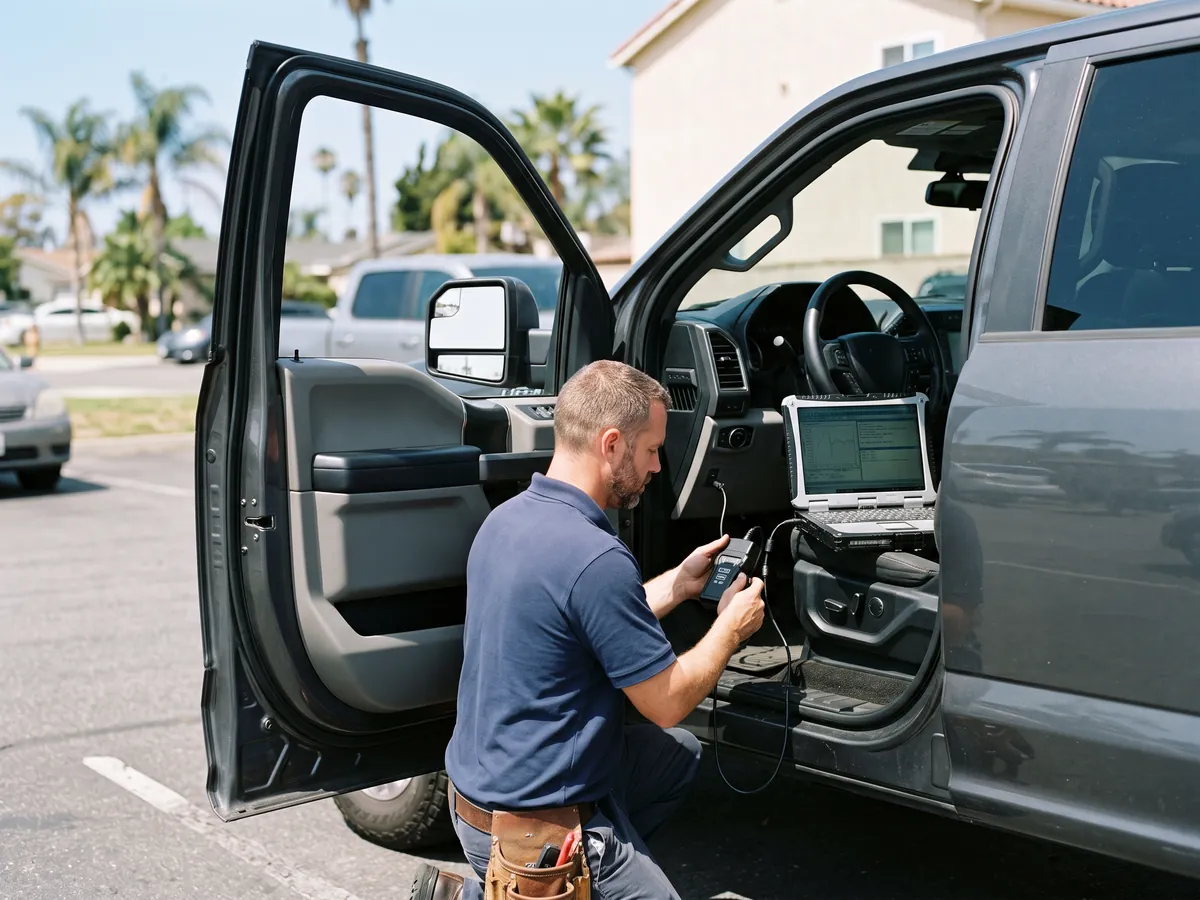
Vehicles in Devore work harder than most. Pickups pull horse trailers and flatbeds up rough driveways, commuters run I-15 up the Cajon Pass and I-215 down to the valley, and contractors' trucks start before dawn and sit in dusty yards. That produces a particular set of automotive calls: keys lost on a trail or in a pasture, fobs killed by heat or a water trough, ignition cylinders worn by heavy key rings, and lockouts at hitch-up time. An automotive locksmith covers those in one visit and comes to the vehicle. We open locked cars with air wedges and long-reach tools, cut keys by code or by decoding the lock, program chip keys, remote-head keys and proximity fobs with a scan tool on the OBD-II port, extract broken keys, and repair or replace ignition cylinders. We also work on fleet pickups and trailer hardware, so a small business can keep its trucks moving. The alternative is the dealership, which usually means a tow or a drive to San Bernardino and an appointment. That is the right call for some vehicles, including certain European models and a few newer cars with locked security gateways, and we'll tell you honestly if yours is one. Otherwise we can usually finish in your driveway. No key gets cut until we have seen your ID and paperwork showing the vehicle is yours.
What to know first in Devore
Here's what a mobile automotive locksmith visit looks like. You call with the year, make, model and what happened. We check ownership on arrival with ID and registration or title, then look at the key, the lock and the car's behavior before quoting. If a key is needed, we identify the blade profile, such as a Ford HU101, Honda HON66 or Toyota TOY43, cut it by code or by decoding a lock, then connect a programmer to the OBD-II port to add the new transponder or fob to the immobilizer. Ignition and door lock repairs happen right there too: we pull the cylinder, replace worn wafers or the whole cylinder, and key it to your existing key when possible. Before we leave, we test start, lock, unlock, trunk and panic functions, and tell you how many keys the car now recognizes. Around Devore, that means no tow truck, no dealership waiting room, and no second trip when the work is done right the first time.
How we can help in Devore
- Vehicle lockout entry. Lockouts aren't only keys on the seat. Fobs sealed in a closed trunk, a dead 12-volt battery on a push-start car, and doors that relock themselves after a set delay all show up. We confirm ownership, open the cabin, release the trunk if needed, and check the fob before leaving so it doesn't happen again tomorrow.
- Key cutting by code, decoding or duplication. Blade profiles vary more than most drivers expect: Ford HU101, GM HU100, Honda HON66, Toyota TOY43, Nissan NSN14, Hyundai and Kia HY22 and dozens more. We stock common blanks so a Devore visit doesn't stall over parts, and we confirm the profile on the phone when the vehicle is older or less common.
- Smart key and proximity fob programming. A replacement proximity fob that looks right isn't always right. Frequency, chip type and button layout must match the car, so we check FCC ID and part numbers instead of shape. Then we pair it on site, delete any lost fob from memory, and show you the backup start spot for days when the fob battery runs low.
- All-keys-lost key origination. Losing your only key doesn't automatically mean towing to a dealership. On most domestic and Asian vehicles we can originate a key where the car sits: decode the lock for the cuts, program the chip or fob, and remove the lost key from memory. Certain European and late-model systems are exceptions, and we identify those on the first call.
- Fleet and work vehicle key programs. Delivery vans, service pickups, box trucks and company cars each bring different keys and immobilizers. We handle mixed fleets in one scheduled visit, quote per vehicle up front, and keep notes so future spares go faster. Medium-duty trucks that shipped with widely shared mechanical keys can have door cylinders rekeyed for real control.
How Devore shapes the job
Horse properties around Devore run on trucks and trailers: heavy-duty pickups, gooseneck and bumper-pull trailers, tack room doors and coupler locks that collect dust and grime. We repair and rekey trailer and tack room locks, cut keys for hitch locks, and program spare keys for tow vehicles, so a key lost at a show or trail staging area doesn't leave horses waiting. Corroded cylinders get cleaned or replaced.
Foothill and canyon roads around Devore put cars at trailheads, scenic pullouts and steep driveways where cell coverage can be spotty. Before heading up, keep a spare key on a person rather than in the car, and know your fob's backup start spot. During red-flag wind days or an evacuation order, a car that won't start is a serious problem, so a spare made ahead of fire season earns its keep.
Inland summers in Devore are hard on key electronics. Cabin temperatures cook fob batteries, soften shells, loosen glued seams and crack rubber buttons, and 12-volt car batteries fail more often in heat, which mimics key trouble. Before replacing a fob, have it tested; a new coin cell or shell often fixes it. Keep fobs off the dashboard and spares inside the house, not the glovebox.
Common situations
Say a contractor's flatbed won't start before a morning job, and the foreman has just discovered that the only key is missing. The truck sits in his driveway off Kenwood Avenue. We arrive, verify his ID and the registration, cut a fresh key from the VIN's code, program it into the immobilizer, and erase the missing key so it can't start the truck. The flatbed rolls out for its first job with a working spare riding in the office instead of on the ring.
- Say you bought a used pickup from a private seller in Devore and got a single key. Two problems: no spare, and no idea how many other keys the truck still accepts. We check the title and your ID, cut and program a second key, then erase all stored keys and re-add only the two in your hand. Any old copy floating around now turns the ignition but won't start the engine.
- A pickup's tailgate lock hasn't turned in years because the owner never needed it, until a new tonneau cover arrives and the tailgate suddenly has to lock. The cylinder is packed with grit and corrosion. We rebuild it to match the ignition key, check the latch rods, and fit the new toolbox with a cylinder that matches where the hardware allows. Fewer keys, and every one of them turns.
- A Ford Explorer owner in Devore forgot the five-digit door keypad code and long ago lost the card it came on. After the ownership check, we read the factory keypad code from the vehicle with a diagnostic tool and, while connected, program a second key so the household isn't relying on one fob. One stop, no dealership appointment, and two working ways back into the car.
Step by step with Julian's Locksmith
- Tell us the vehicle and the problem. Call (951) 903-3193 with the year, make and model, how the car starts (turn key or push button), and what's wrong: locked out, key lost, key won't turn, remote dead. Those details tell us which blanks, fobs and programming tools to load before heading to Devore.
- Verify ownership. Before we open or key any vehicle, we check a photo ID against the registration or title. If the car belongs to a relative, employer or lender, bring documents that tie you to it. The same rule that slows you down for a moment stops a stranger from having a key made for your car.
- Diagnose on site. We test before we sell. A key reader checks the transponder, a frequency tester checks the remote, and we watch how the ignition, door lock and dash behave. A weak 12-volt battery, a worn cylinder and a dead chip can look alike from the driver's seat, but they need very different fixes.
- Quote before work starts. Pricing depends on key type, security system, parts choice and whether any working key exists, so we quote after confirming those details at the vehicle. You'll know the total and the options, like OEM or aftermarket fobs, before we cut a single blank.
- Cut, program or repair. Most of the work happens in or beside your vehicle. We cut by code or decoded depths, program through the diagnostic port or directly to a module when the car requires it, and handle ignition, door or trunk repairs with parts carried on the van.
- Test and hand off. We don't drive off until the car starts reliably several times and every lock works by key and remote. If something else looks off, such as a weak battery or a sluggish door actuator, we mention it so it doesn't become tomorrow's problem.
How we quote the job
- Whether you still have a working key. Duplicating a working key is the cheapest path to a new one. With no keys left, we need cut data from a code or a decoded lock, sometimes a PIN, and extra programming steps to erase lost keys. Making a spare now avoids the higher all-keys-lost cost later.
- Parts: OEM, aftermarket and blanks. Factory fobs and keys usually cost more than quality aftermarket equivalents, and some vehicles accept only OEM parts. We explain both options, including how they differ in feel, range and longevity, and let you choose. Some used fobs can be reset and reprogrammed, though many models don't allow it.
- Extra keys, extra vehicles and add-on work. Fleet owners save by planning. A scheduled visit to make spares for every van, erase missing keys and fix worn cargo locks costs less than a string of emergencies. We quote per unit and per task so you can approve the whole list or phase it in over a few months.
Every job gets a clear quote before any work starts. Call (951) 903-3193 with the details and we'll tell you what to expect for your situation in Devore.
Practical tips before you call
- If your car came with a key code tag, store it at home with your important papers, never in the glovebox. Also save a photo of your registration and VIN. If every key is lost, those details speed up both the ownership check and the key origination.
- Use the metal key in the driver's door lock every few months. Door cylinders opened only by remote collect dust and seize, and you'll find out on the day the fob dies. A light shot of lock lubricant once a year keeps the wafers moving freely.
- For older vehicles, ask for keys cut by code instead of copied. A copied key reproduces years of wear, which then wears the ignition even faster. A code-cut key matches factory depths and often makes a sticky ignition feel normal again without any lock repair.
- If your proximity-key car parks close to the house, keep the fobs in a signal-blocking pouch or a metal box away from the front door. Relay devices can stretch a fob's signal to a car in the driveway. Some vehicles also let you switch off passive entry in the settings menu.
Common errors that cost time and money
- Buying a bargain fob online without checking the FCC ID, frequency and chip. Many arrive locked, refurbished or incompatible, and once some fobs are programmed to a vehicle they can never be reused. Ask a locksmith to confirm the part before you order.
- Towing a car to the dealer before checking other options. For most vehicles, an automotive locksmith can make and program the key where the car sits, avoiding the tow fee and the wait for a service appointment. Call first and ask whether your model is a locksmith job or dealer-only.
- Not erasing lost keys after replacing them. If a key with your car's chip was stolen along with a bag or jacket, it can still start the car until it's removed from the immobilizer memory. Ask for lost keys to be erased whenever one goes missing.
Service in Devore
Devore is about 8 miles from our San Bernardino base, roughly 14 minutes in light traffic via Kendall Drive or Palm Avenue to I-215 North, through the Devore junction onto I-15 North, exit Kenwood Avenue for Devore Heights. When you call, you get an arrival estimate based on where the technician is and the traffic at that moment.
Stuck on the shoulder or in a parking lot along I-215? Get somewhere safe, turn on your hazards, and give us the nearest exit or business so we can find the car without guessing.
About Devore: The Devore Animal Shelter on Shelter Way is the San Bernardino County shelter for unincorporated areas of the county as well as Highland and Yucaipa.
| Neighborhoods | Cable Canyon, Glen Helen, Lytle Creek, Kimbark Avenue area, Kimbark Canyons, Cajon Boulevard corridor |
|---|---|
| ZIP codes | 92407 |
| Main routes | I-15, I-215, Cajon Boulevard, Kenwood Avenue |
| From our San Bernardino base | about 8 miles via Kendall Drive or Palm Avenue to I-215 North, through the Devore junction onto I-15 North, exit Kenwood Avenue for Devore Heights; Devore Road exit for Glen Helen and lower Cajon Boulevard |
Need a car key in Devore?
Call (951) 903-3193 with the year, make and model, and tell us whether you still have a working key. We'll tell you whether the key can be made at the car or has to come from the dealer, and quote the job before any work starts.
Frequently asked questions
What if my push-button car says 'key not detected'?
Try the backup method first: hold the fob against the start button, or set it in the designated pocket in the console, then press start. If that works, the fob battery is weak, so replace it. If it doesn't, the fob may be damaged or unprogrammed, or the car's antenna may have a fault. We can test the fob and program a replacement if needed.
How many keys should my car have?
At least two working keys, kept in different places. Some vehicles need two programmed keys to add another without equipment, and every vehicle gets much more expensive to key once the last one is gone. Fleet vehicles benefit from two per unit plus a sign-out log. If you're down to one in Devore, a spare is the most useful small purchase you can make.
Can you make motorcycle keys?
Yes, for most makes. Many bikes use mechanical keys we can cut from the ignition or a lock code; others have transponder or proximity systems that need programming. All-keys-lost on a motorcycle sometimes means removing the ignition or seat lock to decode it. Bring the registration and your ID, and tell us the year and model so we bring the right blank.
Is an automotive locksmith cheaper than the dealership?
Often, especially once you count the whole cost. A dealer may need the car towed in for programming, then charge for the key and a separate programming fee, plus your time without the car. A mobile locksmith comes to you and usually offers OEM or aftermarket options. For some luxury models the dealer is the only route. We quote before any work, so you can compare.
My key turns but the car won't start. Is it the key?
Possibly. If the dash shows a flashing security or key light and the engine cranks briefly then dies, or won't crank at all, the immobilizer may not be reading the chip. A damaged transponder, a key that was never programmed or a failed clone are common causes. If the dash is dim and nothing happens at all, check the car battery first.
Can a lost key still start my car?
Yes, until it's erased. Every programmed key stays in the immobilizer's memory, so if a key was stolen with a purse or lost where someone could match it to the car, it remains usable. When we make a replacement, we can erase all stored keys and re-add only the ones you still hold. That cuts the lost key off completely.
How far is Devore from your base?
Devore is about 8 miles from our San Bernardino base, roughly 14 minutes in light traffic. Arrival time depends on traffic and on the job the technician is finishing, so we give you an estimate on the phone before you commit.
Related services in Devore
Automotive Locksmith in nearby cities
- Automotive Locksmith in Glen HelenSan Bernardino County
- Automotive Locksmith in MuscoySan Bernardino County
- Automotive Locksmith in North FontanaSan Bernardino County
- Automotive Locksmith in RialtoSan Bernardino County
- Automotive Locksmith in FontanaSan Bernardino County
- Automotive Locksmith in EtiwandaSan Bernardino County
- Automotive Locksmith in San BernardinoSan Bernardino County
- Automotive Locksmith in BloomingtonSan Bernardino County