
Chino, San Bernardino County
Access Control Systems in Chino
Short answer: Julian's Locksmith designs, repairs, maintains and upgrades access control for businesses, apartment communities and HOAs in Chino. That covers standalone keypad locks, card and fob readers, electric strikes, maglocks, gate entry panels and cloud-managed systems. We start with a door-by-door walk, explain the options in plain terms, quote before any work, and tell you when a low-voltage contractor should handle part of the job.
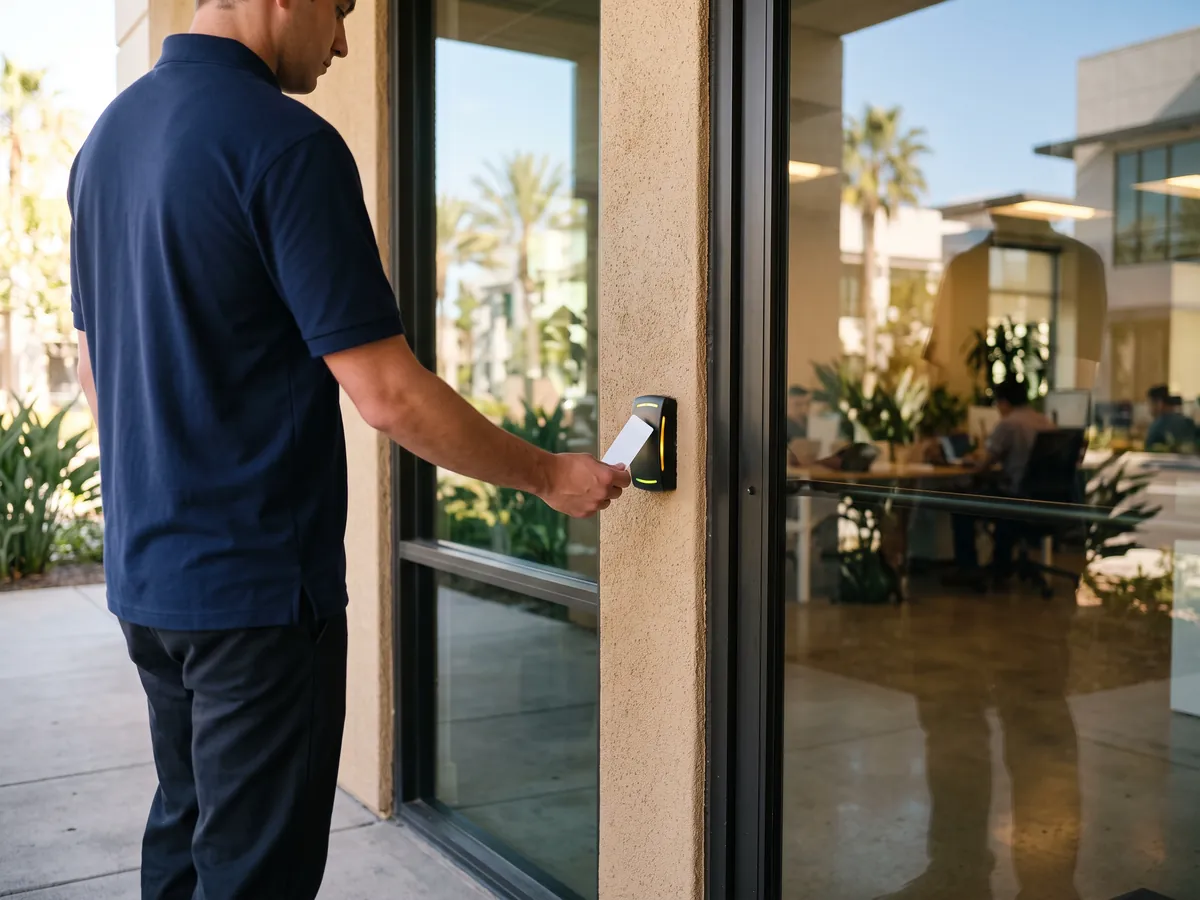
An access control problem rarely announces its real cause. A door that won't buzz open might have a dead backup battery, a strike that's out of line with the latch, a closer that no longer pulls the door shut, or a schedule someone changed by accident. Swapping parts until something works gets expensive fast. When we troubleshoot a system in Chino, we start at the door and work back toward the controller: measure voltage at the lock, watch the latch and keeper, check the door position switch, then read the event log. Fixing the actual fault is usually cheaper than replacing the system, and we tell you so when it is.
Access control replaces keys with credentials: a card, a fob, a phone or a code. A reader at the door checks the credential, a controller decides whether it is valid at that moment, and the lock releases. The advantage for a business is control. A lost card gets deleted instead of triggering a rekey of the whole building, and an audit log shows who entered which door and when. In Chino the use cases are mostly small and midsize. Office suites and medical or dental practices near Chino Valley Medical Center, multi-tenant buildings in the Eucalyptus Business Park and apartment communities with pedestrian gates all need a way to manage who gets in. Many already have a system installed, and the usual call is about upkeep: readers that stop reading, a power supply that failed, a door that stays unlocked, or credentials nobody can delete because no one has the software login. We repair and upgrade stand-alone and small networked systems. Older 125 kHz proximity cards are easy to clone, so a move to encrypted credentials is worth a look. Larger systems tied to a fire alarm, elevators or multiple sites often need a low-voltage contractor, and we say so.
What to know first in Chino
Residential communities use access control differently than offices do. An office has a known roster of employees; an apartment community has hundreds of residents, their guests, delivery drivers, vendors, maintenance staff and the occasional former tenant who kept a fob. The system has to handle move-ins and move-outs every week, enforce amenity hours at the pool and gym, let a visitor call a unit from the gate, and keep fire department access in mind. In Chino, many complexes run a telephone entry panel at the vehicle gate, fob readers on pedestrian gates, and keypad or fob locks on the leasing office and mailroom. The weak spots are predictable: unencrypted fobs that residents duplicate at kiosks, entry panels that dialed out over a landline the phone company has since retired, gate locks beaten up by daily slamming, and nobody auditing the active fob list. We repair those pieces individually, or plan a phased upgrade that keeps residents moving through the gates while the work happens.
Work included on a typical visit
- Standalone keypad and prox locks. For one door or a few, a standalone lock such as an Alarm Lock Trilogy, a Schlage CO-series or a dormakaba E-Plex holds its own user codes, schedules and audit log. No controller, no software subscription, no cable runs. We install them on existing door preps where possible and program the first users with you before we leave.
- Networked card and fob systems. Whether the software runs on a local server or in the cloud, a networked system depends on clean work at the door: correct reader placement, door position switches, request-to-exit devices and properly sized power. That's where long-term reliability is won or lost, and it's where a locksmith background matters most.
- Preventive maintenance visits. Maintenance also covers the database. We help your administrator find users who haven't badged in for months, credentials with no name attached and doors carrying outdated schedules. Cleaning that list closes the most common gap in any access control system: people who should no longer have access but still do.
- Upgrades and credential migration. Upgrading the reader protocol is another common step. Older systems use Wiegand, an unencrypted one-way signal; newer readers support OSDP with Secure Channel, which encrypts traffic and alerts the controller if a reader is disconnected. When the existing cable has enough conductors in good condition, that change can happen without pulling new wire.
- User management, remote access and audit trails. An audit trail is only useful if you can read it. We name doors and users clearly, enable the event types that matter (granted, denied, forced, held open), and show you how to filter a report by person, door or time range. That's the record you'll want when something goes missing.
What's different about Chino
Warehouses and distribution centers around Chino need access control that handles shift changes, contract drivers and dozens of exterior doors. Dock offices, man doors beside roll-ups and perimeter gates take hard daily use, and heavy-duty strikes or electrified mortise locks outlast lighter hardware. Group schedules let each shift badge in only during its hours, while door-held alerts catch man doors propped open for airflow during the summer heat.
Older apartment buildings and commercial properties from the 1960s and 1970s in Chino bring their own challenges: plaster or block walls, doors that have sagged for decades, and frames never prepped for electrified hardware. Wireless locks, surface raceway and careful door repair make access control practical without tearing the building apart. We often fix hinges, closers and frames first, because new electronics won't work on a door that doesn't close properly.
Summer heat in Chino is hard on access control. Backup batteries in hot electrical rooms age faster, keypads in direct sun fade and crack, standalone lock batteries drain sooner, and metal doors on west-facing walls can expand enough to bind a strike. We look at heat exposure during every survey and maintenance visit, specifying sun hoods, ventilated enclosures and outdoor-rated hardware, and replacing batteries before the hottest months arrive.
Situations this covers
A dental office near Chino Valley Medical Center calls because the back-door reader reads cards one time in three, and a former receptionist's card still opens the door. The software login belongs to a previous office manager. We'd inspect the reader and cabling, replace a failing power supply, reset the controller's admin access, and delete cards that don't belong. We'd also suggest a switch to encrypted credentials when the budget allows.
- For example, a dental office near Yanks Air Museum lets a front-desk employee go at the end of a week. Her fob still works on the back door, and the keypad on the supply room shares one code across the whole staff. We'd delete her fob from the system, replace the shared keypad code with individual PINs so future departures take one deletion, and pull the past month's entries so the office manager can see who used that door.
- Suppose a company moves into a suite in Chino where the previous tenant left readers, strikes and a locked controller cabinet, but no admin password and no cabinet key. After confirming the new lease with the property manager, we'd open the cabinet, identify the controller, and either reset it to factory defaults for the new tenant or recommend replacing it if the manufacturer no longer supports it.
- Say a boutique in The Preserve has an aluminum storefront door with an electric strike that hums when the buzzer is pressed, yet the door won't open unless someone shoves it. The weatherstrip and an overtightened closer are pressing the latch hard against the keeper, and the strike can't release under that load. Adjusting the strike, relieving the preload and replacing the worn closer would make the release dependable again.
How the visit works
- Start with a call. If it's a repair, note exactly what happens: does the reader beep or flash, does the strike click, does the door release but refuse to open? Those details narrow the cause. If it's a new project, think about who needs access to which doors and at what times.
- Site walk and assessment. For upgrades we inventory what's already installed: reader models and card formats, controller brand and firmware, wiring type, electrified hardware and battery age. That inventory shows which pieces still have years left in them and which ones are holding the whole system back.
- Written quote and options. Bigger upgrades are often easier to approve in phases: worst doors first, perimeter next, interior doors after that. We can structure the quote that way so a Chino business or HOA spreads the work across budget cycles without leaving any door half-finished.
- Hardware work at the door. We install or repair the electrified lock, reader, door position switch and request-to-exit device, mount everything plumb and secure, and terminate wiring neatly with labels at both ends. Every door is tested for release, relock, egress and key override before we move to the next one.
- Programming and handoff. Before we leave, your designated administrator performs the common tasks while we watch: enrolling a fob, disabling one, changing a schedule and pulling an entry report. Practicing on your own system beats reading a manual in the middle of a problem.
- Ongoing service and support. After the job, call us for repairs, adds and changes. Many Chino customers book a yearly maintenance visit to test batteries, egress, release and closers, and to review the user list. Our hours are 6:30 a.m. to 11:30 p.m. every day.
Pricing factors
- Number of doors and gates. The first door carries costs that later doors don't: a controller, power supply, enclosure and software setup. That's why adding a second or third door to an existing system often costs less per opening than the first did. If you expect to grow, choosing a controller with spare door capacity is worth it.
- Door and frame construction. Fire-rated doors limit the choices: the hardware must be listed for fire doors, and the opening still has to latch positively when power fails. That often means an electrified lock or a fire-rated fail-secure strike, both of which cost more than basic hardware. We check the label on the frame or door edge before quoting.
- Wiring, power and building layout. Every electrified lock needs a dependable power source sized for its voltage and current draw, plus battery backup. If there's no circuit near the controller location, an electrician adds one. Long runs to distant doors may need heavier wire or a local power supply. Those details surface during the site walk.
Every job gets a clear quote before any work starts. Call (951) 903-3193 with the details and we'll tell you what to expect for your situation in Chino.
What not to do
- Putting a fail-safe strike on a fire-rated door. Fire doors must latch positively when power fails, so electrified hardware on them has to be fail-secure and listed for fire doors. A fail-safe strike unlatches during an outage or alarm, which defeats the whole purpose of the door's rating.
- Installing a maglock without code-compliant egress. A maglock holds the door until power drops, so people inside need a motion sensor, a push-to-exit button and a fire alarm release to get out. Skipping any of those creates a life-safety hazard and a likely inspection failure.
- Buying a kit online and mounting it on whatever door is there. Consumer-grade maglocks and strikes are often undersized, ship without proper egress devices and aren't listed for commercial use. They tend to fail inspection or fail open, and the business pays to remove them before a proper access control installation.
Practical tips before you call
- Give every person their own credential. Shared codes and pass-around fobs make the audit trail meaningless and turn every departure into a code change for everyone. Individual PINs or fobs mean one deletion when someone leaves your Chino business, and a clear record of who used which door and when.
- Use door-held-open alerts. A door position switch costs little compared with what walks out of a propped door. Set a reasonable delay so deliveries don't trigger constant alerts, then route notifications to a person who will actually check, not a shared inbox nobody reads.
- Make offboarding a checklist item. The moment someone leaves, disable their credential before the final paycheck or deposit refund goes out. Ask HR or the leasing office to notify whoever administers the access control system, and make sure that person has a backup who can do the same when they're on vacation.
- Keep the override keys accounted for. Know exactly how many exist, who holds them and where they're stored. If one has gone missing, rekey the override cylinders now. An unaccounted-for override key bypasses every card reader, schedule and audit log your system has.
Getting to Chino
Chino is about 36 miles from our San Bernardino base, roughly 42 minutes in light traffic via I-215 South to I-10 West, I-15 South to SR-60 West. When you call, you get an arrival estimate based on where the technician is and the traffic at that moment.
Homes and businesses just off SR-83 are routine stops for us. Give the suite or unit number and any gate instructions, and say whether the van can park out front or should pull into a side lot.
About Chino: Chino covers about 29.7 square miles at the western end of the Inland Empire, bordered by Chino Hills, Pomona, Ontario and Eastvale.
| Neighborhoods | West Chino near Ramona Avenue, South Chino near Prado Regional Park, Central Avenue corridor, Chino Airport area, Schaefer Avenue area, Downtown Chino |
|---|---|
| ZIP codes | 91708, 91710 |
| Main routes | SR-60, SR-71, SR-83, Central Avenue |
| From our San Bernardino base | about 36 miles via I-215 South to I-10 West, I-15 South to SR-60 West (Pomona Freeway), exit Central Avenue for downtown Chino and College Park, or Euclid Avenue (SR-83) south for East Chino, Chino Airport and The Preserve; SR-210 West to I-15 South is the alternate when I-10 backs up |
Business lock or door work in Chino?
Call (951) 903-3193 with the address, the doors or hardware involved and when the site is open. We'll quote the job before any work starts and book a time within our hours that suits your schedule.
Frequently asked questions
What does access control mean for a business in Chino?
Access control replaces or supplements keys with credentials such as fobs, cards, PINs or phones that a system checks before releasing a door. You decide who can enter each door and when, remove someone's access instantly, and see a record of entries. For a small business it can be one keypad lock; for a larger site, a networked system covering every door and gate.
Will you work on a system another company installed?
Yes. We regularly troubleshoot and repair access control that someone else installed, whether the original company is gone, unresponsive or simply too far away. It helps to have the admin login and any documentation, but it isn't always required. If a component is no longer supported, we'll tell you and lay out repair and replacement options.
Can key fobs be copied?
Older 125 kHz proximity fobs and cards can be copied easily because they transmit an unencrypted number, which is why some apartment residents in Chino get copies made at kiosks. Encrypted 13.56 MHz credentials, such as MIFARE DESFire EV2 or EV3 and HID Seos, are designed to resist copying. If your system still uses old prox, upgrading to encrypted credentials closes that gap.
Is cloud-based access control better than on-site software?
Neither is better for everyone. Cloud systems offer remote management, automatic updates and no server to maintain, in exchange for a recurring subscription. On-site systems can avoid subscription fees and keep data in-house, but someone has to maintain the computer and apply updates. For most small and mid-size businesses in Chino, cloud management is simpler to run day to day.
Keypad, card or phone: which credential should we use?
Keypads are inexpensive to run, but codes get shared. Cards and fobs identify each person and are quick at busy doors. Phone credentials avoid lost plastic and are easy to issue remotely, but depend on charged phones. Many Chino businesses use cards or fobs for staff, a keypad for limited vendor access and card plus PIN at sensitive rooms.
Can you put access control on a glass storefront door?
Yes, with the right hardware. Aluminum storefront doors usually take an electric strike made for narrow stile frames or an electrified version of the existing deadlatch. Frameless glass doors may need a maglock with a special bracket or a different locking approach. We check frame depth, latch type and egress requirements before choosing hardware.
How far is Chino from your base?
Chino is about 36 miles from our San Bernardino base, roughly 42 minutes in light traffic. Arrival time depends on traffic and on the job the technician is finishing, so we give you an estimate on the phone before you commit.
Related services in Chino
Access Control in nearby cities
- Access Control in MontclairSan Bernardino County
- Access Control in Chino HillsSan Bernardino County
- Access Control in OntarioSan Bernardino County
- Access Control in PomonaLos Angeles County
- Access Control in ClaremontLos Angeles County
- Access Control in UplandSan Bernardino County
- Access Control in Diamond BarLos Angeles County
- Access Control in La VerneLos Angeles County