
Charter Oak, Los Angeles County
Charter Oak Storefront Door Lock Replacement for Aluminum Shop Doors
Short answer: Storefront door lock replacement in Charter Oak means swapping the deadlock, deadlatch, cylinder or paddle on an aluminum shop door for one that fits the same stile prep. Julian's Locksmith identifies the existing lock from its faceplate, matches backset, cam and finish, keys it fresh and tests every function. We verify you can authorize the work first. Call (951) 903-3193.
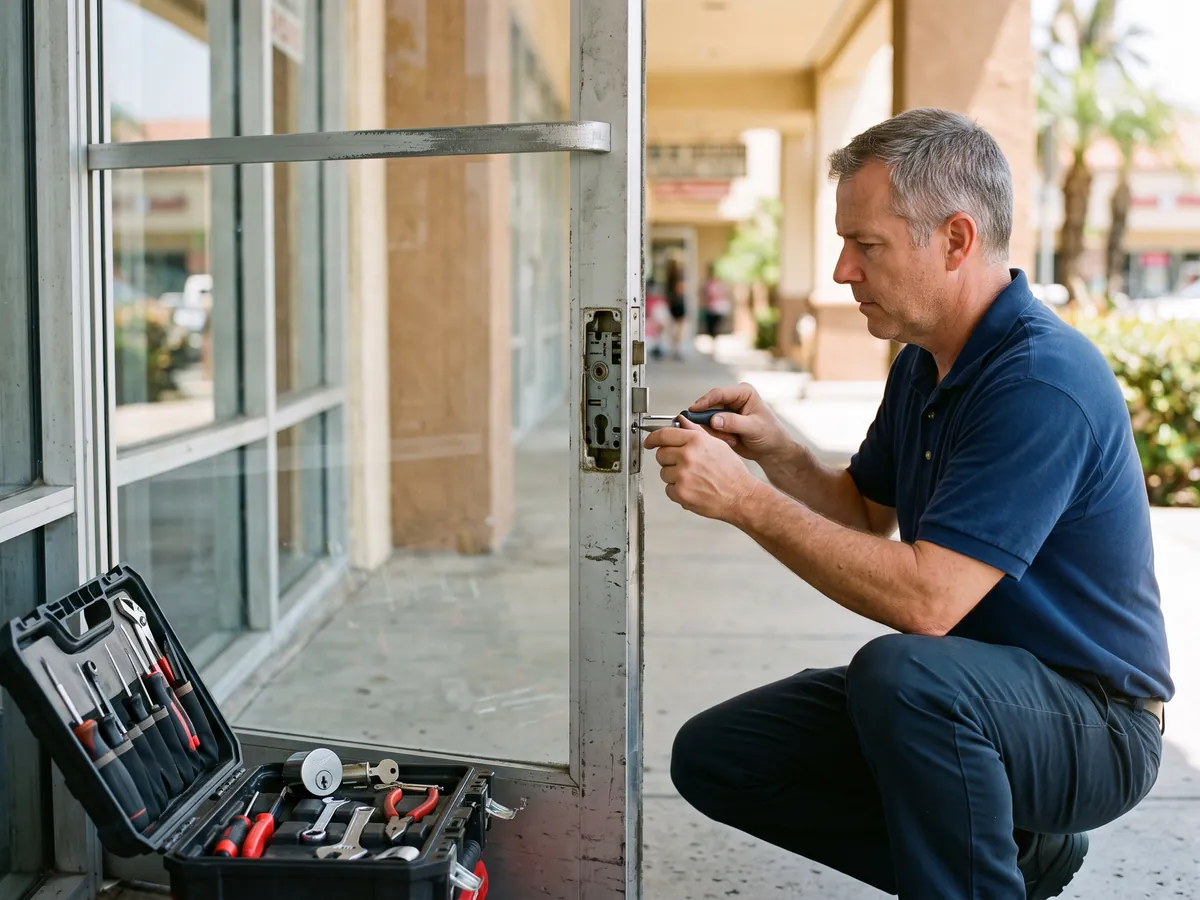
Storefront locks look standard, but a replacement that doesn't match won't fit. An aluminum narrow-stile door has a tight mortise pocket, a specific backset, a particular faceplate shape and a cam that must suit the cylinder. A hardware-store deadbolt can't go in, and the wrong online deadlock may need the stile cut. Storefront door lock replacement in Charter Oak starts with identifying what is there, then choosing a lock that drops into the same prep so the door isn't damaged. Julian's Locksmith carries common storefront parts and can order the rest. Send a photo of the faceplate and call (951) 903-3193.
How this works in Charter Oak
Replacement lets you choose the security level, and two rules shape that choice. First, egress: the main door and any exit door must open from the inside without a key or special knowledge while people are in the building. A thumbturn or a push-pull paddle satisfies that. A key-only cylinder on the inside is permitted in some occupancies only under conditions such as a posted sign and unlocked business hours, so we suggest asking your fire authority or building department before converting. Second, accessibility: levers, paddles and pulls should work without tight gripping or twisting. Within those limits, storefront door lock replacement in Charter Oak can add a hookbolt deadlock in place of a plain latch, a beveled cylinder guard, a high-security cylinder from Medeco, Mul-T-Lock or ASSA, and a restricted keyway that prevents casual copying. We explain what each addition stops, what it doesn't, and whether it's worth the cost.
Work included on a typical visit
- Mortise cylinder replacement. A broken key, spun cylinder or worn pins often calls for only a new mortise cylinder, not a whole lock. We match the thread, length and cam, key the new cylinder fresh, and leave the existing case in place when it tests sound.
- Paddle handles and trim replacement. If a lever or pull has loosened its mounting or cracked, replacement is safer than another round of tightening. We fit trim that works without tight gripping, so the door stays easy for every customer and employee to use. Accessibility rules favor lever and paddle designs for good reason.
- Locks for pairs and inactive leaves. On double doors the lock, flush bolts and meeting-stile hardware work together as one system. We replace the active leaf's lock, check the bolts at head and floor, and confirm the inactive leaf stays firmly held when everything is locked.
- Keying new locks to your system. New storefront locks can be keyed to match your back door and office locks, so one key opens everything it should. We can also fit into a master key arrangement with your landlord's system if the lease calls for it.
- Keypad and electrified replacements. If you want staff to enter with codes or cards, we can recommend narrow-stile electric strikes or electrified latches. We tell you at the start if a job includes work we don't do ourselves, so nothing comes as a surprise.
What's different about Charter Oak
Leasing offices and ground-floor shops in apartment communities share keying questions with the main building, and the same management company may want a master key arrangement. We replace the storefront lock to fit the property's key system, document the keying, and make sure staff, maintenance crews and the owner each have only the access they need. We also leave a keying chart for the manager's files.
Businesses that open for early commuters need a lock that works every time, in the dark, with cold hands. Replacement plans for these shops should favor smooth cylinders, a finish that is easy to find by feel and sometimes a keypad for the opening shift. Our day starts at 6:30 a.m., so call the evening before a planned swap.
Older commercial buildings, especially in neighborhoods like Charter Oak, may still carry the original storefront hardware, and the manufacturer may be long gone. We identify the lock, find a modern equivalent and adapt the faceplate or strike where required. When earlier repairs have re-cut the pocket, we assess it carefully so the new lock sits properly instead of rattling loose later.
Common situations
- A departing tenant finds his lease requires returning the original hardware. A previous occupant replaced the storefront lock with a different model, and the landlord wants the building standard restored. We identify the standard lock, source it, install it and key it to the landlord's system. The tenant leaves the door in the condition the lease asks for, with notes showing what was done.
- A tailoring shop's door carries a hasp, a slide bolt and a rim deadbolt added by earlier tenants. None was designed for the aluminum stile, and the screws are loose. We remove the clutter, repair the holes where possible, and install one mortise deadlock and cylinder that actually belongs there. For the first time in years the door closes cleanly and locks with a single key turn.
- A coffee shop owner wants early-shift staff to use codes instead of keys. The door has a narrow stile, so we talk through electrified options. The job needs low-voltage wiring in the frame and a power supply, so we coordinate with an electrician for that part. We then install a compatible electrified latch that keeps a mechanical key override for the owner.
- An insurance survey suggests a keyed deadlock on a gift shop's front door, since the existing latch can be slipped with a card. We replace the latch with a hookbolt deadlock, fit a cylinder guard and advise the owner to confirm with the insurer that the upgrade satisfies the policy wording. We also write up the hardware installed, so the owner has something specific to send.
How the visit works
- Identify the lock and the failure. Tell us what the lock does and send photos of the faceplate on the door's edge, the cylinder face and the paddles. Those usually name the maker and model, which lets us bring a matching lock instead of guessing at the door.
- Verify who can authorize the work. Replacing a lock changes who can enter, so we verify the person requesting the work, the same way we do for lockouts. Tenants should have a lease page or a manager's message handy, and owners a business or property record.
- Choose the replacement and any upgrades. We lay out the options: like-for-like replacement, a higher-security cylinder, a hookbolt in place of a latch, or an electrified option. You hear what each stops, what it costs and how it affects egress and accessibility.
- Remove the old lock and prepare the pocket. A tidy pocket makes a lasting repair. After removing the lock, we clear debris, check how the screws bite into the stile and confirm nothing inside the door is bent. We tell you if the stile itself needs a glazier's attention.
- Fit, key and align the new lock. Fitting is a series of small checks: the cam engages fully, the bolt travels freely, the cylinder doesn't spin and the strike lands on the bolt. We correct each before moving on, so the final test reveals no surprises.
- Test every function and hand over keys. The last step is a full walk-through: lock, latch, paddle, closer and alarm contact if there is one. We make sure the door secures properly under its own weight, then hand over the keys and explain how to request more.
Pricing factors
- Matching and part availability. Finish and handing affect availability too. Dark bronze or black parts, or a lock that comes in only one hand, may need ordering. If a part is on order, we make the door secure in the meantime and schedule the return visit.
- Keypad, electric and wiring needs. Mechanical replacements are the least expensive. Electrified hardware adds the lock itself, a power supply and wiring, and sometimes work by an electrician or low-voltage contractor. We tell you in advance which parts are ours and which are not ours.
- Door condition and timing. Timing matters too. A planned weekday visit is simpler than an urgent late-evening call, and several locks done together generally cost less per lock. When you can schedule ahead within our hours, we can bring exactly the right parts with us.
Every job gets a clear quote before any work starts. Call (951) 903-3193 with the details and we'll tell you what to expect for your situation in Charter Oak.
Practical tips before you call
- After a forced attempt, leave the lock alone until it is photographed. Scratches, tool marks and pulled screws help your insurer understand what happened. Don't keep forcing the key or hammering the cylinder, which can turn a replaceable part into a stuck door.
- Ask about egress before changing how the door locks from inside. A thumbturn or paddle satisfies the requirement that exit doors open without a key, whereas a key-only inside cylinder is allowed only under conditions such as signage, so check with your fire authority first.
- Count your keys before the change. Write down who holds each one, including managers, cleaners, contractors and your landlord. That list tells you whether a rekey, a new cylinder or a restricted keyway is the right response, and it makes the next audit easy.
- Test the finished work like a customer and like a burglar. Pull the door shut and listen for the bolt, push hard on the lock side, and try the paddle from outside. If anything feels loose or inconsistent, mention it before the technician leaves.
What not to do
- Buying a residential deadbolt for an aluminum storefront door. A standard cylindrical deadbolt needs a round bore that a narrow stile can't accommodate, and forcing one in weakens the metal around the lock. Storefront doors use mortise cases built for the stile, so match the lock to the door rather than the door to the lock.
- Leaving the old strike and loose screws in place. A fresh lock meeting a worn strike or stripped anchors loses much of its benefit and wears quickly. Replace the strike when it shows wear, and re-anchor it in the jamb with the right fasteners.
- Putting a new case behind an old cylinder and calling it done. If a former employee still holds a key that fits the old cylinder, the new case changes nothing about who can get in. Rekey or replace the cylinder whenever the real concern is key control.
Service in Charter Oak
Charter Oak is about 38 miles from our San Bernardino base, roughly 43 minutes in light traffic via Palm Avenue to I-215 North, I-15 South. When you call, you get an arrival estimate based on where the technician is and the traffic at that moment.
Most trips into Charter Oak use Glendora Avenue for at least part of the drive, and the technician keeps an eye on live traffic along the way so the arrival estimate you heard on the phone stays honest.
About Charter Oak: In 1887 Glendora founder George Dexter Whitcomb helped route the Santa Fe railroad north of the South Hills, bypassing Charter Oak, which stayed largely agricultural for decades.
| Neighborhoods | Cienega Avenue tracts near the Charter Oak Unified district office, Tudor Street and Greenhaven Street, Covina Boulevard and Charter Oak High School area, Valley Center Avenue edge and Rancho San Jose mobile home park, Charter Oak Park blocks, Glendora Avenue mobile home park |
|---|---|
| ZIP codes | 91724 |
| Main routes | I-210, SR-57, Arrow Highway, Covina Boulevard |
| From our San Bernardino base | about 38 miles via Palm Avenue to I-215 North, I-15 South, then the Foothill Freeway (SR-210) West, which becomes I-210 at the SR-57 junction, to the Sunflower Avenue exit in Glendora and south on Sunflower Avenue to Arrow Highway; the Grand Avenue exit suits the west side |
Lock or door hardware trouble in Charter Oak?
Call (951) 903-3193 with the address and what the door or lock is doing. We'll quote the repair before any work starts.
Frequently asked questions
How do I know which replacement lock fits my storefront door?
A replacement must match the original's backset, faceplate, cam, cylinder length, handing and finish. The stamping on the faceplate at the edge of the door usually shows the maker and model. A photo of that plus the cylinder face lets us confirm the match before we arrive, and we measure everything again on site.
How much does storefront door lock replacement cost?
We don't quote a figure without knowing the lock, because the range is wide. A cylinder swap costs less than a full case, and high-security or electrified hardware costs more. Cost depends on parts, matching, keying, door condition and timing. We give a firm quote before we start and do only what you approve.
What hours can you replace a storefront lock?
Julian's Locksmith serves Charter Oak every day from 6:30 a.m. to 11:30 p.m. We're closed overnight. If a lock fails outside those hours, secure the door in a way that keeps exits usable, and call us as soon as we open again. When you call, tell us the door type and what the lock is doing, and send a photo if you can, so we can plan the right parts and tools.
Can you replace just the cylinder?
Yes. If the case tests sound, a new mortise cylinder of the correct length and cam is often all you need, especially after a broken key, worn pins or a change in who holds keys. It costs less than a full lock. We check the case first so you don't replace a cylinder only to face a bolt problem next month.
Is it better to replace the lock or the whole door?
In most cases the lock. The door is a sturdy assembly, and a new lock restores security at a fraction of the cost of a new leaf. Door replacement makes sense only if the stile is bent, the corner joints have opened or the glass is cracked. We tell you which situation you have after inspecting the door.
What happens to my old lock and keys?
We can hand the old lock back to you or dispose of it, as you prefer. If we replaced the cylinder, the old keys no longer work, and we confirm that before leaving. Keep the damaged parts if you're filing an insurance claim, since they show your insurer exactly what failed.
How far is Charter Oak from your base?
Charter Oak is about 38 miles from our San Bernardino base, roughly 43 minutes in light traffic. Arrival time depends on traffic and on the job the technician is finishing, so we give you an estimate on the phone before you commit.
Related services in Charter Oak
- Storefront Lock Repair in Charter Oak
- Storefront Door Repair in Charter Oak
- Aluminum Storefront Door Repair in Charter Oak
- Narrow Stile Lock Repair in Charter Oak
- Glass Door Lock Repair in Charter Oak
- Commercial Lock Replacement in Charter Oak
- Business Lock Replacement in Charter Oak
- Commercial Lock Rekey in Charter Oak
- High Security Lock Replacement in Charter Oak
- Storefront Lockout in Charter Oak
Storefront Door Lock Replacement in nearby cities
- Storefront Door Lock Replacement in CovinaLos Angeles County
- Storefront Door Lock Replacement in CitrusLos Angeles County
- Storefront Door Lock Replacement in San DimasLos Angeles County
- Storefront Door Lock Replacement in GlendoraLos Angeles County
- Storefront Door Lock Replacement in AzusaLos Angeles County
- Storefront Door Lock Replacement in IrwindaleLos Angeles County
- Storefront Door Lock Replacement in West CovinaLos Angeles County
- Storefront Door Lock Replacement in WalnutLos Angeles County
