
Charter Oak, Los Angeles County
Commercial Lock Replacement in Charter Oak: Match the Door, Not Just the Lock
Short answer: Replace or rekey? If a commercial lock still works but too many people hold keys, rekeying the existing cylinders is usually the faster fix. Replace the lock when the lever sags, the latch drags, the key sticks, the door was forced, or parts are no longer made. Julian's Locksmith can inspect the hardware at your Charter Oak door and tell you which applies.
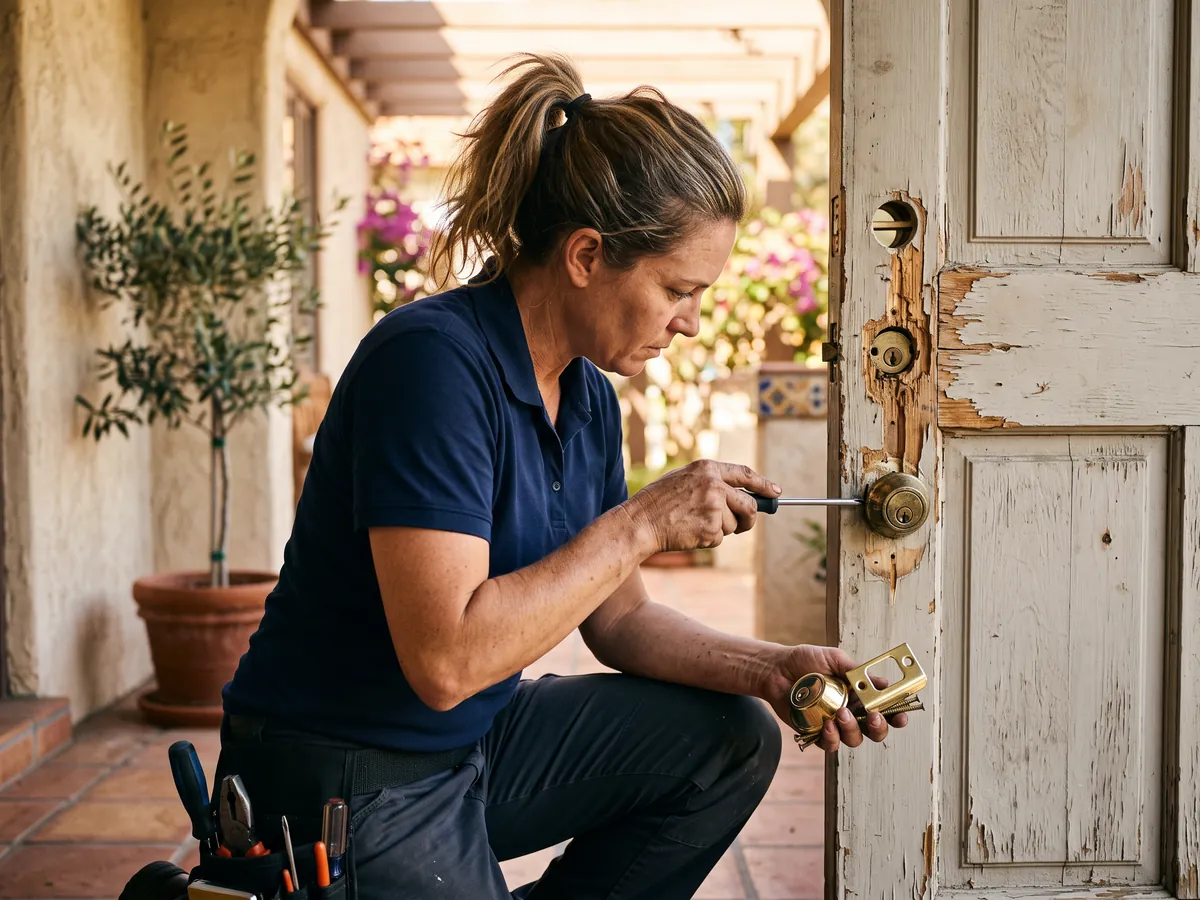
The lock that failed on your front door may have been a residential model from a home center. Those are built for a house, where a door opens a few dozen times a day, not a retail entrance that cycles from opening to closing. Commercial hardware is tested under the ANSI/BHMA standards, where Grade 1 is the toughest rating and higher numbers mean lighter duty. Julian's Locksmith recommends Grade 1 for busy entrances and Grade 2 where traffic is moderate, then fits it to the holes already in your door so you do not pay for new door prep. This page explains how that choice gets made for commercial lock replacement in Charter Oak.
How this works in Charter Oak
Commercial doors sit inside a web of codes that residential doors mostly escape, and a good replacement respects all of it. Doors on the path out of a building must open from the inside without a key, a tool or special knowledge, which rules out a deadbolt that needs a key on the exit side. Doors on accessible routes need hardware operable with one hand, without tight grasping or twisting, so levers rather than knobs. Fire-rated doors carry a label on the hinge edge and must use latching hardware listed for that assembly, plus a working closer, and the label limits how much field drilling is allowed. California building and fire codes add details by occupancy, and your fire marshal or building department has the final say. We are locksmiths, not code officials, but we know where locks go wrong. When we spot a labeled fire door, a delayed-egress requirement or a missing lever, we say so before ordering parts, so you choose with the full picture.
What we can do on-site
- Storefront deadlocks and latches. If your front door only locks when someone lifts the handle or leans on it, the culprit is often a worn hookbolt, a sagging door or a misaligned strike, not just the lock. We check hinge wear and pivot condition during the swap, because a new case will fail early if the door still drags at the jamb.
- Exit device locking trim and cylinders. When the device itself has failed, with a stuck latch, a bar that does not spring back or a bent chassis, the whole exit device is replaced. Rim, surface vertical rod and concealed rod devices each fit differently, so we measure door width and note whether the door is single or part of a pair before sourcing.
- Fire-rated and labeled openings. Fire-rated doors limit field changes. Drilling oversized holes, removing factory prep or adding unlisted parts can void the opening's rating. For that reason, we try to replace a fire door's lock with a listed product that fits the existing prep. If a different lock would need new holes, we explain what the label allows before touching the door.
- Choosing the right lock function. Commercial locks are sold by function, not just by style. An office function locks from inside with a turn button and from outside with a key. A storeroom function stays locked outside at all times while allowing free exit. A classroom function lets staff lock the outside with a key while the inside stays free. We help you match function to the room.
- Interchangeable cores and master-key fit. If your building uses small format interchangeable cores, replacing a lock does not mean rekeying the building. The new lock accepts your existing core, and a control key swaps it in seconds. We confirm the core brand and keyway, since Best-style 7-pin cores are common, and ask for the control key before the visit so the swap stays routine.
What's different about Charter Oak
Shopping centers around Charter Oak pack many storefronts into one landlord's footprint, and each tenant often controls its own entry lock. Aluminum storefront doors with narrow stiles are the norm, which narrows hardware choices to slim deadlocks and latches. If your shop sits near Charter Oak Unified School District office on Cienega Avenue, tell us the center's name and whether the landlord needs notice. We schedule around opening times and replace the lock, cylinder and strike together so the door closes cleanly.
Inland summer heat does real damage to commercial doors. Metal doors expand, closers thicken or leak, lubricants dry out and plastic parts turn brittle. A lock that worked in February may drag in August. In Charter Oak, we check door alignment and closer settings after every lock swap, favor hardware with metal internals, and suggest dry lubricant on latch bolts. Sun-facing glass doors are usually the first to show wear.
Older neighborhoods around Charter Oak still hold corner shops, small offices and converted houses with commercial doors from earlier decades. Many carry mortise locks, wood doors with worn edges and brass levers that no longer match anything. Replacement here means measuring carefully, protecting old door edges, and finding a modern Grade 1 lock that fits the original pocket. We aim to keep the character of the entrance while fixing the part that fails.
Situations this covers
- Picture a dental practice in a medical building where the supply room door has a passage function, left over from an earlier tenant. The owner wants it locked at all times but still free to exit. A storeroom-function chassis fits the same holes, so we would swap it, key it to the practice's cylinders and hand over two keys with a written record.
- Say a small manufacturer in an industrial park has a rear exit device whose outside trim spun loose after years of deliveries. The device itself is fine, but the trim and cylinder are worn out. We would replace both in place, check the push bar from the inside, and leave the door latching and the trim locking exactly as designed.
- A new tenant takes over a restaurant space and finds the back door on a hollow metal frame, with a lock nobody has a key for and a bent strike. After the landlord confirms in writing that the tenant controls the hardware, we would replace the lock, fit a longer strike with proper screws, and key the door to the new owner.
- A typical call: the property manager of a small office building off Valley Center Avenue wants every suite entry matched. Three of the eight locks are different brands, two sag, and one tenant holds a master key nobody can account for. We would walk the doors with a clipboard, write a schedule, replace the worn ones with matching Grade 1 levers and pin them all to a single key plan.
Step by step with Julian's Locksmith
- Walk the doors and list them. For a single door, this is a few minutes of looking and measuring. For a multi-suite building, it is a systematic pass. Either way, we check the lock, strike, hinges and closer together, because a new lock on a door that drags will not last long.
- Match function, grade and prep. We pick the replacement from the maker's catalog by cross-referencing your lock's series and function. If the model is discontinued, we suggest a successor or retrofit and show you the differences in finish, trim and keying before anything is ordered.
- Quote, order and schedule. Scheduling matters as much as parts. The doors on a building's exit path should never all be out of service at once, so we sequence the work. Evening and early-morning visits fit our hours, which run every day from 6:30 a.m. to 11:30 p.m.
- Replace with every door secured. We work one door at a time. The old lock comes out, the new one goes in, and the door is latched and locked before we move to the next. If a door must stay propped for a delivery or for staff to pass, we agree on that in advance.
- Adjust and test every function. A commercial lock is not finished when it turns. We test every function from both sides, key and lever, check that the latch enters the strike fully, and confirm the door closes and latches without a push. Exit doors get an egress test; electrified doors get a test with the system.
- Hand over keys and records. If the building uses a master system, we record where each new cylinder or core sits in the hierarchy so the next commercial lock replacement does not start from scratch. Tell us which employees or tenants should receive keys, and we will cut and label them.
What affects the cost
- Hardware grade and series. Series matters as much as grade. Within a single maker, one cylindrical line may be built for offices and another for heavy-traffic entries. We explain the difference in plain terms and recommend the lighter line where it is truly adequate, such as interior offices that see few uses a day.
- Door and frame condition. Past damage matters too. If someone has pried the edge or drilled extra holes, we may need to repair or reinforce the door before the new lock will hold. We separate those repairs on the quote, so you see what the lock costs and what the door repair costs.
- Timing, access and lead time. In commercial lock replacement, parts on hand cost less to install than parts on order. Special finishes, mortise cases and electrified items can take days to reach us, which stretches the schedule rather than the labor. We say which parts are in stock and which need ordering when we quote.
Every job gets a clear quote before any work starts. Call (951) 903-3193 with the details and we'll tell you what to expect for your situation in Charter Oak.
Practical tips before you call
- Tell your tenants or staff in advance. A notice that a locksmith will be replacing hardware on a given morning avoids confusion and lets people move belongings and plan their routes. Include the door names, the time window and who to contact in Charter Oak if access is needed.
- Keep the old lock until the new one in your commercial lock replacement has been tested. A hardware cross-reference sometimes needs a second look at the original, and a failed lock may matter for a warranty or insurance conversation. A bag and a label with the door name is enough.
- Keep the master key chart and treat it like cash. Store it locked, away from the keys, and limit who can see it. When we replace locks in a master-keyed system, the chart tells us how to pin the new cylinders. If you do not have one, tell us and we will help you start one.
- Choose finishes with a long view. Satin chrome and satin stainless are offered by most makers and hide wear. Special finishes like dark bronze or painted aluminum can mean longer lead times and may be hard to match when you add doors later. Ask which finish your building standard uses.
What not to do
- Swapping one lock after an employee leaves and ignoring the rest. If that person's key also opens other doors, one new lock changes little. Decide whether to rekey or replace across every door that key reaches, then collect or track the remaining keys.
- Ignoring the closer, hinges and strike. A new lock on a sagging door or a worn strike will bind, rattle or fail to latch. Many lock problems are really alignment problems, so inspect the whole opening before you blame the lock.
- Skipping the closing-time test. A lock that works at noon can fail at night if the latch barely enters the strike. Lock and unlock each door from both sides, with the door closing on its own, before the installer leaves.
Service in Charter Oak
Charter Oak is about 38 miles from our San Bernardino base, roughly 43 minutes in light traffic via Palm Avenue to I-215 North, I-15 South. When you call, you get an arrival estimate based on where the technician is and the traffic at that moment.
Our path into Charter Oak depends on where the previous job wrapped up. Sometimes that's a straight run via Glendora Avenue; other times it's surface streets the whole way. Either way, you get a heads-up call when the technician is close.
About Charter Oak: Charter Oak is an unincorporated census-designated place in Los Angeles County covering about 0.93 square miles between Covina, Glendora and San Dimas.
| Neighborhoods | Cienega Avenue tracts near the Charter Oak Unified district office, Bonnie Cove Avenue corridor, Calora Street and Nubia Street tracts, Covina Boulevard and Charter Oak High School area, Lyman Avenue and Sunflower Avenue area, Glendora Avenue mobile home park |
|---|---|
| ZIP codes | 91724 |
| Main routes | I-210, SR-57, Arrow Highway, Covina Boulevard |
| From our San Bernardino base | about 38 miles via Palm Avenue to I-215 North, I-15 South, then the Foothill Freeway (SR-210) West, which becomes I-210 at the SR-57 junction, to the Sunflower Avenue exit in Glendora and south on Sunflower Avenue to Arrow Highway; the Grand Avenue exit suits the west side |
New or replacement locks in Charter Oak?
Call (951) 903-3193 and tell us which doors and what kind of hardware you have in mind. If you already bought the lock, keep the box handy so we can check it fits the door, and we'll quote the install before any work starts.
Frequently asked questions
Can you replace just the lock on my panic bar?
Often yes. Many exit device problems come from the lever trim or outside cylinder, which can be replaced without removing the device. If the bar itself is damaged or the latch fails, the whole device is replaced. We identify the make, handing and fire rating, test the push bar from inside afterward, and never leave an exit door needing a key to get out.
Will a new lock fit my existing door without cutting?
Usually yes. Cylindrical locks use a standard 2-1/8 inch bore with a smaller edge hole, mortise locks use a pocket sized to a specific case, and storefront locks fit a narrow stile. We measure backset, thickness and faceplate and choose a replacement that matches. Cutting is only needed when you change lock type or the old prep is damaged or nonstandard, and we tell you before we start.
Can you replace locks on glass doors?
Yes, but glass systems vary. Patch fittings, bottom-rail locks and cylinder-in-rail hardware are specific to the manufacturer and the cutouts in the glass, and tempered glass cannot be modified. We identify the system, confirm the replacement part exists, and tell you the lead time before any work. Aluminum-framed glass doors with narrow stiles are more routine and use slim deadlocks and latches.
Can you work outside our business hours?
Within our schedule, yes. Julian's Locksmith works every day from 6:30 a.m. to 11:30 p.m. We are closed overnight and are not a 24/7 service. Many Charter Oak businesses book commercial lock replacement before opening or after closing. Tell us your hours, and we will propose a time that keeps your doors secured throughout.
What records do I get after a replacement?
You receive an itemized invoice listing each door, the lock installed and the work done, along with the keys. For cylinders or cores with key numbers or bitting, we record those so you can order duplicates through authorized channels. If you have a master system, we note where each new cylinder sits in the hierarchy. Keep the record locked up and away from the keys.
How long does a commercial lock replacement take?
A single cylindrical or storefront lock is usually a short visit when parts are on hand. Mortise cases, exit devices, fire-rated openings and electrified doors take longer, and special-order parts add days before the visit. Multi-door buildings are scheduled in phases. We give you an honest estimate when you call, and we do not promise a clock time we cannot control.
How far is Charter Oak from your base?
Charter Oak is about 38 miles from our San Bernardino base, roughly 43 minutes in light traffic. Arrival time depends on traffic and on the job the technician is finishing, so we give you an estimate on the phone before you commit.
Related services in Charter Oak
- Lock Replacement in Charter Oak
- Business Lock Replacement in Charter Oak
- Commercial Lock Installation in Charter Oak
- Commercial Lock Repair in Charter Oak
- Commercial Door Hardware in Charter Oak
- Commercial Rekey in Charter Oak
- Storefront Door Lock Replacement in Charter Oak
- Panic Bar Replacement in Charter Oak
- Commercial Master Key System in Charter Oak
- Commercial Locksmith in Charter Oak
Commercial Lock Replacement in nearby cities
- Commercial Lock Replacement in CovinaLos Angeles County
- Commercial Lock Replacement in CitrusLos Angeles County
- Commercial Lock Replacement in San DimasLos Angeles County
- Commercial Lock Replacement in GlendoraLos Angeles County
- Commercial Lock Replacement in AzusaLos Angeles County
- Commercial Lock Replacement in IrwindaleLos Angeles County
- Commercial Lock Replacement in West CovinaLos Angeles County
- Commercial Lock Replacement in WalnutLos Angeles County