
Brea, Orange County
Safe Lock Replacement in Brea: Match, Fit and Test
Short answer: Safe lock replacement means removing a failed lock body, dial or keypad and fitting a new one that bolts into the same holes and moves the same bolt work. The safe usually has to be open first. Julian's Locksmith does this on site in Brea: we identify the lock, verify your ID and ownership, quote the job, then install and test the replacement. Call (951) 903-3193.
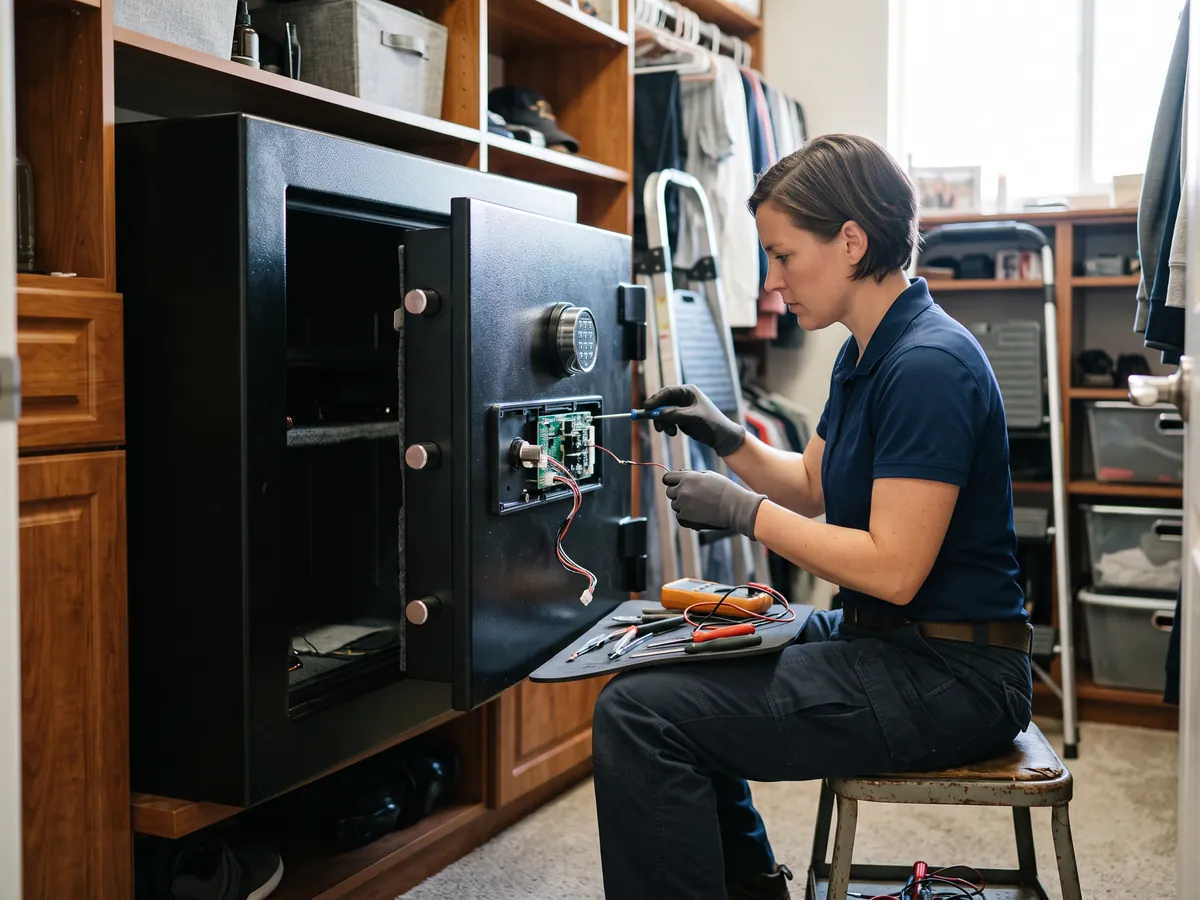
Sometimes the lock still works and you replace it anyway. The combination has passed through too many hands, the model was discontinued and parts are drying up, a business needs a record of who opened the safe, or an insurer wants a listed lock before it covers what's inside. Those are good reasons to schedule a safe lock replacement in Brea on your own timeline instead of waiting for a failure at the worst moment. We'll talk through what you want the lock to do, such as dual control, a time delay or an audit trail, then match one to your safe's door and bolt work. Julian's Locksmith quotes before the visit and tests before leaving.
What to know first in Brea
Safe locks come in tiers, and a replacement should never quietly drop you into a lower one. At the top of the mechanical world are UL-listed Group 2 combination locks from makers such as Sargent & Greenleaf and LaGard, built to resist manipulation, with Group 1 and 1R classes above them for more demanding attacks. Their electronic cousins, including the Kaba Mas X-10 and the S&G 6120, carry their own UL listings. Below them sit the unrated locks found in many consumer gun safes and fire chests, usually built around a small keypad board and a solenoid or motor. Both tiers have a place. A drawer safe for passports does not need a bank-grade lock, and a deposit safe at a retail counter should not depend on a hobby-grade keypad. We'll tell you which tier your safe already has, whether a lock of that tier is available, and what you would gain by stepping up. Insurance requirements often key off this rating, so check your policy before you choose.
How we can help in Brea
- Mechanical dial lock replacement. Mechanical dial locks, such as the Sargent & Greenleaf 6730 and the LaGard 3330 family, are replaced as a unit: lock case, spindle and dial ring. We match the case to your existing mounting holes and cut the spindle to your door thickness. A combination lock has no battery to fade, so the swap is a one-time job.
- Key-operated safe lock replacement. Key locks on safes come with locking cams of different lengths and shapes. Match the cam and you match the safe. We measure the cutout, thread, cam style and throw direction, then fit a new cylinder that works with your original latch and cut keys that we test in both positions. A spare gets cut during the same visit.
- Gun safe lock replacement. Many consumer gun safes are built around a specific lock, and switching styles can mean adapting brackets or drilling the door. We prefer an identical-pattern replacement. If none exists, we tell you plainly what an alternative involves before touching a drill. If you bought the safe to meet a legal listing, ask the maker how a lock change may affect it.
- Commercial deposit and cash safe locks. Business safes carry more weight than home ones: employees come and go, and cash handling creates rules. Replacement can include dual-control locks needing two codes, time-delay locks that hold the door for a set interval, and locks that record each opening. We match the lock to your cash policy instead of the other way around.
- Older and discontinued safes. Antique and mid-century safes from makers such as Mosler and Diebold often carry locks the maker stopped producing decades ago. A replacement may be a modern lock fitted to the old mounting pattern with an adapter plate. We also tell you when the original lock is better repaired than replaced, since collectors care about original parts.
Local factors in Brea
Shopping centers and strip malls rely on small deposit safes and under-counter cash safes. Staff turn over often and the lock sees constant use. Replacement here usually means a dual-control or audit-capable lock, one that keeps managers and cashiers on separate access levels, and fast service before opening or after close. Tell us your closing time when you call and we'll plan the visit so the safe works again before the next shift.
Foothill homes near Brea live with wildfire season and Santa Ana winds, and owners keep fire-rated safes for documents and heirlooms. A fire safe's lock is often part of the door's insulated structure, so replacement has to preserve the seal. If you evacuated and came home to a safe exposed to heat or smoke, mention it when you call. Soot-clogged or warped locks may need replacing, and we'll check the door fit.
Older Brea homes often hide safes the current owners never bought: a wall safe behind a closet shelf, a floor safe under a rug, a cast-iron box in a basement. Their locks can date to the mid-century, with parts discontinued long ago. We measure the mounting pattern, test the bolt work and fit a compatible modern lock where the original can't be saved. Proof you own the house is enough; you don't need the original receipt.
Example situations
- Picture a 1970s office safe in a back room off State College Boulevard, its dial gritty and its owner needing three attempts to open it each morning. The wheels have worn and the spindle has loosened in the door. After confirming the owner's authority, we would fit a matching mechanical lock, set a new combination and test it a dozen times with the door open.
- Say a buyer at an estate sale hauls home a heavy 1960s safe with no combination, a crumbling lock and the maker's tag long gone. After checking the bill of sale, we would open it by the gentlest method that works, measure the mounting holes, find a compatible modern lock and fit it. The buyer ends up with a working safe that no stranger's number can open.
- Here's a Saturday-night problem: a small medical office finds the keypad on its controlled-medication safe has stopped responding at 10:45 p.m. We close at 11:30 p.m., so we would say right away whether the drive and the job fit that window. If they don't, we'd advise keeping the safe shut and the room locked, and book the first Sunday morning slot.
- For example, a burglary attempt leaves a home safe with its dial knocked off and the spindle driven inward. Nothing was taken, but the handle no longer moves. Expect us to read the police report number first, open the safe if we can, replace the damaged lock parts, check the relocker, and hand the broken pieces back for the insurance claim.
How the visit works
- Call and describe the lock. Call (951) 903-3193 and tell us the safe's make if you know it, the type of lock, what it's doing wrong and where the safe sits. Photos of the dial or keypad, the maker's plate and any label inside the door help more than a long explanation.
- Verify ownership and get the quote. Ownership checks protect you as much as us. A safe holds what matters most, so we won't replace its lock for someone who can't show a connection to it. Estates, rentals and business safes each have their own paperwork, and we'll tell you what to have ready when you call.
- Open and inspect. Once the safe is open, we decide repair versus replace on evidence. We move the bolts by hand, check that the handle travels freely, and see whether the lock case, wiring or spindle is the real problem. Often more than one part is involved, and we explain which.
- Remove the old lock and match the new one. The old lock comes out carefully, with screws and parts kept together in case the insurer or police want them. We measure the case, mounting holes, spindle and cam, then compare them to the new lock on the bench before it goes anywhere near the door.
- Fit the new lock and set your code. The new lock goes in and the cam, spindle or wiring is connected. We set the combination or enroll the master code using the maker's own procedure. You choose the numbers, and you can enter them yourself so that we never see them.
- Test with the door open, then closed. With the door standing open, we operate the new lock repeatedly, at least a dozen times, watching the bolts move fully each time. Only then do we close the door, test again, and open it once more. Nothing counts as done until the lock works from the closed position.
What affects the cost
- Lock type and rating. Insurance and compliance sometimes decide the tier for you. If a policy asks for a listed lock on a safe holding cash or jewelry, the price follows that requirement. Tell us what your carrier or auditor expects, and we'll quote a lock that meets it instead of one that costs less but fails the test.
- Safe location and access. Gated communities, secured buildings and locked offices add logistics: gate codes, escorts, parking and timing. Passing those along on the phone saves time on arrival, and a smooth arrival keeps the visit shorter and the final quote closer to the original.
- Timing, distance and extras. We're based in San Bernardino and drive to every job, so distance from our base is part of the price. Daytime calls fit most easily, while late-evening calls may price differently because of scheduling. You'll hear the figure before we drive.
Every job gets a clear quote before any work starts. Call (951) 903-3193 with the details and we'll tell you what to expect for your situation in Brea.
What not to do
- Skipping the test with the door open. Plenty of home attempts at lock work end with the door closed and a lock that no longer responds. Test the new lock at least a dozen times with the door standing open, then closed, before the safe holds anything of value.
- Forcing the handle when the lock won't release. Heavy pressure can bend bolts, strip the cam or snap the handle shaft, and every bit of added damage raises the cost. If the handle doesn't move easily after the right code, stop and call. A gentle approach keeps the repair small.
- Buying a universal lock and hoping it fits. Safe locks aren't one-size parts. A wrong spindle length, flipped bolt position or off-pattern hole spacing leaves you with a lock you can't use and sometimes can't return. Check the fit first, or call us before you place the order.
Advice before you book
- Keep a short written record of who knows the code or holds a key, and when it last changed. For a business safe, put it in the key-control file. At home, a sealed envelope with a trusted person works. After a lock replacement is the right moment to start.
- Try fresh alkaline batteries in a keypad safe before deciding the lock is dead. Low voltage makes keypads beep, flicker or ignore keys, and it costs little to rule out. Use name-brand cells, fit them in the right direction and avoid rechargeables, which often run below the voltage the lock expects.
- Photograph the lock, the maker's plate and the label on the inside edge of the door before you call. A clear picture of the model number tells us quickly whether an original part still exists. Keep the photos in your phone's favorites; they also help with insurance records.
- Ask for the old lock back after any attack on your safe. Police and insurance adjusters may want to see what failed and how. We bag the parts and note which safe they came from, and you decide who receives them.
Service in Brea
Brea is about 51 miles from our San Bernardino base, roughly 55 minutes in light traffic via I-215 South briefly to SR-210 West. When you call, you get an arrival estimate based on where the technician is and the traffic at that moment.
Homes and businesses just off SR-57 are routine stops for us. Give the suite or unit number and any gate instructions, and say whether the van can park out front or should pull into a side lot.
About Brea: Brea's Art in Public Places program began in 1975 and has placed more than 140 sculptures and other artworks around the city.
| Neighborhoods | Greenbriar, Country Hills, La Floresta, Carbon Canyon, City Hall Park area, Olinda Village |
|---|---|
| ZIP codes | 92821, 92823 |
| Main routes | SR-57, SR-90, SR-142, Brea Boulevard |
| From our San Bernardino base | about 51 miles via I-215 South briefly to SR-210 West (Foothill Freeway) through Rialto, Fontana, Rancho Cucamonga and La Verne, then SR-57 South (Orange Freeway) through Pomona and Diamond Bar and over the Puente Hills to the Lambert Road or Imperial Highway (SR-90) exits; alternate via I-15 South and SR-60 West to SR-57 South, or SR-60 West to SR-71 South and Carbon Canyon Road (SR-142) through Chino Hills for Olinda Village and Olinda Ranch |
Safe trouble in Brea?
Call (951) 903-3193 with the safe's brand, the lock type (dial or keypad) and what happened. We'll quote the job before any work starts and ask for proof of ownership on arrival.
Frequently asked questions
Will you need to drill my safe to replace the lock?
Not unless the safe is shut and can't be opened another way. If it's already open, no drilling is involved. If it's closed with a failed lock, we try the correct combination, manipulation, bypass or the maker's override before reaching for a drill. When drilling is the only route, we explain where, why and how the hole will be repaired.
When should a safe lock be replaced instead of repaired?
Repair makes sense when the problem is a battery, a loose connection, a worn cable or a gummed-up dial. Replacement makes sense when the lock has been drilled or punched, when parts are no longer available, when wear has gone through the wheel pack or keypad board, or when you simply no longer trust it. We test first and tell you honestly which side your lock falls on.
Can I replace a dial lock with a keypad lock?
Often, yes. A keypad lock needs a mounting pattern and bolt position compatible with your door, and it brings batteries and electronics into the picture. Some owners gain speed, while others miss the reliability of a dial. We can walk through the tradeoffs and see whether your door accepts a keypad. It's a bigger conversion than a like-for-like swap, so we quote it separately.
Will a new lock hurt my safe's resale value?
A properly fitted lock of the right tier usually helps, since a safe with a failed or damaged lock is hard to sell and one with a recent, rated lock is easier to judge. A badly matched or amateur-installed lock, a visible drill hole or a missing label can work against you. If resale matters, keep the paperwork for the new lock.
Will the new lock use my old combination or key?
Usually not. A new lock has its own combination or code, which you set, and key locks arrive with fresh keys. That's a benefit, because anyone who knew the old combination or held the old key loses access. If you need compatibility with an existing key set, tell us at the quote stage and we'll see what's possible.
Can the lock be replaced if the safe is closed and locked?
The safe has to be opened first, by the gentlest method that works, and only then can the lock be swapped. If your safe is open right now, keep it open and call us, and please don't shut it while the lock is in doubt. If it's already shut, tell us on the phone so we can plan the opening and the replacement together.
How far is Brea from your base?
Brea is about 51 miles from our San Bernardino base, roughly 55 minutes in light traffic. Arrival time depends on traffic and on the job the technician is finishing, so we give you an estimate on the phone before you commit.
Related services in Brea
Safe Lock Replacement in nearby cities
- Safe Lock Replacement in La HabraOrange County
- Safe Lock Replacement in PlacentiaOrange County
- Safe Lock Replacement in Rowland HeightsLos Angeles County
- Safe Lock Replacement in FullertonOrange County
- Safe Lock Replacement in La Habra HeightsLos Angeles County
- Safe Lock Replacement in Yorba LindaOrange County
- Safe Lock Replacement in AnaheimOrange County
- Safe Lock Replacement in City of IndustryLos Angeles County