
Automotive locksmith
Pontiac Key Replacement
Short answer: Julian's Locksmith makes Pontiac keys on site: basic mechanical key, transponder (chip) key, remote head key, key with a separate remote fob and flip key for 16 Pontiac models from 2000 to 2010. Pick your model below, or call (951) 903-3193 with your VIN.
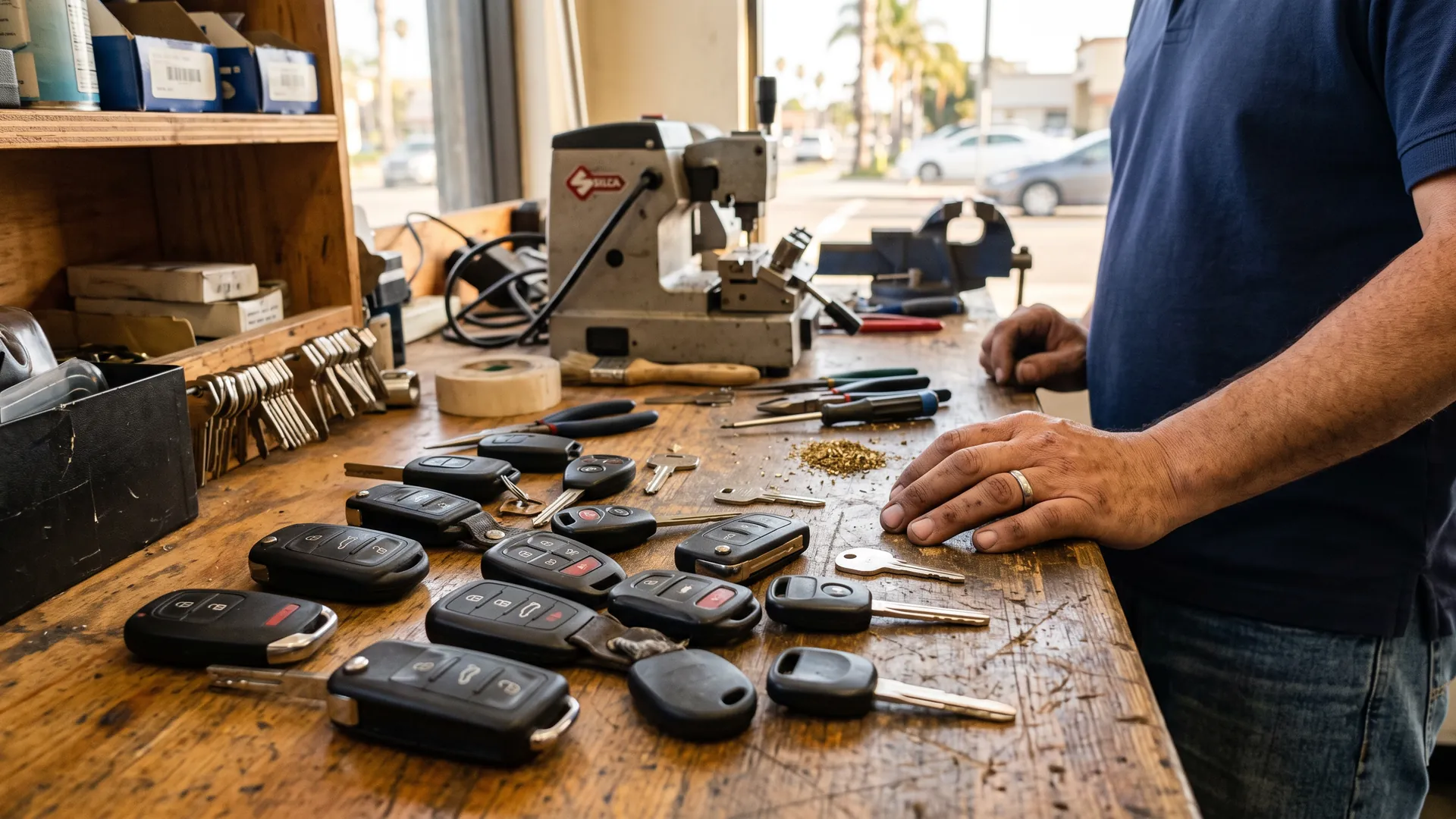
Pontiac models
- Pontiac Aztek2001–2005
- Pontiac Bonneville2000–2005
- Pontiac Firebird2000–2002
- Pontiac G32009–2009
- Pontiac G52007–2009
- Pontiac G62005–2010
- Pontiac G82008–2009
- Pontiac Grand Am2000–2005
- Pontiac Grand Prix2000–2008
- Pontiac GTO2004–2006
- Pontiac Montana2000–2005
- Pontiac Montana SV62005–2006
- Pontiac Solstice2006–2010
- Pontiac Sunfire2000–2005
- Pontiac Torrent2006–2009
- Pontiac Vibe2003–2010
How Pontiac keys and immobilizers work
Pontiac's last decade covers nearly every theft-deterrent system GM used, plus a few it borrowed from partners. The 2000-2002 Firebird and Trans Am use PASS-Key II, often called VATS: a resistor pellet in the blade has to match the value the car expects. The Grand Am and Sunfire use Passlock, where a sensor in the ignition lock cylinder does the checking and the key carries no chip at all. The Bonneville, Aztek, both Montana vans and every Grand Prix from 2000 through 2008 use PASS-Key 3, or PK3, with a transponder in the key head. Later GM-engineered models such as the G5, G6, Solstice and 2007-2009 Torrent use PK3+, the Circle Plus system with a Philips 46 chip, and so does the Holden-built G8. Then come the outside designs: the Vibe follows Toyota, the GTO came from Holden with its own transponder electronics, and the G3 is a Korean-designed Aveo5. Every Pontiac of this era is a turn-key car, and the brand's final cars were built in 2010.
Pontiac key programming
On a Pontiac, the first job is identifying which system you have, because the right approach changes completely. Passlock cars like the Grand Am and Sunfire only need a correctly cut key. A Firebird needs a cut key with the matching VATS resistor value. PK3 and Circle Plus cars need the chip learned: with one working key, an OBD-II key programmer handles it at the car, and on many of these models GM's timed ignition-on sequence can do the same job. The original key keeps working either way. The Vibe follows Toyota's procedures for its 4D-67 chip. The GTO and G3 need tools that cover their Holden and Korean-designed electronics, and the G8 pairs a GM chip with Holden-built electronics, so we check coverage by VIN before quoting. Most fobs are separate transmitters paired as their own step, while the GTO, G3, G8 and later Vibe carry the remote in the key head. Every job starts with your ID and the registration or title.
All Pontiac keys lost
Losing every key to a Pontiac is usually solvable where the car sits. On a Passlock or VATS car we decode a lock or use the key code, cut a key, and for a Firebird match the resistor value read at the steering column. PK3 and Circle Plus cars also need an all-keys-lost relearn through the OBD-II port, which can include timed security waits adding up to about 30 minutes, and keys found later may need relearning. A Vibe may need an immobilizer reset, and a GTO, G8 or G3 can need special tool coverage or dealer-level access, which we confirm before work starts. Proof of ownership comes first.
Pontiac models we cover
- Aztek (2001–2005). The Aztek was Pontiac's polarizing crossover, sold for the 2001 through 2005 model years and built at Ramos Arizpe, Mexico, on the same line as the Buick Rendezvous. It rode on a shortened version of GM's minivan platform with a 3.4-liter V6, and offered Versatrak all-wheel drive, a removable console cooler and an optional tent package. Production ended in December 2004. For key work it belongs with GM's PASS-Key 3 vehicles, so a replacement key needs its chip learned before the engine will run.
- Bonneville (2000–2005). The final Bonneville arrived for the 2000 model year on GM's G platform, shared with the Buick LeSabre, and ran through 2005 as Pontiac's largest car. Trims ran from SE and SLE to the supercharged SSEi, and the 2004-2005 GXP brought a 4.6-liter Northstar V8. Cars were built at Lake Orion, Michigan, with some late cars from Hamtramck, and the last one was assembled on May 27, 2005. Every one uses a PASS-Key 3 transponder key with a separate keyless-entry remote.
- Firebird (2000–2002). The fourth-generation Firebird, including the Formula and Trans Am, was sold through the 2002 model year as coupes, T-top coupes and convertibles, with WS6 performance packages on V8 cars. It shared its F-body platform and assembly plant in Sainte-Therese, Quebec, with the Chevrolet Camaro until production ended in 2002. For key work these cars are unusual: theft protection comes from a resistor pellet in the key blade rather than a transponder chip, so a replacement key is about the right cut and the right resistance.
- G3 (2009–2009). The G3 was Pontiac's smallest US car, a rebadged Chevrolet Aveo5 five-door hatchback with a 1.6-liter four-cylinder, offered in the United States for the 2009 model year only. It arrived in spring 2009, just as GM was preparing to wind down the Pontiac brand, so relatively few were sold. Its key hardware follows the Korean-designed Aveo rather than other Pontiacs: the remote and blade share one head. That matters when you need a replacement, because the parts and programming steps are specific to this small family.
- G5 (2007–2009). The G5 was Pontiac's compact coupe, sold in the United States for the 2007 through 2009 model years. It shared its platform, interior hardware and keys with the Chevrolet Cobalt coupe; the Pursuit and G5 Pursuit sold earlier were Canada-only models. In the US it came only as a two-door. Its keys use GM's Circle Plus transponder system, and it is one of the cars covered by GM's well-known ignition switch recall, which makes the key ring itself part of the story.
- G6 (2005–2010). The G6 replaced the Grand Am for the 2005 model year and became Pontiac's mainstream midsize car, built at Orion Assembly in Michigan on GM's Epsilon platform. The sedan ran through 2010, while the coupe and the retractable-hardtop convertible ran from 2006 through 2009. Trims ran from base and GT to GTP and later GXP. Every G6 uses a Circle Plus transponder key with a separate fob, and remote start was common, so many owners carry a 5-button remote.
- G8 (2008–2009). The G8 was a rear-drive sedan built by Holden in Elizabeth, South Australia, based on the VE Commodore and sold for the 2008 and 2009 model years. The base car used a 3.6-liter V6, the GT a 6.0-liter V8 and the GXP a 6.2-liter LS3. Production ran from December 2007 to June 2009, and a planned Sport Truck was cancelled. Its key is a folding remote key, and the car's Holden-built electronics make it a different playbook from GM's North American Pontiacs.
- Grand Am (2000–2005). The fifth-generation Grand Am was sold as a sedan and coupe from 1999 through 2005 and built in Lansing, Michigan, on GM's N-body platform, with SE and GT trims. Engines included a 2.4-liter Twin Cam, the 2.2-liter Ecotec from 2002, and a 3.4-liter V6. Production ended in May 2005 as the G6 took over. Its keys are simple to duplicate because the Passlock theft system reads the ignition cylinder rather than a chip in the key.
- Grand Prix (2000–2008). The Grand Prix was Pontiac's midsize W-body car through this period. The 1997-2003 design, built in Kansas City, Kansas, came as a sedan and coupe with GT and GTP trims, the GTP using a supercharged 3.8-liter V6; the coupe ended after 2002. The 2004-2008 sedan moved production to Oshawa, Ontario, and added a 5.3-liter V8 GXP late in the 2005 model year. Both designs use GM's PASS-Key 3 transponder keys, but the key profile, fob and remote-start options change with the year, so the model year and the key head both matter.
- GTO (2004–2006). The revived GTO was a rear-drive V8 coupe built by Holden at Elizabeth, South Australia, derived from the Holden Monaro and sold for the 2004 through 2006 model years. The 2004 car used the 5.7-liter LS1; 2005 and 2006 cars got the 6.0-liter LS2, with a six-speed manual or four-speed automatic. About 40,800 reached US buyers across the three years. Its key is a remote head key with Australian-designed electronics, which makes replacements more specialized than on Pontiac's North American cars.
- Montana (2000–2005). The Montana was Pontiac's minivan, a twin of the Chevrolet Venture and Oldsmobile Silhouette, offered in regular and extended lengths with available all-wheel drive in later years. Pontiac introduced Montana as its own model for 1999, and the original body continued as a fleet model for 2005 after the Montana SV6 arrived. Built in Doraville, Georgia, these vans use PASS-Key 3 transponder keys and separate remotes, many with buttons for the power sliding doors. Its successor, the Montana SV6, is listed separately.
- Montana SV6 (2005–2006). The Montana SV6 replaced the original Montana for 2005, adding a longer crossover-style nose to GM's minivan body shared with the Chevrolet Uplander, Buick Terraza and Saturn Relay. In the United States it was sold for only the 2005 and 2006 model years before poor sales ended its US run, though it continued in Canada and Mexico. It was built at Doraville, Georgia. Keys stay with GM's PASS-Key 3 system, and fobs often include sliding door and remote start buttons.
- Solstice (2006–2010). The Solstice was Pontiac's two-seat roadster, built in Wilmington, Delaware, and sold from the 2006 model year, with a turbocharged GXP from 2007 and a targa-roof coupe for 2009. It shared its Kappa platform with the Saturn Sky and Opel GT. Production ended when the Wilmington plant closed in July 2009, and only a handful were registered as 2010 models. Keys use GM's Circle Plus transponder system, and the car is part of GM's ignition switch recall, so key ring weight matters.
- Sunfire (2000–2005). The Sunfire was Pontiac's compact J-body car, sold from 1995 through 2005 alongside the Chevrolet Cavalier. In the United States it was sold only as a coupe from 2003, when a facelift arrived and the 2.2-liter Ecotec became the only engine. Production ended in June 2005, and the G5 eventually took its place. Its keys are straightforward because the Passlock theft system lives in the ignition cylinder, leaving the key itself as a simple cut metal blade.
- Torrent (2006–2009). The Torrent replaced the Aztek as Pontiac's crossover for the 2006 model year and ran through 2009. It was a restyled version of the first-generation Chevrolet Equinox with firmer suspension, built by CAMI in Ingersoll, Ontario, with a 3.4-liter V6 and, from 2008, a GXP model using a 3.6-liter V6 and six-speed automatic. Catalogs list GM's Circle Plus transponder key for 2007-2009 cars with a separate fob that added remote start, while the 2006 launch-year cars sit under different listings.
- Vibe (2003–2010). The Vibe was a compact hatchback developed with Toyota and built by NUMMI in Fremont, California, alongside the Toyota Matrix. The first generation ran from 2003 through 2008, with a sporty GT and an all-wheel-drive model offered until 2006. The second generation covered the 2009 and 2010 model years, although production ended in August 2009. Because the Vibe shares Toyota's electrical design, its keys and immobilizer follow Toyota practice rather than GM's, which surprises many owners.
Common Pontiac key problems
- A flashing security light and a crank-no-start on a Grand Am or Sunfire usually points to the Passlock sensor in the ignition cylinder, not the key. A new key will not cure it; the cylinder or sensor needs service and a relearn.
- The G5 and Solstice were part of GM's 2014 ignition switch recall, which warned that a heavy key ring could turn the switch out of run. Keep only the car key and fob on the ring.
- Firebird no-starts with the right key often trace to worn VATS contacts or wiring in the steering column. The starter stays locked out for a few minutes after a bad reading, so repeated cranking makes things worse.
- Ignition cylinders on twenty-year-old Grand Prix, Grand Am and Bonneville cars wear along with their keys. Cutting a fresh key to factory depths, rather than copying a worn one, often restores a smooth turn.
- A cracked plastic head on a PK3 or Circle Plus key can let the transponder fall out, leaving a key that unlocks the doors but will not start the car. A new learned key is the lasting fix.
- Replacement fobs bought online often refuse to pair because the FCC ID or part number differs from the original. Read the back of your old fob before ordering, or let us source the matching one.
- Inland heat shortens the life of the CR2032 cells in most Pontiac fobs, and the G3 uses a smaller CR1620. If range drops before the buttons stop working, start with a fresh battery.
- Remote head and folding keys on the GTO, G8 and G3 wear where the blade meets the head. A new shell can often be fitted around the original electronics, which avoids programming a whole new remote.
Dealer or mobile locksmith?
The biggest difference between a dealership and a mobile locksmith is where the work happens. A dealer programs keys in its service bay, so if every key is lost, the car usually has to be towed there, and you work around the service department's schedule and the time it takes to order a key by VIN. Julian's Locksmith brings the cutting machine, key blanks and programming equipment to the car, whether it sits in your driveway, a workplace lot or a parking structure. For a Pontiac car we can program on-site, that means no tow and no shuttle rides back and forth. The trade-off is real, though: on vehicles where only the dealer can program keys, a tow or appointment may still be necessary, and we'll say so before you spend anything on our visit.
How the job works
- Identify the exact key your car uses. Every job starts with the VIN, the trim and a look at any key you still have. From those we confirm the keyway, the transponder or smart-key chip, the remote frequency, the FCC ID and the button layout. Two Pontiac car keys that look identical can carry different electronics, so this step keeps the wrong part from ever reaching the car.
- Verify ownership before any work. California holds licensed locksmiths responsible for knowing whose car they're making keys for. We record your name, the VIN and the plate on a work order. If you aren't the registered owner, you'll need the owner's written authorization along with your own photo ID before we begin.
- Get the key code or decode the lock. If you still have a working key, we can read its cuts directly and check them against the factory depths for the Pontiac keyway. A worn key gets corrected back to spec during this step, so the new key turns crisply instead of reproducing years of wear in a fresh piece of metal.
- Cut the blade on-site. Our van carries a code-cutting machine that handles both traditional edge-cut blades and the laser-cut, side-milled profiles common on newer keys. The blade is cut to the code, then test-fitted in a door lock and the ignition or emergency keyhole to confirm smooth operation before any programming begins.
- Program the chip, remote or smart key. Programming tells the car's computers that the new key belongs to the vehicle. Transponder chips are added to the immobilizer, remote buttons to the body control module, and proximity fobs to the keyless system. If a step requires dealer-only access on your car, you'll have heard that before we arrived, not halfway through the job.
- Test everything and clear out old keys. Before we leave, every function gets checked: doors, trunk or liftgate, panic button, remote range, engine start, and the emergency blade in the driver's door. If keys are missing, we delete them from the car's memory where the system allows, so a lost key can no longer start the engine.
Proof of ownership
Not every situation fits the simple case, so here's how we handle the common exceptions. For a leased or financed vehicle, a registration that lists you as the registered owner or lessee works with your ID. If you just bought the car, bring the signed title or bill of sale along with your ID. For a company or fleet vehicle, we need written authorization from the business plus the driver's ID. If the car belongs to a family member, the registered owner should be present or provide signed permission and a copy of their ID. Rental vehicles go through the rental company.
Frequently asked questions
Do you come to Southern California to make car keys, or do I bring the car to you?
We come to you. Julian's Locksmith is a mobile-only service, so the van drives to wherever the car is parked in Southern California: your driveway, an apartment lot, a workplace or a shopping center. That matters most when every key is lost, because it saves you a tow. Just make sure we'll have room to work beside the driver's door and that the vehicle is accessible when we arrive.
When can you come out to Southern California for a car key?
We work every day from 6:30 a.m. to 11:30 p.m., weekends included. Weekends are included. Call (951) 903-3193 and we'll give you an honest ETA to Southern California based on where we are at the time. If you're stuck outside our hours, it's usually smarter to leave the car parked and locked, get home safely, and call when we open than to pay for an overnight tow.
What happens to the key I lost? Can it still start my Pontiac?
When we program new keys, we can usually erase lost keys from the immobilizer, which stops them from starting the engine. On some systems the car only remembers the keys present during programming, so the lost one drops off automatically. Keep in mind that a lost key's metal blade can still open the doors, so if it went missing with something that shows your address, ask about rekeying the door locks.
Can you fix a broken Pontiac key instead of replacing it?
Often, yes. If the shell is cracked, the buttons are worn or the blade snapped, but the circuit board and chip are healthy, we can transfer the electronics into a new housing and cut a fresh blade to your key code. Your existing programming stays intact. If the board has been damaged by water or impact, a repair won't last, and we'll recommend a new programmed key instead.