
Automotive locksmith
Chevrolet Key Replacement
Short answer: Julian's Locksmith makes Chevrolet keys on site: basic mechanical key, transponder (chip) key, remote head key, key with a separate remote fob, flip key and smart proximity key with push-button start for 42 Chevrolet models from 2000 to 2026. A few models need a dealer-supplied key, and each model page says which. Pick your model below, or call (951) 903-3193 with your VIN.
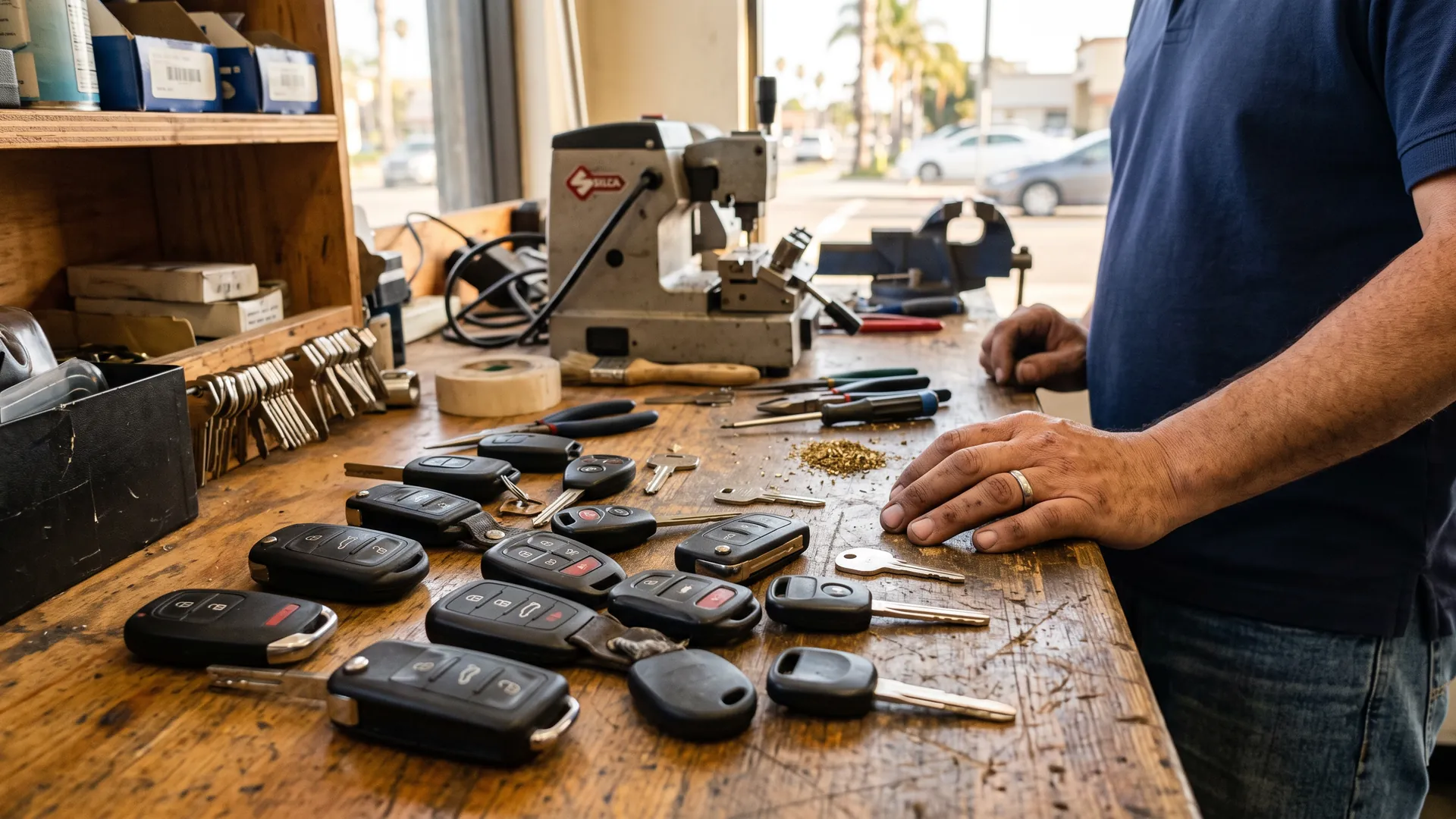
Chevrolet models
- Chevrolet Astro2000–2005
- Chevrolet Avalanche2002–2013
- Chevrolet Aveo2004–2011
- Chevrolet Blazer2000–2026
- Chevrolet Blazer EV2024–2026
- Chevrolet Bolt EV / Bolt EUV2017–2023
- Chevrolet Camaro2000–2024
- Chevrolet Captiva Sport2012–2015
- Chevrolet Cavalier2000–2005
- Chevrolet City Express2015–2018
- Chevrolet Cobalt2005–2010
- Chevrolet Colorado2004–2026
- Chevrolet Corvette2000–2026
- Chevrolet Cruze2011–2019
- Chevrolet Equinox2005–2026
- Chevrolet Equinox EV2024–2026
- Chevrolet Express2000–2026
- Chevrolet HHR2006–2011
- Chevrolet Impala2000–2020
- Chevrolet Kodiak2000–2009
- Chevrolet Lumina2000–2001
- Chevrolet Malibu2000–2025
- Chevrolet Metro2000–2001
- Chevrolet Monte Carlo2000–2007
- Chevrolet Prizm2000–2002
- Chevrolet S-102000–2004
- Chevrolet Silverado 15002000–2026
- Chevrolet Silverado EV2024–2026
- Chevrolet Silverado HD (2500/3500)2000–2026
- Chevrolet Sonic2012–2020
- Chevrolet Spark2013–2022
- Chevrolet SS2014–2017
- Chevrolet SSR2003–2006
- Chevrolet Suburban2000–2026
- Chevrolet Tahoe2000–2026
- Chevrolet Tracker2000–2004
- Chevrolet TrailBlazer2002–2026
- Chevrolet Traverse2009–2026
- Chevrolet Trax2015–2026
- Chevrolet Uplander2005–2008
- Chevrolet Venture2000–2005
- Chevrolet Volt2011–2019
How Chevrolet keys and immobilizers work
Chevrolet key systems since 2000 fall into a handful of families, and the model year usually tells us which one a car or truck carries. The 2000-2002 Camaro still used PASS-Key II, where a resistor pellet in the key blade was the only electronic check. Most trucks, vans and many cars of that period, including the Cavalier, the 2000-2005 Impala, the S-10 Blazer and the first Avalanche, used Passlock instead: the sensor sits in the ignition cylinder and the key holds no chip. The C5 Corvette was an early PASS-Key 3 car with a transponder in the key head. From about 2006, Circle Plus keys carrying a Philips 46 chip spread across the lineup, from the Cobalt and Impala to the Avalanche and Express. The 2010s brought HU100 laser-cut blades and flip keys, then proximity fobs with push-button start. Starting with the 2020 Corvette, newer models moved to GM's Global B electrical architecture, where key programming needs online authorization, and the Blazer EV and Equinox EV use it too. Two outliers follow their builders: the Korean-engineered Aveo and the Nissan-built City Express.
Chevrolet key programming
Programming a Chevrolet key starts with identifying the system. PASS-Key II keys are never programmed; we measure the resistor value and cut a blank with the matching pellet. Passlock keys only need cutting, though the theft module may need GM's timed relearn after cylinder work. Circle Plus and HU100 transponder keys are added through the OBD-II port with a key programmer, and GM's owner's manuals also describe an on-board add when you already hold recognized keys. Separate keyless-entry remotes are learned as their own step. Proximity fobs on Global A models, such as the 2016-2024 Camaro and the 2018-2024 Equinox, are registered over OBD-II with no on-board shortcut. Global B vehicles need a tool with a live online connection, and some jobs still require dealer software. Before any of it, we check your ID and registration so we know the vehicle is yours.
All Chevrolet keys lost
When every key is gone, the route depends on the system. On Passlock and PASS-Key II vehicles we cut a new key from the code or by decoding a lock, add the right resistor pellet where needed, and the vehicle starts with no programming. Circle Plus and HU100 transponder vehicles get a freshly cut key programmed over OBD-II, and GM's own 30-minute relearn also works on many of them, erasing the lost keys in the process. Proximity-fob models need a new fob, an emergency blade cut to the locks and a programmer, often with a long security wait. Global B models and the electric Blazer EV and Equinox EV may need online authorization or the dealer, and we tell you which before starting. Expect to show ID and proof of ownership first.
Chevrolet models we cover
- Astro (2000–2005). The Astro was Chevrolet's rear-drive midsize van, built in passenger and cargo versions and sold alongside the nearly identical GMC Safari until production ended in 2005. Fleets, contractors and families used them hard, so many still on the road have worn door locks and ignition cylinders. Every 2000-2005 Astro uses a plain metal key with no transponder, which keeps key replacement simple. Vans with power locks came with a separate keyless-entry remote, and all-wheel-drive versions use the same key as two-wheel-drive vans.
- Avalanche (2002–2013). The Avalanche was Chevrolet's crew-cab pickup with a fold-down midgate that opened the cab into the bed, built from 2002 through 2013 on Suburban and Silverado underpinnings. Its two generations sit on opposite sides of GM's key change. The 2002-2006 trucks use a chipless key with Passlock in the ignition, while the 2007-2013 trucks moved to a Circle Plus transponder key that has to be programmed. Both generations use a separate keyless-entry remote, and the later trucks often added remote start.
- Aveo (2004–2011). The Aveo was Chevrolet's subcompact, engineered by GM's Korean operation and sold in the US from 2004 through 2011 as a sedan and as the Aveo5 hatchback, before the Sonic replaced it. Its immobilizer comes from the Korean side of GM rather than the Circle Plus system used on American-built Chevrolets of the period, so programming follows a different procedure. Aveos start with a turned transponder key, and the keyless-entry hardware varies by year and trim.
- Blazer (2000–2026). Chevrolet used the Blazer name on two very different vehicles in this period. The truck-based S-10 Blazer, a two- and four-door SUV, carried on through 2005 even after the larger TrailBlazer took over most of its sales in 2002. The name returned for 2019 on a midsize crossover with push-button start. The keys could hardly be more different: a chipless Passlock key on the old SUV and a proximity smart key on the new one, so the model year decides everything.
- Blazer EV (2024–2026). The Blazer EV is Chevrolet's electric midsize crossover, built in Mexico on GM's Ultium-based BEV3 platform and sold from the 2024 model year in LT, RS and high-performance SS form. Its electronics run on GM's newest Global B architecture. There is no conventional start button: with an authorized fob inside, pressing the brake readies the car to drive. That design is convenient day to day, but it also means replacement keys depend on newer, tightly controlled programming systems.
- Bolt EV / Bolt EUV (2017–2023). The Bolt EV was Chevrolet's compact electric hatchback, sold from 2017 to 2023, with the slightly larger Bolt EUV joining for 2022 and 2023. Both were recalled for battery pack replacement. Every Bolt powers up with a button and a proximity fob, but the fob changed with the 2022 refresh, so a fob for a 2019 Bolt EV will not program to a 2022 Bolt EUV. A new-generation Bolt arrives as a 2027 model, outside the years covered here.
- Camaro (2000–2024). Chevrolet's pony car covers three key eras in this range. The fourth-generation Camaro ended with the 2002 model year still using GM's resistor-pellet PASS-Key II system. After a seven-year break, the 2010 Camaro returned with a flip key and transponder, and the 2016-2024 sixth generation moved to push-button start with a proximity fob. Convertibles, SS and ZL1 models follow the key hardware of their generation, though convertible fobs can differ from coupe fobs.
- Captiva Sport (2012–2015). The Captiva Sport was a compact crossover Chevrolet sold mainly to rental and fleet buyers from 2012 to 2015, essentially a continuation of the 2008-2010 Saturn Vue after the Saturn brand was discontinued. It uses a turned key with a Circle Plus transponder and a separate keyless-entry remote, the same arrangement as the last Vue. Four-cylinder and V6 versions share the key, and because so many passed through fleets, the history of the keys on a used one is worth checking.
- Cavalier (2000–2005). The Cavalier was Chevrolet's compact sedan and coupe for more than two decades, and the 2000-2005 cars are the last of the third generation, freshened for 2003. Every one of them uses Passlock: the key is plain metal, and the theft check happens in the ignition cylinder. That keeps keys simple to replace, while aging cylinders and Passlock sensors are the usual cause of no-starts on these cars. Z24 and LS Sport models share the same key as the base car.
- City Express (2015–2018). The City Express was a small cargo van that Nissan built for Chevrolet from its NV200, sold from the 2015 to 2018 model years mostly to businesses and fleets. Under the bowtie it is a Nissan, and so is the key: a remote-head key with lock, unlock and panic buttons in the head and a Nissan transponder inside. That matters when you call around, because the right parts and programming procedure come from the Nissan side rather than from GM.
- Cobalt (2005–2010). The Cobalt replaced the Cavalier for 2005 and ran through 2010 as a coupe and sedan, including supercharged and later turbocharged SS models. It is also the car at the center of GM's 2014 ignition switch recall. Most Cobalts use a Circle Plus transponder key with a separate remote, and the key ring matters more here than on most cars: GM's recall advice was to carry nothing but the ignition key until the repair was done.
- Colorado (2004–2026). The Colorado is Chevrolet's midsize pickup. The first truck ran from 2004 to 2012, the name skipped 2013 and 2014, and an all-new truck arrived for 2015, with the ZR2 off-roader joining for 2017. The third generation, launched for 2023, moved to push-button start and GM's newest electrical architecture. Each generation uses a different key: a chipless key on the first, an HU100 transponder key with a separate remote on the second, and a proximity fob on the third.
- Corvette (2000–2026). The Corvette spans four generations in this range, and its keys trace GM's whole progression. The C5 used a transponder key with a separate remote, the C6 made keyless push-button start standard in 2005, the C7 refined that system from 2014, and the mid-engine C8, launched for 2020, was the first vehicle on GM's Global B electrical architecture. That last step matters most for replacement keys, because Global B programming requires online authorization.
- Cruze (2011–2019). The Cruze was Chevrolet's compact sedan from 2011, later joined by a diesel and, in the second generation, a hatchback. The first generation stayed on sale as the fleet-oriented Cruze Limited during 2016 while the redesigned car arrived, and US production ended in 2019. Key hardware tracks those changes: first-generation cars all use a flip key, while second-generation cars split between a flip key on most trims and a proximity fob with push-button start on Premier and some LT and hatchback models.
- Equinox (2005–2026). The Equinox is Chevrolet's compact crossover, sold since 2005 and now in its fourth generation. The 2005-2009 model began with a chipless Passlock key and switched to a Circle Plus transponder key for 2007. The second generation used a flip key, the third made push-button start standard across the lineup, and the 2025 redesign moved to GM's Global B architecture with online-authorized key programming. The electric Equinox EV is a separate vehicle and should not be confused with these when ordering parts.
- Equinox EV (2024–2026). The Equinox EV is Chevrolet's electric compact crossover, built in Mexico on GM's BEV3 platform with Global B electronics. Deliveries of the 2024 model began in May 2024, and the 2025 lineup was simplified to LT and RS trims. Despite the shared name, it has little in common with the gas Equinox under the skin, so keep the two apart when ordering parts. Plan on treating fob replacement as a specialized job tied to GM's newest security software.
- Express (2000–2026). The Express is Chevrolet's full-size van and the twin of the GMC Savana, built in cargo, passenger and cutaway versions on the same basic design since 1996, with a major update for 2003. Because the body has stayed in production so long, the key has changed twice underneath it. Fleet managers should check which key era each van belongs to, since keys for a 2006 van, a 2012 van and a 2020 van are three different parts.
- HHR (2006–2011). The HHR was Chevrolet's retro-styled compact wagon, built on the same Delta platform as the Cobalt from 2006 to 2011, with a two-door Panel cargo version added during the run and a turbocharged SS for 2008-2010. Like the Cobalt, it was part of GM's 2014 ignition switch recall. It uses a Circle Plus transponder key with a separate remote, and keeping a light key ring is part of living with one safely.
- Impala (2000–2020). The Impala returned as a front-drive sedan for 2000 and stayed in Chevrolet's lineup through 2020. The 2000-2005 cars use a chipless Passlock key, the 2006-2013 generation moved to a Circle Plus transponder key, and the 2014-2020 car offered both a flip key and push-button start. The older body also lived on as the fleet-only Impala Limited from 2014 to 2016, which uses the earlier key, so read your registration carefully.
- Kodiak (2000–2009). The Kodiak was Chevrolet's medium-duty conventional truck, sold in weights from the C4500 to the C8500 and upfitted as box trucks, wreckers, dump trucks, utility rigs and the odd crew-cab pickup conversion. It shared its design with the GMC TopKick, and GM ended production in 2009 when it left the medium-duty business. Many of these trucks now work for small fleets and owner-operators, often with replaced cylinders and aftermarket body locks, so we treat each one as its own key puzzle.
- Lumina (2000–2001). The Lumina sedan was Chevrolet's midsize front-drive car through 2001, and its final years overlapped the new Impala, with many late cars going to fleets. Only the 2000 and 2001 model years fall in this range. These cars sit at the tail end of GM's PASS-Key era: catalogs generally list Passlock for 2000-2001 Luminas, but the earlier resistor-pellet key was used on this platform for years, so the key in your hand is the best guide to what you need.
- Malibu (2000–2025). Chevrolet's midsize sedan went through five distinct designs between 2000 and its final 2025 model year, and its keys changed almost as often as its sheet metal. Cars through 2007 rely on the Passlock sensor in the ignition cylinder, 2008-2012 cars moved to a chipped Circle Plus key, 2013-2015 cars got a flip key, and 2016-2025 Malibus split between a flip key and a smart fob with a start button. Fleet-oriented Classic and Limited versions sold beside newer cars use the keys of the design they were built on, so the body matters as much as the year.
- Metro (2000–2001). The Metro was Chevrolet's smallest car, a Suzuki-engineered subcompact that carried on after the Geo brand was retired. In the 2000-2026 window it covers only the 2000 and 2001 model years: a three-door hatchback and four-door sedan for 2000, then only the LSi sedan for 2001, its last year in the US. Key work on a Metro is purely mechanical, with no chip and no immobilizer, just an accurately cut key and a lock cylinder that still turns freely after more than two decades.
- Monte Carlo (2000–2007). Chevrolet's two-door Monte Carlo shared its front-drive W-body underpinnings with the Impala, and its last two designs cover 2000 through 2007. The 2000-2005 coupe uses a plain key with Passlock in the ignition cylinder, while the restyled 2006-2007 car moved to the Circle Plus transponder key used across much of GM's lineup at the time, including on the V8-powered SS. Neither generation offers push-button start, so every Monte Carlo has a conventional ignition cylinder, and keyless entry, where fitted, comes from a separate remote.
- Prizm (2000–2002). The Prizm was a Toyota Corolla built at the NUMMI plant in Fremont, California, and sold with Chevrolet badges from 1998 to 2002. Because it is Toyota underneath, its keys and locks follow Toyota practice rather than GM's Passlock or PK3 systems. Within the 2000-2026 window it covers the 2000 to 2002 model years, the end of the line before the Pontiac Vibe took its place at NUMMI. Most Prizm key requests today are spares or worn-key replacements on a car that has outlasted its original keys.
- S-10 (2000–2004). Chevrolet's compact pickup reached the end of its second generation in 2004, when the Colorado took its place. Between 2000 and 2004 the S-10 came as a regular cab, an extended cab with an optional third door and, from 2001, a Crew Cab, plus the off-road ZR2 and the lowered Xtreme. All of them use a key with no transponder chip and GM's Passlock theft deterrent in the ignition cylinder, so key replacement is a cutting job, while no-start complaints usually trace back to the ignition lock.
- Silverado 1500 (2000–2026). The Silverado 1500 is Chevrolet's best-selling vehicle, and its key system has changed with nearly every generation since the GMT800 trucks of 2000. Passlock trucks through 2006 use a plain key, 2007-2013 trucks moved to a chipped Circle Plus key, 2014-2018 trucks got the laser-cut HU100 blade, and smart keys arrived on upper trims for 2019 before the 2022 refresh brought Global B electronics and Hitag Pro fobs. Carryover Classic, LD and LTD trucks sold beside new designs keep the keys of the truck they were built from.
- Silverado EV (2024–2026). The Silverado EV is Chevrolet's full-size electric pickup, built at GM's Factory Zero in Detroit on the Ultium-based BT1 platform, a narrower relative of the Hummer EV's underpinnings. Production started in 2023 for the 2024 model year, with the first trucks going to fleet buyers in WT form before the RST and other retail trims followed. A front trunk and a fold-down midgate set it apart from the gas Silverado, and so does its key: a proximity fob tied to GM's newest, online-controlled security.
- Silverado HD (2500/3500) (2000–2026). Chevrolet's heavy-duty Silverado 2500HD and 3500HD pickups and chassis cabs follow the 1500's key technology, often a year behind because they are redesigned on their own schedule. Passlock trucks run through 2006, Circle Plus keys cover 2007-2014, the HU100 blade arrives for 2015, upper trims gain push-button start for 2020, and Global B electronics come with the 2024 refresh. Duramax diesels and gas V8s use the same keys within a generation, so year and trim decide what you need, not the engine.
- Sonic (2012–2020). The Sonic replaced the Aveo for 2012 as Chevrolet's subcompact, sold as a sedan and a five-door hatchback through the 2020 model year, including the turbocharged RS. Every US Sonic we know of uses a turn-key ignition, and most came with GM's flip key, which folds a laser-cut HU100 blade into a remote with the transponder inside. That keeps key replacement straightforward: a new flip key, cut and programmed at the car, covers both starting the engine and remote locking.
- Spark (2013–2022). Chevrolet's smallest car of the 2010s was a Korean-built five-door hatchback sold in the US from 2013 to 2022. The first generation ran through 2015, joined by the battery-electric Spark EV from 2014 to 2016 in a few states, and a redesigned Spark followed for 2016 with push-button start offered on its top trim. Key replacement is usually simple on a Spark, but the second generation's keyless option means checking the dash for a START button before ordering anything.
- SS (2014–2017). The SS was a rear-drive V8 performance sedan built by Holden in Australia and sold by Chevrolet from 2014 to 2017. Based on the VF Commodore, it carried a 6.2-liter LS3 and, from 2015, the option of a six-speed manual. Its key system comes from Holden rather than from Chevrolet's US-built cars, with push-button start and a smart fob on every car. Few were sold, so parts and programming options are thinner than for a Malibu or Impala, and a second working fob is worth having.
- SSR (2003–2006). The SSR, short for Super Sport Roadster, was Chevrolet's retro-styled convertible pickup with a power-retractable hardtop, built at the Lansing Craft Centre in Michigan for the 2003 to 2006 model years. It rides on a version of the TrailBlazer's GMT360 platform, and its key system follows that SUV: a plain, chipless key with Passlock in the ignition. Low production makes some body parts hard to find, but the key itself is simple to replace once the ignition cylinder is in good shape.
- Suburban (2000–2026). The Suburban is the longest-running nameplate in the American market, and from 2000 through 2026 it spans four generations shared with the Tahoe and GMC Yukon XL. Its keys track GM's truck technology: Passlock keys through 2006, Circle Plus transponder keys for 2007-2014, HU100 keys with optional push-button start for 2015-2020, and Global B smart fobs from 2021. Half-ton and heavy-duty Suburbans of the same year use the same key system, so the model year and the ignition style are what we need to know.
- Tahoe (2000–2026). The Tahoe is Chevrolet's full-size SUV on the Silverado's frame, the shorter sibling of the Suburban. From 2000 to 2026 it covers four generations, and its keys follow the same path as GM's trucks: Passlock through 2006, Circle Plus transponders through 2014, HU100 keys and optional push-button start through 2020, then Global B smart fobs from 2021. Police Pursuit Vehicle and Special Service Tahoes use the key system of their generation, sometimes with fleet-specific options, so we check the VIN on any former police unit.
- Tracker (2000–2004). The Tracker was Chevrolet's version of the Suzuki Vitara, a compact body-on-frame SUV sold as a two-door convertible and a four-door hardtop. The second generation arrived for 1999 and ran until Chevrolet dropped the Tracker in the US after 2004, with ZR2 and LT versions alongside the base model. Because Suzuki engineered it, the key and locks have nothing in common with other Chevrolets of the time. Most Tracker key jobs today involve worn keys and tired cylinders rather than electronics.
- TrailBlazer (2002–2026). Chevrolet has used the TrailBlazer name on two very different vehicles. The 2002-2009 TrailBlazer was a body-on-frame midsize SUV, including the long-wheelbase EXT through 2006 and the V8-powered SS from 2006, with a plain Passlock key. After an eleven-year break, the name returned for 2021 on a small front- or all-wheel-drive crossover built in South Korea, slotting between the Trax and Equinox. The two share nothing in their keys, so the model year is the first thing we ask.
- Traverse (2009–2026). Chevrolet's three-row crossover arrived for 2009, effectively replacing the Uplander minivan and the TrailBlazer, and it has grown through three generations since. The first, on GM's Lambda platform, uses a Circle Plus transponder key with a separate remote; every 2018-2023 Traverse starts with a button and smart fob; and the 2024 redesign moved to Global B electronics with encrypted Hitag Pro fobs. A short-run 2024 Traverse Limited kept the previous design, which is worth knowing if your registration says 2024.
- Trax (2015–2026). The Trax is Chevrolet's smallest crossover. The first generation, a subcompact closely related to the Buick Encore, ran from 2015 through 2022 in the US, with a refresh for 2017. After a gap with no 2023 model, an entirely different second-generation Trax arrived for 2024, larger and lower and positioned as Chevrolet's entry vehicle. Both generations mix turn-key and push-button cars depending on trim, so we confirm the ignition type before cutting or programming anything.
- Uplander (2005–2008). The Uplander was Chevrolet's last minivan, sold in the US from 2005 to 2008 with SUV-inspired styling and a long front end on GM's U-body platform. It replaced the Venture and shared its structure with the Pontiac Montana SV6, Saturn Relay and Buick Terraza. Every Uplander uses a turn-key ignition with a GM transponder key, and most passenger vans add a separate keyless remote that may also run power sliding doors and remote start. Short-wheelbase vans went mostly to fleets in the later years.
- Venture (2000–2005). The Venture was Chevrolet's front-drive minivan from 1997 to 2005, offered in regular and extended lengths, with the Warner Bros. Edition among its variants. In the 2000-2026 window it covers 2000 through 2005, with only the extended-wheelbase van left for the final year before the Uplander replaced it. Like its Pontiac Montana and Oldsmobile Silhouette siblings, it uses a GM PASS-Key 3 transponder key, so a replacement needs both cutting and programming, a job we can usually finish at the van.
- Volt (2011–2019). The Volt was Chevrolet's plug-in hybrid hatchback, driving on battery power before a gasoline engine took over as a generator. Two generations were sold from 2011 to 2019, and both start with a power button and a proximity key rather than a key in a cylinder. The two generations use different fobs, so check the part number before ordering a spare. Because the car won't power up without a recognized fob, a lost or dead key stops it completely.
Common Chevrolet key problems
- A flashing security light with a crank-no-start, or an engine that dies after a few seconds, is the classic Passlock fault on 2000-2005 Impalas, Cavaliers, S-10 Blazers and first-generation Avalanches. The cylinder sensor or its wiring is usually to blame, not the key.
- GM's 2014 ignition switch recall covered the 2005-2010 Cobalt and 2006-2011 HHR because a heavy key ring could knock the switch out of RUN. If a VIN check shows the recall still open, carry only the ignition key until it is repaired.
- Flip keys on the Camaro, Cruze, Equinox and Impala tend to break at the hinge, leaving the blade floppy or unable to lock open. The transponder and circuit board usually survive, so a new shell often avoids programming a whole new key.
- On trucks, vans and sedans with a separate remote, the remote cannot start the engine. A new fob fixes the locks, but a no-start with a security message is a key or immobilizer problem, which owners often misread as a remote failure.
- Push-button Chevrolets show a remote-not-detected style message when the fob battery runs low. The owner's manual shows a backup spot, usually in the console or cupholder area, where a weak fob can still be read to start the vehicle.
- Global B models such as the 2023 and newer Colorado, the 2025 and newer Equinox and the C8 Corvette use a CR2450 fob battery rather than the CR2032 found in earlier Chevy fobs. The two cells are not interchangeable, so check before buying.
- Inland Empire heat is hard on fob batteries and on the plastic heads of older transponder keys. A cracked head can let the chip shift or fall out, which typically leaves you with a key that turns the ignition but will not start the engine.
- Used fobs bought online are frequently locked to another vehicle. Some Global A fobs can be unlocked or reflashed before programming, but many newer GM fobs cannot be reused at all, so ask us before ordering one.
Dealer or mobile locksmith?
The biggest difference between a dealership and a mobile locksmith is where the work happens. A dealer programs keys in its service bay, so if every key is lost, the car usually has to be towed there, and you work around the service department's schedule and the time it takes to order a key by VIN. Julian's Locksmith brings the cutting machine, key blanks and programming equipment to the car, whether it sits in your driveway, a workplace lot or a parking structure. For a Chevrolet car we can program on-site, that means no tow and no shuttle rides back and forth. The trade-off is real, though: on vehicles where only the dealer can program keys, a tow or appointment may still be necessary, and we'll say so before you spend anything on our visit.
How the job works
- Identify the exact key your car uses. We ask a few quick questions on the phone: the year, whether the car starts with a turn key or a button, how many keys you have left, and whether the remote still works the doors. Then we check the VIN against our programming references so the van arrives with the correct blank or fob, not a close guess.
- Verify ownership before any work. Before cutting or programming, we compare your government photo ID with the vehicle registration or title and check that the VIN on the paperwork matches the VIN on the dash. If the registration is locked inside, we open the car first, confirm the documents, and only then make the key.
- Get the key code or decode the lock. A key is cut from a code, not a guess. When the factory code can be retrieved through manufacturer channels after ownership is verified, we use it. When it can't, we decode a door lock with a pick-decoder tool that reads the wafer positions without damaging anything, then work out any missing cuts.
- Cut the blade on-site. Cutting happens right beside your car. For a smart key, that means the emergency blade hidden inside the fob; for a transponder or remote-head key, it's the main blade you'll use every day. We deburr the cuts and check the fit in each lock so nothing binds or sticks later on.
- Program the chip, remote or smart key. Programming tells the car's computers that the new key belongs to the vehicle. Transponder chips are added to the immobilizer, remote buttons to the body control module, and proximity fobs to the keyless system. If a step requires dealer-only access on your car, you'll have heard that before we arrived, not halfway through the job.
- Test everything and clear out old keys. The last step is a short walkthrough. We show you how many keys the car now recognizes, point out the dead-fob start method for your vehicle, and hand you an itemized receipt. If a spare makes sense, it's simplest to add it during this same visit while the equipment is already connected.
Proof of ownership
Not every situation fits the simple case, so here's how we handle the common exceptions. For a leased or financed vehicle, a registration that lists you as the registered owner or lessee works with your ID. If you just bought the car, bring the signed title or bill of sale along with your ID. For a company or fleet vehicle, we need written authorization from the business plus the driver's ID. If the car belongs to a family member, the registered owner should be present or provide signed permission and a copy of their ID. Rental vehicles go through the rental company.
Frequently asked questions
What happens to the key I lost? Can it still start my Chevrolet?
When we program new keys, we can usually erase lost keys from the immobilizer, which stops them from starting the engine. On some systems the car only remembers the keys present during programming, so the lost one drops off automatically. Keep in mind that a lost key's metal blade can still open the doors, so if it went missing with something that shows your address, ask about rekeying the door locks.
When can you come out to Southern California for a car key?
We work every day from 6:30 a.m. to 11:30 p.m., weekends included. Weekends are included. Call (951) 903-3193 and we'll give you an honest ETA to Southern California based on where we are at the time. If you're stuck outside our hours, it's usually smarter to leave the car parked and locked, get home safely, and call when we open than to pay for an overnight tow.
Do you come to Southern California to make car keys, or do I bring the car to you?
We come to you. Julian's Locksmith is a mobile-only service, so the van drives to wherever the car is parked in Southern California: your driveway, an apartment lot, a workplace or a shopping center. That matters most when every key is lost, because it saves you a tow. Just make sure we'll have room to work beside the driver's door and that the vehicle is accessible when we arrive.
Can you fix a broken Chevrolet key instead of replacing it?
Often, yes. If the shell is cracked, the buttons are worn or the blade snapped, but the circuit board and chip are healthy, we can transfer the electronics into a new housing and cut a fresh blade to your key code. Your existing programming stays intact. If the board has been damaged by water or impact, a repair won't last, and we'll recommend a new programmed key instead.