
Whittier, Los Angeles County
Loose Door Lock Repair in Whittier, Done Right at Your Door
Short answer: A loose door lock in Whittier nearly always comes down to four causes: mounting screws that backed out, a trim ring that spun free, a worn spindle or cylinder, or stripped holes in the door. Snugging the two long screws fixes many. If it keeps loosening, call Julian's Locksmith at (951) 903-3193 and we'll repair or replace it at your door.
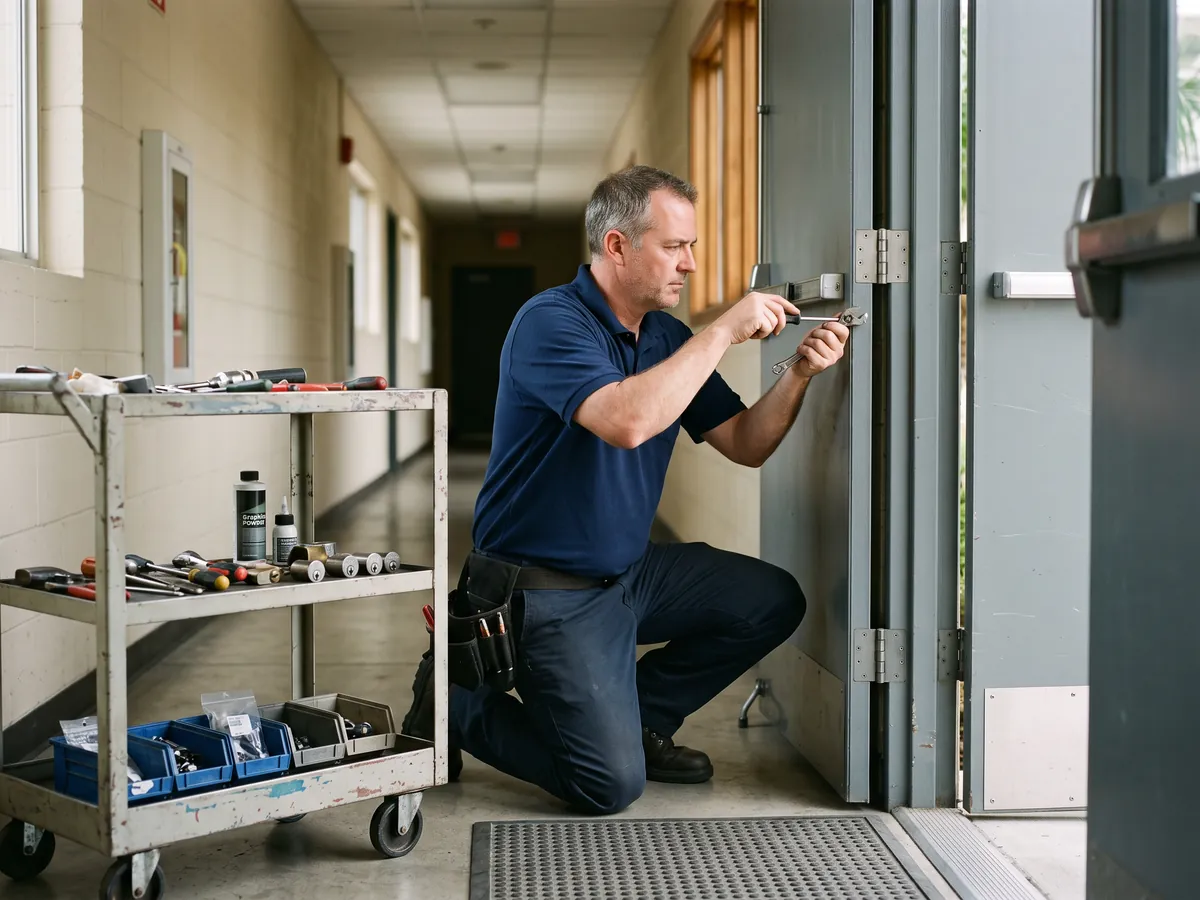
Doors move. In Whittier, a wood door can swell with winter moisture and shrink again during a dry Santa Ana spell, a dark steel door on a west wall bakes through summer afternoons, and a stucco house shifts a little as the ground settles. Each movement twists the lock against the screws that hold it. After enough seasons, that twisting backs out a mounting screw or pulls a latch faceplate loose. It is why a loose door lock so often shows up after a change in weather rather than after any single event. Julian's Locksmith corrects the lock and, where we can, the door movement that loosened it.
What to expect in Whittier
The door your lock lives in matters as much as the lock. Solid wood holds screws well but swells and shrinks. Hollow-core interior doors have thin skins and little structure, so mounting screws can crush the cardboard core and leave the lock slumped in its hole. Steel doors are strong around the bore but can dent, and fiberglass doors depend on a wooden block inside the edge where the latch lives. Aluminum and glass patio doors take hardware screws into thin extrusions that strip easily. Each material has its own repair. Wood can be doweled and re-drilled. A crushed hollow-core door can take a bore reinforcer. A cracked wooden edge may need a repair plate. When the lock hole is oversized or ragged, a reinforcing ring or repair kit brings back a clean, tight fit. Serious structural damage belongs with a door carpenter, and we'll say so plainly. For everything up to that point, Julian's Locksmith can repair the opening and refit the lock on the same visit.
How we can help in Whittier
- Spinning trim rings and cover plates. If the round plate behind your knob turns freely under your fingers, the cover is no longer locked to the chassis. On most sets it twists off or snaps free. We check the mounting plate behind it, re-seat or replace it, and secure it so it stays put. It's a small repair that stops the lock feeling cheap.
- Knobs that spin without opening the door. When the handle turns freely but the latch doesn't move, the connection between handle and latch has failed. The spindle may have rounded off, the set screw may have slipped, or the latch retractor may have broken inside the door. We open the lock up, find the break and replace the weak part so the door opens normally again.
- Stripped screw holes and oversized bores. Hollow-core doors, thin skins and soft pine edges can lose their grip entirely. For those we use door edge repair plates, bore reinforcers and epoxy wood filler. They won't make a bad door good, but a stable, tight seat for the lock is usually achievable, and we'll tell you when the door itself needs a carpenter.
- Patio, garage-entry and side doors. Side doors live outdoors, where sun, sprinklers and dust speed up looseness. We tighten, protect the threads, and swap in weather-rated hardware when the old lock has corroded past the point of being worth saving. Tell us when you call which door it is and what it's made of.
- When replacing the lock is the honest answer. If we recommend replacement, we match the new hardware to your door: the right backset, the right handing and a finish that suits the rest of the house. A well-fitted new lock sits tight from day one. If it makes sense to keep your existing key, we can usually set that up.
Local factors in Whittier
Family homes in Friendly Hills put locks through constant abuse: doors pushed open with a shoulder, handles used as hanging bars, backpacks swinging off knobs. A bedroom or bathroom privacy knob is the most common casualty, and a child stuck behind a jammed door is exactly when you want a lock that opens. We repair or replace worn parts, and where it makes sense we suggest sturdier levers and door stops that take the hits instead.
Foothill homes near Whittier College catch wind-driven dust and grit, plus big swings between day and night temperatures, and wood doors flex with them. Santa Ana gusts also slam poorly latched doors and pound the hardware. Grit in the latch makes a lock feel sticky and tempts people to force it. We clean, lubricate with dry products that don't hold dust, set the strike so the latch seats firmly without banging, and check hinge screws that wind may have worked loose.
Houses from the mid-century decades in Whittier often still wear their original knobs, and years of daily turning rounds off spindles and loosens set screws. Mortise locks and early cylindrical sets are common, along with doors painted over many times. We clean paint out of screw heads, dress or replace worn spindles, and rebuild chewed-up holes with dowels, because original brass hardware is usually worth saving when it can be made tight again. Tell us roughly when the house was built and we'll bring matching parts.
Situations this covers
- Before listing a house in Whittier, a seller and an agent walk through and note six wobbly door locks that a buyer's inspector would flag. We'd go room by room, tighten what only needs tightening, replace the worn ones, and hand back a short written list of what changed, so the hardware stops being a negotiating point.
- It is 11:05 on a Saturday night and the kitchen door handle just came off in someone's hand. We close at 11:30 p.m. every night, so we would say early on whether the drive to Whittier fits before closing. If it doesn't, we'd talk through a safe way to secure the door and book the first Sunday visit.
- Picture a rental where a lever handle droops and the interior trim spins. The tenant sends the property manager a photo and a short note, and the manager books us to repair or replace the set. We'd check the door and strike while there, tighten whatever needs it, and leave a note listing exactly what was done and which keys still work.
- In a 1960s ranch house, the latch faceplate and strike screws have been tightened three times in two years, and each time they chew out of the soft wood again. We would rebuild the holes with dowels and fit a reinforced strike with long screws, then show the owner why the earlier fixes never held.
From your call to the finished job
- Tell us exactly what moves. Photos help if you can text them. A close-up of the inside trim, a shot of the door edge with the latch showing, and the brand name on the knob let us bring the right spindles and screws. Don't worry if you can't identify the brand; we'll sort it out on site.
- Get a quote and a time. We give you an honest arrival estimate and a price based on what you've described. It's a plan, not a trap, and we'll adjust it only if we find something different on site. If the problem sounds bigger than a simple tightening, we'll explain what that could involve.
- Test and diagnose on site. Next, the interior trim comes off. We look at the screws, spindle, cylinder and bore, check for cracked plastic or worn brass, and test the latch by hand. The inspection shows whether a tune-up is enough or whether we're dealing with worn-out hardware.
- Choose repair or replacement. Once we know the cause, we lay out the options with a price for each. Tighten and treat the threads, replace a worn part, rebuild the door opening, or fit a new lock. Nothing starts until you pick one, and if we find more, we explain it before adding anything.
- Refit and test under load. After repairs, we reassemble in the right order and tighten the screws gradually, checking the handle after each pass. We apply removable thread-locker where it helps, confirm the latch retracts fully, and make sure the door closes and latches without a push.
- Hand-off and follow-up checks. Before we leave, we show you what was wrong and what we changed, hand over any spare parts or keys, and point out the screws worth rechecking in a few weeks. A quick follow-up check after the first month can catch anything that settles.
What affects the cost
- How deep the problem goes. The biggest swing is between a lock that only needs tightening and one that needs parts. Re-torquing screws with thread-locker is a short job. Replacing a spindle, spring or cylinder, or rebuilding the door opening, takes more time and materials. We diagnose first, then quote the real cause rather than the symptom.
- Lock grade and brand. Common Kwikset and Schlage models are easy to match, which keeps repairs quick. Older, imported or discontinued hardware takes longer to source, and sometimes we recommend a modern replacement in a matching style. Tell us the brand on the knob or the shape of the trim if you can see it.
- Number of locks and doors. Whole-house sweeps make sense after a purchase, a repaint or a long stretch without maintenance. Tell us how many locks you have and what kinds, and we'll give a combined quote that works out lower per lock than visiting several times. Matching keys on all of them is optional.
Every job gets a clear quote before any work starts. Call (951) 903-3193 with the details and we'll tell you what to expect for your situation in Whittier.
Mistakes to avoid
- Stuffing toothpicks into stripped holes on a high-use door. A glued toothpick may hold a hinge screw on a closet door, but an entry door takes daily torque. Proper dowels, reinforcers or longer screws into the framing hold up far better.
- Taking the lock off a closed door with no plan. Once the knob is gone, the latch can slide out and leave the door shut with nothing to grip. Keep the latch pulled back or prop the door open, and keep a screwdriver on the side you may need to open from.
- Ignoring the door and frame. If the strike is off or the door has dropped, the lock gets blamed for a problem it didn't create. Replacing a lock without fixing alignment just moves the same stress onto new parts, and the new lock loosens too.
Practical tips before you call
- Blue thread-locker is your friend. A tiny dab on set screws and mounting screws holds them against vibration but still lets you remove them later. Skip the red kind, which is meant to be permanent and can ruin the screw or the chassis the next time you need to open the lock.
- Keep a small kit of spare parts. A hex key set, the right screwdriver bits and a spare set of mounting screws cost little, and they turn a minor loosening into a quick fix. Store them in a drawer with a note about which lock they belong to.
- Check your hinges while you're at it. A door that has sagged even a few millimeters pulls the latch against the strike and stresses the lock every time you close it. Tightening the hinge screws, or replacing one with a three-inch screw that reaches the framing, often calms a loose-feeling lock.
- Treat a spinning trim ring as a warning sign. When the round plate behind the knob turns freely, the part behind it has lost its grip. Fix it while the lock still works, because a loose plate usually means the screws behind it are loosening too.
Reaching Whittier
Whittier is about 54 miles from our San Bernardino base, roughly 58 minutes in light traffic via Palm Avenue to I-215 North, I-15 South through Fontana, Rancho Cucamonga and Ontario. When you call, you get an arrival estimate based on where the technician is and the traffic at that moment.
Rush hour on Whittier Boulevard can stretch a drive considerably. We'd rather give you a realistic arrival window than an optimistic one, and we'll call you if a closure or a crash changes the plan.
About Whittier: The magnitude 5.9 Whittier Narrows earthquake struck on October 1, 1987, killing eight people and damaging many historic buildings in Uptown, and the Whittier Conservancy formed that year to resist demolitions.
| Neighborhoods | Whittwood, Central Park, Hadley-Greenleaf, Leffingwell Ranch, East Whittier, Uptown Whittier |
|---|---|
| ZIP codes | 90601, 90602, 90603, 90604, 90605, 90606 |
| Main routes | I-605, Whittier Boulevard, Beverly Boulevard, Colima Road |
| From our San Bernardino base | about 54 miles via Palm Avenue to I-215 North, I-15 South through Fontana, Rancho Cucamonga and Ontario, then I-10 West (San Bernardino Freeway) through Pomona and Covina to I-605 South (San Gabriel River Freeway), exiting at Beverly Boulevard or Whittier Boulevard and heading east into Uptown; Colima Road and Whittier Boulevard lead east to College Hills, Whittwood and East Whittier. Alternate via SR-60 West to I-605 South when the 10 is jammed |
Lock or door hardware trouble in Whittier?
Call (951) 903-3193 with the address and what the door or lock is doing. We'll quote the repair before any work starts.
Frequently asked questions
Is a loose door lock a security risk?
It can be. A lock that moves on the door is easier to twist, pry or wear out, and looseness throws the bolt and latch out of line with the strike so they don't engage fully. It is also a sign that parts are wearing. A quick repair now usually costs much less than replacing the lock later, so don't leave it for months.
What do you need from me before you start?
Confirmation that you live at the address, own the property or are authorized to have the work done. Photo ID is usually enough, along with something showing the address, such as a utility bill or lease. For rentals, we may ask for the landlord's okay. It protects you and the property, and it takes only a moment.
Why does my lever handle droop?
A drooping lever usually has a worn or broken return spring inside the lock, or a loose connection between the lever and the spindle. Heavy levers and busy doors wear springs faster. Some models take a replacement spring cassette; on others it is more practical to replace the lever. We test the spring and tell you which route makes sense.
Do you fix loose patio door handles?
Yes, though sliding doors are different. The handle usually screws into thin aluminum that strips easily, and the latch hooks into a keeper on the frame. We can fit larger screws or thread inserts, replace the handle set or tune the latch and keeper alignment. Sizes vary by brand, so mention the make of the door or send a photo of the handle.
Can you fix a loose smart lock or keypad deadbolt?
Often. Heavy battery-powered locks put extra weight on the mounting, and many come loose from a mismatched backset, a short bolt or a bore that is a bit large. We tighten and align them before we blame the electronics. Electronic faults, such as a failing motor or an app problem, are a different job, and we'll tell you if the lock needs the manufacturer's support.
How long does a loose door lock repair take?
Simple re-tightening is a short task once we're at the door. Replacing worn parts, repairing stripped holes or fitting a new lock takes longer, and several doors take longer still. We'll give you our best estimate of both the arrival time and the work time when you call, and we'll tell you if something changes after we've looked at the lock.
How far is Whittier from your base?
Whittier is about 54 miles from our San Bernardino base, roughly 58 minutes in light traffic. Arrival time depends on traffic and on the job the technician is finishing, so we give you an estimate on the phone before you commit.
Related services in Whittier
Loose Door Lock in nearby cities
- Loose Door Lock in Santa Fe SpringsLos Angeles County
- Loose Door Lock in Hacienda HeightsLos Angeles County
- Loose Door Lock in Pico RiveraLos Angeles County
- Loose Door Lock in La Habra HeightsLos Angeles County
- Loose Door Lock in La MiradaLos Angeles County
- Loose Door Lock in La HabraOrange County
- Loose Door Lock in NorwalkLos Angeles County
- Loose Door Lock in Avocado HeightsLos Angeles County
