
Whittier, Los Angeles County
Locksmith for Retail Store Openings, Remodels and Closings in Whittier
Short answer: Retail's busiest day is our closed day, so timing matters. Julian's Locksmith works every day from 6:30 a.m. to 11:30 p.m., Saturdays included. Book rekeys, repairs and staff key changes for your Whittier store ahead of busy days, and call (951) 903-3193 before a big weekend sale if a door is sticking.
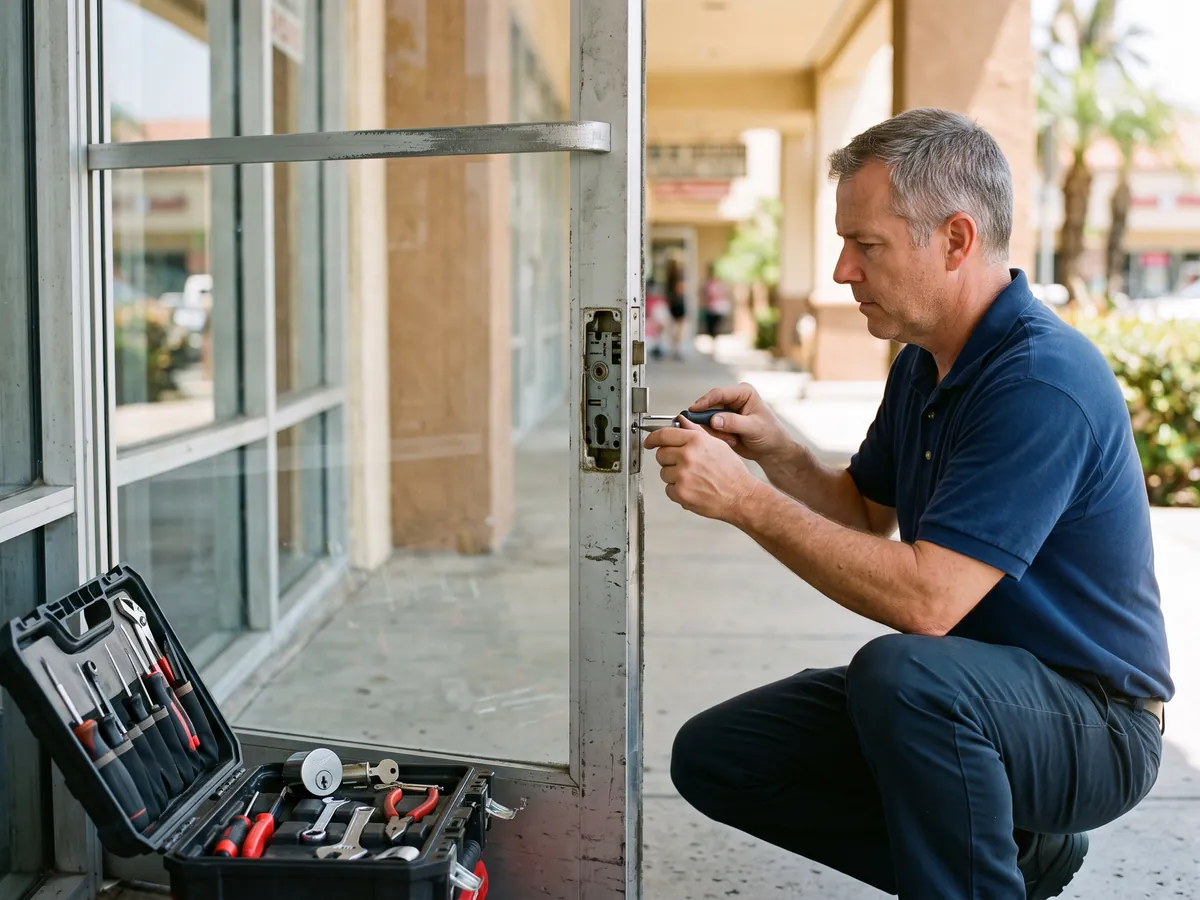
Searching for a locksmith for retail store help usually means one of three things: a door is failing now, you're opening or leaving a space, or you want to tidy up keys before a busy season. This page covers all three. Julian's Locksmith serves Whittier every day from 6:30 a.m. to 11:30 p.m. We're open Saturday too, but it's a big retail day, so we'll help you plan work around it. Call (951) 903-3193, tell us what you sell, and we'll work out what the store actually needs.
What to expect in Whittier
Retail runs on a calendar that doesn't line up neatly with a locksmith's. Julian's Locksmith works every day from 6:30 a.m. to 11:30 p.m. We're closed overnight, and Saturday is a big sales day for most stores. That is workable if you plan for it. Schedule rekeys, repairs and staff changes ahead of busy days, test your front and back doors the day before a big sale, and keep a simple plan for an overnight failure, such as who can secure the door and who calls us when we reopen. A locksmith for retail store owners should be upfront about hours, and we are. Late-evening work after you close, within our schedule, often suits Whittier stores better than daytime. If something does fail overnight, secure the opening with your staff or the landlord's resources, photograph the damage for any report and call us when we reopen, so the permanent repair starts at the first opportunity.
Work included on a typical visit
- Boutiques, apparel and gift shops. A boutique's biggest exposure is often the quiet back door and a front lock that sticks in the morning. We rekey the shop to keys only you control, repair or replace the front cylinder and check fitting-room doors, which need a simple latch that opens from outside in an emergency.
- Convenience stores and corner markets. Convenience stores often run two or three shifts, which multiplies keys. We lay it out so cashiers hold no key to the office, closers hold only what they need and the owner holds the rest. Rekeying when a manager leaves then touches one door instead of all of them.
- Electronics and phone stores. Phones, accessories and small electronics are easy to carry and easy to resell, so inventory control matters. We secure the back room, set up controlled keys for fixture locks and display cabinets and keep a record of who holds which. Locking fixtures can usually share one key, which simplifies opening routines.
- Pop-up, seasonal and holiday shops. Short leases need quick, clean solutions. We rekey the pop-up space on day one, add a keypad if several people will open it and rekey again at the end so the next occupant starts fresh. That keeps temporary shops from leaving keys scattered around town.
- Closing, relocating and lease-end handback. When a store closes, loose ends include forgotten keys, staff cards and hidden spares. We help you account for them and, if needed, rekey before the keys go back to the landlord. That way former staff cannot walk back into a space that is no longer yours.
How Whittier shapes the job
Older downtown storefronts have recessed entries, transom windows, wood-and-glass doors and sometimes a second door to an upstairs office. The hardware is often decades old, with parts that are hard to find. Near Central Park, a locksmith for retail store owners can usually repair and rekey rather than replace, keeping the look while improving security. We check upper-floor doors, alley entries and basement hatches too, because thieves prefer the weakest of them.
Shopping centers and strip malls along Beverly Boulevard put many stores behind one rear service lane, so the back door of your shop shares a space with everyone else's trash, deliveries and cut-throughs. A locksmith for retail store tenants in those centers should start with the rear door, frame and latch, and then handle the front. Know which doors the landlord controls, such as common corridors and roof access, and which are yours, because leases in Whittier divide that line differently.
Neighborhood shops in family suburbs open around school schedules and weekend errands. Parents arrive with strollers, so the front door needs a smooth closer and a latch that doesn't catch. Owners are often alone behind the counter. A locksmith for retail store owners in the residential parts of Whittier keeps hardware friendly to customers, easy for one person to lock up and strong enough to deter after-hours trouble.
Situations this covers
- A pop-up holiday shop takes over a vacant unit near Hellman Wilderness Park from early November through the first week of January. The owner doesn't want a drawer full of keys. We'd install a keypad lock on the rear staff door, rekey the front, record the original hardware for the landlord and schedule a return rekey after the shop closes.
- A franchise operator opening a third location in Whittier wants the new store keyed to match the other two for the regional manager, but with separate keys for staff. We'd design a small system: a master that opens all three stores, a different key family for each store's staff and a stockroom key that is not in the master. We'd document it and confirm the owner's authority.
- At 10:30 on a Friday night, the front deadlatch on a gift shop sticks, and a weekend sale is advertised. We stop at 11:30 p.m. and reopen at 6:30 a.m. The owner calls right away so we can see what's possible before the cutoff. If a repair can't be finished in time, we'd help choose a temporary way to keep the store secure.
- Say a phone accessories shop in a mall near Hoover Hotel loses a key to its display cases. The cases all use different cam locks, and the manager has been borrowing keys from other cases. We'd replace the cam locks with keyed-alike cylinders, give the manager one key family and the owner a master, and show how to label spares so none ends up in a pocket.
From your call to the finished job
- Tell us what you sell and when you trade. A good first call is short and specific. Say what kind of shop it is, what is going wrong or what you're planning, and the date that matters, such as a grand opening or a lease handback. We'll tell you what we can do and what you should have ready.
- Show us the lease and confirm who decides. Employees can call us, but the person who can approve the work must be reachable. We verify ID and authority for stores, including managers acting for an owner. If the owner is away, a phone call from them usually settles it.
- Walk the store from front to back. We start at the customer door and finish at the back, checking every entrance, stockroom, office, cooler or cage and cabinet. We note brand, condition, door type and who uses each door, and spot weak points such as loose strikes and exposed hinge sides.
- Agree a plan, a quote and a schedule. A clear plan splits the work into do-now and can-wait items: the failing back door first, display case locks next, keypad upgrades later. You decide how far to go. We also note anything that affects the lease or needs the landlord's approval.
- Do the work and test it like an opening day. We finish with a closing test: lock every door, walk the building and check from outside that each door really holds. If a door needs a small adjustment, we do it on the spot. You shouldn't discover problems at 9 p.m. when you're closing.
- Set up keys by role and leave a record. You get a one-page key record: how many keys of each type, who holds them and which doors they open. Keep it with the lease paperwork. If you later need more keys or a rekey, the record saves time.
What affects the cost
- Doors, fixtures and cabinets. Large stores with several entrances, a warehouse area and multiple cash points need more time than a small shop. Phased work is often possible, starting with the entrance and back door. We show you the options and what each one does to the total.
- Hardware grade, finish and appearance. Commercial-grade locks from makers such as Schlage, Sargent and Corbin Russwin last longer under daily use than light-duty sets. Storefront doors may need specific cylinders and cams. Price differences are real, and we explain what you get for each step up.
- Electronics, safes and extras. Keypads, electric strikes, delayed-egress hardware and safes add parts, programming and sometimes power wiring. Not every store needs them. For some doors, a good mechanical deadbolt with a short key list does more at lower cost, and we'll say so.
Every job gets a clear quote before any work starts. Call (951) 903-3193 with the details and we'll tell you what to expect for your situation in Whittier.
Mistakes to avoid
- Putting a key-operated deadbolt on an exit door and leaving it locked during business hours. Doors on the path out of the store must open from inside without a key, and a locked exit is dangerous in a fire or a crowd. Ask us about thumbturn or exit hardware instead.
- Assuming the landlord handles the interior doors. In most retail leases, the tenant is responsible for everything inside the space. Find out what your lease says before a door fails, not after, so you know whom to call and who pays.
- Trusting a 'Do Not Duplicate' stamp. It's a request, not a lock, and many kiosks will copy the key anyway. If copying is a real risk for your store, use a restricted keyway with controlled blanks, which cannot be duplicated without authorization.
Practical tips before you call
- Never stamp the store name or address on a key tag. A lost ring then points straight to your front door. Use short codes and keep the code list in a separate, locked place away from the keys themselves, such as the office safe or a drawer at home.
- Keep register drawer, display case and cash office keys on separate rings from the front and back door keys. If a ring goes missing, you rekey one function instead of the whole store. Label each ring with a code, and note in your key record who carries which ring at close.
- Test emergency exits at least monthly. The rear door must open from inside without a key, and nothing should block it, including stacked boxes or a rolled-up mat. A keyed deadbolt or chain on an exit door is a hazard and an inspector's first complaint.
- Read the alterations and locks section of your lease before ordering anything. Some landlords require approval, a copy of every key or a particular keyway. A short email asking permission, kept on file, prevents arguments at move-out and shows you acted in good faith.
Service in Whittier
Whittier is about 54 miles from our San Bernardino base, roughly 58 minutes in light traffic via Palm Avenue to I-215 North, I-15 South through Fontana, Rancho Cucamonga and Ontario. When you call, you get an arrival estimate based on where the technician is and the traffic at that moment.
Traffic matters more than mileage. We check conditions on Workman Mill Road and its connecting routes before quoting you a time, and we don't pretend a long drive through heavy congestion is a short one.
About Whittier: The magnitude 5.9 Whittier Narrows earthquake struck on October 1, 1987, killing eight people and damaging many historic buildings in Uptown, and the Whittier Conservancy formed that year to resist demolitions.
| Neighborhoods | Uptown Whittier, Friendly Hills, Sunglow, College Hills, Central Park, Whittwood |
|---|---|
| ZIP codes | 90601, 90602, 90603, 90604, 90605, 90606 |
| Main routes | I-605, Whittier Boulevard, Beverly Boulevard, Colima Road |
| From our San Bernardino base | about 54 miles via Palm Avenue to I-215 North, I-15 South through Fontana, Rancho Cucamonga and Ontario, then I-10 West (San Bernardino Freeway) through Pomona and Covina to I-605 South (San Gabriel River Freeway), exiting at Beverly Boulevard or Whittier Boulevard and heading east into Uptown; Colima Road and Whittier Boulevard lead east to College Hills, Whittwood and East Whittier. Alternate via SR-60 West to I-605 South when the 10 is jammed |
Here are our real hours: 6:30 a.m. to 11:30 p.m., every day of the week, weekends included. We aren't a 24/7 locksmith and won't pretend to be. If you're locked out while we're closed, your auto club or your property manager's emergency line may get you in sooner, and we're glad to book you for the moment we reopen.
Car keys are made only for the registered owner or someone the owner has authorized. Have your driver's license plus the registration or title ready, and we match the name and VIN before cutting or programming anything. If the paperwork is inside the locked car, we open it first and check before going further.
Locked out in Whittier?
Call (951) 903-3193 with the address and what's locked. You'll get an arrival estimate and a quote before anyone heads out, and when we arrive we'll ask for ID that ties you to the property. If a child or pet is shut inside a hot car or building, call 911 first.
Frequently asked questions
How do I protect high-value merchandise?
Start with the room it lives in: a strong door and frame, a restricted-keyway cylinder and a short key list. Then add the right container, such as a day safe or locking case. Cameras and alarms are separate trades. We advise on locks, keys and safes, and we'll tell you honestly when a safe would need drilling or a specialist.
Should I rekey a new retail space before or after I stock it?
Before. Once inventory is on the shelves, you want to know that only your keys work. Previous tenants, landlord contractors and brokers may all have copies. Rekey the entry, back door and stockroom once the build-out is done and before stock arrives. If you're still under construction, use construction cores and rekey at the end.
Do you install cameras or alarms?
No. We don't install camera or alarm systems; our work is locks, keys, safes and door hardware, including keypad and electric-strike entry. Alarm and camera work belongs to security system installers. We can coordinate with them where a door needs a contact or a strike, and we'll tell you what we need from them so the door works mechanically and electronically.
Does the type of store change which locks I need?
Yes. A boutique, a corner market, a phone shop and a furniture showroom face different risks. Cash, portable valuable stock, deliveries, walk-in coolers, staff turnover and visible glass all push the plan in different directions. We ask what you sell and how you trade before recommending hardware, so you aren't sold a generic package.
Can seasonal workers get temporary access?
Yes. Keypad locks work well because you can change or delete a code when the season ends, with no keys to collect. Where the lease allows, we fit a keypad on the staff door and leave the front on a keyed deadbolt. For stores that prefer keys, we label them by role and keep a record to count at season end.
An employee quit and still has a key. What should I do?
Rekey the doors that employee could open, not necessarily the whole store. A key map showing who held what makes this quick. For roles with access to the cash office or stockroom, rekey promptly. For others, you may decide the risk is low. We'll help you weigh it and replace only the keys you need to.
How far is Whittier from your base?
Whittier is about 54 miles from our San Bernardino base, roughly 58 minutes in light traffic. Arrival time depends on traffic and on the job the technician is finishing, so we give you an estimate on the phone before you commit.
Related services in Whittier
- Retail Locksmith in Whittier
- Storefront Locksmith in Whittier
- Storefront Lock Repair in Whittier
- Commercial Locksmith in Whittier
- Business Locksmith in Whittier
- Business Lock Rekey in Whittier
- Commercial Rekey in Whittier
- Storefront Lockout in Whittier
- Commercial Security Locks in Whittier
- Business Security Upgrade in Whittier
Locksmith for Retail Store in nearby cities
- Locksmith for Retail Store in Santa Fe SpringsLos Angeles County
- Locksmith for Retail Store in Hacienda HeightsLos Angeles County
- Locksmith for Retail Store in Pico RiveraLos Angeles County
- Locksmith for Retail Store in La Habra HeightsLos Angeles County
- Locksmith for Retail Store in La MiradaLos Angeles County
- Locksmith for Retail Store in La HabraOrange County
- Locksmith for Retail Store in NorwalkLos Angeles County
- Locksmith for Retail Store in Avocado HeightsLos Angeles County


