
Westminster, Orange County
Key Control System for Westminster Properties and Businesses
Short answer: A key control system is the set of rules, hardware and records that decides who can get a key, who can copy it, where spares are stored and what happens when one goes missing. In Westminster, Julian's Locksmith builds one with restricted keyways, a numbered key register, a locked cabinet and a rekey plan. Call (951) 903-3193 and we will walk your property first.
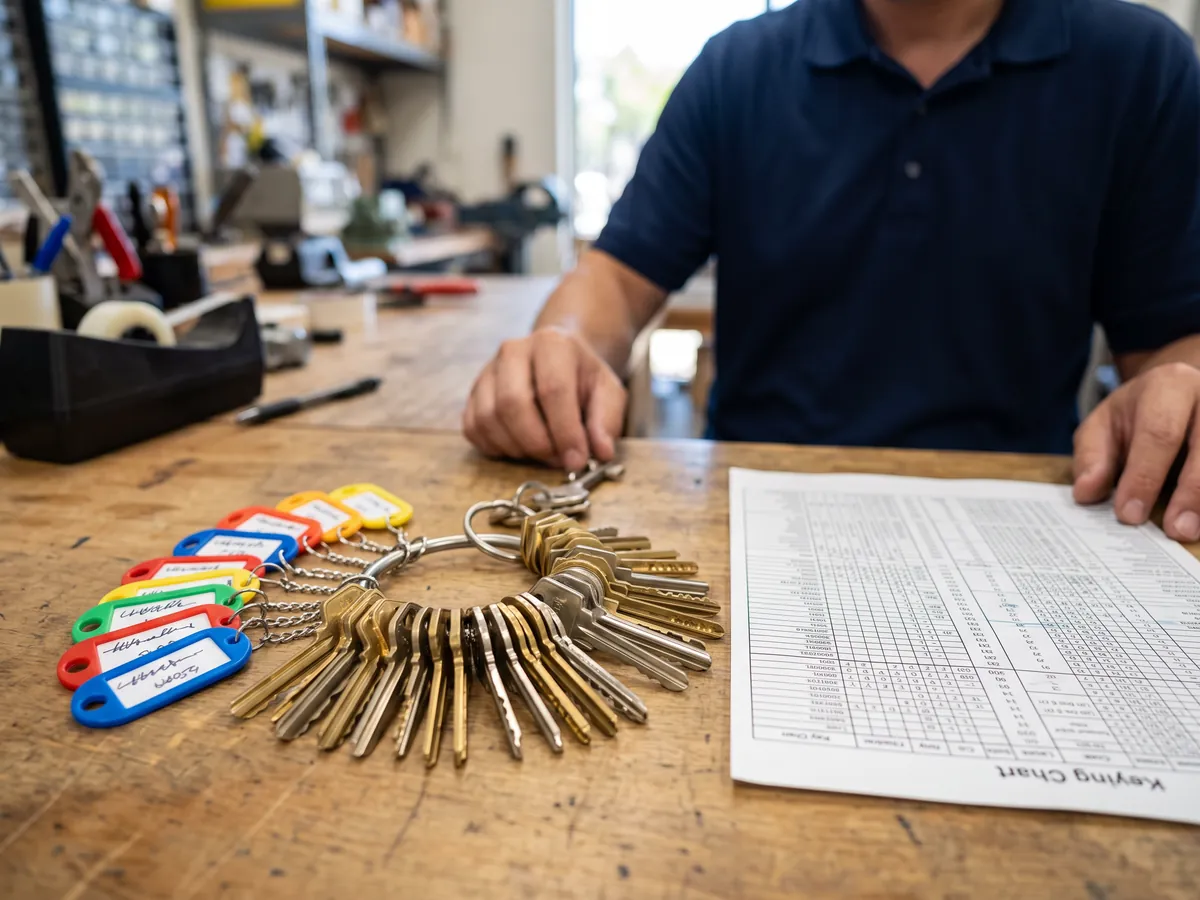
Searching for a key control system in Westminster turns up two quite different products. One is the software-driven electronic key cabinet. The other is the older discipline of controlling physical keys with restricted keyways, logs and locked storage. Both are legitimate, and many sites use each where it fits. An electronic cabinet shines for shared vehicle or equipment keys with many borrowers. Restricted keys and cores suit doors with a few trusted holders. Card readers suit doors with many users and high turnover. Julian's Locksmith handles the lock and key side directly, and when a job needs a low-voltage contractor or a cabinet vendor we say so plainly and work alongside them.
What to know first in Westminster
Think of key control as four layers, each closing a different gap. The first is copy control. A standard Kwikset or Schlage keyway can be duplicated at a hardware store or grocery kiosk in a couple of minutes, and a 'Do Not Duplicate' stamp is only a request that many shops ignore. A restricted keyway moves that power from the public to a short list of authorized people. The second layer is issue control: a register that ties each numbered key to a named holder, a date and a signature. The third is storage control. Spares, returned keys and the master set live in a locked cabinet bolted to something solid, in a room that is itself controlled. The fourth is response control: a written sequence for a lost key, a departing employee or a suspected copy, so nobody improvises late on a Friday. A system with only the second layer is a spreadsheet. A system with only the first is an expensive key. In Westminster we usually start with whichever layer your site is missing most, then add the others over time.
How we can help in Westminster
- Key control audits and key reconciliation. Not every key problem is a lost key. Auditing often turns up worn keys that barely turn, copies cut from copies of copies, and cylinders pinned differently than the chart says. We test each key in each lock, note which ones are marginal, and tell you whether the fix is a new key, a new cylinder or a full rekey.
- Keying schedules, bitting lists and key registers. Where records already exist, we reconcile them against the real cylinders instead of starting over. Old charts are often right for the first dozen doors and wrong after years of patched-in changes. We test, correct, and mark each entry as verified so the next person knows how far to trust the document.
- Factory-registered keys and duplication authorization. With patented and many proprietary systems, the manufacturer records your keying, and extra keys can be ordered only by people on your authorization list. We help you name those people, complete the paperwork and place factory orders on your behalf, so a request from someone outside the list goes nowhere.
- Fleet, vehicle and equipment key control. Many fleets leave ignition keys in the vehicle for convenience, which works until a truck disappears. A better habit is a morning sign-out and an evening return, enforced at one cabinet. We help design that routine, find a wall space with good sightlines and cut matched spares for each vehicle.
- Emergency-access planning and egress checks. When locks change, the keys in the fire department box must change too, or responders arrive with a key that no longer works. We add that step to every rekey checklist for Westminster buildings that have a box, along with the alarm company's keyholder list and any after-hours contact sheets.
Local factors in Westminster
Apartment communities carry the heaviest key load: unit keys, a maintenance master, the leasing office, laundry, mailroom, trash enclosure and pool. Keep unit keys off the maintenance ring where possible, use cores or turnover rekeys to cut downtime, and put vendor access in tamper-evident pouches. California's Civil Code section 1954 sets notice rules for entering a unit, so your key policy should say who may enter, when and how it is logged.
Shopping center tenants juggle two sets of keys: their own storefront and back-of-house, and the landlord's roof, utility and service-corridor keys. Know which locks the landlord controls before you rekey, and tell management what you change. Inside your suite, restricted keys on the stockroom, cash office and rear door give you control. Near Sid Goldstein Freedom Park and the Vietnam War Memorial, rear service lanes are shared, so the back door deserves your best cylinder.
Neighborhood organizations run on volunteers: youth leagues, snack shacks, school booster closets, community centers. Keys pass from parent to parent and nobody knows who has the last copy. A restricted keyway, a numbered key for each officer and a handoff line in the annual checklist keeps things simple. Use a lockbox with a changing code for one-off events instead of handing out a key you will never see again.
Common situations
- Say an HOA board in Little Saigon realizes eleven volunteers have held clubhouse and pool-gate keys over fifteen years, and nobody can say who still has one. A reasonable approach: rekey the clubhouse and gate to a restricted keyway, issue numbered keys to current board members only, and add a line to the board handoff checklist so keys come back at the end of each term.
- Imagine a church or community center where volunteers have run the kitchen, nursery and office for decades. Keys have multiplied, and the building has no master list. We would walk the building with the administrator, group the doors by who truly needs them, and propose a small master system on a restricted keyway, with a keyholder list the administrator reviews every January.
- A six-person retail shop does not need a software system. Picture an owner who wants it sorted in one working day: restricted keys on the stockroom and cash office, a locked box for the extra set, and a handwritten log taped inside the box lid. We would set that up in a single visit and mark a date to review it each quarter. Simple and used beats elaborate and ignored.
- A restaurant owner receives an insurance renewal questionnaire asking how keys are controlled, and the honest answer is that she trusts her managers. That is not yet a system. A one-page policy, a register for the four keys that open the building and a restricted keyway on the back door give her written answers. Ask your own carrier which answers it expects.
From your call to the finished job
- Walk the property together. A good walkthrough takes longer than people expect, because the odd doors matter: the roof hatch, the meter room, the side gate, the old padlocked shed. We photograph each lock, list the brand and keyway, and mark where doors are shared between tenants or departments.
- Audit and reconcile the keys. If a full audit is not practical on day one, we sample: the exterior doors, the highest-risk rooms and every master-level key. That is usually enough to show whether control is sound or shaky, and it lets you decide how deep to go without halting normal operations.
- Decide who needs what. Think about edge cases now: cleaners, contractors, seasonal workers, a board member, the landlord. Each gets a defined key, a supervised visit or a lockbox. Writing these rules before a problem appears keeps the decision from being made at 6 a.m. by whoever happens to be standing there.
- Install the hardware. With the plan approved, we install restricted cylinders or interchangeable cores, mount the key cabinet to solid framing and adjust any hardware that does not line up. Doors that cannot take the new cylinders are noted in writing so they are not mistaken for protected doors.
- Cut, tag and issue the keys. We keep a small set of spares and, if you use cores, the control key in the cabinet rather than with any individual. Everyday keys go to named holders only. Anything left over is either stored with a record or retired, never left in a drawer just in case.
- Schedule audits and agree a loss plan. A key control system degrades without maintenance, so we agree on an audit rhythm before leaving. Quarterly is typical for busy sites and annual works for quiet ones. Put the date on a calendar, name the person who runs it, and decide what counts as a failed audit.
What affects the cost
- Keyway type: common, restricted or patented. A common keyway is the cheapest to key and the easiest to copy. Proprietary restricted keyways cost more per cylinder and per key, and patented systems cost more again. The extra spend buys copy control, and the right level depends on what the door protects. We help you match protection to risk instead of upgrading everything.
- Standard cylinders or interchangeable cores. Cores cost more up front than ordinary cylinders because the housings and control keys add parts. They pay back wherever rekeying will happen more than once: turnover-heavy staffing, tenant suites, rental units. If you expect to rekey rarely, standard repinnable cylinders may be the better value.
- Cabinets and electronic key tracking. We mount cabinets and key them, but specialty electronic cabinets come from their manufacturers and may need an electrician or network technician. We will tell you where our part ends, quote that part clearly, and coordinate scheduling so the cabinet is not left waiting on a power run.
Every job gets a clear quote before any work starts. Call (951) 903-3193 with the details and we'll tell you what to expect for your situation in Westminster.
What not to do
- Restricting the front door but leaving side doors on common keyways. A thief or former employee uses the weakest door, not the strongest. Before spending on high-security cylinders, list every exterior and sensitive door and decide which ones deserve the same level of protection.
- Labeling keys and hooks with door names or addresses. Labels make the cabinet easy to use for everyone, including a thief. Use numbers or color codes and keep the translation in the register, so a lost tag tells a finder nothing about what it opens.
- Building the system once and never auditing it. Registers drift as people change roles, doors get added and keys get lent. A system that was accurate in January can be fiction by December. Put a recurring audit on the calendar with a named owner.
Practical tips before you call
- Limit master-level keys to the smallest number your operation can live with. Every extra master multiplies how many doors one lost key exposes. Most small and mid-size sites do well with two or three, held by named people, and door-level or department-level keys for everyone else.
- Run a key amnesty before you decide what to rekey. Tell everyone that for one week keys can be dropped in a sealed envelope with no questions asked. You will recover keys that were simply forgotten in coats and drawers, and the list of doors needing attention can shrink dramatically.
- Write the loss plan on a single page and tape it inside the cabinet door. It should name who to call first, which doors to treat as exposed, who can authorize a rekey and how to reach us at (951) 903-3193. When a key goes missing, panic costs more than the key does.
- Ask your insurance carrier or broker what, if anything, your policy says about key control or lock changes after a key loss. Some crime and property policies attach conditions, and it is far easier to learn that now than after a claim. Get the answer in writing and file it with your key policy.
Reaching Westminster
Westminster is about 61 miles from our San Bernardino base, roughly 65 minutes in light traffic via I-215 South through Colton and Grand Terrace to SR-91 West in Riverside, SR-91 West through Corona and Santa Ana Canyon to SR-55 South or SR-57 South. When you call, you get an arrival estimate based on where the technician is and the traffic at that moment.
Rush hour on Magnolia Street can stretch a drive considerably. We'd rather give you a realistic arrival window than an optimistic one, and we'll call you if a closure or a crash changes the plan.
About Westminster: The 2020 census counted 39,799 Vietnamese Americans in Westminster, about 44 percent of residents, and the city is often described as the capital of overseas Vietnamese.
| Neighborhoods | Westminster Mall site at Goldenwest Street and Bolsa Avenue, Midway City, Edwards Street corridor, Beach Boulevard corridor, Goldenwest Street near Westminster High School, Little Saigon along Bolsa Avenue |
|---|---|
| ZIP codes | 92683, 92684, 92685 |
| Main routes | I-405, SR-22, SR-39, Bolsa Avenue |
| From our San Bernardino base | about 61 miles via I-215 South through Colton and Grand Terrace to SR-91 West in Riverside, SR-91 West through Corona and Santa Ana Canyon to SR-55 South or SR-57 South, then SR-22 West (Garden Grove Freeway) to the Beach Boulevard (SR-39), Magnolia Street or Valley View Street exits; when the 91 is jammed, I-10 West to SR-57 South and SR-22 West is the usual alternate |
Business lock or door work in Westminster?
Call (951) 903-3193 with the address, the doors or hardware involved and when the site is open. We'll quote the job before any work starts and book a time within our hours that suits your schedule.
Frequently asked questions
Where should a key cabinet go?
Choose a room that locks, away from public view and heat, ideally within camera range. Mount the cabinet to studs or masonry, not just drywall. Avoid placing it near the main entrance, where visitors can see it, or in a closet that everyone uses. A cabinet near the manager's desk works well because use is noticed, but only if that room stays locked when the manager is out.
How long does it take to set up a key control system?
A small office can be done in a single visit: audit, a few restricted cylinders, a cabinet and a register. Larger sites take a planned project over several visits, especially when factory-ordered restricted keys are involved. We give you a realistic schedule with the quote and build it around your hours. We work seven days a week, 6:30 a.m. to 11:30 p.m.
Do I need a key control system for a small business?
If more than one person holds keys, some version of key control helps. A six-person shop does not need software. It needs a short list of who holds which key, a restricted blank on the stockroom or cash office, and a place to keep spares. Start small, write it down, and review it each quarter. You can add cores or a cabinet later as the business grows.
How often should we audit our keys?
Quarterly works for busy sites with turnover, such as apartment communities, retail centers and warehouses. Annual is reasonable for quiet offices. Also audit after a manager changes, a tenant leaves, a break-in occurs or any master-level key goes missing. An audit can be short: count the cabinet, compare it to the register, check master-level keys first and note anything unaccounted for.
What is a restricted keyway and how do I know if I have one?
A restricted keyway uses a key profile whose blanks are not sold to the general public. Patented systems such as Medeco, Mul-T-Lock and Schlage Primus are the strongest examples. A useful clue is a brand name stamped on the key and an authorization card that came with the lock. Plain brass keys stamped Kwikset or Schlage with no card are almost certainly unrestricted.
Is a key control system required by law?
For most businesses there is no general legal requirement. Some industries, such as those storing controlled medications or regulated records, have rules set by their regulators, and some insurance policies or leases attach conditions. Building and fire codes also affect exit doors. Check with your regulator, carrier or landlord about what applies, and we will install to whatever standard they set.
How far is Westminster from your base?
Westminster is about 61 miles from our San Bernardino base, roughly 65 minutes in light traffic. Arrival time depends on traffic and on the job the technician is finishing, so we give you an estimate on the phone before you commit.
Related services in Westminster
- Master Key System in Westminster
- Employee Key Control System in Westminster
- Restricted Key System in Westminster
- Restricted Keyway in Westminster
- Duplicate-Protected Keys in Westminster
- Master Key Rekey in Westminster
- Commercial Lock Rekey in Westminster
- Business Master Key System in Westminster
- Access Control in Westminster
- Property Management Locksmith in Westminster
Key Control System in nearby cities
- Key Control System in Garden GroveOrange County
- Key Control System in StantonOrange County
- Key Control System in Fountain ValleyOrange County
- Key Control System in Huntington BeachOrange County
- Key Control System in Seal BeachOrange County
- Key Control System in CypressOrange County
- Key Control System in Los AlamitosOrange County
- Key Control System in Santa AnaOrange County