
Walnut, Los Angeles County
Master Key Installation for Walnut Offices, Shops and Buildings
Short answer: Plan on door-by-door work rather than one big shutdown. For a modest Walnut office or shop, cylinders pinned in the field can often be finished in a single visit, with each door out of service only briefly. Larger buildings, restricted keyways and factory-ordered cores take longer. We work every day, 6:30 a.m. to 11:30 p.m.
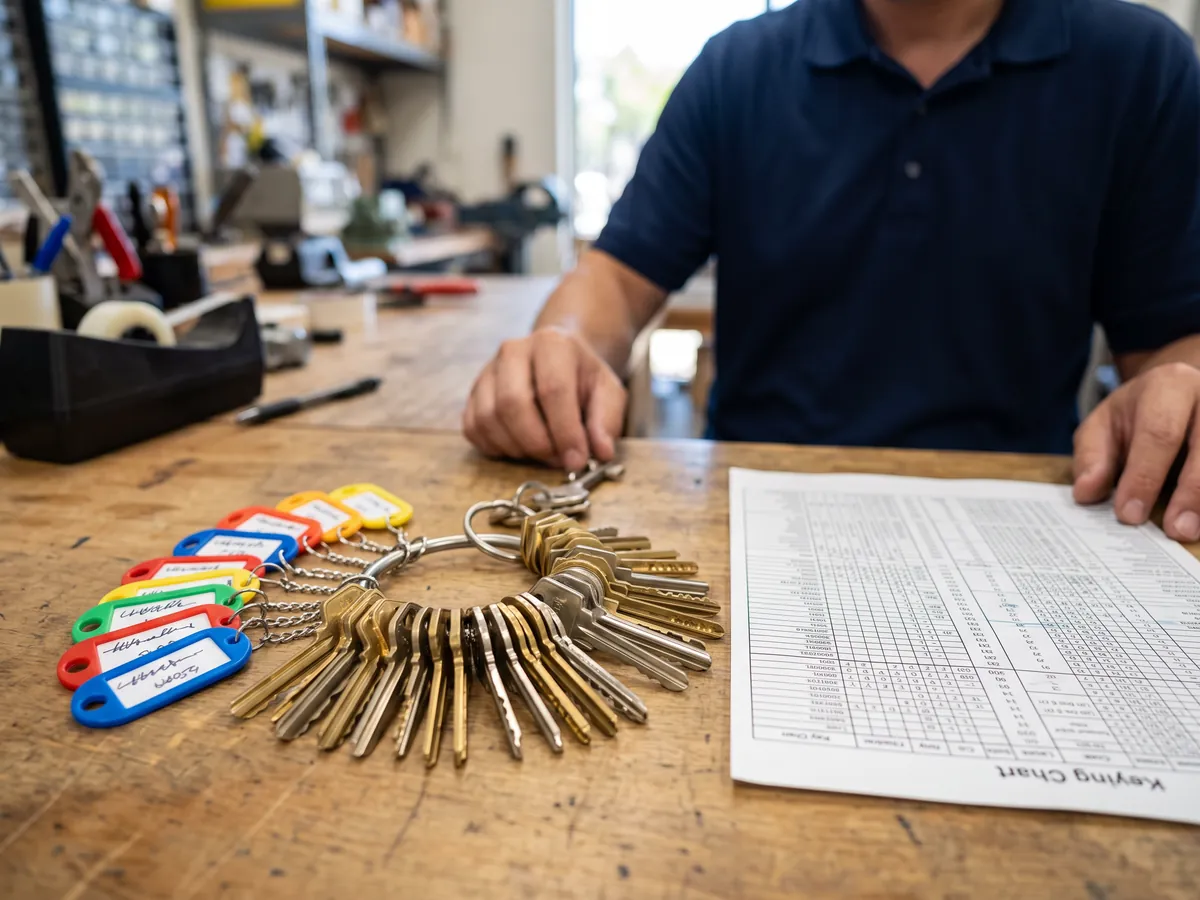
Managers and HOA boards in Walnut rarely need a master key system explained. They need it installed without disturbing residents or tenants. For a community or a multi-tenant property, master key installation is mostly about sequencing: common-area doors, utility rooms and amenity spaces first, private doors only with proper notice, and every new key logged to the person who signs for it. Julian's Locksmith builds a schedule around your notice requirements and your staff's availability, works one opening at a time, and leaves you with a key schedule that a new manager could pick up cold. Call (951) 903-3193 to plan a phased installation.
Master Key Installation in Walnut: what to expect
Before anything else, master key installation is a sorting exercise. A building's doors fall into roughly four piles. The first can be re-pinned in place: conventional pin-tumbler cylinders in Schlage, Sargent, Corbin Russwin and similar commercial locks, plus Schlage SC1 and Kwikset KW1 hardware that uses standard pins. The second needs a cylinder swap, usually because the lock body is fine but the keyway is wrong or the cylinder is worn. The third needs new hardware: Kwikset SmartKey, unbranded import locks with unpinnable cylinders, and anything past repair. The fourth belongs to the manufacturer, meaning patented keyways such as Medeco and Mul-T-Lock, which are keyed through authorized channels and take lead time. Electronic locks and keypads can often sit beside a mechanical system, with a keyed override cylinder that joins the chart, but the electronics themselves don't join. The survey produces a door list in those four piles, so you see what each one costs in time before anything is ordered.
What we can do on-site
- Re-pinning existing cylinders. Cylinders from a single manufacturer are consistent enough that a whole run of doors can often be re-pinned in an afternoon. Each gets inspected for scoring on the plug, spring fatigue and sticky pins, because a pin that binds under a master shows up later as a lock that only works if you jiggle the key.
- Replacing hardware that can't take a master. Some hardware cannot take a master and shouldn't be forced to. Kwikset SmartKey cylinders, unmarked import deadbolts and worn-out knobs get replaced with commercial-grade locks in the same finish and handing where possible. We show you which doors fall in this group during the survey so there are no surprises on installation day.
- Interchangeable core installation. Interchangeable cores let you swap an entire lock cylinder with a control key in seconds, which suits buildings that expect to re-key often. We install the housings, set up the core and control keys, and pin the cores to your chart. Future changes mean swapping cores rather than disassembling cylinders.
- Mortise, rim and cylindrical lock cylinders. A master key that opens the front lever but not the rear exit device isn't much of a master. We pin mortise cylinders for storefront deadlatches, rim cylinders for exit-device trim and the keyed cylinders in cylindrical levers all to the same chart, matching tailpiece length and cam so each one retracts its bolt.
- Padlocks, cabinets and utility spaces. A master key system isn't only doors. Gates, equipment cabinets, key boxes, roll-up shutters and electrical panels usually use padlocks or cam locks that can be keyed into the same chart. We fit padlocks and cam locks that accept your keyway, so one ring can cover the whole site.
How Walnut shapes the job
Senior communities and 55-plus complexes need hardware that is easy on hands and clear about who can enter. Master key installation for a community office or clubhouse should respect lever-handle accessibility, keep emergency staff access straightforward and avoid unwieldy key rings for volunteers. We favor few levels, clearly labeled keys and a documented access plan that first responders can follow.
Summer heat across Los Angeles County bakes south-facing doors and gate hardware, thins lubricant and speeds spring fatigue. The extra pins and springs in a master-keyed cylinder are more sensitive to grit and sticky lubricant, so we clean chambers thoroughly, use dry lubricants and choose weather-rated padlocks for exposed openings. Test every key again after the first hot week; a sticky pin shows up then.
Housing offices, small campus buildings and departmental suites near Walnut High School deal with constant turnover, graduating staff and lost keys. A system built on interchangeable cores suits that churn, because a lost key triggers a core swap instead of a full re-pin. Master key installation sets up the housings, the control keys held by facilities, and a simple log that survives the next semester's staffing changes.
Example situations
- A property manager with four small buildings wants one master that opens every common area, while each building has its own maintenance sub-master. Installation involves matching keyways across all four buildings and scheduling around residents. We work building by building, test each one completely, and hand over a combined door schedule so the next manager understands the layout.
- A typical call: a veterinary clinic near W.R. Rowland Adobe Ranch House at Lemon Creek Park has outgrown its eight keys. Exam rooms, the drug cabinet, the kennel area and the front door all need different holders, and technicians come and go. We re-pin the existing Schlage cylinders into a three-level system, replace one worn deadbolt that can't take a master, and issue the lead veterinarian a single master key.
- Say a family-owned nursery along La Puente Road has a main office, an equipment barn, a chemical storage room and a workshop. Heat, dust and irrigation spray punish ordinary cylinders. We install sealed, weather-rated hardware where it's exposed, keep chemical storage on its own limited key, give the owner the only master, and sign seasonal workers' keys out and back in at the end of each season.
- A typical project: an HOA clubhouse with a fitness room, a pool equipment room, a mail room and a management office. Right now a board member, two vendors and a former manager all carry keys of unknown origin. We install master-keyed cylinders throughout, limit the pool equipment room to maintenance, and give the current manager the only master. Old keys are collected and logged.
From your call to the finished job
- Walk the site and list every door. Bring whatever records exist: an old chart, keys with stamped numbers, hardware schedules from the build. We compare them with what's on the doors, because paperwork and reality rarely match. Differences go on the door list, and that list drives the quote.
- Sort the doors and quote the work. We'll tell you plainly where money can be saved and where it shouldn't. Reusing sound hardware is fine; forcing a worn cylinder to carry a master is not. The written quote separates must-do items from optional upgrades so you can phase the project.
- Agree the hierarchy and sign off the chart. This step decides how secure and manageable the system will be. We ask who needs which doors, group them into key levels and set the bittings. You review a plain-language version first: key names, who gets them, which doors they open.
- Pin, cut and prepare everything. Cylinders are pinned and keys are cut against the signed chart. Pins are sized with a micrometer, keys are cut by code, and every cylinder is tested with its change key and master before it goes near a door. Preparing in advance keeps each door's downtime short.
- Install door by door and check function. We work one opening at a time, so your building stays usable. For each door, we fit the cylinder, check latch and bolt throw, operate the lock from both sides and confirm the closer still latches. Any door needing adjustment gets it before we move on.
- Cross-test, hand over and collect old keys. The finish is a handover, not a goodbye at the door. We test the full set of keys, review the paperwork with your key manager, and agree how retired keys are collected and disposed of. After that you know who holds what and what to do when something goes missing.
What affects the cost
- Number of doors and cylinders. More openings mean more cylinders to pin, more keys to cut and more doors to test. We count cylinders, not just doors, since a single door can have a lever lock, a deadbolt and an exit-device cylinder. Your quote in Walnut lists the count it's built on.
- Door types and special hardware. Standard office levers are the easy end. Mortise cylinders, exit-device rim cylinders, keyed padlocks, gate locks and cabinet cam locks each need their own parts and sometimes their own tools. Tell us what's on your doors and the quote will account for the extra pieces.
- Schedule, access and travel. Work that must avoid your business hours, spread across several visits or coordinate with tenants takes longer than a single clean visit. We travel to you anywhere in the service area, and the quote reflects the number of visits and any limits on access.
Every job gets a clear quote before any work starts. Call (951) 903-3193 with the details and we'll tell you what to expect for your situation in Walnut.
What not to do
- Starting with a key count instead of an access plan. Handing everyone a master feels simple but defeats the purpose. Begin with who needs which doors, build the hierarchy from that, and let the number of keys follow. It takes an extra hour of planning and prevents years of cleanup.
- Mixing keyways and expecting a single master across all of them. A key only fits locks of its own keyway. Combining brands means swapping cylinders to one family, which is fine, but it has to be planned and priced, not discovered halfway through the day.
- Forgetting the extras: a rapid-entry box key, an alarm company key, gate padlocks, the mailbox, cabinets. Those extras are often where an installation falls short. Add them to the door schedule at the survey stage and make sure each one is changed or noted.
What to do before we arrive
- Keep the number of hierarchy levels as low as your building allows. Each master level adds extra shear lines in every cylinder, which means more keys that can open it. Two levels cover most small businesses; a third is for real size; a fourth is rare.
- Tell us about your exit paths. Doors on the path of travel have to open from inside without a key. We can master key the outside cylinder on an exit device without touching inside operation, but we want to see these doors before the chart is final.
- Hunt for old paperwork. Hardware schedules from the original build, an earlier keying chart or even a box of keys with stamped numbers can save hours. Partial records still help us rebuild a bitting list, and they show how a previous locksmith organized the doors.
- Ask your landlord or fire marshal what they need. Some buildings carry a rapid-entry box with a key inside; others have alarm company keys or elevator keys. Tell us about them so those keys fit the final chart and nothing is missed on inspection day.
Service in Walnut
Walnut is about 40 miles from our San Bernardino base, roughly 46 minutes in light traffic via I-215 South briefly to SR-210 West. When you call, you get an arrival estimate based on where the technician is and the traffic at that moment.
Most trips into Walnut use Grand Avenue for at least part of the drive, and the technician keeps an eye on live traffic along the way so the arrival estimate you heard on the phone stays honest.
About Walnut: Walnut incorporated as a general law city on January 19, 1959, and counted 28,430 residents in the 2020 census.
| Neighborhoods | Ridge Estates, West Valley, Lemon Creek, Creekside, Country Hollow, Three Oaks |
|---|---|
| ZIP codes | 91789 |
| Main routes | SR-60, SR-57, I-10, Valley Boulevard |
| From our San Bernardino base | about 40 miles via I-215 South briefly to SR-210 West (Foothill Freeway) through Rialto, Fontana, Rancho Cucamonga and La Verne, then SR-57 South to the Temple Avenue exit and west past Mt. SAC to Grand Avenue, Amar Road and La Puente Road; I-10 West to SR-57 South as the alternate, and SR-60 West through the 57/60 confluence to Lemon Avenue, Fairway Drive or Nogales Street for Valley Boulevard and West Valley |
Business lock or door work in Walnut?
Call (951) 903-3193 with the address, the doors or hardware involved and when the site is open. We'll quote the job before any work starts and book a time within our hours that suits your schedule.
Frequently asked questions
What if I lost my original keying chart?
It's common and fixable. We can decode existing cylinders by pulling and measuring the pin stacks, then rebuild a chart from what is actually on your doors. It takes longer than working from records, and sometimes starting fresh with a new chart is faster and cleaner. We talk you through both options and quote them separately.
Can electronic or keypad locks be part of the system?
The electronics can't be master keyed, but many commercial electronic locks carry a mechanical override cylinder, and that cylinder can join your chart. A keypad deadbolt with a standard key cylinder can be pinned to the system; a fully keyless smart lock stays outside it. Access control can run beside the mechanical keys, though low-voltage work may need a specialist contractor.
Do I have to replace all of my locks?
Almost never. Re-pinning is the standard approach, and it keeps your existing hardware, finishes and door prep. We replace only the locks that fail the survey, such as worn cylinders, incompatible brands or hardware that is past repair. If you want to standardize on one brand anyway, we can quote that as an option, but it isn't required for master key installation.
What about the fire department's rapid-entry box?
If your building has a rapid-entry box, often called a Knox box, the key inside must match what firefighters need to reach. After a master key installation we help you decide what belongs in the box, but your fire marshal decides what the department wants. Many departments prefer keys to the main entry and the fire panel room over a full grand master. Ask them before the chart is final.
How do I check your license?
Julian's Locksmith holds California locksmith company license LCO7891, issued through the Bureau of Security and Investigative Services. You can verify it at search.dca.ca.gov before we arrive. Any locksmith quoting work on your Walnut property should give you a company name and license number without hesitation; if they don't, look elsewhere.
Do you need proof that I own or manage the building?
Yes. Before we change locks or create keys that open a business or residence, we ask for ID and something that ties you to the property, such as a deed, lease, property management agreement or a letter of authority from the owner. California's Locksmith Act, administered by the Bureau of Security and Investigative Services, regulates our work. A quick call tells you what to have ready.
How far is Walnut from your base?
Walnut is about 40 miles from our San Bernardino base, roughly 46 minutes in light traffic. Arrival time depends on traffic and on the job the technician is finishing, so we give you an estimate on the phone before you commit.
Related services in Walnut
Master Key Installation in nearby cities
- Master Key Installation in West CovinaLos Angeles County
- Master Key Installation in Diamond BarLos Angeles County
- Master Key Installation in ValindaLos Angeles County
- Master Key Installation in Rowland HeightsLos Angeles County
- Master Key Installation in CovinaLos Angeles County
- Master Key Installation in City of IndustryLos Angeles County
- Master Key Installation in Charter OakLos Angeles County
- Master Key Installation in La PuenteLos Angeles County